Job 30:17-19; 7:16
All night long my bones are racked with pain,
a gnawing pain that never sleeps.
– God has cast me into the mire,
where I am like dust and ashes.Spare me, LORD,
for my days are but a breath.
– God has cast me into the mire,
where I am like dust and ashes.
Monday of the Ninth Week in Ordinary Time
Saint Boniface, Bishop, Martyr
SAINT BONIFACE, BISHOP, MARTYR
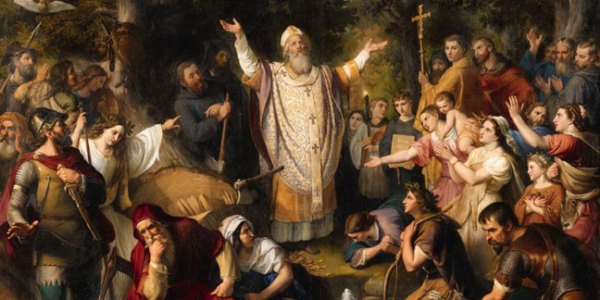
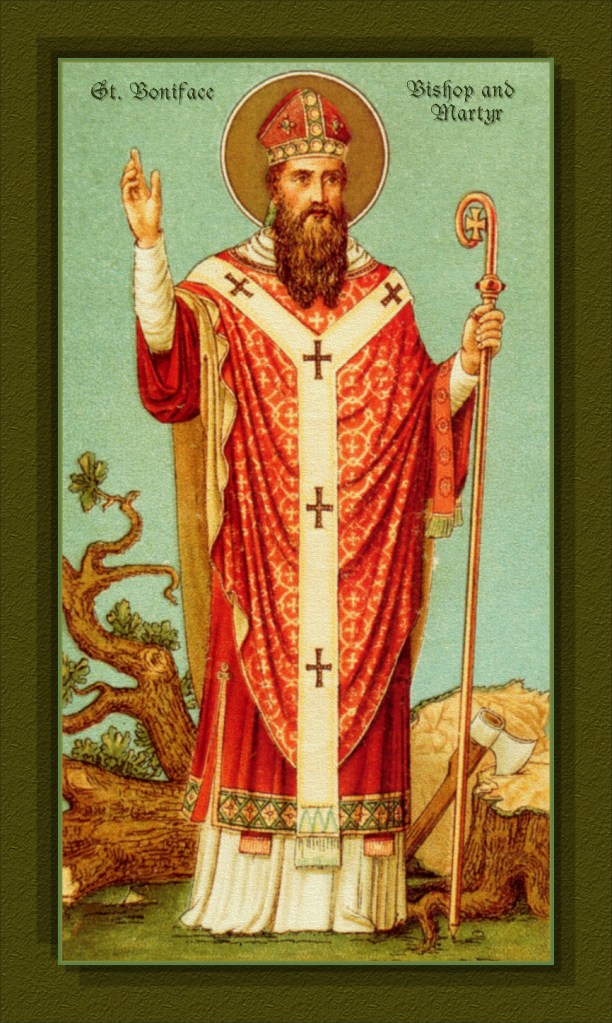
Boniface was born at Crediton in Devonshire, England, in the year 680. Some missionaries staying at his father’s house spoke to him of heavenly things, and inspired him with a wish to devote himself, as they did, to God. He entered the monastery of Exminster, and was there trained for his apostolic work. His first attempt to convert the pagans in Holland having failed, he went to Rome to obtain the blessing of Pope Gregory II on his mission, and returned with authority to preach to the German tribes. It was a slow and dangerous task; his own life was in constant peril, while his flock was often reduced to abject poverty by the wandering robber bands. With unflagging perseverance, he founded monasteries, established centres of learning, and fought heresies and abuses. He convened the first German synod and was named the Primate of Germany.Yet his courage never flagged. He began with Bavaria and Thuringia, next visited Friesland (now the Netherlands) in 716, then passed on to Hesse and Saxony, everywhere destroying the idol temples and raising churches on their site. He endeavored, as far as possible, to make every object of idolatry contribute in some way to the glory of God; on one occasion, having cut down an immense oak which was consecrated to Jupiter, he used the tree in building a church, which he dedicated to the Prince of the Apostles. He was now recalled to Rome, consecrated Bishop by the Pope, and returned to extend and organize the rising German Church. With diligent care he reformed abuses among the existing clergy, and established religious houses throughout the land. At length, feeling his infirmities increase, and fearful of losing his martyr’s crown, Boniface appointed a successor to his monastery, and set out to convert a fresh pagan tribe. At Dokkum in 755, while he was waiting to administer Confirmation to some newly-baptized Christians, a troop of pagans arrived, armed with swords and spears. His attendants would have opposed them, but the Saint said to his followers: “My children, cease your resistance; the long-expected day is come at last. Scripture forbids us to resist evil. Let us put our Hope in God: He will save our souls.” Scarcely had he ceased speaking, when the barbarians fell upon him and slew him with all his attendants, to the number of fifty-two.He is known as the Apostle of Germany.
From a letter by Saint Boniface, Bishop and Martyr
(Ep. 78: MGH, Epistolae, 3, 352-354)
The careful Shepherd watches over Christ’s flock
In her voyage across the ocean of this world, the Church is like a great ship being pounded by the waves of life’s different stresses. Our duty is not to abandon ship but to keep her on her course.
The ancient Fathers showed us how we should carry out this duty: Clement, Cornelius and many others in the city of Rome, Cyprian at Carthage, Athanasius at Alexandria. They all lived under emperors who were pagans; they all steered Christ’s ship—or rather His Most dear Spouse, the Church. This they did by teaching and defending Her, by their labours and sufferings, even to the shedding of blood.
I am terrified when I think of all this. Fear and trembling came upon me and the darkness of my sins almost covered me. I would gladly give up the task of guiding the Church which I have accepted if I could find such an action warranted by the example of the Fathers or by holy Scripture.
Since this is the case, and since the Truth can be assaulted but never defeated or falsified, with our tired mind let us turn to the words of Solomon: Trust in the LORD with all your heart and do not rely on your own prudence. Think on Him in all your ways, and He will guide your steps. In another place he says: The name of the LORD is an impregnable tower. The just man seeks refuge in it and he will be saved.
Let us stand fast in what is right and prepare our souls for trial. Let us wait upon God’s strengthening aid and say to Him: O LORD, You have been our refuge in all generations.
Let us trust in Him who has placed this burden upon us. What we ourselves cannot bear let us bear with the help of Christ. For He is All-powerful and He tells us: My yoke is easy and My burden is light.
Let us continue the fight on the day of the LORD. The days of anguish and of tribulation have overtaken us; if God so wills, let us die for the holy laws of our fathers, so that we may deserve to obtain an Eternal inheritance with them.
Let us be neither dogs that do not bark nor silent onlookers nor paid servants who run away before the wolf. Instead let us be careful shepherds watching over Christ’s flock. Let us preach the whole of God’s plan to the powerful and to the humble, to rich and to poor, to men of every rank and age, as far as God gives us the strength, in season and out of season, as Saint Gregory writes in his book of Pastoral Instruction.
Ready to Be Called to Account
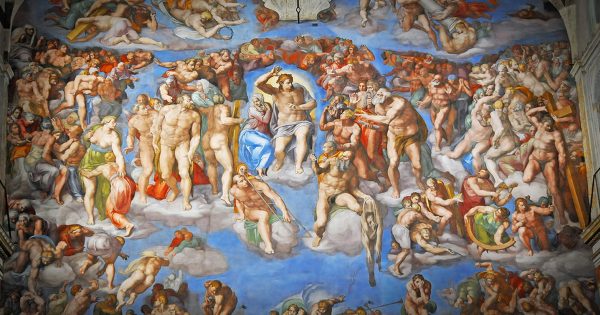
[On Judgement Day] men and women will let go of the world, misery of the earth. Then they will see their work in Eternity. Then will be made known who lived life in Purity. For them will be a ready reward. There has ever been Hope in the heavens since Our Saviour, middle-earth’s Measurer, was bound fast on that black beam…. Christ knows all good deeds….
Then the LORD of spirits, Glory’s Leader, will grant His desires after this doom to the one who now sorely considers his sins, who endures great dread of mind. Then life’s Wielder will reward him, the Shepherd of Heaven, after his journey hence, with his good deeds, since he grieved so much, sorry for his sins. Nor must he be too slow nor too late for these lessons, he who wishes to live with God, enjoy that building the bright Father will ready for us, Ruler of spirits. It is the Victory LORD who will adorn the dwelling, who will build it brightly. The Pure will go to it without sins, just as the Wielder says, King of all kings. Thus all the living, those who understand this well, will obey the Wielder, those who wish to climb the heights of the heavens.
Yet it will happen, though it be heaped with earth, the body with loam, that it will take life, spirit after the grave. The people will be summoned, all Adam’s offspring to the Meeting. Then Spirit and skeleton will be united together for that journey. That will reveal the Truth, when on that Great Day we gather, a crowd at the Cross. Then many Judgements will be made, all that has happened under Heaven—hot or cold, good or evil. Eagerly will He listen, the Highest of Heaven’s Kings, to the deeds of heroes. Never has horn been sounded so strongly nor trumpet blown that the bright voice will not be heard the louder by men all over middle earth, the world of the Wielder. The plains will tremble at the message that He has in mind for all of us.
Now echo this word: it will be known that I cannot deny this doom under the heavens, but it must come to pass like this for each of the peoples, burning flame over all the bright dwellings. Later, after that fire, life will be laid down firmly. He who considers this well will have wealth in Heaven.
Anglo-Saxon Spirituality
Anglo-Saxon Spirituality is an anthology of sermons, homilies, and poems written during the Anglo-Saxon age (c. 660-1066). The above text is from a manuscript of poems found in the cathedral library in Exeter, England. (The word “doom” referred to the last judgement in Old English.) [From Anglo-Saxon Spirituality: Selected Writings (CWS), translated and introduced by Robert Boenig.
1 Thessalonians 2:8; Galatians 4:19
I have longed to give you the Gospel,
and more than that, to give you my very life;
– you have become very dear to me.My little children, I am like a mother giving birth to you,
until Christ is formed in you.
– You have become very dear to me.
“The refusal to take sides on great moral issues is itself a decision. It is a silent acquiescence to evil. The Tragedy of our time is that those who still believe in honesty lack fire and conviction, while those who believe in dishonesty are full of passionate conviction.”
– Ven. Archbishop Fulton Sheen
 Daily Reflections
Leave a comment