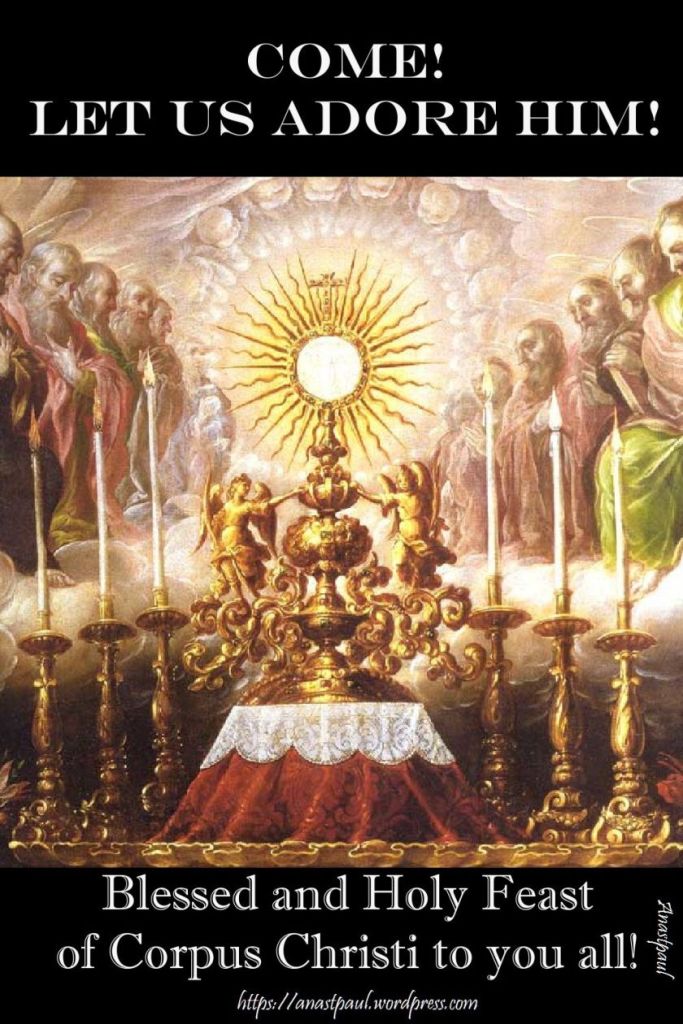
In these times when belief in the Real Presence of Our LORD in the Eucharist seems to be lower than it has ever been, and the incidence of profanation of the Most Blessed Sacrament through direct and indirect sacrilege as high as it has ever been, we must turn all the more to the consoling Presence of Our LORDin the Eucharist to adore, to make reparation, seek grace, and to find healing.
For as it is written: “As I live, saith the LORD, every knee shall bow to Me, and every tongue shall confess to God. (Romans 14:13)
May Our LORD Jesus Christ in the Most Blessed Sacrament, be praised, adored, and loved, with grateful affection, at every moment, in all the Tabernacles of the world, even to the end of Time.
O, Sacrament most holy! O Sacrament Divine! All praise, and all is thanksgiving, be every moment Thine!
John 6:48, 49, 50, 51, 52
I am the Bread of Life.
Your forefathers ate manna in the desert,
and they died.
– This is the Bread that comes down from Heaven;
anyone who eats This Bread will never die.I am the Living Bread come down from Heaven.
Anyone who eats this bread will live for ever.
– This is the Bread that comes down from Heaven;
anyone who eats This Bread will never die.
Thursday of the Ninth Week in Ordinary Time
Tobiah and Sarah approach their marriage bed with a prayer full of love for God. Sarah had been married seven times before, and every husband had died on their wedding night. Yet the Love of God moves Tobiah to a confidence that refuses to be overshadowed. It verifies that the Love of God is the First and Greatest of all the Commandments. Those who understand this Law of Love “are not far from the Kingdom of God”. (Mark 12:28-34)
FEAST OF CORPUS CHRISTI (TRADITIONAL)

In every Holy Mass, the words, “The Mystery of Faith is said, by the priest at the Consecration. Today’s feast celebrates the mystery that is Transubstantiation. Two months ago on Holy Thursday, the LORD’s Last Supper was celebrated in the sombre time of Lent. The Body of Christ was taken in procession to be repost before His Death on Good Friday. Today the first Thursday after the close of the Easter Season and the Octave of Pentecost, the Church again celebrates this Mystery with a Joyous Mass, and the first session thereafter.
The Introit tells us to “sing joyfully to God.“ The Sequence [by Saint Thomas Aquinas] “explains“, in so far as a mystery can be explained.“This is the Dogma given to Christians, That bread is changed into Flesh and wine into Blood. What thou dost not understand, what thou dost not see, a lively Faith confirms in a Supernatural manner.“ Only the Epistle, an excerpt from Holy Thursday’s (1 Cor 11: 23-29), sounds a cautious note, reminding us that we must be in a State of Grace to partake of this Great Mystery.
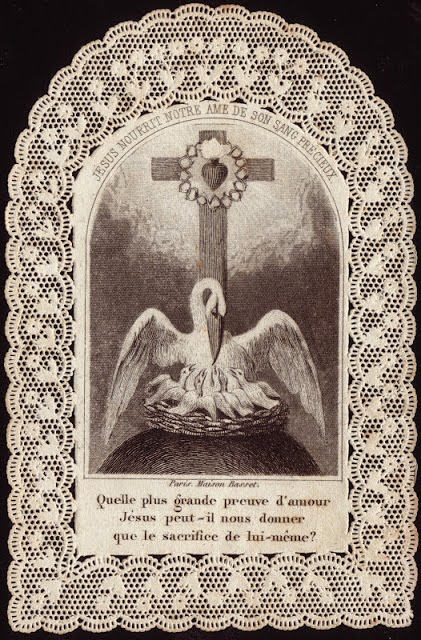
Christ is called “The Good Pelican” and the pelican is a symbol of Christ because pelicans will, if need be, peck at their own chests and feed their young on their own flesh and blood.
Below is the literal translation of St. Thomas Aquinas’ hymn which he wrote for this great feast, “Adoro Te Devote”, “I devoutly adore You”.
LISTEN HERE: https://www.youtube.com/watch?v=-xs67InkZ3A&t=36s
I devoutly Adore You
I devoutly adore You, hidden Deity,
Who are truly hidden beneath these appearances.
My whole heart submits to You,
And in contemplating You, it surrenders itself completely.
Sight, touch, taste are all deceived in their judgment of You,
But hearing suffices firmly to believe.
I believe all that the Son of God has spoken;
There is nothing truer than this Word of Truth.
On the Cross only the Divinity was hidden,
But here the humanity is also hidden.
Yet believing and confessing both,
I ask for what the penitent thief asked.
I do not see wounds as Thomas did,
But I confess that You are my God.
Make me believe much more in You,
Hope in You, and love You.
O memorial of Our LORD’s Death,
Living Bread that gives Life to man,
Grant my soul to live on You,
And always to savour Your sweetness.
LORD Jesus, Good Pelican,
wash my filthiness and clean me with Your Blood,
One drop of which can free
the entire world of all its sins.
Jesus, Whom now I see hidden,
I ask You to fulfill what I so desire:
That the sight of Your Face being unveiled
I may have the happiness of seeing Your Glory. Amen.
From a work by Saint Thomas Aquinas, Priest
(Opusculum 57, in festo Corporis Christi, lect. 1-4)
O Precious and Wonderful Banquet!
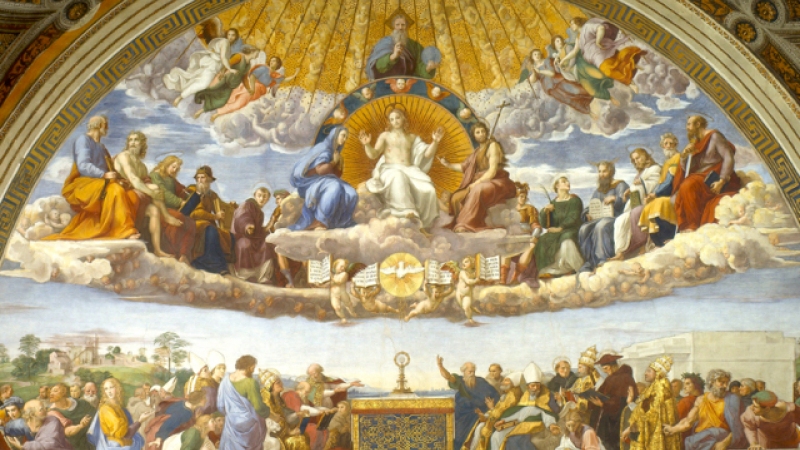
Since it was the Will of God’s Only-begotten Son that men should share in His Divinity, He assumed our nature in order that by becoming man He might make men gods. Moreover, when He took our flesh He dedicated the whole of its substance to our salvation. He offered His Body to God the Father on the Altar of the cross as a Sacrifice for our reconciliation. He shed His Blood for our ransom and purification, so that we might be redeemed from our wretched state of bondage and cleansed from all sin. But to ensure that the memory of so great a gift would abide with us for ever, He left His Body as Food and His Blood as Drink for the faithful to consume in the form of bread and wine.
O Precious and Wonderful Banquet that brings us salvation and contains all sweetness! Could anything be of more intrinsic value? Under the Old Law it was the flesh of calves and goats that was offered, but here Christ Himself, the True God, is set before us as our Food. What could be more wonderful than this? No other Sacrament has greater healing power; through it sins are purged away, virtues are increased, and the soul is enriched with an abundance of every Spiritual gift. It is offered in the Church for the living and the dead, so that what was instituted for the salvation of all may be for the benefit of all. Yet, in the end, no one can fully express the sweetness of this Sacrament, in which Spiritual Selight is tasted at its very Source, and in which we renew the memory of that surpassing Love for us which Christ revealed in His Passion.
It was to impress the vastness of This ove more firmly upon the hearts of the faithful that Our LORD instituted thisSacrament at the Last Supper. As He was on the point of leaving the world to go to the Father, after celebrating the Passover with His disciples,He left it as a perpetual memorial of His Passion. It was the fulfillment of ancient figures and the greatest of all His miracles, while for those who were to experience the sorrow of His departure, it was destined to be a unique and abiding consolation.
The Daily Miracle of Love
Factus is the word written on the tabernacle door of our parish church. “Et homo factus est—“and he became man”. Factus…one word. But what a wealth of joy and happiness, of sublime love, of perfect bliss. Factus. My God is here, factus. The Second Person of the Most Holy Trinity, factus.
Beloved, when I think of You, my heart just beats faster and faster. O Jesus, I love You. But do I love You enough; do I really realise what the word factus implies? Factus:that God became Incarnate, that Nazareth is True; that the hidden years are True; that the public ministry is True; that the Passion is True; that the Crucifixion is True; that the Resurrection is True; that Transubstantiation, the daily miracle, is True; that the Real Presence is True!
Factus.I see the word as I receive Holy Communion. Factus,I tremble with fear. For if love has done that, then what is justice going to be like? O Beloved, where are your children? The churches are empty in the daytime. They are filled on Sundays, but so many are absent who should be there. And yet, daily, the miracle of love takes place; daily, bread and wine become God!
Beloved, I adore you. Prostrate, I lie in the dust before You who have become man. I believe You are Christ, come down to save sinners. Adoring You, I ask for love, a love that knows no limit, a love like a flame that consumes me. O Christ, O LORD, one gift I ask of You: love for You ever increasing, ever growing, ever active on Your behalf!
Servant of God Catherine de Hueck Doherty
Catherine de Hueck Doherty († 1985) was born in Russia and founded the Madonna House Apostolate in Combermere, Canada, which today serves the poor in six countries. [From O Jesus: Prayers from the Diaries of Catherine de Hueck Doherty. © 1996, Madonna House Publications, Combermere, Canada. http://www.madonnahouse.org. Used with permission.]
“The refusal to take sides on great moral issues is itself a decision. It is a silent acquiescence to evil. The Tragedy of our time is that those who still believe in honesty lack fire and conviction, while those who believe in dishonesty are full of passionate conviction.”– Ven. Archbishop Fulton Sheen
 Daily Reflections
Leave a comment