
(Solemnity of the Most Holy Body and Blood of Jesus Christ)
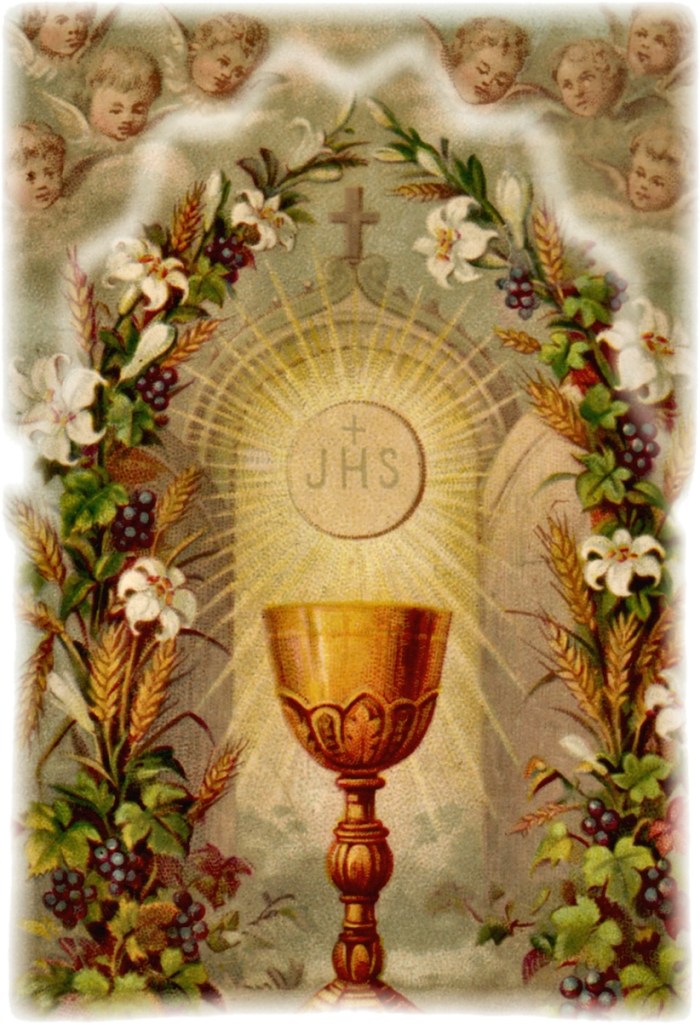
Come, let us adore Christ the LORD, the Bread of Life
John 6:48, 49, 50, 51, 52
I am the Bread of Life.
Your forefathers ate manna in the desert,
and they died.
– This is the bread that comes down from heaven;
anyone who eats this bread will never die.I am the living bread come down from heaven.
Anyone who eats this bread will live for ever.
– This is the bread that comes down from heaven;
anyone who eats this bread will never die.
Second Sunday After Pentecost (Traditional)
The Solemnity of the Most Holy Body and Blood of Christ
Saint Barnabas, Apostle
Saint John Paul II reminded us that the Church “does not only celebrate the Eucharist but solemnly bears it in procession, publicly proclaiming that the sacrifice of Christ is for the salvation of the whole world.” We rejoice in this post-Easter expression of our Eucharistic Faith and devotion in order to deepen our attachment to the unique and unending Event that transforms our lives: “Out of the darkness of my life, so much frustrated, I put before you the one great thing to love on earth: the Blessed Sacrament…. There you will find romance, glory, honour, fidelity, and the true way of all your loves on earth” (J.R.R. Tolkien). As the Sequence for Corpus Christi begs: “Oh, feed us still, still keep us Thine;/ So may we see Thy glories shine/ In fields of immortality”.
SECOND SUNDAY AFTER PENTECOST
The Holy Eucharist, as is Sacrifice [the Holy Mass], is the perpetual manifestation of God‘s love for us. The Holy Eucharist, as a Sacrament, shows also how much God loves us, since He invites us to His Table.
When the Feast of Corpus Christi is transferred to the following Sunday, the Mass: Cibavit is celebrated as on the feast.
ST. BARNABAS, APOSTLE
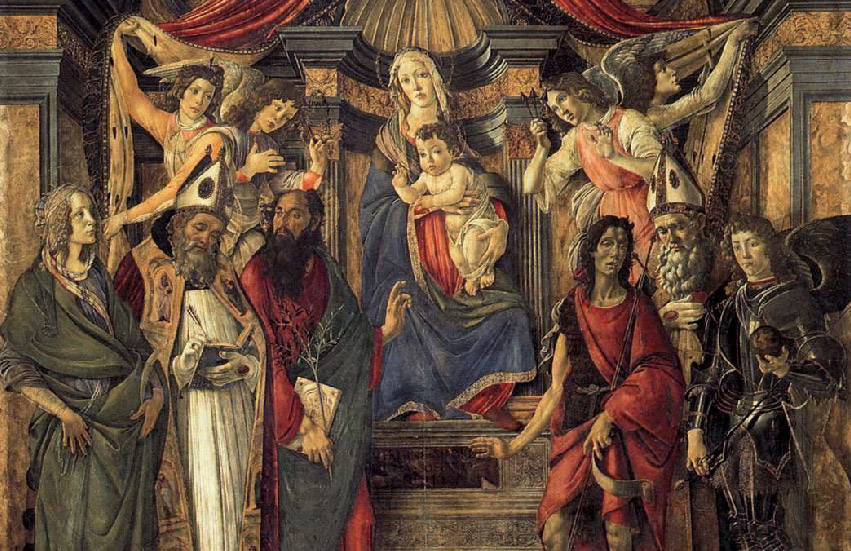
Catholics celebrate the memory of St. Barnabas on June 11. The apostle and missionary was among Christ’s earliest followers and was responsible for welcoming St. Paul into the Church. Though not one of the 12 Apostles chosen by the LORD, Jesus, he is traditionally regarded as one of the 72 disciples of Christ and most respected man in the first century Church after the Apostles themselves.
St. Barnabas was born to wealthy Jewish parents on the Greek-speaking island of Cyprus, probably around the time of Christ’s own Birth. Traditional accounts hold that his parents sent him to study in Jerusalem, where he studied at the school of Gamaliel (who also taught St. Paul). Later on, when Christ’s Public Ministry began, Barnabas may have been among those who heard Him preach in person. At some point, either during Christ’s ministry or after His Death and Resurrection, Barnabas decided to commit himself in the most radical way to the teachings he had received. He sold the large estate he had inherited, contributed the proceeds entirely to the Church, and joined Christ’s other apostles in holding all of their possessions in common. Saul of Tarsus, the future St. Paul, approached Barnabas after the miraculous events surrounding his conversion, and was first introduced to St. Peter through him. About five years later, Barnabas and Paul spent a year in Antioch, building up the Church community whose members were the first to go by the name of “Christians.” Both Paul and Barnabas received a calling from God to become the “Apostles of the Gentiles,” although the title is more often associated with St. Paul. The reference to the “laying-on of hands” in Acts, chapter 13, suggests that Paul and Barnabas may have been consecrated as Bishops on this occasion.
Barnabas and Paul left Antioch along with Barnabas’ cousin John Mark, who would later compose the most concise account of Christ’s Life and be canonized as St. Mark. The group’s first forays into the pagan world met with some success, but Mark became discouraged and returned to Jerusalem. The question of Mark’s dedication to the mission would arise again later, and cause a significant personal disagreement between Paul and Barnabas. For many years prior to this, however, the two apostles traveled and preached among the Gentiles, suffering persecution and hardships for the sake of establishing Christianity among those of a non-Jewish background. The remarkable success of Barnabas and Paul led to one of the earliest controversies in Church history, regarding the question of whether Christian converts would have to observe Jewish rites. During the landmark Council of Jerusalem, recorded in the Book of Acts, the assembled apostles confirmed St. Peter’s earlier proclamation that the laws of the Old Testament would not be mandatory for Christians.
Barnabas and Paul finally separated in their ministries, while remaining Apostles of the One Catholic Church, over Paul’s insistence that Mark not travel with them again. In death, however, the “Apostles to the Gentiles” were reunited. Mark is said to have buried Barnabas after he was killed by a mob in Cyprus around the year 62. St. Paul and St. Mark were, in turn, reconciled before St. Paul’s martyrdom five years later. He is said to have been stoned to death in Salamis in the year 61. St. Luke described Barnabas as ‘a good man, full of the Holy Ghost and of Faith’ (Acts 6:24), and he was known for his exceptional kindliness and personal sanctity, and his openness to pagans.
From a work by Saint Thomas Aquinas, priest
(Opusculum 57, in festo Corporis Christi, lect. 1-4)
O precious and wonderful banquet!
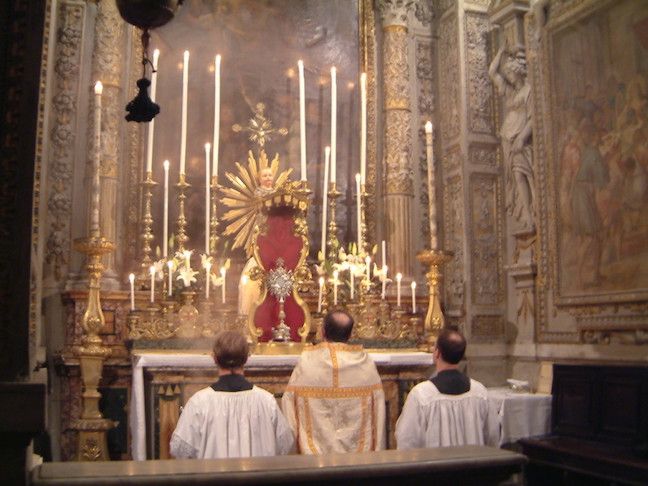
Since it was the Will of God’s Only-begotten Son that men should share in His Divinity, He assumed our nature in order that by becoming man He might make men gods. Moreover, when He took our flesh He dedicated the whole of its substance to our salvation. He offered His Body to God the Father on the Altar of the cross as a Sacrifice for our reconciliation. He shed His Blood for our ransom and purification, so that we might be redeemed from our wretched state of bondage and cleansed from all sin. But to ensure that the memory of so great a gift would abide with us for ever, He left His Body as Food and His Blood as Drink for the faithful to consume in the form of bread and wine.
O Precious and Wonderful Banquet that brings us salvation and contains all sweetness! Could anything be of more intrinsic value? Under the Old Law it was the flesh of calves and goats that was offered, but here Christ Himself, the True God, is set before us as our Food. What could be more wonderful than this? No other Sacrament has greater healing power; through it sins are purged away, virtues are increased, and the soul is enriched with an abundance of every Spiritual gift. It is offered in the Church for the living and the dead, so that what was instituted for the salvation of all may be for the benefit of all. Yet, in the end, no one can fully express the sweetness of this Sacrament, in which Spiritual delight is tasted at its very Source, and in which we renew the memory of that surpassing Love for us which Christ revealed in His Passion.
It was to impress the vastness of This ove more firmly upon the hearts of the faithful that Our LORD instituted this Sacrament at the Last Supper. As He was on the point of leaving the world to go to the Father, after celebrating the Passover with His disciples, He left it as a perpetual memorial of His Passion. It was the fulfillment of ancient figures and the greatest of all His miracles, while for those who were to experience the sorrow of His departure, it was destined to be a unique and abiding consolation.
DAILY MEDITATION
The banquet is prepared today and every day for us in the Holy Eucharist. The rich, that is, those who have no interest except in worldly, material things, persist in declining this invitation to the Eucharistic banquet. They have no taste for such food. The poor, however, those who are free of earthly encumbrances, the sick, the weak, and those who have little of this world’s goods, all are satisfied at the Eucharistic Table. We rejoice that we are among those who have been invited to the Eucharistic banquet. We lift ourselves above earthly goods and desires and long for the Eternal goods supplied by the Eucharist. “He hath filled the hungry with good things; and the rich He hath sent empty away” (Lk 1:53). In our hunger for the Holy Eucharist and in our longing for Holy Communion, we shall want nothing. A great blessing is our realization that we are the poor, the weak, the blind, and the lame, and that we stand so much in need of the strength and help of the Holy Eucharist.
The special fruit of a devout participation in the Eucharistic banquet is the spirit, the will, and the strength necessary to love as God wishes us to love (Epistle)…. By the fruits of fraternal Charity, by our willingness to sacrifice ourselves for the good of the brethren, great things and in small, others will be able to judge us, and we shall be able to judge ourselves. By this means, we shall be able to determine how fruitful our reception of Holy Communion has been. Nothing in the life of a Christian is more difficult than the consistent practice of fraternal Charity. The more closely we are associated with others in life, the more heavily the burdens of others weigh upon us (see Gal 6:2), and the greater is the strain placed upon our love. But from the reception of Holy Communion, we shall obtain the strength to practice fraternal Charity, to master ourselves, and to suppress our personal desires and ambitions. There we shall find the strength to forgive others, to understand their difficulties, and to treat them with Charity and deference under all circumstances. By the strength gained from Holy Communion, we shall be able to avoid all bitterness and uncharitableness. By this means. we shall be able to maintain peace of soul, in spite of all internal and external disturbances, and become “one bread, one body, all that partake of one bread“ [1 Corinthians 10:17].
Dom Benedict Bauer (d.1963) – German Benedictine, respected theologian and archabbot of St. Martin’s Abbey Bueron.
RESPONSORY
Know that in this Bread is the Body of Christ
which hung upon the Cross,
and in this Cup, the Blood of Christ
which flowed from His side.
Take, therefore, and eat His Body;
take and drink His Blood,
– and you will become members of His Body (the Catholic Church).Eat this Sacred Food,
so that your bond of unity with Christ may never be broken.
Drink this Sacred Blood, the price He paid for you,
so that you may never lose heart because of your sinfulness.
– And you will become members of His Body (the Catholic Church).
“The refusal to take sides on great moral issues is itself a decision. It is a silent acquiescence to evil. The Tragedy of our time is that those who still believe in honesty lack fire and conviction, while those who believe in dishonesty are full of passionate conviction.”– Ven. Archbishop Fulton Sheen
 Daily Reflections
Leave a comment