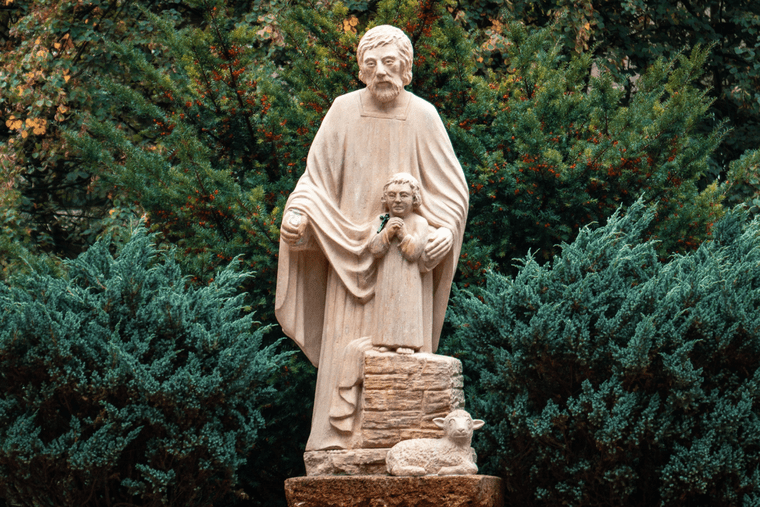
7 Lessons From St. Joseph for Modern Dads
Today, the world celebrates Father’s Day, I would like to honour these heroic men by sharing two artcles, from different prospectives of Catholic fatherhood. The first, on imitating St. Joseph and the second by Msgr. Pope from Washington, DC. A Blessed Father’s Day to all!
The wordless lessons he teaches fathers, from new dads and granddads to godfathers and expectant dads, are timeless reminders well suited for Father’s Day. Read more…ncregister.com/features/7-lessons-from-st-joseph-for-modern-dads
We Priests Are Fathers, Pointing Always to Heaven
COMMENTARY: Good fathers inspire their children and help them set goals and priorities. So too must a priest point always to Heaven, inspire the faithful to its lofty heights and, by God’s grace, equip, empower and enable the faithful to get there by proper priorities, the life of virtue and due reference to the four last things.
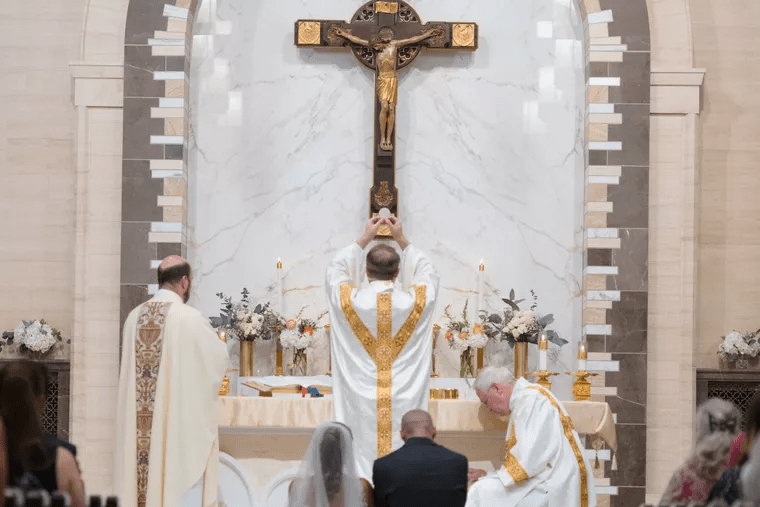
Spiritual fatherhood begins in a paradoxical place: the summons by Jesus of his first priests to radical detachment from family, property, career and, yes, fatherhood. The paradox is especially manifest in what we call today “celibacy.” Consider a central text from Mark’s Gospel regarding this counsel:
“Simon Peter said, ‘We have given up everything and followed You.’ Jesus said, ‘Amen, I say to you, there is no one who has given up house or brothers or sisters or mother or father or children or lands for My sake and for the sake of the Gospel who will not receive a hundred times more now in this present age: houses and brothers and sisters and mothers and children and lands, with persecutions, and Eternal Life in the age to come’” (Mark 10:28-30).
What every priest, every spiritual father, knows is that this passage is dripping with irony. For indeed, we have forsaken the gift of marriage, and therefore fatherhood — and yet, we have thousands who call us “father.” Read more….
https://www.ncregister.com/commentaries/we-priests-are-fathers-pointing-always-to-heaven
Eleventh Sunday in Ordinary Time
External Solemnity of the Sacred Heart of Jesus (Optional, Traditional)
Third Sunday after Pentecost (Traditional)
- The LORD says to Moses: “I carried you on eagle’s wings and brought you to Myself.” Today, “when Jesus saw the crowds He felt sorry for them” (Mt 9:36-10:8). The LORD was moved with pity because He wanted each person in that crowd to be brought to a personal relationship with Himself. So Jesus summons the Twelve to be the labourers for the harvest. They are to proclaim: “the Kingdom of Heaven is close at hand”. Speaking on behalf of the LORD, their words mean, “you of all the nations shall be My very own”. Or, as Saint Paul expresses it after the Resurrection, “what proves that God loves us is that Christ died for us while we were still sinners” (Romans 5:6-11).
- The Liturgy celebrates today the mercy of God towards us poor sinners. Jesus has come, not to call the just but sinners, and the Holy Ghost comes to establish the reign of God in our sinful, unclean hearts.
From a Treatise on the LORD’s Prayer by Saint Cyprian of Carthage, Bishop and Martyr
(Nn. 4-6: CSEL 3, 268-270)
Let your prayer come from a humble heart
When we pray, our words should be calm, modest and disciplined. Let us reflect that we are standing before God. We should please Him both by our bodily posture and the manner of our speech. It is characteristic of the vulgar to shout and make a noise, not those who are modest. On the contrary, they should employ a quiet tone in their prayer.
Moreover, in the course of His teaching, the LORD instructed us to pray in secret. Hidden and secluded places, even our own rooms, give witness to our belief that God is present everywhere; that He sees and hears all; that in the fullness of His Majesty, He penetrates hidden and secret places. This is the teaching of Jeremiah: Am I God when I am near, and not God when I am far away? Can anyone hide in a dark corner without My seeing him? Do I not fill Heaven and earth? Another passage of Scripture says: The eyes of the LORD are everywhere, observing both good and wicked men.
The same modesty and discipline should characterize our Liturgical prayer as well. When we gather to celebrate the Divine Mysteries with God’s Priest, we should not express our prayer in unruly words; the petition that should be made to God with moderation is not to be shouted out noisily and verbosely. For God hears our heart not our voice. He sees our thoughts; He is not to be shouted at. The LORD showed us this when He asked: Why do you think evil in your hearts? The book of Apocalypse testifies to this also: And all the churches shall know that I am the One who searches the heart and the desires.
Anna maintained this rule; in her observance of it she is an image of the Church. In the First Book of Kings we are told that she prayed quietly and modestly to God in the recesses of her heart. Her prayer was secret but her Faith was evident. She did not pray with her voice, but with her heart, for she knew that in this way the LORD would hear her. She prayed with Faith and obtained what she sought. Scripture makes this clear in the words: She was speaking in her heart; her lips were moving but her voice could not be heard; and the LORD heard her prayer. The Psalmist also reminds us: Commune within your own hearts, and in the privacy of your room express your remorse. This is the teaching of the Holy Ghost. Through Jeremiah He suggests this: Say in your hearts: LORD, it is You that we have to worship.
My friends, anyone who worships should remember the way in which the tax-collector prayed in the temple alongside the Pharisee. He did not raise his eyes immodestly to Heaven or lift up his hands arrogantly. Instead he struck his breast and confessing the sins hidden within his heart he implored the assistance of God’s mercy. While the Pharisee was pleased with himself, the tax-collector deserved to be cleansed much more because of the manner in which he prayed. For he did not place his hope of salvation in the certainty of his own innocence; indeed, no one is innocent. Rather he prayed humbly, confessing his sins. And the LORD who forgives the lowly heard his prayer.
Trusting in His Merciful Heart
Since I am aware that I can do nothing because of my misery, I give myself completely to You, my only Love, so that You alone can work in me according to Your Plan. For I desire nothing other than what You wish…. The arms with which I shall do battle are prayer, the Presence of God, silence; yet I am aware of how little I am able to use these weapons. Nevertheless I shall arm myself with complete confidence in You, Patience, Humility, and conformity with Your Divine Will. But who shall help me fight a continual battle against enemies such as those which make war on me? You, my God, have declared Yourself my Captain; You have raised the standard of the Cross, saying, take up the Cross and follow in My footsteps. To correspond with this invitation, I promise to resist Your love no longer; rather, I will follow You to Calvary without hesitation.
My God, I desire nothing except to become Your perfect image, and since Yours was a hidden life of humiliation, love, and sacrifice, so also I wish mine to be. I desire to enclose myself henceforth within Your Most Loving Heart as in a desert, so that I may live in You, and with You, and for You this hidden life of love and sacrifice. O my LORD, You know my great desire to become a victim of Your Sacred Heart, wholly consumed by the fire of Your holy love. May Your heart be the altar upon which my holocaust shall be made, and You be the Priest Who will consume this victim by the flames of Your burning love….
I am confident that all will be accomplished by the fire of Divine Love. My God, how well You know my great need of Your help. I trust in Your Infinite Mercy and shall always do so regardless of the spiritual state in which I might find myself. Always and everywhere I shall endeavour to recognise Your will in all things, even though my eyes see only contradiction and uncertainty. I know I cannot depend upon myself, so I shall trust completely in You. Nothing shall separate me from the love of Christ, for in You, O LORD, I have hoped; I shall never be confounded. In all things I shall be content knowing that the route I travel leads to Calvary. I desire to love You with a suffering love, a selfless love, an active love, a firm, undivided, persevering love. I have promised You many things, but in no way do I depend on my own indolent spirit. You have enlightened me as to what I must do; now help me to execute it. All this I Hope of Your Infinite mercy.
Saint Teresa Margaret of the Sacred Heart
Saint Teresa Margaret († 1770) was an Italian Carmelite nun who died at the age of twenty-two. [From God Is Love: Saint Teresa Margaret—Her Life, Margaret Heart Rowe.
DAILY MEDITATION
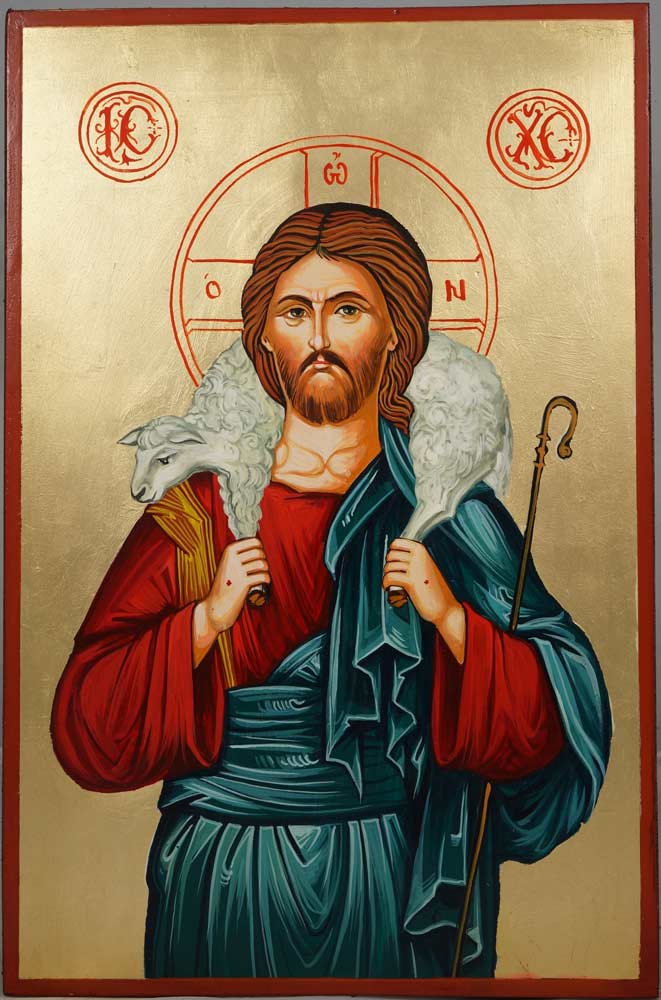
- The memory of Easter dominates the texts and prayers of the Mass for this Sunday. First of all, we are reminded of Christ, the Redeemer, the Restorer of Life. “ What man is there of you that has a hundred sheep, and if he shall lose one of them, does he not leave the ninety-nine in the desert, and go after that which was lost, until he find it; and when he hath found it, lay it upon his shoulders rejoicing?“ [Gospel, Luke 15:1–10]. Did we not also experience this attention of the Good Shepherd at Easter? Our first rescue by the Good Shepherd, at our Baptism, has not yet been completed. We are still exposed to danger; we may still wander away from his vigilant care, become lost in the wilderness, and the thicket of sin. We still must struggle against the powers of evil working within us, and the temptations, which assail us from without.
- At the Offertory, those things which we heard in the Epistle and Gospel become realities. We are the sheep, lost in worldliness, trivialities, temporal things, and sin. We are indeed lost groats. In the Holy Sacrifice of the Mass, we disengage ourselves from our I’ll-advised absorption in temporal things and sin. We resign ourselves and allow ourselves to be found, and taken up by Christ, who, by His Suffering, and Death has come forth in search of us. We repent of our waywardness and infidelity, which have caused us to seek worldly things instead of following Christ. In the spirit of sacrifice, we surrender to Christ, and become sacrificial victims with Him, seeking thus to be free from our perverted love of the things of this world. We long to be changed from enemies of God to His friends, and to serve Him faithfully, and to belong to Him entirely. When we return to Him in the Holy Sacrifice, He prepares for us, the sheep who won lost, the Joyful banquet of the Holy Eucharist.
- Dom Benedict Bauer (d.1963) – German Benedictine, respected theologian, and archabbot of St. Martin’s Abbey in Bueron.
RESPONSORY
Let us consider how we should live in the presence of God and His angels;
– And so let us stand singing Psalms in such a way that mind and voice are in harmony.Let us recall that God does not delight in how much we pray,
but in our purity of heart and sorrow for sin.
– And so let us stand singing Psalms in such a way that mind and voice are in harmony.
 Daily Reflections
Leave a comment