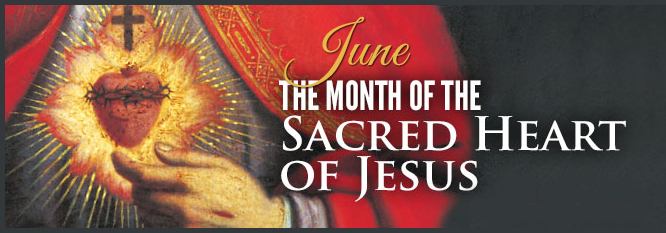
“Heart of Jesus, ease our burdens and console us in our sorrows.” St. Margaret Mary Alacoque
1 Corinthians 1:27, 29; 2 Corinthians 12:9; 1 Corinthians 1:28
To shame the strong, God chose the weak
so that no one might boast in His Presence.
– For His power is made perfect in weakness.God chose those who were nothing at all,
to humble those who were everything.
– For His power is made perfect in weakness.
Monday of the Eleventh Week in Ordinary Time
Saint Ephrem, Deacon, Confessor, Doctor of the Church (Traditional, June 18)
Saint Romuald, Abbot
Saint Juliana Falconieri, Virgin (Traditional)
SS. Gervase and Protase, Martyrs (Traditional)
SAINT EPHREM, DEACON, CONFESSOR, DOCTOR OF THE CHURCH

St. Ephrem of Nisibis in Mesopotamia was cast forth from his home by his father, a pagan priest. At first he lived as a hermit; he was later ordained a Deacon of Edessa and became renowned as a poet, an orator, and a holy monk . According to tradition, Ephrem began to write hymns in order to counteract the heresies that were rampant at that time. For those who think of hymns simply as the song at the end of Mass that keeps us from leaving the church early, it may come as a surprise that Ephrem and others recognized and developed the power of music to get their points across. Tradition tells us that Ephrem heard the heretical ideas put into song first and in order to counteract them made up his own hymns. In the one below, his target is a Syrian heretic Bardesan who denied the Truth of the Resurrection: “How he blasphemes Justice, And Grace her fellow-worker. For if the Body was not raised, This is a great insult against grace, To say grace created the body for decay; And this slander against justice, to say justice sends the body to destruction.”
The originality, imagery, and skill of his hymns captured the hearts of the Christians so well, that Ephrem is given credit for awakening the Church to the important of music and poetry in spreading and fortifying the Faith.
Ephrem’s home was in physical as well as spiritual danger. Nisibis, a target of Shapur II, the King of Persia, was besieged by him three times. During the third siege in in 350, Shapur’s engineers turned the river out of its course in order to flood the city as Ephrem describes (speaking as Nisibis):
“All kinds of storms trouble me — and you have been kinder to the Ark: only waves surrounded it, but ramps and weapons and waves surround me… O Helmsman of the Ark, be my Pilot on dry land! You gave the Ark rest on the haven of a mountain, give me rest in the haven of my walls.”
The flood, however, turned the tide against Shapur. When he tried to invade he found his army obstructed by the very waters and ruin he had caused. The defenders of the city, including Ephrem, took advantage of the chaos to ambush the invaders and drive them out.
“He has saved us without wall, and taught us that He is our Wall: He has saved us without king and made us know that is our King: He has saved us, in each and all, and showed us that He is All.”
He died in 379 A.D.
SAINT ROMUALD, ABBOT
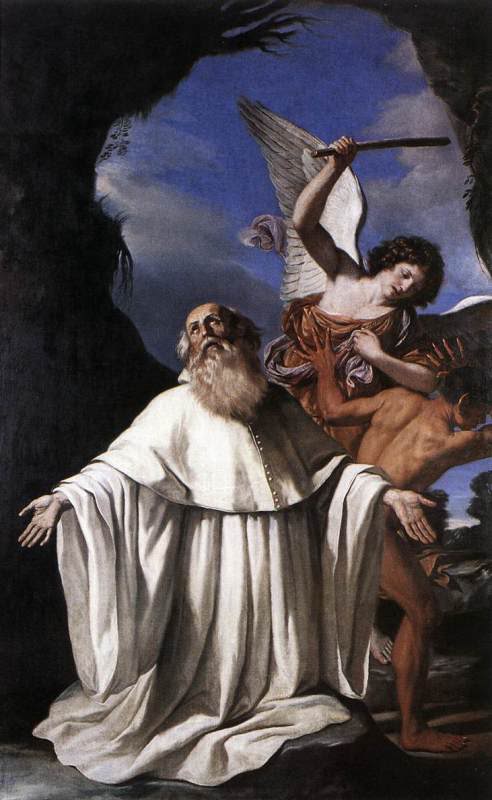
A native of Ravenna, Italy, Romuald witnessed his own father slay a man as a result of a feud. He sought refuge in a Cluniac monastery, but his desire for strictness exceeded that of his fellow monks. Influenced by the hermit Marinus and the writings of the Desert Fathers, Romuald conceived a love for solitary prayer. He travelled throughout Italy, renewing monastic life through his founding of hermitages while directing himself to a life of perfection by the practice of virtues. He fought strenuously against the depraved habits of the monks of his day. At Camaldoli, he established a house that would become a new branch of the Benedictines. The monks there live in simple hermitages and come together for Liturgy and communal meals. Romuald died in 1027 at the age of 120.
SAINT JULIANA FALCONIERI, VIRGIN
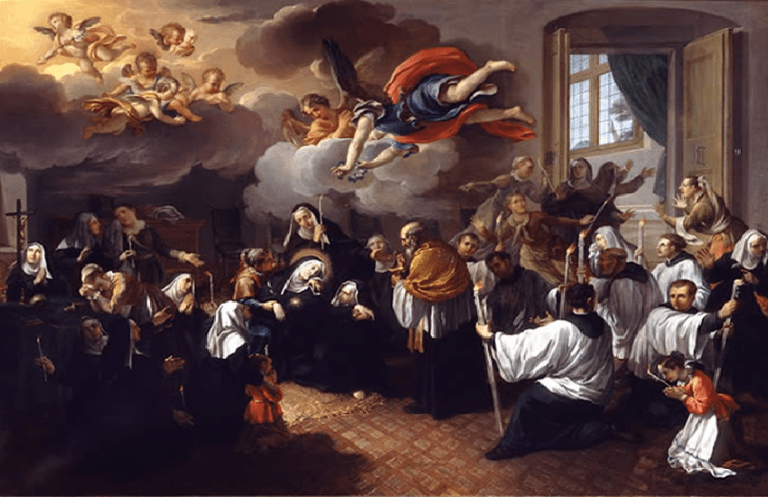
Saint Juliana Falconieri, born in florence in 1270, niece of Saint Alexis for Falconieri, even as a child showed such sanctity that her holy uncle told her mother that she had given birth to an angel. To hear sin spoken of made her tremble. At the age of 15 she consecrated her virginity to God. She founded the Order of the Mantelette [wearers of a short cloak or mantle]; she was then asked by Saint Philip Beniti, to take charge of the whole Order of the Servites, and thus may be regarded as a second foundress of this Community devoted to the Sorrows of the Blessed Virgin.
At the end of her life; on account of constant sickness, it was not possible for her to receive the Blessed Sacrament; she asked that it might be brought near her heart. When this was done, the Sacred Host miraculously penetrated her breast. She died on June 19, 1340. In olden and times the pagans placed in the mouth a piece of money as payment to the boatman Charon. In the Fourth Century, it was already an ancient tradition of the Roman Church to comfort the last moments of the faithful by administration of the Holy Eucharist; the Viaticum also was sometimes placed on the breast of the dead person. This custom, which testified to the robust Faith of that early age in the immortality of the soul and final resurrection was afterwards modified by the Church, decreeing that Communion after Confession and (the Sacrament of) Extreme Unction should suffice as a Viaticum.
STS. GERVASE AND PROTASE, MARTYRS
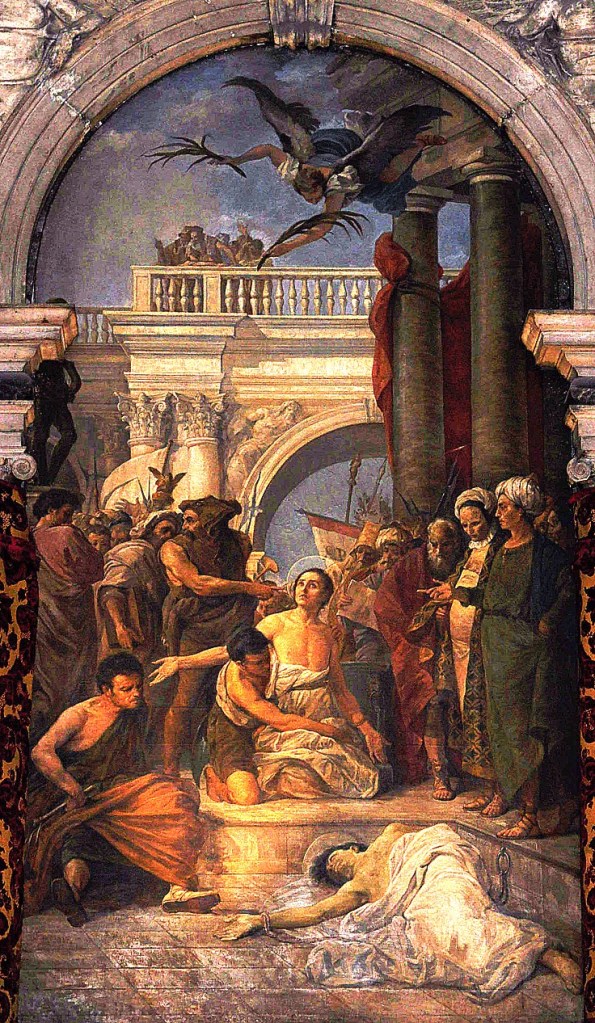
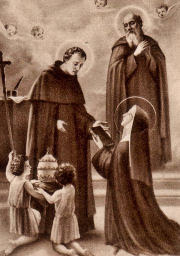
St. Gervase and St. Juliana Falconieri
Sts. Gervase and Protase, said to be twins, were called by St. Ambrose the proto-martyrs of Milan. At the close of the Fourth Century he discovered their relics and had them suitably enshrined. Their names are included in the Litany of Saints.
From a Treatise on the LORD’s Prayer by Saint Cyprian, Bishop and Martyr (Nn. 8-9: CSEL 3, 271-272)
Our prayer is communal
Above all, He who preaches peace and unity did not want us to pray by ourselves in private or for ourselves alone. We do not say “My Father, Who art in Heaven,” nor “Give me this day my daily bread.” It is not for himself alone that each person asks to be forgiven, not to be led into temptation or to be delivered from evil. Rather, we pray in public as a community, and not for one individual but for all. For the people of God are all one.
God is then the teacher of harmony, peace and unity, and desires each of us to pray for all men, even as He bore all men in Himself alone. The three young men shut up in the furnace of fire observed this rule of prayer. United in the bond of the Spirit they uttered together the same prayer. The witness of Holy Scripture describes this incident for us, so that we might imitate them in our prayer. Then all three began to sing in unison, blessing God. Even though Christ had not yet taught them to pray, nevertheless, they spoke as with one voice.
It is for this reason that their prayer was persuasive and efficacious. For their simple and spiritual prayer of peace merited the presence of the LORD. So too, after the Ascension we find the apostles and the disciples praying together in this way. Scripture relates: They all joined together in continuous prayer, with the women including Mary, the mother of Jesus, and His brothers. They all joined together in continuous prayer. The urgency and the unity of their prayer declares that God, who fashions a bond of unity among those who live in His home, will admit into His Divine Home for All-Eternity only those who pray in unity.
My dear friends, the LORD’s Prayer contains many great mysteries of our Faith. In these few words there is great spiritual strength, for this summary of Divine Teaching contains all of our prayers and petitions. And so, the LORD commands us: Pray then like this: Our Father, who art in Heaven.
We are new men; we have been reborn and restored to God by His grace. We have already begun to be His sons and we can say “Father.” John reminds us of this: He came to His own home, and His own people did not receive Him. But to all who received Him, who believe in His Name, He gave the power to become children of God. Profess your belief that you are sons of God by giving thanks. Call upon God who is your Father in Heaven.
She Who Always Gives to Those Who Ask
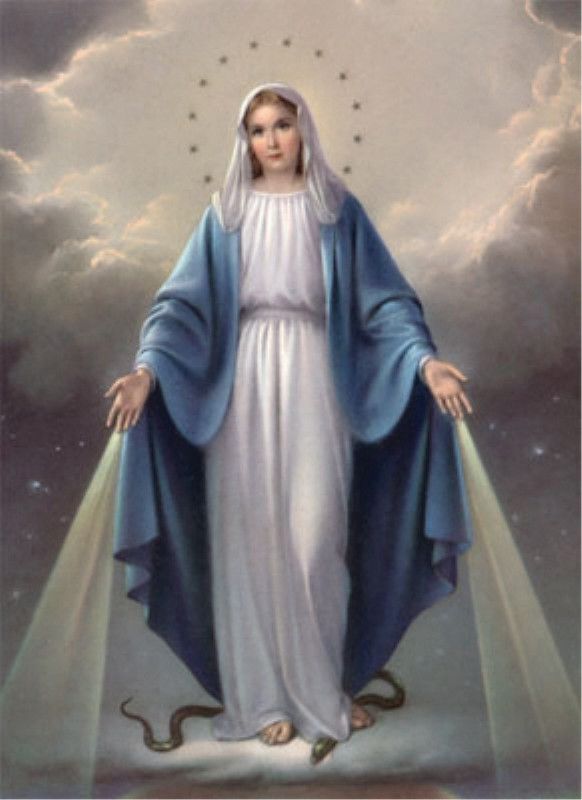
Our Lady of All Graces, pray for us!
Mary is most ready and profuse in opening her treasures, dispensing her riches, her gifts, her graces, to him who calls upon her and has recourse to her in all his wants and necessities. How many humiliations, petitions, memorials, and intercessors; how many months and years are required to gain some favour, some help from men! And you may congratulate yourself if even this suffices, and you be not spurned, without obtaining anything, as but too frequently happens. But not so with Mary. All have most prompt access to her: the noble, the rich and the poor, the just and the sinner, the miserable, afflicted, the weak, the sick, the outcast, contemned, and infamous, the living and the dead. At all times, at every moment, she hears all, receives all, encourages all, grants all petitions, consoles all, and most abundantly distributes to all her graces, gifts, and benefits. A sigh, a glance, a word, is sufficient, and she immediately comes to meet you, to offer herself to you, and to pour into your bosom all her treasures. “You will find her ever ready to help you”, says Richard of Saint-Laurent. She has not the heart to keep you waiting, even a moment; burning with the desire to do good to all, she does not delay, and cannot restrain the torrent of her kindness. “Eager to do good, she knows not delay, nor is she a miserly keeper of graces; the Mother of Mercy knows not slow delays, when she is going to pour forth the treasures of her beneficence upon her servants”, says Novarinus.
The holy Evangelist Saint John saw her fly to the desert with the wings of an eagle: she was given a huge pair of eagle’s wings to fly away from the serpent into the desert (Rv 12:14). The flight of the eagle is most swift, and the symbol is well suited to the Mother of Beneficence because she does not run, but flies, with a velocity surpassing that of the very seraphim, to the help and assistance of him who calls her in the desert of miseries.
Dom Roberto, er. cam.
Dom Roberto was a 17th–century Camaldolese hermit at Monte Corona in Italy. [From The Love of Mary, Readings for the Month of May.
 Daily Reflections
Leave a comment