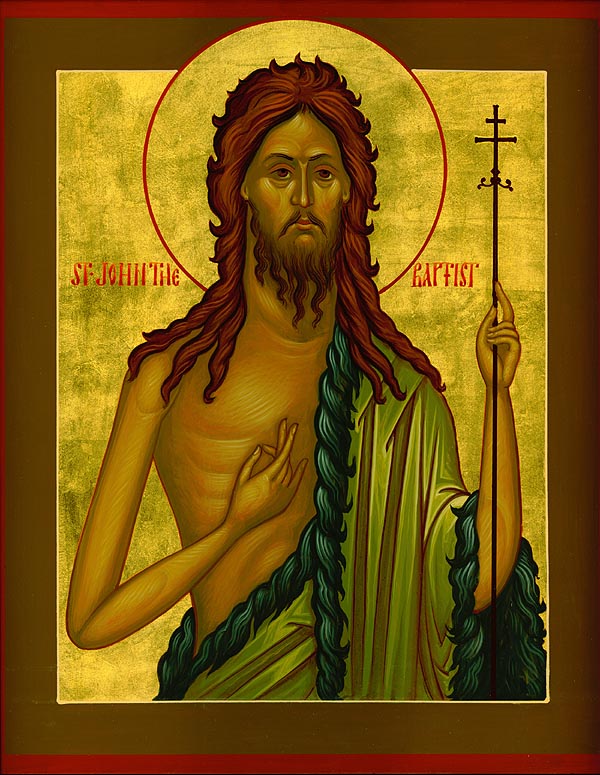
Solemnity of the Nativity of John the Baptist
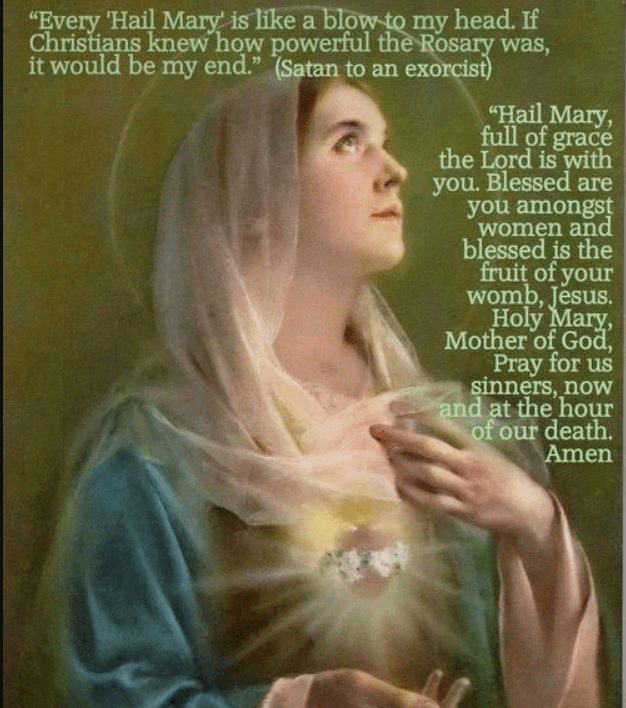
Saturday of the Blessed Virgin Mary
Why does the Church celebrate the birthday of John the Baptist? Because John is the last of all the prophets. Not only his message, but his life itself proclaims the coming of Christ. John the Baptist’s mission in life, the purpose of his God-given existence, was to prepare the way of the LORD: “Behold, the Lamb of God!” And John the Baptist’s joyful leap in his mother’s womb reveals what God desires for all of us: to be transformed by the presence of Jesus and Mary. “With John the Baptist, the Holy Spirit begins the restoration to man of ‘the Divine likeness’, prefiguring what he would achieve with and in Christ” (CCC 720)
SAINT JOHN THE BAPTIST
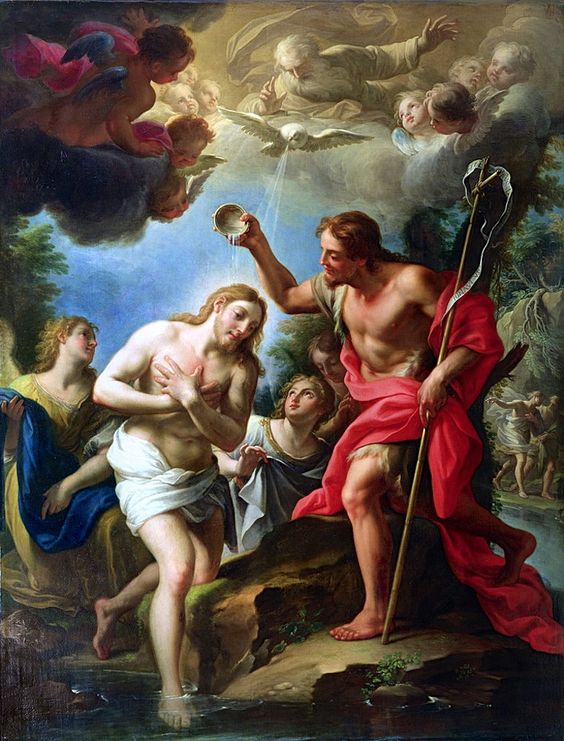
This great religious reformer was sent by God to prepare the people for the Messiah. His vocation was one of selfless giving. The only power that he claimed was the Spirit of Yahweh. “I am baptizing you with water, for repentance, but the one who is coming after me is mightier than I. I am not worthy to carry His sandals. He will baptize you with the Holy Ghost and fire” (Matthew 3:11). Scripture tells us that many people followed John looking to him for hope, perhaps in anticipation of some great messianic power. John never allowed himself the false honour of receiving these people for his own glory. He knew his calling was one of preparation. When the time came, he led his disciples to Jesus: “The next day John was there again with two of his disciples, and as he watched Jesus walk by; he said, ‘Behold, the Lamb of God.’ The two disciples heard what he said and followed Jesus” (John 1:35-37). It is John the Baptist who has pointed the way to Christ. John’s life and death were a giving over of self for God and other people. His simple style of life was one of complete detachment from earthly possessions. His heart was centred on God and the call that he heard from the Spirit of God speaking to his heart. Confident of God’s Grace, he had the courage to speak words of condemnation or repentance, of salvation
From a sermon by Saint Augustine, Bishop
(Sermo 293, 1-3: PL 38, 1327-1328)
The Voice of one crying in the Wilderness
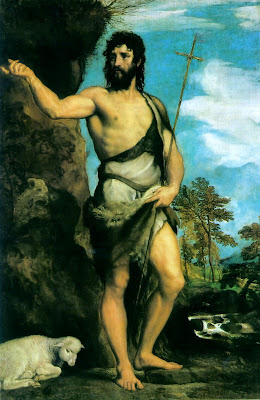
The Church observes the birth of John as a hallowed event. We have no such commemoration for any other fathers; but it is significant that we celebrate the birthdays of John and of Jesus. This day cannot be passed by. And even if my explanation does not match the dignity of the feast, you may still meditate on it with great depth and profit.
John is born of a woman too old for childbirth; Christ was born of a youthful virgin. The news of John’s birth was met with incredulity, and his father was struck dumb. Christ’s birth was believed, and He was conceived through Faith.
Such is the topic, as I have presented it, for our inquiry and discussion. But as I said before, if I lack either the time or the ability to study the implications of so profound a mystery, He who speaks within you even when I am not here will teach you better; it is He Whom you contemplate with devotion, Whom you have welcomed into your hearts, whose temples you have become.
John, then, appears as the boundary between the two Testaments, the Old and the New. That he is a sort of boundary the LORD Himself bears witness, when He speaks of the law and the prophets up until John the Baptist. Thus he represents times past and is the herald of the new era to come. As a representative of the past, he is born of aged parents; as herald of the new, he is declared to be a prophet while still in his mother’s womb. For when yet unborn, he leapt in his mother’s womb at the arrival of blessed Mary. In that womb he had already been designated a prophet, even before he was born; it was revealed that he was to be Christ’s Precursor, before they ever saw one another. These are divine happenings, going beyond the limits of our human fraility. Eventually he is born, he receives his name, his father’s tongue is loosened. See how these events reflect reality.
Zechariah is silent and loses his voice until John, the Precursor of the LORD, is born and restores his voice. The silence of Zechariah is nothing but the age of prophecy lying hidden, obscured, as it were, and concealed before the preaching of Christ. At John’s arrival, it becomes clear when the One who was being prophesied is about to come. The release of Zechariah’s voice at the birth of John is a parallel to the rending of the veil at Christ’s Crucifixion. If John were announcing his own coming, Zechariah’s lips would not have been opened. The tongue is loosened because a voice is born. For when John was preaching the LORD’s coming he was asked: Who are you? And he replied: I am the voice of one crying in the wilderness. The voice is John, but the LORD in the beginning was the Word. John was a voice that lasted only for a time; Christ, the Word in the Beginning, is Eternal.
DAILY MEDITATION
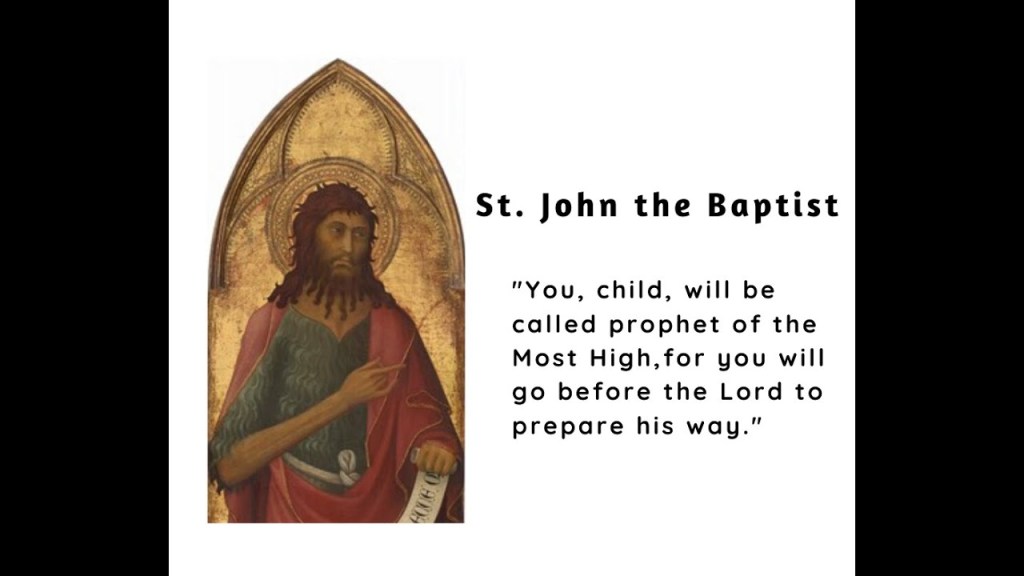
Several holy Fathers write that Elizabeth fled with her child into the desert, to conceal herself from the cruelties of King Herod; and that John was nourished, and kept either by an angel, or in some other manner by Divine Providence. Others write that, in his third or at most of his fifth year, he had voluntarily gone into the desert, eager to serve God, more perfectly and to prepare himself for his mission. No one ought to think this incredible, since, even before he was born, he was gifted with the use of his reason, and comprehended the great mission to which he was called by the Almighty. So much is certain that he was from his most tender years in the wilderness. The holy evangelists, and the holy Fathers tell us what manner of life he led there. He subsisted on wild honey, and locusts, which are used as food in the East; but he ate so little, that Our LORD said of him, that he had neither taken food nor drink. His drink was water; his garments, a coat of camels’ hair, which was fastened around his loins by a leather belt. The ground was his bed, and he employed day and night in prayer and meditation. By fasting and other austere penances, he prepared himself for his mission. Saint Augustine, remarks that the severe life of penance of John was the model after which the hermits regulated their lives; hence they acknowledge him as their founder.
St. John kept the grace and innocence which he received in the womb of his mother unimpaired, and yet led a most, austere life from his tenderest years until his end. How does it happen that you have such an aversion to all penances, as you certainly must know that you have long since lost the Grace and innocence received in Holy Baptism? …. How do you suppose you will be able to render an account of your doings to God? Truly, if we could save our souls as easily without all self-denial, by enjoying the pleasures of the world, and living in comfort and luxury, we might say that John did not act wisely in leading so severe a life. But who dares even think this of one, who, before he was born, was already filled with the Holy Ghost? We act very unwisely if we flatter ourselves that, living so different a life, shall obtain a place in Heaven near Him. “Hence,“ says the above-cited holy teacher, “let us encourage ourselves to do penance,“ in consideration of the austere penances of Saint John. “Let us stimulate ourselves to modify our bodies, that we may escape the awful Judgement of the Living God.“
Fr. Francis Xavier Weninger (d. 1888] – Austrian Priest, professor, and author ; joined the Jesuits as missionary preacher to the United States
“What will this child turn out to be?”
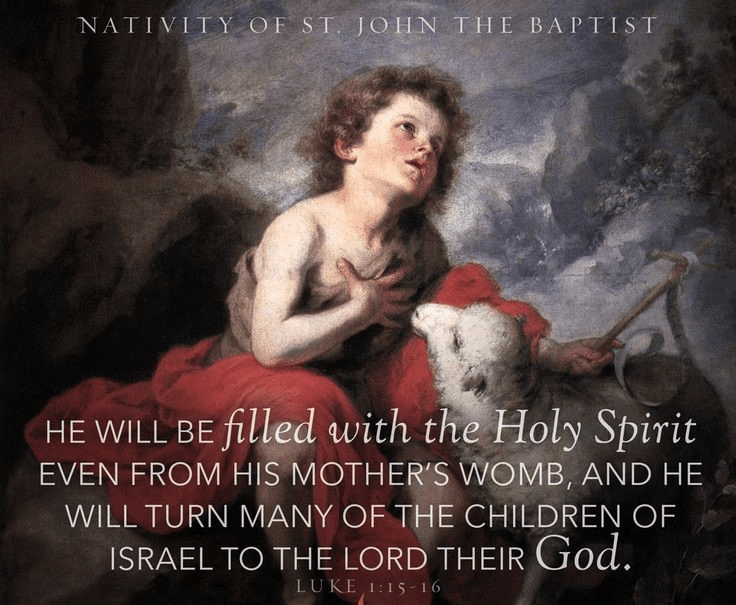
If you bid us do so, we want to tell the ears of your charity briefly why Our LORD and Saviour said that blessed John was a lamp, and why He wanted him to be sent before Him. John was sent before Him like a voice before the Word, a lamp before the sun, a herald before the judge, a servant before his master, a friend before the bridegroom. Because the darkness of sin and the night of unbelief had oppressed the whole world and it could not see the Sun of Justice, blessed John was sent ahead like a lamp. Thus the eyes of the heart, weakened by the inflammation of iniquity and unable to see the great and True light, first became accustomed to look at the light of the lamp as at slight brightness. Gradually, then, as the cloud of sins was removed and the moisture of unbelief disappeared, at the coming of Christ they could be gladdened rather than tormented by that Heavenly Light. Just as you encourage watery eyes to see if you show the slight brightness of a lamp, and pain them if you bring a bright light, so it is with Our LORD and Saviour, who is the True Light. If He had not first sent blessed John as a lamp, the entire world could not have endured His brightness. Allow John to speak and say: I am…. a voice that cries in the wilderness. He was a voice, because he was filled with the spirit of God’s word. Just as the utterance of a voice is transmitted by a speaker to a listener through some kind of instrumentality or vehicle, so John was the servant and bearer of the word when he spoke about Christ….
Now in order that we may be able to celebrate such a holy feast with not only bodily but also Spiritual joy, dearly beloved, according to our strength let us prepare our souls to give alms and to observe peace with everyone…. Saint John will be able to obtain for us whatever we ask only if he knows that we are celebrating his feast as peaceable, chaste, and temperate men, free from any immodest speech. It is through paternal solicitude that I am mentioning these Truths. Through the goodness of God I have such trust in your devotion that you will not only keep yourselves but also all who belong to you chaste and temperate, in every kind of upright conduct. Therefore in a spirit of gratitude to God I beg him to allow you to persevere happily.
Saint Caesarius of Arles
Saint Caesarius of Arles († 542) was a monk, Archbishop, and celebrated preacher. [From Saint Caesarius of Arles: Sermons, Volume III (187-238), The Fathers of the Church, a new translation, Vol. 66, Sr. Mary Magdeleine Mueller, o.s.f., Tr.
Jeremiah 1:5, 9, 10
Before I formed you in the womb I knew you;
before you were born I consecrated you,
– and I appointed you a prophet to the nations.
I have placed My words in your mouth;
have set you over nations and over kingdoms.
– And I appointed you a prophet to the nations.
 Daily Reflections
Leave a comment