
“Here is this Heart that has loved men so much and instead receives nothing but ingratitude, irreverence and contempt, in this Sacrament of Love” Jesus, to Saint Margaret Mary Alacoque.
Psalm 56:2, 4, 14
Have pity on me, O God,
for men trample upon me;
all day long they persecute me with their constant attacks.
– I place my trust in You.
For You have rescued my soul from death
and You have kept my feet from stumbling.
– I place my trust in You.
Tuesday of the Twelfth Week in Ordinary Time
Feria after Pentecost (Traditional)
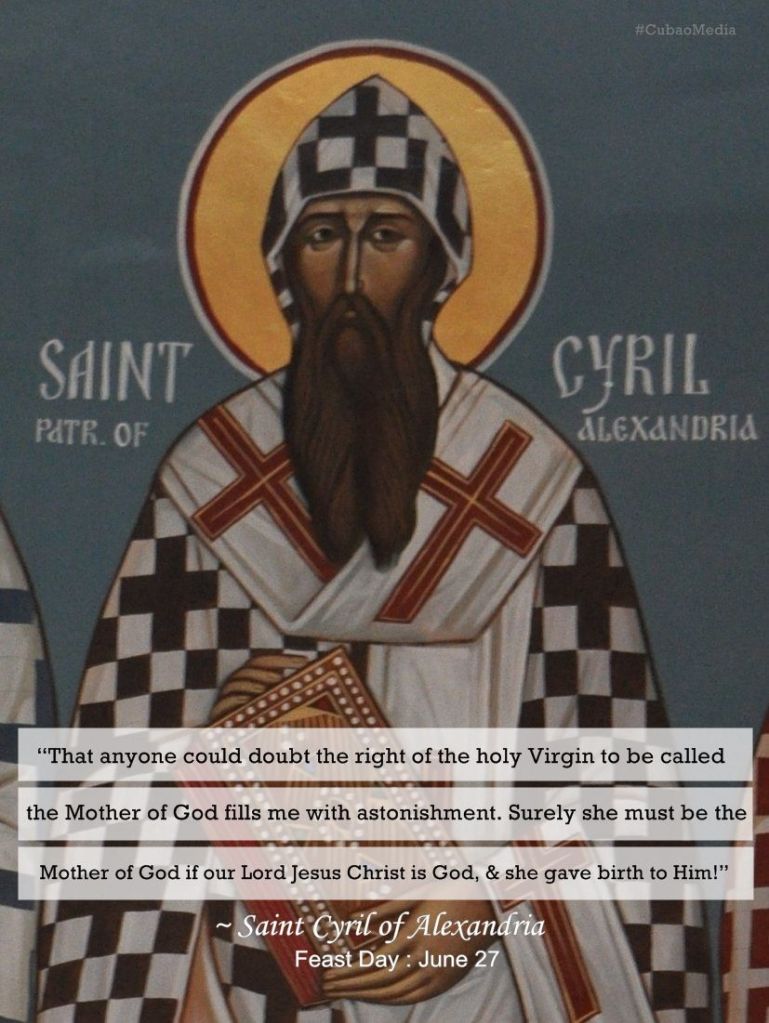
Saint Cyril of Alexandria, Bishop and Doctor of the Church
SAINT CYRIL, BISHOP AND DOCTOR OF THE CHURCH
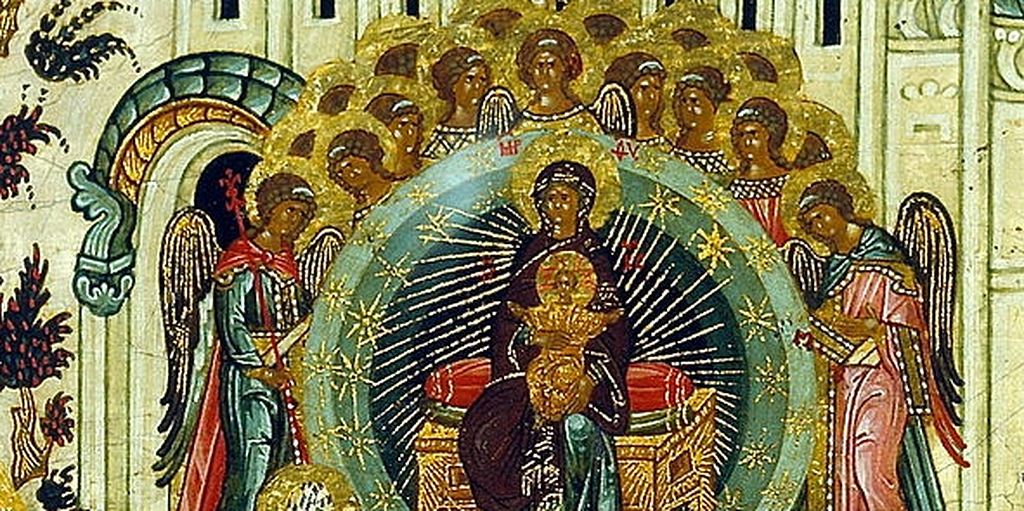
Mother of God, Theotokos, pray for us!
At the dawn of the fifth century St. Cyril was consecrated as Patriarch of Alexandria.
Being a man of intense personal devotion, St. Cyril was filled with a zeal and fire reminiscent of St. Paul.
So great was this intensity that he influenced what was at times a violent pressure which drove the Novatians, the Jews, and the governor Orestes out of Alexandria.
Such zeal can be dangerous if misdirected, but through continued prayer, penance, and the guidance of the Holy Spirit this passion came to be essential to St. Cyril’s holiness and vocation.
For beginning in 427-428 Nestorius became Patriarch of Constantinople and he began causing more confusion over the Incarnation.
Nestorius erroneously taught that Mary should not be called the Mother of God, but the Mother of Christ.
In teaching this he simultaneously neglected the honor due to the Blessed Mother and to a proper understanding of the Incarnation.
For the Lord Jesus is truly God and truly Man yet One person.
Thus, while Mary of course is not the Creator, by being the Mother of Christ who is God, she is the Mother of God, the Theotokos.
This great revelation of Mary as the Theotokos is central to Her dignity and is at the heart of why She has been so greatly exalted by God and consequently why we do so well to devote ourselves to Her.
To Nestorius’ false teachings, St. Cyril charitably and patiently responded with two separate admonishments before he reported the matter to the pope.
Ultimately, St. Cyril’s efforts were invaluable to defending these doctrines and for this reason he has been declared a Doctor of the Church.
St. Cyril’s life and teachings remind us of the importance of keeping our eyes focused on the truth.
At times it can be difficult to articulate and wrap our minds around the mysteries of our faith, and as Our Lady of Fatima warned the errors of Russia have spread great confusion across the Church.
In such an hour, we must remain humble and faithful.
As Our Lady of Fatima prescribed, let us meditate upon Her own life and the life of Her Son through the mysteries of the Rosary.
By doing so we shall take refuge in the Immaculate Heart of the Mother of God and draw ever closer to the Lord Jesus, who is the Way, the Truth, and the Life.
Reprinted from article by Christopher P. Wendt, International Director, Confraternity of Our Lady of Fatima, February 09, 2023
From a treatise on Christian Perfection by Saint Gregory of Nyssa, Bishop
(PG 46, 283-286)
Christ should be manifest in our whole life
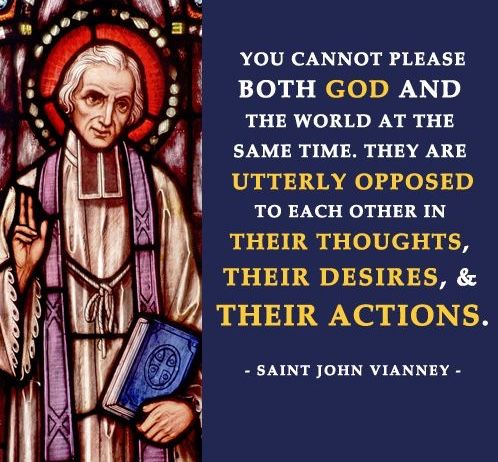
The life of the Christian has three distinguishing aspects: deeds, words and thought. Thought comes first, then words, since our words express openly the interior conclusions of the mind. Finally, after thoughts and words, comes action, for our deeds carry out what the mind has conceived. So when one of these results in our acting or speaking or thinking, we must make sure that all our thoughts, words and deeds are controlled by the Divine ideal, the Revelation of Christ. For then our thoughts, words and deeds will not fall short of the nobility of their implications.
What then must we do, we who have been found worthy of the name of Christ? Each of us must examine his thoughts, words and deeds, to see whether they are directed toward Christ or are turned away from Him. This examination is carried out in various ways. Our deeds or our thoughts or our words are not in harmony with Christ if they issue from passion. They then bear the mark of the enemy who smears the pearl of the heart with the slime of passion, dimming and even destroying the lustre of the precious stone.
On the other hand, if they are free from and untainted by every passionate inclination, they are directed toward Christ, the Author and Source of Peace. He is like a pure, untainted stream. If you draw from Him the thoughts in your mind and the inclinations of your heart, you will show a likeness to Christ, your Source and Origin, as the gleaming water in a jar resembles the flowing water from which it was obtained.
For the Purity of Christ and the purity that is manifest in our hearts are identical. Christ’s Purity, however, is the Fountainhead; ours has its source in Him and flows out of Him. Our life is stamped with the beauty of His thought. The inner and the outer man are harmonized in a kind of music. The mind of Christ is the controlling influence that inspires us to moderation and goodness in our behaviour. As I see it, Christian perfection consists in this: sharing the titles which express the meaning of Christ’s name, we bring out this meaning in our minds, our prayers and our way of life.
Saving Wisdom
A ship is guided to the right port by means of the helm, but the Word of God pilots the soul of man and leads him without risk of error to everything that is necessary for salvation. For so spoke one of the holy prophets: “Provide yourself with words” (Ho 14:3), those which are inspired by the Holy Ghost, for no man of sense will say that it means the words of the wise of this world. For their words lead men unto the pit of destruction. But the words of God point out the pathway to a better life, and beget in us an earnestness that makes us cheerfully advance unto the duty of performing all those things by means of which we are made partakers of Eternal Life. Let us listen, therefore, to the Saviour’s words, which He addressed unto those who wanted to learn whether there be few who are saved (Lk 13:23-24), and to whom the Saviour answered, “Strive to enter by the narrow gate; for many, I say to you, shall seek to enter, and shall be able.” Now this replay may seem perhaps to wander from the scope of the question. For the man wanted to learn whether there be few who are saved, but Jesus described to him the way whereby he might be saved himself.
We answer that it was the custom of Our Saviour to meet His questioners as having regard to what was useful and necessary. And this He especially did when anyone wanted to learn what was superfluous and unedifying. For what good was there in wishing to learn whether there be many or few who will be saved? On the contrary, it was a necessary and valuable thing to know in what way a person may attain Salvation. Jesus is purposefully silent, therefore, with respect to the useless question that had been asked Him, but proceeds to speak of what was essential, namely the knowledge necessary for the performance of those duties by which men can enter in at the straight and narrow door. For this He has also taught us, saying: Enter by the narrow gate, since the road that leads to perdition is wide and spacious, and many take it; but it is a narrow gate and a hard road that leads to life, and only a few find it.
Now I consider it my duty to mention why the door is narrow through which a man goes unto life. Whoever, therefore, would enter must, before everything else, possess an upright and uncorrupted Faith, and secondly, a spotless morality in which there is no possibility of blame…. Those who wish to live holily cannot do so without labour. For labours spring up before us and we have need altogether of Fortitude and Patience and Nobleness of conduct.
Saint Cyril of Alexandria
Saint Cyril of Alexandria († 444) was an eminent figure of ancient Christian literature and a valiant defender of the faith. [From Commentary on the Gospel of Saint Luke. R. Payne Smith, Tr.
DAILY MEDITATION
Consider first that man naturally desires to find rest, but he does not attend it: “My inner parts have boiled without any rest“ (Job 30:27]. And the reason is that he takes a road directly contrary to it. What does a man do who seeks rest in a natural way? He tries to avoid whatever may disturb him, he is angry with everyone who causes such disturbance, he resents it, he takes revenge for it; and what is this but to desire the waves of the sea not to buffet him? What is required, therefore, is not so much to fly from disturbing influences [a thing which is impossible to a man obliged to live in the midst of those waves] as to know how to dwell amongst disturbing influences without being disturbed, so as to be like a rock in the midst of the waves: “I will not fear thousands of the people surrounding me“ [Ps 3:7].
There have been some among the philosophers, who professed to teach a similar doctrine, but they did so rather brilliantly than solidly. No one ever taught it on a true foundation till Christ brought it down from Heaven to earth. Therefore it is that He here says, “Learn of Me,“ and by so saying He shows that the Doctrine is certainly worthy of the Teacher . He might have bade thee learn from Him to foretell future things, to heal the sick, to raise the dead, to walk dryshod upon the waters. But what would it be to say such things as these? Christ was not so worthy of admiration for the Infinite miracles which He wrought upon the earth, as for the infinite examples which He gave of meekness and humility, such as were never seen or heard of in all the ages before Him. With good reason, then, does He say, “Learn of Me, because I am meek and humble of Heart“ [Matthew 11:29]. If thou knowest well, how to practice these two Virtues taught thee by Christ, thou hast found the rest which thou desirest. Prepare thyself, then, like a diligent scholar to hear His Doctrine, since it is upon it that the rest must be founded if it is to be lasting: upon “Everlasting foundations,“ which can never be shaken, built “upon a solid rock“ [Ecclesiasticus, 26:24].
Fr. Paola Segneri (d. 1694) – Italian Jesuit missionary preacher, ascetical writer, and one of Italy’s greatest orators.
Colossians 3:17; Romans 14:7
Whatever you do in word and deed,
– do all in the name of the Lord Jesus.
None of us lives just for himself,
and none of us dies for himself alone.
– Do all in the name of the Lord Jesus.
 Daily Reflections
Leave a comment