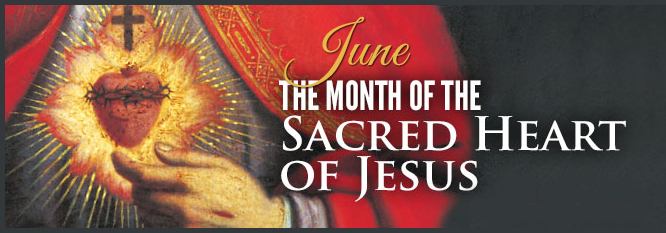
“Heart of Jesus, grant to all those who shall communicate on the first Friday, nine months consecutively, the grace of final perseverance and the Sacraments at death.” – St. Margaret Mary Alacoque
1 Samuel 25:32, 33; Matthew 5:7
Blessed be the LORD, the God of Israel,
who has sent you to me today.
– You have held me back today from shedding blood
and from taking revenge into my own hands.
Blessed are the merciful;
they shall obtain mercy.
– You have held me back today from shedding blood
and from taking revenge into my own hands.
Friday of the Twelfth Week in Ordinary Time
Commemoration of St. Paul, Apostle (Traditional)
The First Martyrs of the Holy Roman Church
The First Martyrs of the Holy Roman Church
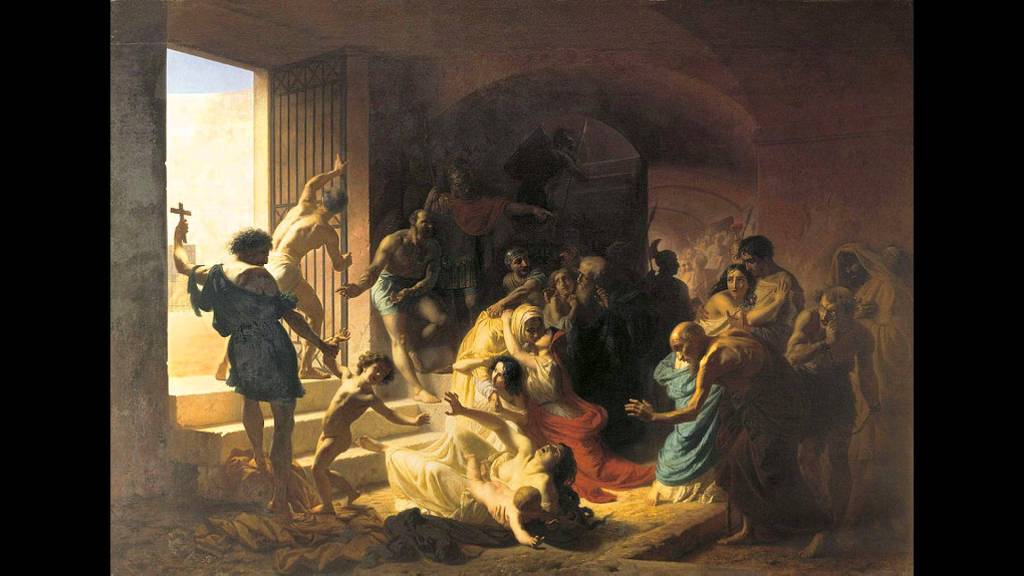
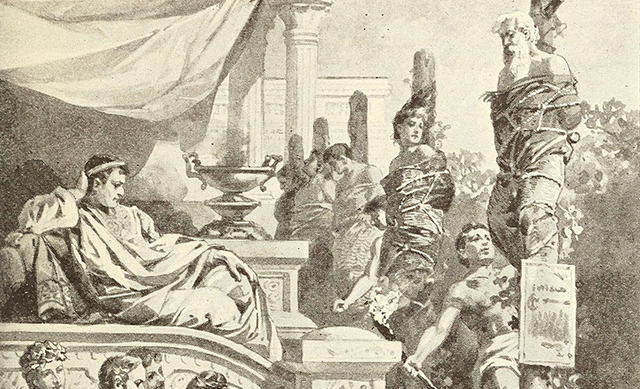
Within twenty years after Christ died, the Gospel had reached the centre of the Empire. A small community of converts gathered in Rome. In July of the year 64, a fire broke out in the city and spread rapidly in the summer heat. Within ten days, two-thirds of the city was destroyed. Suspicions of arson centred on the Emperor Nero himself, who was composing an epic poem while the city burned. Notoriously brutal and unbalanced, Nero fixed the blame on the Christians. He had them arrested, interrogated, and then murdered for his personal entertainment. Tertullian’s famous saying aptly describes the impact of their witness: “The blood of the martyrs is the seed of Christians.”
This memorial is in honour of the nameless followers of Christ brutally killed by the mad Emperor Nero as scapegoats for the fire in Rome. The pagan historian Tacitus and Saint Clement of Rome tell of a night of horror (15 August, 64 A.D.) when in the imperial parks Christians were put into animal skins and hunted, were brutally attacked, and were made into living torches to light the road for Nero’s chariot. From 64 to 314 “Christian” was synonymous with “execution victim.”
COMMEMORATION OF ST. PAUL, APOSTLE
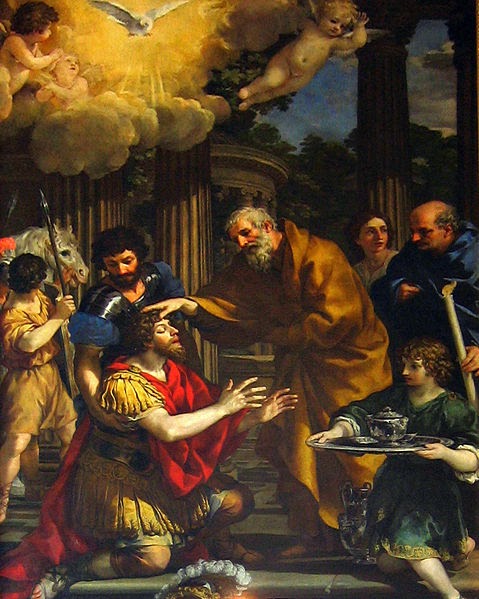
Saul of Tarsus was first a great persecutor and made havoc of the infant church. Miraculously converted, he began his three great Apostolic Voyages, and wrote his Epistles. After a captivity of two years in Cæsarea, he came to Rome, and travelled to that part of the church situated beyond Italy. He was beheaded in 65 A.D.
As June 29 is mainly devoted to the honouring of Saint Peter, this day is assigned as the special feast of Saint Paul. The Mass of today, according to ancient Roman traditions, was that of the second station of yesterday. As Saint Peter still lives and governs through his successors, so does Paul continue to preach the Gospel every day throughout the world, by means of his writings, which the Church reads almost invariably at Holy Mass. The Acts and the Epistles tell us enough about the life of Paul, to give us a rule and model of what a truly pastoral, and Apostolic life should be. On this model, under the rule of Saint Benedict for more than 1400 years, the disciples of the patriarch of Monte Cassino have lived in a monastery in the shadow of the Basilica, and carried on the Divine Office.
From a letter written to the Corinthians by Saint Clement I, Pope and Martyr
(Cap 5, 1-7, 4; Fink 1, 67-71)
Though victims of jealousy, they gave the finest example
Let us leave behind the examples from times of old, and come to those who struggled closest to us; let us consider the noble models of our own generation. It was through jealousy and envy that the greatest and most upright pillars of the Church were persecuted and struggled unto death. Let us set before our eyes the good apostles. First of all, Peter, who because of unreasonable jealousy, suffered not merely once or twice but many times, and, having thus given his witness, went to the place of glory that he deserved. It was through jealousy and conflict that Paul showed the way to the prize for perseverance. He was put in chains seven times, sent into exile, and stoned; a herald both in the East and the West, he achieved a noble fame by his Faith. He taught justice to all the world and, when he had reached the limits of the western world, he gave his witness before those in authority; then he left this world and was taken up into the holy place, a superb example of endurance.
Around these men with their holy lives gathered a great throng of the elect, who, though victims of jealousy, gave us the finest example of endurance in the midst of many indignities and tortures. Through jealousy women were tormented like Dirce or the daughters of Danaus, suffering terrible and unholy acts of violence. But they courageously finished the course of Faith and despite their bodily weakness won a noble prize. It was jealousy that separated wives from husbands, and violated the words of our father Adam: This is now bone of my bone and flesh of my flesh. Jealousy and strife have overthrown great cities and uprooted mighty nations.
We are writing this, beloved, not only for your admonition but also as a reminder to ourselves; for we are placed in the same arena, and the same contest lies before us. Hence we ought to put aside vain and useless concerns and go straight to the glorious and venerable norm which is our Tradition, and we should consider what is good, pleasing and acceptable in the sight of Him who made us. Let us fix our gaze on the Blood of Christ, realizing how precious it is to His Father, since it was shed for our salvation and brought the grace of repentance to all the world.
“Of course I want to!”
Here is a good thought that is not often mentioned: receive Communion not only for yourself, in order to have this immense Grace, but for Jesus, in order to respond to His desire to come down into you, to give Him the joy of descending into your heart, which is a heaven for Him. Perhaps you will say, “What? My poor heart, so miserable, so unworthy, a heaven for Jesus?” Yes, if you call upon Him to make your heart a heaven for Him.
Here we must remember that sensible love is nothing in itself. It could be that before and after Communion you will be cold and distracted. But listen to little Thérèse: “I cannot say that I have often received consolations during my thanksgivings [after Communion]; that is perhaps the moment when I have had the fewest. I find that completely natural, since I have offered myself to Jesus, not as a person who desires to receive His visit for my own consolation, but on the contrary, for the pleasure of Him who gives Himself to me. It is not in order to remain in the golden ciborium that He comes down each day from Heaven, but in order to find another heaven, the heaven of our souls, made in His image, the Living Temple of the adorable Trinity.”
A Lamb—a Being even more gentle than a lamb—invites you to receive Him and takes away all your sins. LORD, I am not worthy to receive you, but speak only a word, a single word, and I shall be purified—my soul, my heart—by this word which You have spoken, and I will become truly a heaven for You. These words, “Behold the Lamb of God, who takes away sins”, and “I am not worthy, but speak only a Word”, are the most beautiful, the most complete preparation for Communion. Here we see the incomparable richness and depth of the liturgical prayers. They say everything, as long as we recognise their full sense with Faith and Love.
If you only knew how Jesus hungers for you, how He burns with desire to come into your heart, how impatient He is to come down to you, bridging all distance between you and Him! So go to Him; respond to His desire. Desiderio desideravi: “I have desired with a great desire to eat this Pasch with you. I thirst, I thirst for you to come to me; I thirst to come down into you” (cf. Lk 22:15). Never deprive Him of this happiness through your own fault. The most beautiful morning prayer, on days when you have not been able to receive Communion because of work or health, is a Spiritual Communion. Renew in the course of your day this act of real and intimate union with him who is the Bread of Life: our daily bread in Holy Communion. Live in a state of Spiritual Communion.
Father Jean du Cœur de Jésus d’Elbée
Father d’Elbée († 1982) was a French priest and spiritual author. He was a member of the Congregation of the Sacred Hearts of Jesus and Mary. [From O Jesus: Prayers from the Diaries of Catherine de Hueck Doherty.
DAILY MEDITATION
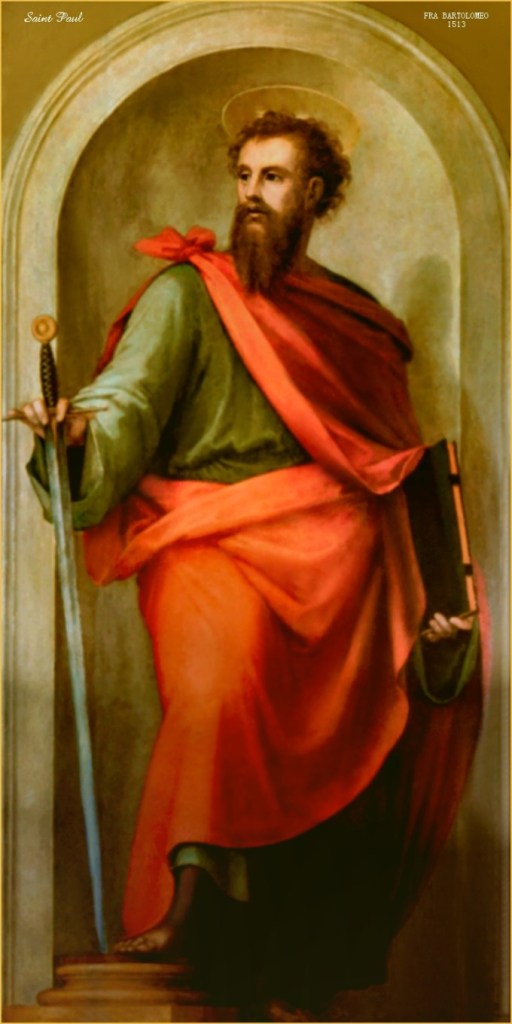
Saint Paul preached the Gospel everywhere with great ardour, journeyed through many cities, lands, and kingdoms, brought many thousands to Christianity, and sent many apostolic men into different countries to convert the inhabitants. Who can give an account of his cares and the labours, the disgrace and derision, the misery and persecution, which he suffered for the true Faith? … “I am ready,“ said he, “ not only to be bound in Jerusalem, but also to die for the name of Jesus” [Acts of the Apostles, 21:13].
He proved his words by deeds. When he arrived at Jerusalem, he immediately went into the temple to pray, but hardly had the Jews seen him, when they fell upon him, dragged him out of the temple, and would certainly have killed him with their blows had not the tribune, Claudius Lysias, hastily appeared with his soldiers and released him from their fury. He, however, took him prisoner and sent him to Caesarea to the governor Felix, who, although he found him innocent, kept him in prison. Festus, his successor, would have sent him back to Jerusalem, that he might be judged there, but Paul appealed to the emperor, and was sent to Rome, where, after two years of imprisonment, he was set at liberty. The Saint then began again his apostolic labours, travelled through Italy, and France, ventured even to Spain, preaching the Gospel everywhere and converting a great number of people. But why did God show such mercy to Paul? The apostle himself replies: “But for this cause have I obtained mercy; that in me first, Christ Jesus might show forth all Patience for the information of them that shall believe in Him unto Life Everlasting“ [1, Timothy 1:16]. God would place an example of His mercy before the eyes of men, and make known that no one is so great a sinner that he may not be converted and receive pardon for his iniquities. And let this, my reader, be today in lesson for you.
Fr. Francis Xavier Weninger [died 1888] – Austrian priest, professor, and also; joined the Jesuits as missionary preacher to the United States.
“The refusal to take sides on great moral issues is itself a decision. It is a silent acquiescence to evil. The tragedy of our time is that those who still believe in honesty lack fire and conviction, while those who believe in dishonesty are full of passionate conviction.” – Ven. Archbishop Fulton Sheen
 Daily Reflections
Leave a comment