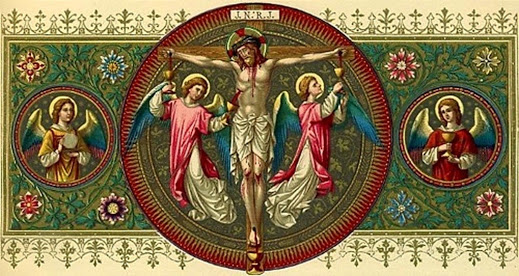
First Saturday of the Blessed Virgin Mary
Saturday of the Twelfth Week in Ordinary Time
The Feast of the Most Precious Blood of Our LORD Jesus Christ
First Saturday of the Blessed Virgin Mary
St. Oliver Plunket, (England, Ireland)
Junípero Serra, Priest (USA)
Three disguised angels recline with Abraham at table. When the elderly Sarah hears the angelic messenger announce that in a year she will give birth to a son she is incredulous (Book of Genesis 18:1-15). The centurion is the opposite. He is waiting on the word of Jesus, fully believing that He can restore life to the dying (Mt 8:5-17). It is by this “word” that Jesus drove out evil spirits and cured “all who were sick”.
FEAST OF THE MOST PRECIOUS BLOOD OF OUR LORD JESUS CHRIST
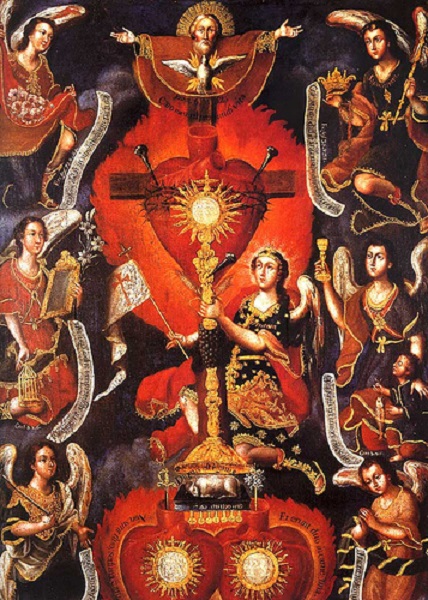
In the Liturgical reform of Pope Pius X, this day was chosen for the feast of the Most Precious Blood, which had already been fixed under Pius IX for the first Sunday in July. Pius IX instituted this feast in thanksgiving for the deliverance of the Apostolic See from the violent revolutionaries who had expelled the Pope to Greta. In 1849, with the assistance of the French army, they were vanquished and the Pope was able to return to Rome.
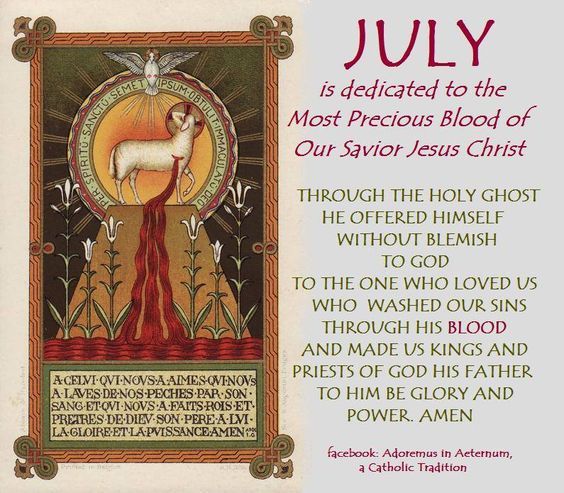
The meaning of this festival is closely akin to that of the Sacred Heart. The Precious Blood is the price of universal redemption, which love would not have to be anything less than itself. There is a very close connection between the Heart and the Blood not only because, according to Saint John, after the Death of Jesus, blood and water flowed from His wounded Heart, but because the first chalice in which that Divine Blood was consecrated, and vivified, was precisely the Heart of the Incarnate Word.
The apostle of this special devotion was the Blessed Gaspare, Del Bufalo, founder of the congregation of the Most Precious Blood. The Holy Mass is quite recent composition. In the ancient Roman Rite the Mass of Passion Sunday was especially intended to recall to the remembrance of the faithful the infinite value of the Blood of Jesus Christ.
FIRST SATURDAY OF THE BLESSED VIRGIN MARY
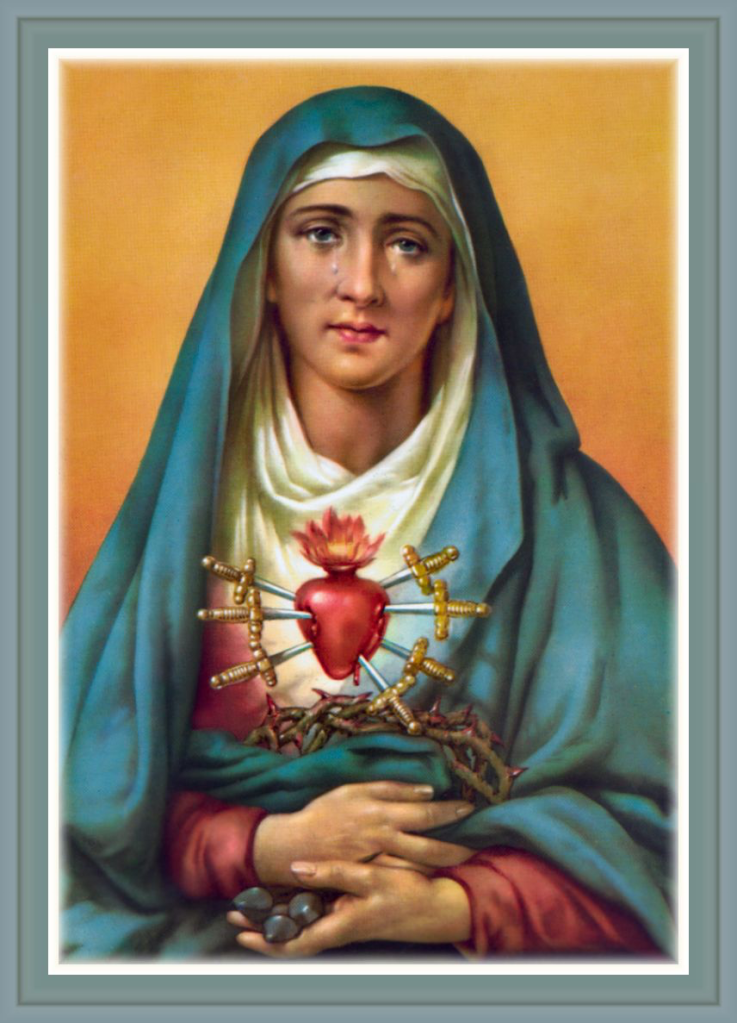
Making Reparation to the Immaculate Heart of Mary
In the Five First Saturdays Devotion
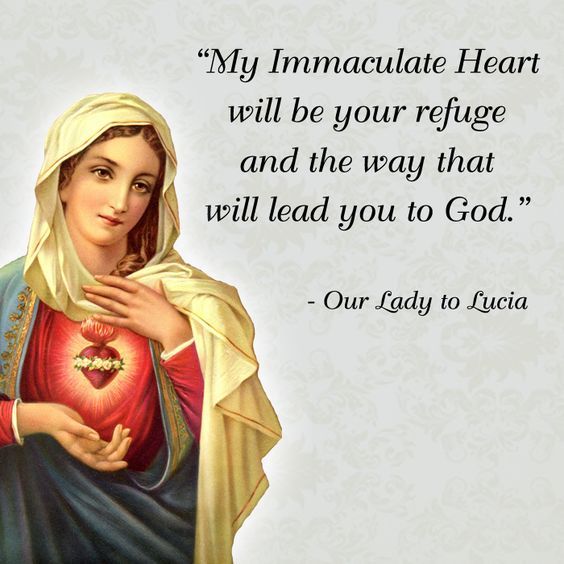
“Look, My daughter, at My Heart, surrounded with thorns with which ungrateful men pierce Me at every moment by their blasphemies and ingratitude. Do you, at least, try to console Me and announce in My name that I promise to assist at the moment of death, with all the graces necessary for salvation, all those who, on the first Saturday of five consecutive months shall confess, receive Holy Communion, recite five decades of the Rosary, and keep Me company for fifteen minutes while meditating on the fifteen mysteries of the Rosary, with the intention of making reparation to Me.”
(Revelation of Our Lady of Fatima to Sr. Lucia)
We cannot imagine the power of the First Saturdays Devotion to console Our Lady for the terrible blasphemies and ingratitude which She endures at every moment, piercing Her Immaculate Heart like cruel thorns. Your fervent Communion of Reparation to the Immaculate Heart of Mary on the First Saturday of each month will bring tremendous graces and mercies to our desperate world, not only for the conversion of sinners, but even to bring an end to the punishments that are falling so heavily upon us for the unprecedented crimes of the world today!
SAINT OLIVER PLUNKET, BISHOP
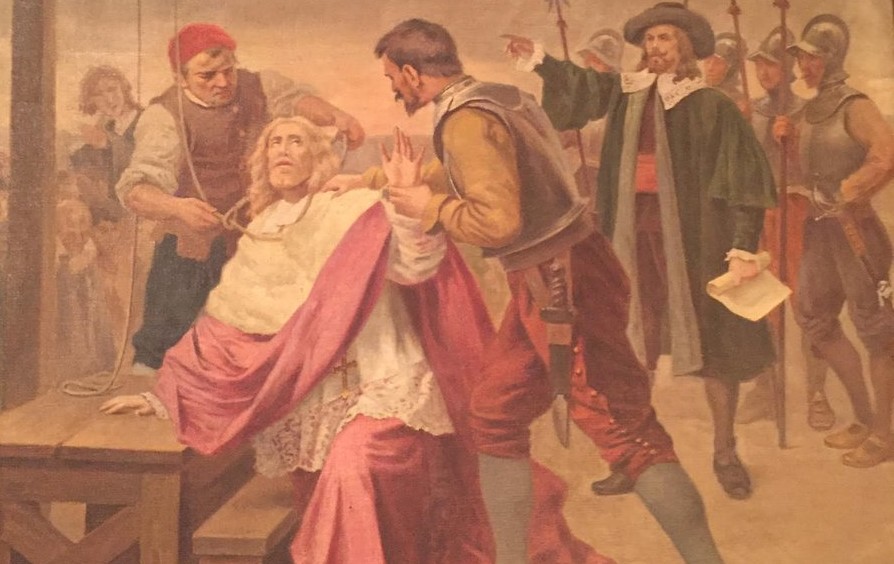
Saint Oliver Plunket (1625–1681) was born in Loughcrew, County Meath, and was related to several aristocratic families. After studying at the Irish College in Rome, he was ordained a priest in 1654 and stayed in Rome as a professor and a representative of the Irish Bishops. In 1669 he was appointed Archbishop of Armagh and Primate of All Ireland. He did much to reorganise and strengthen the Irish Church, despite being forced into hiding for much of his episcopate. Arrested in 1679 at the time of the “Popish Plot”, he was hanged, drawn, and quartered in London on 1 July 1681: the last Catholic martyr to suffer in England. His body is enshrined in Downside Abbey in Somerset, while his head is at St Peter’s, Drogheda.
SAINT JUNÍPERO SERRA, PRIEST
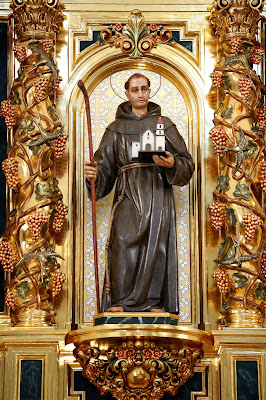
Junípero Serra was born on 24 November 1713 on the island of Majorca and was given the name Peter. He entered the Order of the Friars Minor at Palma in 1730 and, after completing his studies, was ordained to the priesthood in 1736. In April of 1749, he began his missionary work and went to México, where he preached the Gospel to the native peoples and founded missions. He entered California on 1 July 1767 where he proceeded to found nine missions along the California coast from San Diego to San Francisco. He died in Monterey on 28 August 1784 and is buried in the mission church of Saint Charles Borromeo, which he founded. He was canonized in Washington D.C. by Pope Francis on 23 September 2015.
From a homily by Saint Gregory of Nyssa, Bishop
(Orat. 6 De beatitudinibus: PG 44, 1270-1271)
God can be found in man’s heart
In our human life bodily health is a good thing, but this blessing consists not merely in knowing the causes of good health but in actually enjoying it. If a man eulogizes good health and then eats food that has unhealthy effects, what good is his praise of health when he finds himself on a sickbed? Similarly, from the LORD’s saying: Blessed are the pure of heart, for they shall see God, we are to learn that blessedness does not lie in knowing something about God, but rather in possessing God within oneself.
I do not think these words mean that God will be seen face to face by the man who purifies the eye of his soul. Their sublime import is brought out more clearly perhaps in that other saying of the LORD’s: The Kingdom of God is within you. This teaches us that the man who cleanses his heart of every created thing and every evil desire will see the image of the Divine nature in the beauty of his own soul. I believe the lesson summed up by the Word in that short sentence was this: You men have within you a desire to behold the supreme good. Now when you are told that the majesty of God is exalted above the Heavens, that His Glory is Inexpressible, His Beauty Indescribable, and His Nature Transcendent, do not despair because you cannot behold the object of your desire. If by a diligent life of virtue you wash away the film of dirt that covers your heart, then the Divine beauty will shine forth in you.
Take a piece of iron as an illustration. Although it might have been black before, once the rust has been scraped off with a whetstone, it will begin to shine brilliantly and to reflect the rays of the sun. So it is with the interior man, which is what the LORD means by the heart. Once a man removes from his soul the coating of filth that has formed on it through his sinful neglect, he will regain his likeness to his Archetype, and be good. For what resembles the Supreme Good is itself good. If he then looks into himself, he will see the vision he has longed for. This is the blessedness of the pure in heart: in seeing their own purity they see the Divine Archetype mirrored in themselves.
Those who look at the sun in a mirror, even if they do not look directly at the sky, see its radiance in the reflection just as truly as do those who look directly at the sun’s orb. It is the same, says the LORD, with you. Even though you are unable to contemplate and see the Inaccessible Light, you will find what you seek within yourself, provided you return to the beauty and grace of that image which was originally placed in you. For God is Purity; He is free from sin and a stranger to all evil. If this can be said of you, then God will surely be within you. If your mind is untainted by any evil, free from sin, and purified from all stain, then indeed are you blessed, because your sight is keen and clear. Once purified, you see things that others cannot see. When the mists of sin no longer cloud the eye of your soul, you see that blessed vision clearly in the peace and purity of your own heart. That vision is nothing else than the holiness, the purity, the simplicity and all the other glorious reflections of God’s nature, through which God Himself is seen.
John 14:6, 9; 6:47
The LORD said:
I am the Way, the Truth, and the Life.
– Anyone who has seen Me has seen the Father.
Whoever believes in Me has Eternal Life.
– Anyone who has seen Me has seen the Father.
“The refusal to take sides on great moral issues is itself a decision. It is a silent acquiescence to evil. The tragedy of our time is that those who still believe in honesty lack fire and conviction, while those who believe in dishonesty are full of passionate conviction.” – Ven. Archbishop Fulton Shee
 Daily Reflections
Leave a comment