
Genesis 49:10, 8
The royal sceptre shall not pass from Judah,
nor the kingly mace from between his feet.
– until the coming of the One I have promised you;
He will be the desire of the nations.
Your brothers shall praise you;
your father’s sons shall bow down in worship before you.
– Until the coming of the One I have promised you;
He will be the desire of the nations.
Tuesday of the Thirteenth Week in Ordinary Time
Saint Elizabeth of Portugal, Queen, Widow
SAINT ELIZABETH OF PORTUGAL, QUEEN, WIDOW
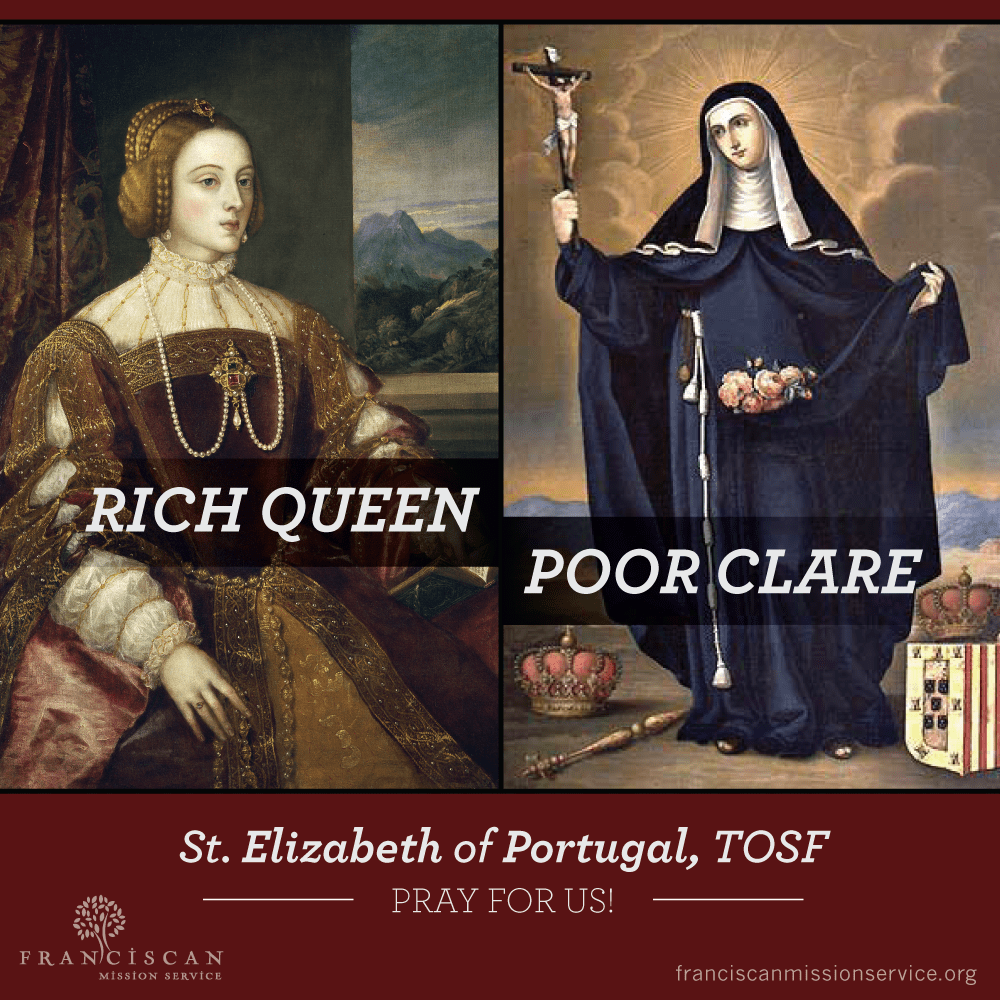
Elizabeth, daughter of Spanish monarchs, is usually depicted in royal garb with a dove or an olive branch. At her birth in 1271, her father Pedro III, future king of Aragon, was reconciled with his father James, the reigning monarch. This proved to be a portent of things to come. Under the healthful influences surrounding her early years, she quickly learned self-discipline and acquired a taste for spirituality.
Thus fortunately prepared, Elizabeth was able to meet the challenge when at the age of 12, she was given in marriage to Denis, king of Portugal. She was able to establish for herself a pattern of life conducive to growth in God’s love, not merely through her exercises of piety, including daily Mass, but also through her exercise of charity, by which she was able to befriend and help pilgrims, strangers, the sick, the poor — in a word, all those whose need came to her notice. At the same time she remained devoted to her husband, whose infidelity to her was a scandal to the kingdom.
Denis, too, was the object of many of her peace endeavours. Elizabeth long sought peace for him with God, and was finally rewarded when he gave up his life of sin. She repeatedly sought and effected peace between the king and their rebellious son Alfonso, who thought that he was passed over to favour the king’s illegitimate children. She acted as peacemaker in the struggle between Ferdinand, king of Aragon, and his cousin James, who claimed the crown. And finally from Coimbra, where she had retired as a Franciscan tertiary to the monastery of the Poor Clares after the death of her husband, Elizabeth set out and was able to bring about a lasting peace between her son Alfonso, now king of Portugal, and his son-in-law, the king of Castile.
Elizabeth died in 1336 and is the patroness of Catholic charities.
Courtesy of Franciscan Media. All Rights Reserved
From a sermon by Saint Peter Chrysologus, Bishop
(De pace: PL 52, 347-348)
Blessed are the peacemakers
Blessed are the peacemakers, the evangelist said, dearest brethren, for they shall be called the sons of God. Truly Christian Virtues grow in a man who enjoys the unchangeable possession of Christian Peace, nor does one come to the title of son of God except through that of peacemaker.
Peace, dearest brethren, rescues man from servitude, provides him with the name of a free man, changes his identity before God together with his condition, from a servant to a son, and from a slave to a free man. Peace among brethren is the Will of God, the joy of Christ, the completion of holiness, the rule of justice, the teacher of Truth, the guardian of morals and a praiseworthy discipline in every regard. Peace lends strength to our prayers; it is the way our petitions can reach God easily and be credited; it is the plenitude which fulfills our desires. Peace is the mother of love, the bond of concord and the manifest sigh of a pure soul, one which seeks to please God, which seeks to be fulfilled and has its desire rewarded. Peace must be preserved according to the LORD’s precepts, as Christ said: I leave you Peace, My Peace I give you, that is, as I left you in peace, in peace shall I find you. As Christ left the world, He wished to leave the gift He wanted to find when He returned.
We have a Commandment from Heaven to retain His gift; His one word is: “I shall find what I left.” God’s is the planting of peace in the root, but the uprooting is from the enemy; for, just as brotherly love comes from God, so hatred comes from the devil; therefore, we must condemn our hatred of men, for it is written: He who hates his brother is a murderer.
Now you see, dearest brethren, why we should love peace and cultivate harmony: because they beget and nurture love. But you know also from the apostle John that, Love comes from God, and that whoever is not with God does not possess love.
Let us therefore, my brethren, keep the Commandments, which are life for us; let us carry on together the obligations of our brotherhood in profound peace; let us bind one another with the ties of salvific charity in this mutual love which covers a multitude of sins. Love ought to be embraced with the grasp of all our desires, since the goods it provides amount to as many rewards. We must keep peace before all other virtues, since God is always in peace.
Love peace, and all the world will be tranquil and quiet. By doing so you store up rewards for me, and joy for yourselves, that the Church of God may be founded on the bond of Peace and may cling to perfect observance in Christ.
The Storm as Symbol of “Fearful Expectation”
There are two messages today: first, we have to hold on to absolute responsibility for real order and commitment to the LORD God. Second, the fundamental character of life is a true waiting, hard for Occidentals [people of the West] to comprehend, especially for modern people. Life means waiting, not Faust-like grasping, but waiting and being ready. We are waiting for the terror of the night, and waiting for the day when this terror will have passed. “The people will languish from fearful expectation.” Anyone who remains stuck, waiting in fearful expectation just to see whether or not he will survive, has not yet laid bare the innermost strata. For the fearful expectation was sent to us in order to remove our false sense of security and behind it is this other metaphysical waiting that is part of existence. Man is always in danger of rooting himself, of running aground. Over and over again, life will shake anyone who only waits in that way, in order to make him hurry out to meet what is coming. Then what vitality he has been given will come to life. Then he will feel that life goes above and beyond individual lives. Only in this way will he be truly human, by living above and beyond himself, waiting for the final reality. That is the reason for this striving and seeking further and knowing it will one day come: to wait until the lights flare up.
We have more expectation than earth can grant, because what we encounter is only a piece of reality, a piece of creation. We are waiting for the fulfillment of a promise: You will one day possess all this because God, as God, is himself reality, realness, and intimacy.
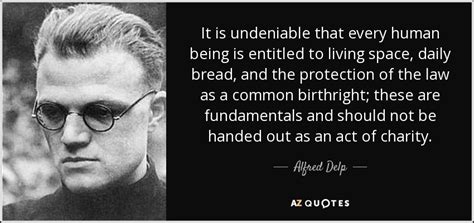
Father Alfred Delp, s.j.
Father Delp († 1945) was a German member of the Society of Jesus involved with youth work and on the editorial team of the Jesuit publication Stimmen der Zeit (Voice of the Times), until it was suppressed in 1941. He was executed during World War II for his resistance to the Nazi regime. [From Advent of the Heart, Seasonal Sermons and Prison Writings, 1941-1944. Abtei St. Walburg, Tr.
Isaiah 58:7-8
Share your bread with the hungry,
and take the poor and homeless into your own house.
– Then your light will break forth like the dawn
and your holiness will go before you.
When you see a man who is naked, clothe him,
and do not scorn your brother.
– Then your light will break forth like the dawn
and your holiness will go before you
“The refusal to take sides on great moral issues is itself a decision. It is a silent acquiescence to evil. The tragedy of our time is that those who still believe in honesty lack fire and conviction, while those who believe in dishonesty are full of passionate conviction.” – Ven. Archbishop Fulton Sheen
 Daily Reflections
Leave a comment