RESPONSORY
Prayer of Manasseh 9, 10; Psalm 51:5, 6
My sins are more numerous than the sands of the sea,
and my transgressions are many.
I am not worthy to raise my eyes to the height of Heaven because of my countless offences;
for I have provoked Your anger,
– and I have done evil in Your Presence.
I know my faults,
and my sin is ever before me,
because I have sinned against You alone.
– And I have done evil in Your Presence.
Fourteenth Sunday in Ordinary Time
Sixth Sunday after Pentecost (Traditional)
St. Augustine Zhao Rong, Priest and Companions, Martyrs
Jesus declares (Mt 11: 25-30), “Everything has been entrusted to Me by My Father.” The pinnacle of this is the handing over of “the Spirit of Him who raised Jesus from the dead”. Jesus assures us that what the Father has handed over to Him is the ability to console those “who labour and are overburdened”. The secrets of Heaven are revealed “to mere children”, because they are not tempted to rely on themselves. Children remain open to receiving all that God is so eager to give them. They “rejoice heart and soul” and “shout with gladness” at the coming of our meek King whose very presence proclaims “peace for the nations”.
SIXTH SUNDAY AFTER PENTECOST
Holy Church reminds us today of the effects of two great Sacraments: Baptism and the Eucharist, which she has conferred at Easter and Pentecost.
In the Epistle, Romans 6:3-11, dead to sin, we have been plunged and buried with Jesus in the baptismal water. Christ atoned for our sins by dying on the Cross, and our old man [our evil nature] was crucified with Him. After the Resurrection, Christ walks in a new Life: we must also walk in newness of life.
In the Gospel, [Mark 8:1–9], Jesus, miraculously feeds 4000 men: He foreshadows how He will feed the souls of men by means of the Holy Sacrament, the True Bread from Heaven.
SAINT AUGUSTINE ZHAO RONG, PRIEST AND COMPANIONS, MARTYRS
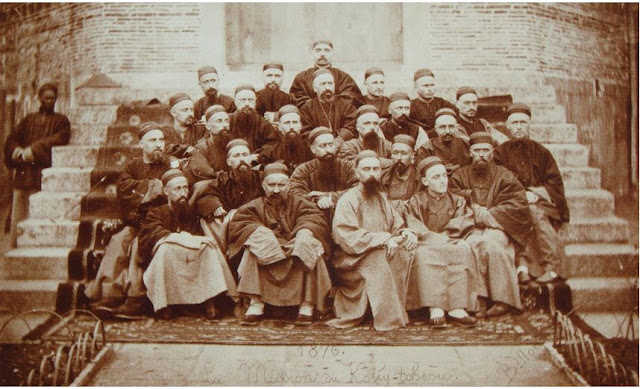

St. Augustine Zhao Rong and his 119 companions are also called the Martyr Saints of China. Most of them (87) were Chinese natives and were children, parents, catechists or labourers, ranging from nine years of age to seventy-two. This group included four Chinese priests. The thirty-three foreign-born martyrs were mostly priests or women religious, especially from the Order of Preachers, including Saint Francis Capillas (+ 15 January 1648), protomartyr of China), the Paris Foreign Mission Society, the Friars Minor, Jesuits, Salesians, and Franciscan Missionaries of Mary. Rong was a Chinese soldier who accompanied the prisoner John Gabriel Taurin Dufresse (Paris Foreign Mission Society) to his martyrdom in Beijing. Moved by the Bishop’s courage, Augustine sought Baptism and not long after was ordained a diocesan priest. He was martyred in 1815. Beatified in groups at various times, these 120 martyrs were canonized 1 October 2000 by Pope Saint John Paul II.
From a sermon by Saint Augustine, Bishop and Doctor of the Church
(Serm. 19,2-3: CCL 41, 252-254)
A Sacrifice to God is a Contrite Spirit
I acknowledge my transgression, says David. If I admit my fault, then You will pardon it. Let us never assume that if we live good lives we will be without sin; our lives should be praised only when we continue to beg for pardon. But men are hopeless creatures, and the less they concentrate on their own sins, the more interested they become in the sins of others. They seek to criticize, not to correct. Unable to excuse themselves, they are ready to accuse others. This was not the way that David showed us how to pray and make amends to God, when he said: I acknowledge my transgression, and my sin is ever before me. He did not concentrate on others’ sins; he turned his thoughts on himself. He did not merely stroke the surface, but he plunged inside and went deep down within himself. He did not spare himself, and therefore was not impudent in asking to be spared.
Do you want God to be appeased? Learn what you are to do that God may be pleased with you. Consider the Psalm again: If You wanted sacrifice, I would indeed have given it; in burnt offerings You will take no delight. Are you then to be without sacrifice? Are you to offer nothing? Will you please God without an offering? Consider what you read in the same Psalm: If You wanted sacrifice, I would indeed have given it; in burnt offerings You will take no delight. But continue to listen, and say with David: A sacrifice to God is a contrite spirit; God does not despise a contrite and humble heart. Cast aside your former offerings, for now you have found out what you are to offer. In the days of your fathers you would have made offerings of cattle — these were the sacrifices. If you wanted sacrifice, I would indeed have given it. These then, LORD, You do not want, and yet You do want sacrifice.
You will take no delight in burnt offerings, David says. If You will not take delight in burnt offerings, will You remain without sacrifice? Not at all. A sacrifice to God is a contrite spirit; God does not despise a contrite and humble heart.
You now have the offering you are to make. No need to examine the herd, no need to outfit ships and travel to the most remote provinces in search of incense. Search within your heart for what is pleasing to God. Your heart must be crushed. Are you afraid that it might perish so? You have the reply: Create a clean heart in me, O God. For a clean heart to be created, the unclean one must be crushed.
We should be displeased with ourselves when we commit sin, for sin is displeasing to God. Sinful though we are, let us at least be like God in this, that we are displeased at what displeases Him. In some measure then you will be in harmony with God’s Will, because you find displeasing in yourself what is abhorrent to your Creator.
Meek and Humble of Heart
Learn from Me, for I am meek and humble of Heart, and you will find rest for your souls. Our LORD is pleased to sum up in these two words, humility of heart and meekness, the whole Christian life and the whole of perfection. There is a very profound reason for this: humility is the root of all Christian Virtues, and meekness is its flower…. The practice of these two virtues, united to a fervent daily Communion, will make Charity, together with the gifts of the Holy Spirit and union with God, increase in us more every day. The Sacrament of Love—the most excellent of all—is the Sacrament of the most intimate union: it contains Jesus Christ in person, while the other Sacraments contain only His Supernatural power and are ordered to the Eucharist as to their end. Communion is, therefore, the most perfect act of the interior life, and if we prepare ourselves for it with humility, zeal, and meekness, we shall find there the most efficacious means for union with God. While our body receives the Body of Christ, our soul is united to His Soul, our intelligence to His Light, our heart to the ever-burning sun of His Love. Our LORD unites Himself to us to assimilate us to Himself, to make of us other Christs.
Every Communion that is not sacrilegious and sterile increases the degree of Charity in us. Who then can measure the effects of daily Communion, above all of fervent daily Communion? If in Holy Communion we learn meekness and humility from the Divine Master, together with zeal for the Glory of God and the salvation of souls, we will find refreshment for our souls according to Jesus’ Promise. We will find an orderly peace and tranquility; we will realise a harmony of soul which, when fully subject to God, will receive His vivifying influence; there will be a harmony of body and soul, of the senses and the spirit. We will find peace and will be able to give it to others….
LORD, give us the zeal with which Your Sacred Heart burns; give us also a profound humility that makes us always adhere to You more while we become detached from ourselves; give us the meekness that will make souls accept what we say to them for the Glory of Your Father and for their own salvation. Grant us a more intimate union with Your Sacred Heart present in the Eucharist, and guide us towards that wholly Divine configuration that will make us Your brothers and sisters for Eternity.
Father Reginald Garrigou-Lagrange, o.p.
Father Garrigou-Lagrange († 1964) was a prolific Dominican theologian and spiritual writer. He was the theology doctoral advisor of the future Saint John Paul II. [From Knowing the Love of God: Lessons from a Spiritual Master Raymond Smith, o.p., and Rod Gorton, Trs.
DAILY MEDITATION
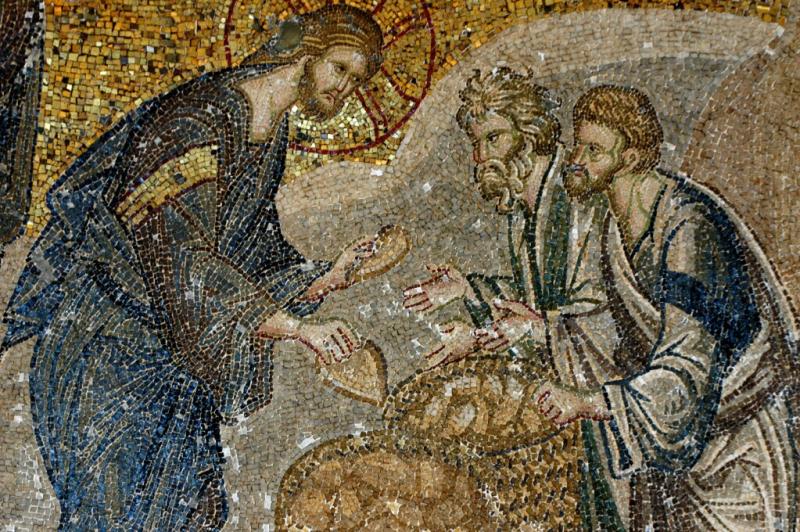
The first miraculous multiplication of bread immediately preceded the Eucharistic discourse at Capernaum, and was obviously intended by Our LORD to lead the thought of the Jews, toward the Heavenly Bread, which He was about to promised them. The second multiplication of bread closely resembles the first in what we might call its ritual details, and thus also inevitably points to the Eucharistic Bread. The special thought, suggested by the miracle and its setting. In today’s Gospel is that of the Blessed Eucharist, as Viaticum — as the food of viatores, as the sustenance of wayfarers, whose way leads through the desert of life.
We, like the people who thronged around Our LORD in the Decapolis, have far to go to our spiritual home. Our wave passes through a desert region, where there is little protection from “the arrow that flieth by day,” and “the demon’s attack at the noontime“ [Ps 90:6]. As the people were exposed to the burning sun of July, in the desert region of the Decapolis, so we wayfarers are exposed to the fiery glow of passion — to the destructive heat of anger, hatred, jealousy, impurity, and all the other fierce movements of passion that constitute the “demon’s attack at the noontime.” Our path is beset by difficulties, for there is no highway through the desert. Besides, the difficulties that come from ourselves, there are the myriad hindrances from others, and there are the innumerable seductions and distractions of worldliness.
Our way then through the desert is long and beset with obstacles of every kind, and as we go forward, the difficulties seem to increase.
Without a Heavenly sustenance, we should certainly break down on the way. But in His great mercy and compassion, Our LORD has devised for us the Sacrament of His Love… only those who frequently receive the Bread of Heaven can fully realize what a miracle of sustenance and strength is contained therein, what is serenity of soul, what is strength of Will it’s supplies!
Dom Eugene Boylan [d. 1964], Irish Cistercian author, retreat master, and Abbot of Mount St. Joseph, and Roscrea
RESPONSORY
My sins, O LORD, have pierced me through like arrows;
but before they wound me,
– heal me, O God, with the ointment of repentance.
Create a clean heart in me, O God,
and put a new and steadfast spirit within me.
– Heal me, O God, with the ointment of repentance.
“The refusal to take sides on great moral issues is itself a decision. It is a silent acquiescence to evil. The tragedy of our time is that those who still believe in honesty lack fire and conviction, while those who believe in dishonesty are full of passionate conviction.” – Ven. Archbishop Fulton Sheen
 Daily Reflections
Leave a comment