1 Chronicles 22:19; Psalm 132:7; Isaiah 56:7
Offer your hearts and souls in seeking the LORD;
rise up and build a sanctuary for the LORD your God.
– Let us enter into His dwelling place;
let us worship at His footstool.
The LORD said: My House shall be called a House of Prayer for all the nations.
– Let us enter into His dwelling place;
let us worship at His footstool.
Thursday of the Fourteenth Week in Ordinary Time
Feria in Pentecost (Traditional)
Saint Henry, Emperor, Confessor
SAINT HENRY, EMPEROR, CONFESSOR
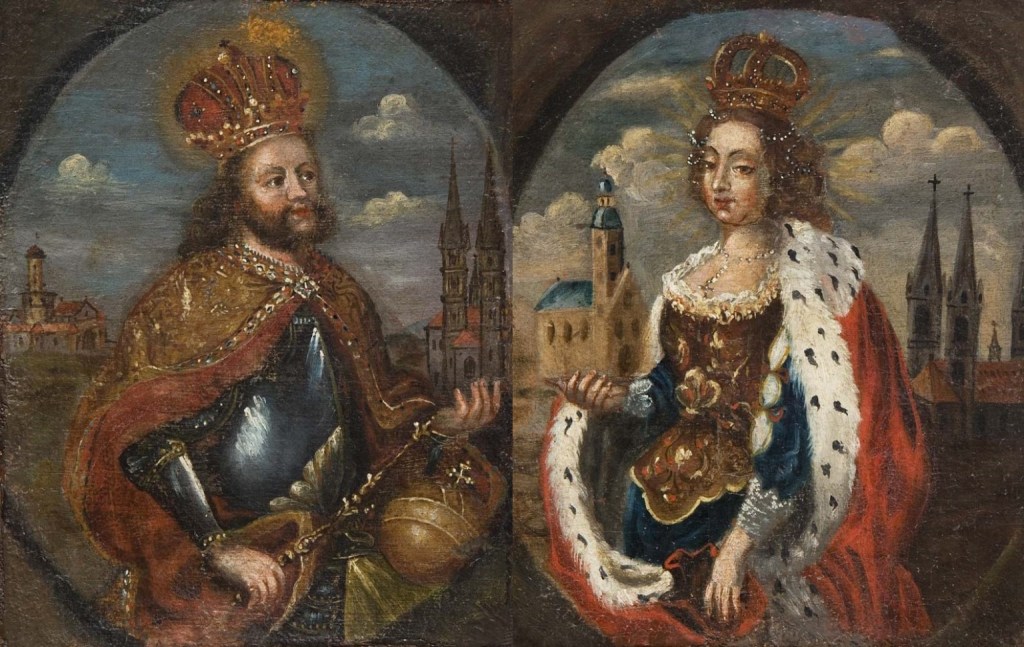
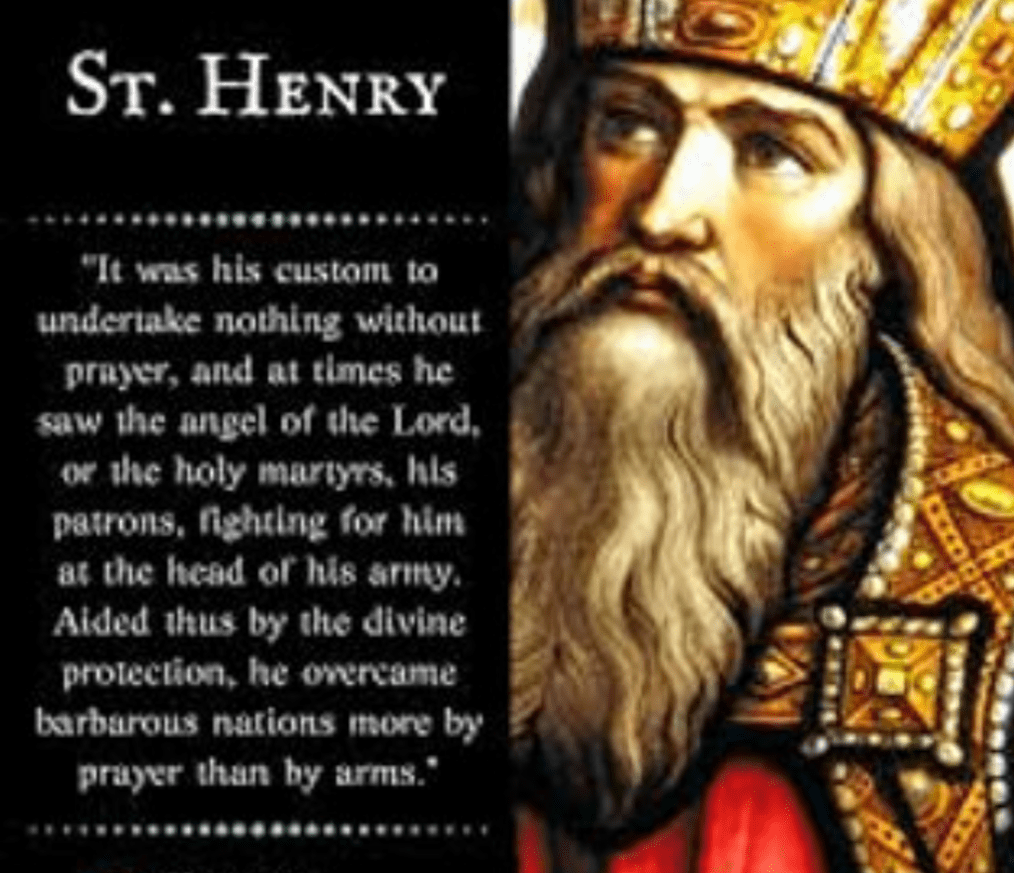
Born in Bavaria, the son of Duke Henry II and Princess Gisela of Burgundy, Saint Henry fought wars on all sides, including famously attacking the Christian Poles in alliance with the pagan Baltic tribes. Yet, after Pope Benedict VIII crowned him as Holy Roman Emperor in 1014, Henry displayed undisputed piety. Together with his wife, Saint Cunegunda, they assisted the poor. As Emperor he was instrumental in fostering ecclesiastical and Monastic reform. He founded the See of Bamberg as a centre for missionary activity to the Slavs. He was openhanded to the poor and a strong supporter of monasteries. On his way home from battles, he would visit pilgrimage sites. Thus it was that, returning home from an attack on the Greeks, he fell gravely ill at Saint Benedict’s monastery at Monte Cassino in 1021. It is said that he was cured by the intercession of Benedict himself. By agreement with his spouse, he preserved virginity in the marriage. After his death in 1024, Henry was canonized by Pope Eugene III in 1146 and declared patron of Benedictine oblates.
From an Ancient Life of Saint Henry
(MGH, Scriptores 4:792-799)
He provided the Church with the benefits of peace and tranquility
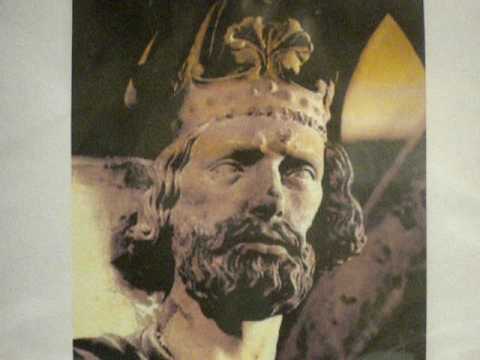
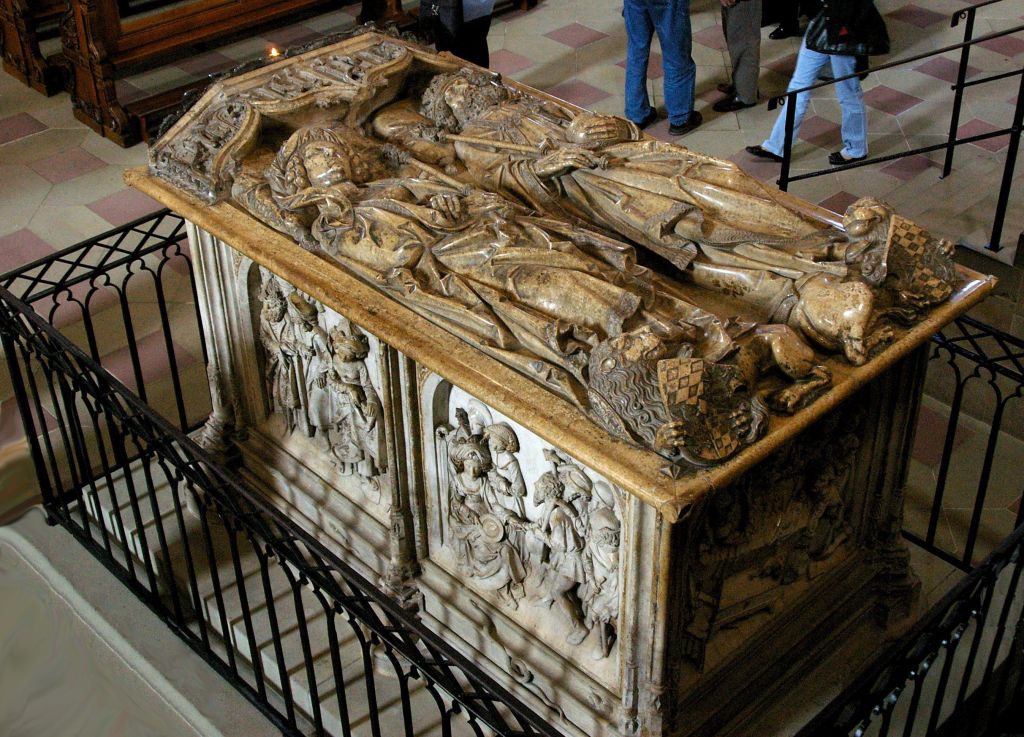
After the most blessed servant of God had been anointed king, he was not satisfied with the anxieties of his realm; so, in order to attain the Crown of Immortality, he determined to campaign for the King of all, for to serve him is to rule. Accordingly, he applied the utmost energy to the extension of religious worship and began to enrich the churches with property and to furnish them with extensive adornment. He re-established the See of Bamberg in his own domain, dedicating it to Peter and Paul, the Princes of the Apostles, and to the most revered Saint George, the martyr; by a special law he submitted it to the holy Church of Rome, to pay the honour due by divine right to the first See and also to secure his foundation under Rome’s patronage. But to show more clearly how carefully this holy man provided his church with the benefits of peace and tranquillity even after his death, we here include his letter of establishment.
“Henry, king by the preordained mercy of God, to all the sons of the Church, both future and present. By the most salutary instructions of sacred eloquence we are taught and advised to abandon temporal riches, to lay aside earthly goods, and to strive to reach the Eternal and Everlasting dwelling-places in Heaven. For present glory is fleeting and meaningless, while it is possessed, unless in it we can glimpse something of Heaven’s Eternity. But God’s mercy toward the human race provided a useful remedy when He made the reward for earthly existence a share in our Heavenly country.
“Therefore, not unmindful of this clemency and aware that by the gratuitous consideration of Divine mercy we were raised up to a position of regal dignity, we think it fitting not only to enlarge the churches constructed by our ancestors, but for the greater glory of God to build new ones and to raise them up as the most grateful gifts of our devotion. Furthermore, not turning a deaf ear to the LORD’s Commandments and obediently following Divine urgings, we desire to take the treasures of Divine generosity bestowed on us by His bounty and store them in Heaven, where thieves cannot dig them up or steal them and rust or moth may not destroy them. Moreover, when we reflect upon all that we have now stored up, our heart will be often drawn with longing and love.
“Accordingly we wish to make known to all the faithful that we have designated a portion of our paternal heritage called Babenberch to be raised to the dignity of an Episcopal See so that there we ourselves and our parents may be held in glorious memory, and that the sacrifice of salvation may be offered constantly for all the faithful.”
DAILY MEDITATION
Let us adore Our LORD followed in the desert by the crowd, who, persuaded that nothing will be wanting to them when they are following Him, rest the care of providing them with food upon the Omnipotent and good Providence of their Divine Saviour. Let us admire the manner in which He justifies the confidence of these good people, is touched with compassion for their needs, and comes to their succour by means of the multiplication of bread. Let us surrender to Him all our homage with this object in view.
In what has respect to us personally, He desires, that we should do everything which depends upon us, awaiting success not from our own efforts, but from His goodness, which alone can enable us to succeed; and as regards, our neighbour, He desires us to be good, charitable, compassionate, the worthy agents of His Love doing good to men. Happy are those who, entering into these designs of God, endeavour to do their neighbour all the good they can, and to show themselves in everything like to Jesus Christ, full of compassion for human misery, full of kindness toward all to whom they can render any service! They will at the Last Day enjoy the happiness of hearing from the mouth of the Judge these sweet words: “Come, ye blessed of My Father, I was hungry, and you gave Me to eat; I was thirsty, and you gave Me to drink” [Matthew 25: 34–35]. Do we thus cooperate with Divine Providence, whether as regards ourselves or our neighbour? What reproaches have we not to address to ourselves on this subject!
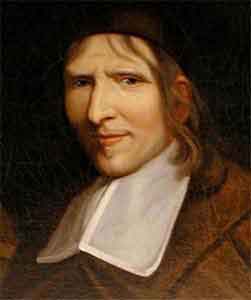
Father, Andre Jean M. Hamon [d. 1874] French Sulpician professor of dogmatics and author of several Spiritual and historical works.
“You received without charge”
(Mt. 10:8)
Today the Church celebrates the feast of Saint Henry, who from 1002 to 1024 was emperor of the medieval Holy Roman Empire and thus the most powerful man of the Europe of his time. He was canonized because he placed his power at the service of what is True and what is good, because he recognised power to be a duty of service. So we can venerate him, but as a model from whom we can learn he seems hardly to come into question—the difference between the situation of his life and ours is too great. The problem most of us face is not how to cope with wielding power but coming to terms with our lack of it. And if he had to struggle to avoid letting himself be blinded by wealth, most Christians in most parts of the world are concerned about how in their poverty they can keep God in their view.
So to begin with this saint seems to be very far distant from us. But today’s Collect translates his life into a way that concerns us all. Our starting points are of course different, but ultimately the direction is the same. The Collect as it were picks out the thread from a host of external events and thereby shows us all the way.
First of all this prayer tells us that Saint Henry was endowed with abundant grace. He was not what he had, what he was, from his own resources: it was given to him, it was grace, and for that reason it was also a responsibility he had to bear to God and to others. Although our lives are built on quite different lines, the same applies to us too: everything essential in our lives has been given to us without our contributing to it. The fact that I am alive is not something I have derived from myself: the fact that people were there who introduced me to life, who enabled me to experience love, who gave me Faith and opened my gaze to God—all that is Grace. We could not do anything if we had not been given the ability to do so first.
But at this point the questions start rising up within us. Is God really fair with His gifts? Why does He give one person so much and another so little? Why is everything made so difficult for one person and everything pretty well heaped up on another? If we burrow into questions like these we do not get any closer to the Truth. We just don’t know what goes on in somebody else’s heart: we know only tiny excerpts from the whole of reality and thus argue very irrationally if on this basis we want to judge the whole world. How, for example, would we be able to know if power brought the Emperor Henry II happiness? Could it not be that it was a fearful burden for him in the immense decisions he was involved in? But we can guess how heavily the fate of childlessness bore on a soul, and historians have passed on to us how terribly he suffered over many years from the pains his illness brought him. In this way he too had to learn that God’s Grace is often dark, but that it is precisely in suffering that grace lies.
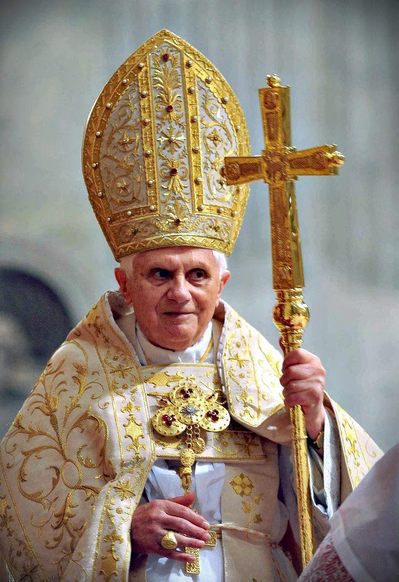
Pope Benedict XVI
Pope Benedict XVI († 2022) was Pope from 2005 until 2013. [From The Yes of Jesus Christ: Exercises in Faith, Hope and Love, Robert Nowell, Tr. Copyright © Pope Benedict XVI, Joseph Ratzinger.
“The refusal to take sides on great moral issues is itself a decision. It is a silent acquiescence to evil. The tragedy of our time is that those who still believe in honesty lack fire and conviction, while those who believe in dishonesty are full of passionate conviction.” – Ven. Archbishop Fulton Sheen
 Daily Reflections
Leave a comment