SATURDAY OF THE BLESSED VIRGIN MARY
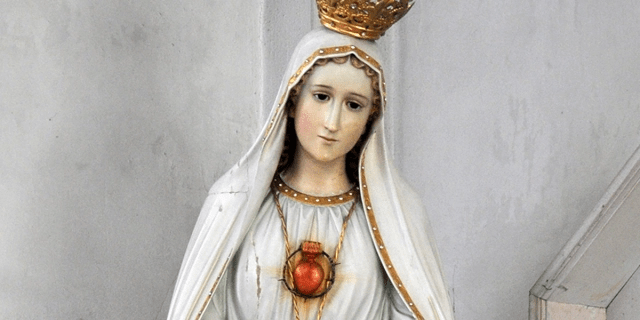
The Church has honored the Mother of God on Saturdays for centuries, dating back to the early Middle Ages.
In the Catholic Church Saturdays are special days in the Liturgy devoted to the Blessed Virgin Mary. On most Saturdays of the year, priests can offer a Votive Mass in honour of the Virgin Mary and in the Liturgy of the Hours there is a specific set of prayers and readings that can be prayed in her honour as well.
Why is Saturday dedicated to the Virgin Mary?
The tradition of setting aside Saturdays to honour the Mother of God is an ancient one, going back hundreds of years. According to the Catholic Encyclopedia, a “special Mass already assigned to the Blessed Virgin on Saturdays in the Leofric Missal,” which dates to the 10th century.
The Dictionary of Mary confirms that, “This liturgical attribution of Saturday to Mary was largely the work of Alcuin (735-804) … [who] composed six formularies for Votive (that is, devotional) Masses – one for each day of the week. And he assigned two formularies to Saturday in honour of Our Lady.”
Nevertheless, while this asserts the historicity of the devotion, it doesn’t tell us why Saturday was chosen.
According to St. Thomas Aquinas (as quoted by Fr. John Hardon), the choice was connected to Jesus’ Resurrection on Sunday and the unshaken Faith of Mary on the previous day.
Since the Resurrection took place on a Sunday, we keep holy this day instead of the Sabbath as did the Jews of old. However, we also sanctify Saturday in honour of the glorious Virgin Mary who remained unshaken in Faith all day Saturday after the death of her Divine Son.
Others have postulated that since Sunday is devoted to Jesus, it would be fitting to dedicate the day prior to His Mother.
Whatever the exact origins were, this devotion to the Virgin Mary on Saturdays was most recently confirmed by the private revelations of Our Lady of Fatima.
On December 10, 1925, the Blessed Virgin Mary appeared to Sister Lucia at a convent in Pontevedra, Spain. Sister Lucia had previously been the recipient of Marian visions in Fatima, Portugal, along with her cousins Jacinta and Francisco. In this new private revelation eight years after the visions at Fatima, Mary requested the institution of the five consecutive First Saturday devotions in reparation to her Immaculate Heart.
This revelation further cemented the connection of Saturdays to devotion to the Virgin Mary, which is always focused on drawing Christians closer to Jesus, her Son.
Saturday is a “preparation day,” and Mary is the “preparer” who helps us reap the fruit of our labour on Sunday, the day of the Resurrection.
Philip Kosloski – published on 05/16/20
Saturday of the Blessed Virgin Mary
Saint Henry, Emperor, Confession (Traditional)
Saint Bonaventure, Bishop, Confessor, Doctor of the Church
SAINT BONAVENTURE, BISHOP, CONFESSOR, DOCTOR OF THE CHURCH
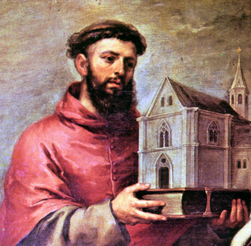
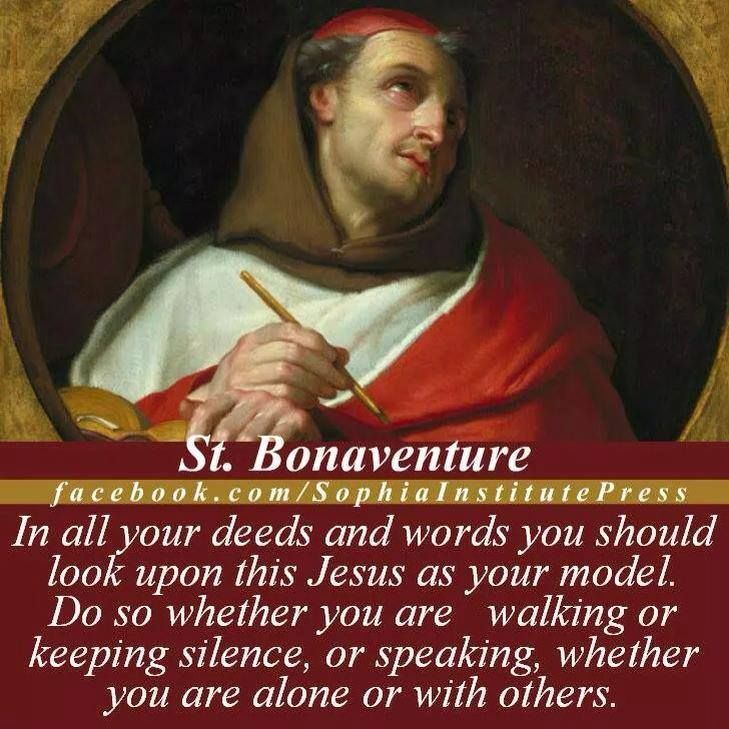
Sanctity and learning raised to the Church’s highest honours, and from a child he was the companion of Saints. Yet at heart he was ever the poor Franciscan friar, and practiced and taught humility and mortification. Saint Francis gave him his name; for, having miraculously cured him of a mortal sickness, he prophetically exclaimed of the child, “O bona ventura!”—good luck. He is known also as the “Seraphic Doctor,” from the fervour of Divine love which breathes in his writings. He was the friend of Saint Thomas Aquinas, who asked him one day from where he drew his great learning. He replied by pointing to his crucifix. At another time Saint Thomas found him in ecstasy while writing the life of Saint Francis, and exclaimed, “Let us leave a Saint to write of a Saint.” They received the Doctor’s cap together. He was the guest and adviser of Saint Louis, and the director of Saint Isabella, the king’s sister. Bonaventure brought a keen mind to his task. He wrote the definitive biography of Saint Francis, well as a commentary on his order’s Rule, and defended evangelical perfection from its critics. He is lauded as the “second founder” of the Franciscans. At the age of thirty-five he was made general of his Order; and only escaped another dignity, the Archbishopric of York, by tears and entreaties. Gregory X appointed him Cardinal Bishop of Albano. When the Saint heard of the Pope’s resolve to create him a Cardinal, he quietly made his escape from Italy. But Gregory sent him a summons to return to Rome. On his way, he stopped to rest himself at a convent of his Order near Florence; and there two Papal messengers, sent to meet him with the Cardinal’s hat, found him washing the dishes. The Saint desired them to hang the hat on a bush that was near, and take a walk in the garden until he had finished what he was about. Then taking up the hat with unfeigned sorrow, he joined the messengers, and paid them the respect due to their character. He sat at the Pontiff’s right hand, and spoke first at the Council of Lyons. His piety and eloquence won over the Greeks to Catholic union, and then his strength failed. He died while the Council was sitting, and was buried by the assembled bishops in 1274.
SAINT HENRY, EMPEROR, CONFESSOR
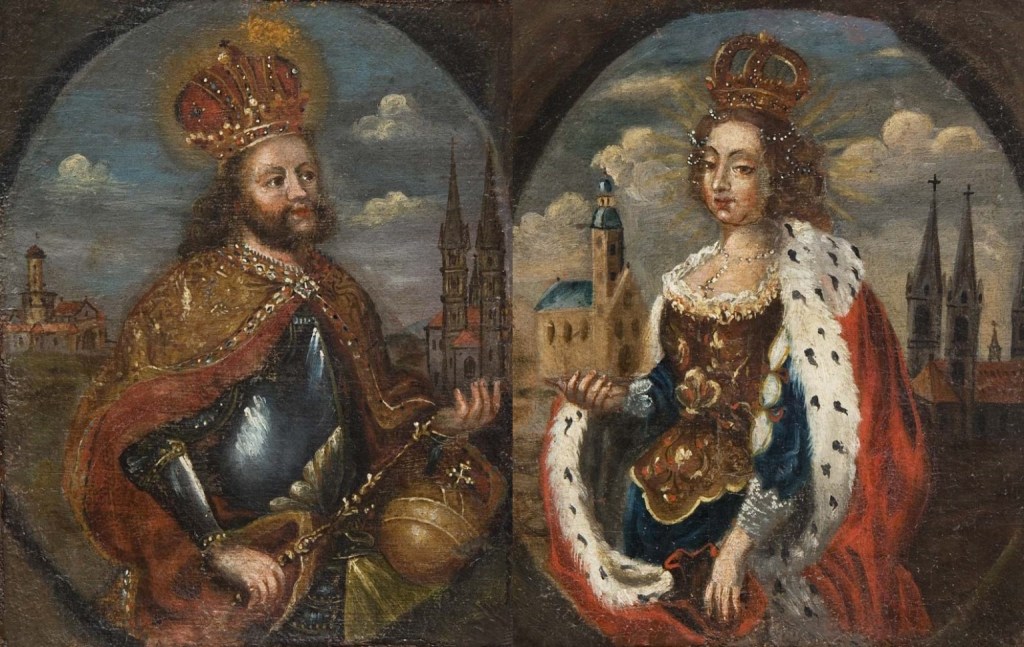
St. Henry, Duke of Bavaria and Emperor of Germany, used his power to extend the Kingdom of God. By agreement with his spouse, he preserved virginity in marriage. He died in 1024.
(See Thursday 13 July, 2023’s Blog for more details on the life of St. Henry.)
From The Journey of the Mind to God, by Saint Bonaventure, Bishop, Doctor of the Church
(Cap. 7,1.2.4.6: Opera omnia 5, 312-313)
Mystical Wisdom is revealed by the Holy Ghost
Christ is both the Way and the Door. Christ is the staircase and the vehicle, like the throne of mercy over the Ark of the Covenant, and the mystery hidden from the ages. A man should turn his full attention to this Throne of Mercy, and should gaze at Him hanging on the Cross, full of Faith, Hope and Charity, devoted, full of wonder and joy, marked by gratitude, and open to praise and jubilation. Then such a man will make with Christ a pasch, that is, a passing-over. Through the branches of the Cross he will pass over the Red Sea, leaving Egypt and entering the desert. There he will taste the hidden manna, and rest with Christ in the sepulchre, as if he were dead to things outside. He will experience, as much as is possible for one who is still living, what was promised to the thief who hung beside Christ: Today you will be with Me in Paradise.
For this passover to be perfect, we must suspend all the operations of the mind and we must transform the peak of our affections, directing them to God alone. This is a Sacred Mystical experience. It cannot be comprehended by anyone unless he surrenders himself to it; nor can he surrender himself to it unless he longs for it; nor can he long for it unless the Holy Ghost, whom Christ sent into the world, should come and inflame his innermost soul. Hence the Apostle says that this mystical wisdom is revealed by the Holy Ghost.
If you ask how such things can occur, seek the answer in God’s grace, not in doctrine; in the longing of the will, not in the understanding; in the sighs of prayer, not in research; seek the Bridegroom not the teacher; God and not man; darkness not daylight; and look not to the light but rather to the raging fire that carries the soul to God with intense fervour and glowing love. The fire is God, and the furnace is in Jerusalem, fired by Christ in the ardor of His loving Passion. Only He understood this who said: My soul chose hanging and My bones death. Anyone who cherishes this kind of death can see God, for it is certainly true that: No man can look upon Me and live.
Let us die, then, and enter into the darkness, silencing our anxieties, our passions and all the fantasies of our imagination. Let us pass over with the Crucified Christ from this world to the Father so that, when the Father has shown Himself to us, we can say with Philip: It is enough. We may hear with Paul: My Grace is sufficient for you; and we can rejoice with David, saying: My flesh and my heart fail me, but God is the Strength of my heart and my Heritage for ever. Blessed be the LORD for ever, and let all the people say: Amen. Amen!
Conformed to the Master
The One so good and so great desires you to embrace Him and is waiting to embrace you. He inclines towards you the flower of His head, pierced with many thorns, and calls you to receive the kiss of peace, as if saying: See how I was disfigured, transfixed, and beaten in order that I might place you upon My shoulder, My straying sheep, and bring you back to the paradise of heavenly pastures. Do something now yourself: be moved with pity for My wounds; and such as you see Me: Set me like a seal on your heart, like a seal on your arm (Sg 8:6);sothat, in every motion of your heart, in every deed of your hands, you may resemble Me who am wearing the seals you behold. In forming you, I conformed you to the likeness of My Divinity; to re-form you, I conformed Myself to the likeness of your humanity. You, who did not keep the imprint of My Divinity stamped on you when you were made, keep at least the imprint of your own humanity stamped on Me when you were re-formed. If you did not stay as I created you, stay at least as I re-created you. If you fail to understand how great were the powers I granted you in creating you, understand at least how great were the miseries I accepted for you in your humanity, in re-creating you, and in re-forming you for joys much greater than those for which I had originally formed you. I became human and visible so that you might see Me and so love Me, since, unseen and invisible in My Divinity, I had not been properly loved. As a price for My Incarnation and Passion, give Me yourself, for whom I became flesh and for whom I suffered. I gave Myself to you, now give yourself to Me.
O most sweet and good Jesus, Father of all Light, from Whom proceeds all that is good, everything that is perfect (Jas 1:17), look down mercifully upon us who humbly confess You and truly know that we can do nothing without Your help. You gave Yourself in payment for us; grant that, although we are little worthy of such a price, we may be so completely and fully restored to Your favour that, conforming to the image of Your Passion, we may also be re-formed to the image of Your Divinity.
Saint Bonaventure
Saint Bonaventure († 1274) was a minister general of the Franciscans. He is a Doctor of the Church. [From The Works of Bonaventure: Cardinal, Seraphic Doctor, and Saint: Volume I. Mystical Opuscula, José de Vinck, Tr
DAILY MEDITATION
(Luke 12: 35-40)
Our LORD, having taught His disciples moderation, taking from them all care and conceit of this life, now leads them on to serve and obey, saying, “let your loins girded,“ that is, always ready to do the work of your LORD, “and your lamps burning,“ that is, do not lead a life in darkness, but have with you, the light of reason, showing you what to do and what to avoid [Luke 12:35). For this world is the night, but they have the loins girded who follow a practical or active life. For such is the condition of servants, who must have with them also lamps burning; that is, the gift of discernment (prudence), that the active man may be able to distinguish, not only what he ought to do, but in what way; otherwise men rush down the precipice of Pride.
But we must observe, that He first orders our loins to be girded, secondly, our lamps to be burning. For first, indeed, comes action, then reflection, which is an enlightening of the mind. Let us then strive to exercise the Virtues, that we may have two lamps burning, that is, the conception of the mind ever shining forth in the soul, by which we are ourselves, enlightened, and learning, whereby we enlighten others.
Daily also in the heavens He betroths the souls of the saints, whom Paul or another offers to Him, as a chaste virgin. But He returns from the celebration of the heavenly marriage, perhaps to all at the end of the whole world, when He shall come from Heaven in the Glory of the Father; perhaps also every hour standing suddenly present at the death of each individual.
Theophylact of Obrid (d.1108) – Highly regarded scholar of Constantinople, whose Scripture commentaries feature in Aquinas’ Catena Aurea
“The refusal to take sides on great moral issues is itself a decision. It is a silent acquiescence to evil. The tragedy of our time is that those who still believe in honesty lack fire and conviction, while those who believe in dishonesty are full of passionate conviction.” – Ven. Archbishop Fulton Sheen
 Daily Reflections
Leave a comment