
Jeremiah 29:8-9, 11; Deuteronomy 18:18
Do not be deceived by the prophets among you;
they prophesy falsely to you in My name.
– I alone know the purpose I have for you.
I will raise up for them a prophet,
and I will place My words into His mouth.
– I alone know the purpose I have for you
Thursday of the Fifteenth Week in Ordinary Time
Saint Apollinaris, Bishop, Martyr
Saint Jerome Emiliani, Confessor (Traditional)
Saint Margaret of Antioch, Virgin, Martyr (Traditional)
SAINT APOLLINARIS, BISHOP, MARTYR
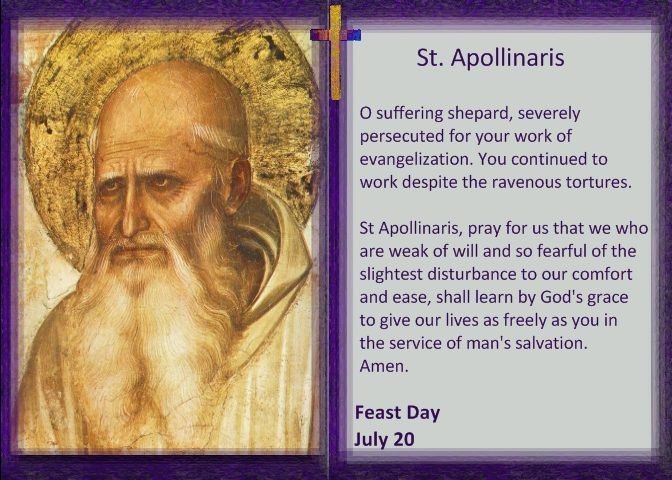
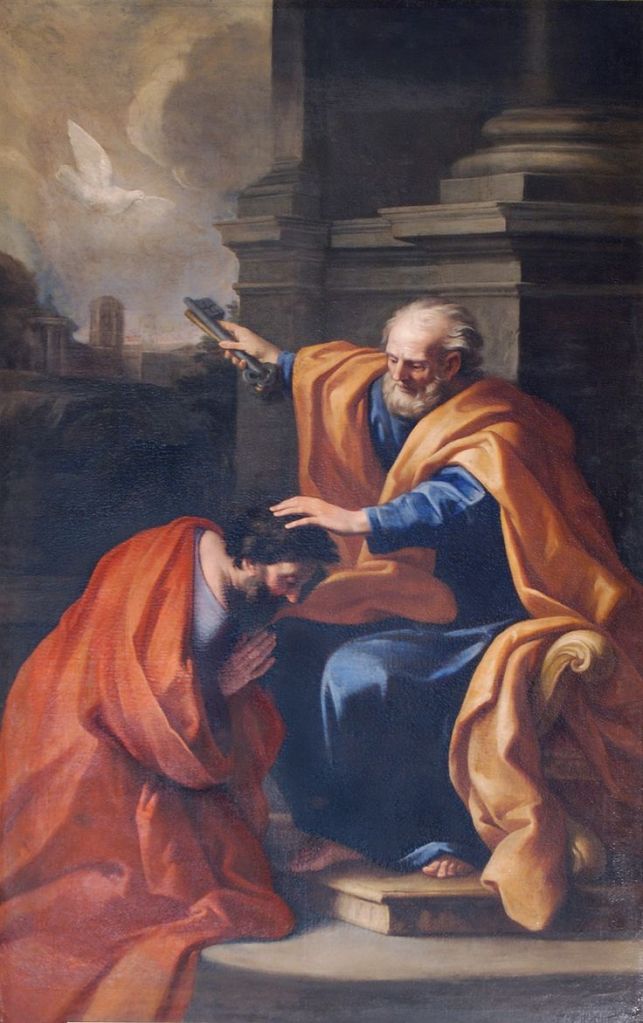
Said to have been a disciple of Saint Peter, Apollinaris, a native of Antioch made bold to preach the Gospel to the natives of the ancient Roman stronghold of Ravenna in the late first century. Chosen the first Bishop of Ravenna, he faced nearly constant persecution. Incensed by the many healings that were brought about by his prayers, the pagan priests instigated repeated oppressions. He and his flock were exiled from Ravenna, during the persecutions of the Emperor Vespasian (or Nero, depending on the source). Identified and arrested as the leader of the ancient community of Christians, he was tortured and then martyred by being run through with a sword in 79 A.D. Tradition holds that Apollinaris was of advanced age when he received the martyr’s crown. In the Tenth Century, Romuald, a young native of Ravenna, went to a monastery under Apollinaris’ patronage to do penance after his father had killed another man in a duel. Apollinaris appeared to Romuald in a vision, encouraging the youth’s monastic vocation. Romuald became a saint and founder of the Camaldolese order.
SAINT JEROME EMILIANI, CONFESSOR
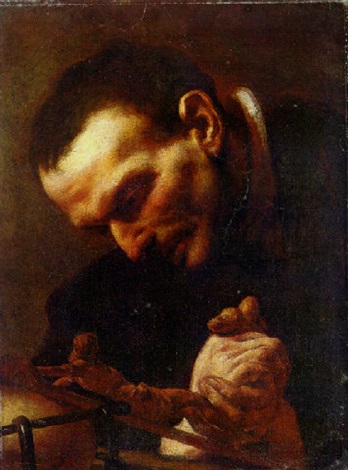
In the 16th century, God raised up a number of saints who by prayer, teaching and good works combatting the influence of the pagan Renaissance. Among these was St. Jerome Emiliani, who spent himself in the care of orphans and the poor. He instituted homes for orphan children, and founded the Congregation whose object was to educate orphans. They are called the Somaschi, from Somascha, the little Italian town in which they were first established. He died on February 8, 1537, from the plague which he contracted while burying the dead. It was related that Saint Charles Borromeo, when going several years afterwards, to make a pastoral visitation to Somascha, became aware of the presence of the relics of a saint through the sweet perfume, which emanated from his tomb. Asking for a thurible, Saint Charles offered incense on the sepulchre, being thus the first to render public veneration to the saint.
COMMEMORATION OF ST. MARGARET OF ANTIOCH
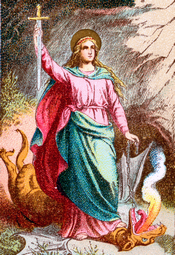
Saint Margaret, called by the Greeks, Marina, was martyred at Antioch in Pisidia under Emperor Diocletian, at the end of the Third Century. Devotion to her became very popular in Rome during the Middle Ages, and many chapels and churches were dedicated to her. She is invoked, especially, by those who are about to become mothers.
DAILY MEDITATION
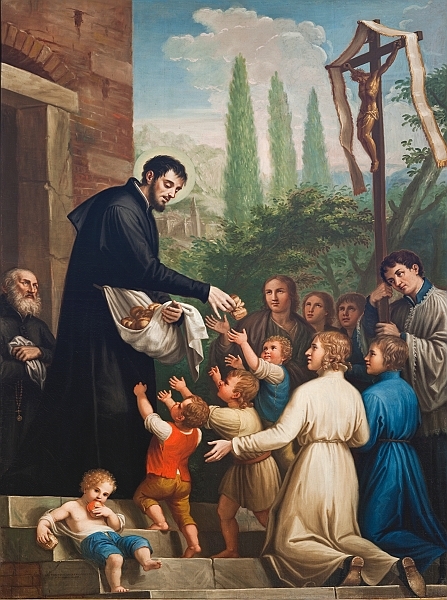
Son of Angelo, Emiliani [popularly called Miani] and of Eleanore Mauroceni, [Jerome] joined the army, and, in 1508, defended, Castelnuovo against the League of Cambray. Taken prisoner and miraculously liberated, he made a pilgrimage to the shrine of Our Lady of Treviso, in fulfillment of a vow. He was then appointed podestà of Castelnuovo, but, after a short time, he returned to Venice to supervise the education of his nephews. All his spare time was devoted to the study of theology, and to works of charity. After his ordination to the priesthood in 1518, the hospitals and hovels of the poor were his favourite resorts. In the year of the plague and famine [1528], he seemed to be everywhere, and showed his zeal, especially for the orphans, whose number had so greatly increased. He rented a house for them near the church of Saint Rose and, with the assistance of some pious laymen, ministered to their wants. To his charge was also committed the hospital for incurables, founded by St. Cajetan. In 1531, he went to Verona and induced the citizens to build a hospital; at Brescia he erected an orphanage, at Bergamo one for boys and another for girls. Here also, he founded the first home for fallen women who wished to do penance.
Two priests, Alessandro Besuzio and Agostino Bariso, now joined him in his labours of charity, and, in 1532 Jerome, founded a religious society, placing the motherhouse at Somascha, a secluded hamlet between Milan and Bergamo. In the rule, Jerome puts down as the principal work of the community the care of orphans, poor and sick, and demands that dwellings, food, and clothing, shall bear the mark of religious poverty. Jerome fell a martyr to his zeal; contracting a disease at Bergamo, he died at Somascha. He was beatified by Pope Benedict X1V in 1747: and canonized by Pope Clement X111 in 1767. The office and Mass in his honour were approved eight years later.
Catholic Encyclopedia [1912] – classic multi-volume reference on “constitution, doctrine, discipline, and history of the Catholic Church.
Saints Catherine of Alexandria
and Margaret of Antioch
Virgin martyrs († early 4th cent.)
Feasts: 25 November and 20 July
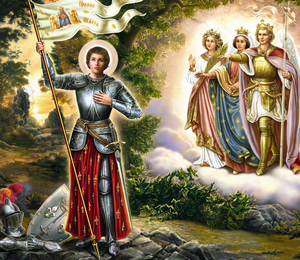
While her patron saints’ stories come largely from the hagiographic tradition, Saint Joan’s account of them comes primarily from the witness stand, as Mark Twain has noted. “When I was thirteen, I had a voice from God to help me to govern myself”—Saint Michael, for it was he who “told me Saint Catherine and Saint Margaret would come to me, and I must follow their counsel”.
Catherine of Alexandria and Margaret of Antioch were among the Fourteen Holy Helpers, saints who became popular during the Middle Ages and were widely invoked against certain ailments and troubles, especially the Plague. For four years they helped Joan cultivate the virtues she needed for her great task. Margaret, or Marina, had been a shepherdess, not unlike Joan herself. And young Catherine had spoken out fearlessly against the Christian persecutions. Called to a debate with fifty pagan philosophers, she converted them with her wisdom. Both young women died martyrs.
Joan recalled, “Saint Catherine and Saint Margaret had rich crowns on their heads. They spoke well and fairly, and their voices are beautiful—sweet and soft…. They told me that my king would be restored to his kingdom, despite his enemies. They promised to lead me to paradise.” Joan worked military wonders, changing the course of the Hundred Years’ War, before she was betrayed into the hands of her enemies and received a martyr’s crown.
Resting with Christ the Victor
Blessed Apollinaris, the first in the priesthood, alone adorned this Church with the exceptional honour of having one of Her own martyred. It is fitting that his name was Apollinaris, since according to the injunction of his God he lost his life in order to acquire it for Life Everlasting. Blessed is he who so finished the race and so kept the Faith that he truly was found to occupy the first place among the believers….
It is not death as much as Faith and dedication that make one a martyr; and just as it is a mark of virtue to fall in battle, in conflict, for the love of the king, so it is a mark of perfect virtue to engage in combat for a long time and to bring it to its conclusion…. The crafty enemy hurled the weapons that he could, and he aimed at him everything he had in his arsenal; nevertheless, he was unable to budge this bravest of leaders, nor could he tarnish his constancy. It is the highest honour, brothers, to despise this present life for the LORD’s sake, if that is necessary, but it is also glorious even while living to scorn and trample underfoot the world and its ruler….
So that the holy Church retain for Herself Her defender, she runs eagerly to Christ, so that She may both preserve the crown of righteousness for the victor, and may furnish for Herself the presence of Her warrior in time of war…. And why should I say more, brothers? She has seen to it; Holy Mother Church has seen to it that She would in no way be separated from Her High-Priest. He is alive here. As a good Shepherd He is at His post in the midst of His flock, and He is never separated in spirit, although in body He has temporarily gone ahead of us. He has gone ahead, I mean, in His earthly condition; in another respect, the very dwelling that is His Body reposes among us. The devil has been destroyed, the persecutor has met his end; here we have reigning and living the one who longed to be put to death for his King.
Saint Peter Chrysologus
Saint Peter Chrysologus († 450), Doctor of the Church, was the archbishop of Ravenna, Italy. [From Saint Peter Chrysologus: Selected Sermons, Volume 3, The Fathers of the Church: A New Translation, Volume 110, William B. Palardy, Tr.
“The refusal to take sides on great moral issues is itself a decision. It is a silent acquiescence to evil. The tragedy of our time is that those who still believe in honesty lack fire and conviction, while those who believe in dishonesty are full of passionate conviction.” – Ven. Archbishop Fulton Sheen
 Daily Reflections
Leave a comment