Romans 12:2; Ephesians 4:23-24
Be transformed by the renewing of your mind,
– so that you may be able to discover what is God’s will,
what is good, pleasing and perfect.
You must be renewed in mind and spirit,
and put on the new man.
– So that you may be able to discover what is God’s will,
what is good, pleasing and perfect.
Feast of Saint Mary Magdalene
Saturday of the Blessed Virgin Mary
SAINT MARY MAGDALENE, PENITENT
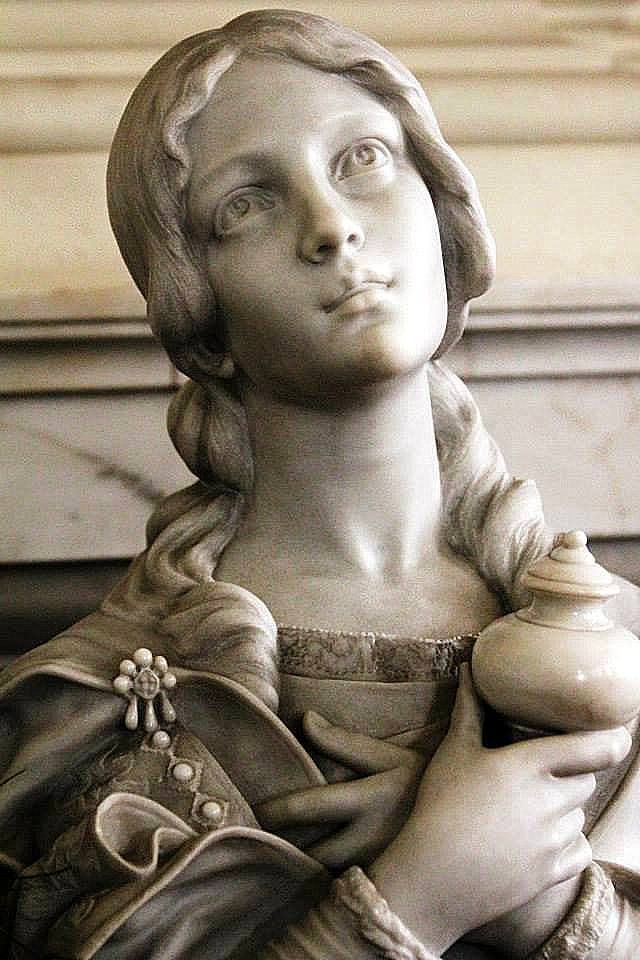
On His journeys, Jesus is accompanied by “the Twelve, as well as certain women who had been cured of evil spirits and ailments”, among them “Mary surnamed the Magdalene, from whom seven demons had gone out” (Lk 8:1-2). Following Jesus brings Mary to Golgotha, where she witnesses His death and burial. Three days later, she meets Jesus outside the empty tomb. She hastens to tell the disciples that she has “seen the LORD”. Tradition names Mary Magdalene “the apostle to the apostles”: “Just as a woman had announced the words of death to the first man, so also a woman was the first to announce to the apostles the words of life” (Saint Thomas Aquinas).
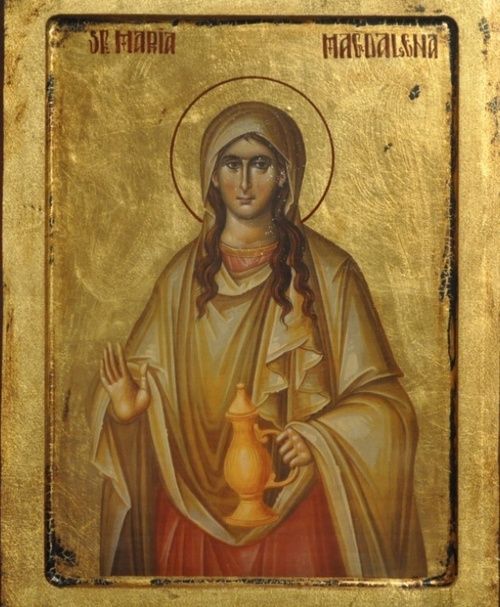
MARY MAGDALENE was one of Christ’s disciples, and was present when he died. Early on the morning of the Resurrection, she was, according to Saint Mark’s account (16:9), the first to see the Risen LORD. By the twelfth century particularly, devotion to Saint Mary Magdalene was widespread in the western Church. Since she was commanded by the Risen LORD to announce the Resurrection to the Apostles (John 20:17-18), she has been given the title “Apostle to the apostles.”
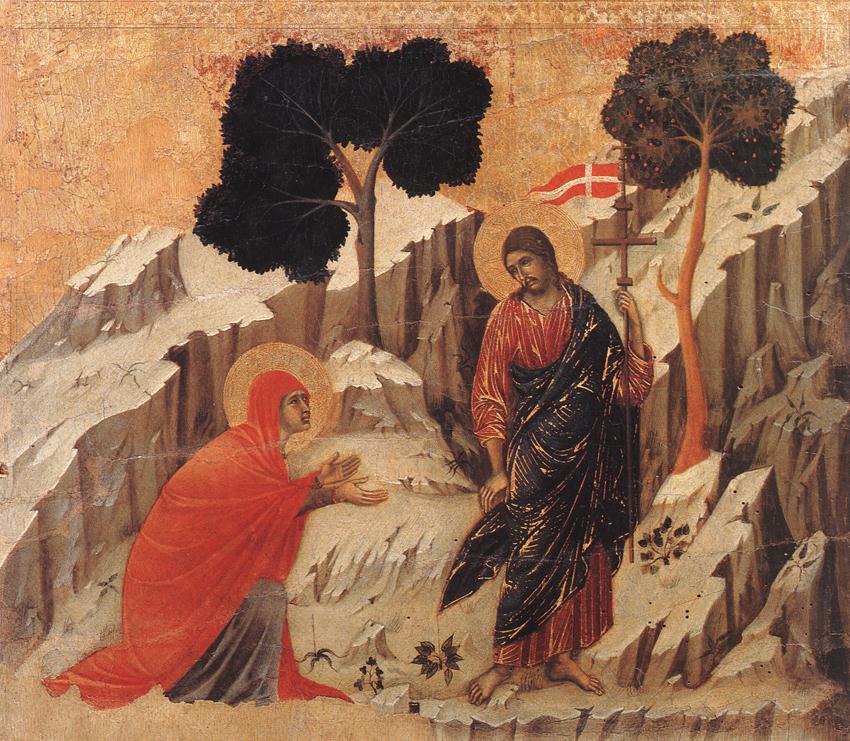
The Latin writers, beginning with Tertullian, have generally, and with great probability, identified Mary of Magdala, as the sister of Lazarus, and as the sinner who anointed the feet of Jesus. The Greeks, on the other hand, distinguished three Marys. Her brother Lazarus, died on the island of Cyprus. His body was brought to Constantinople by the Emperor Leo VI and laid in the Lazarion, [899]. The body of Mary, his sister, who, according to a tradition dating from the sixth century, had been buried at Ephesus, was soon brought, and laid beside him in the new, sepulchral Basilica of Byzantium. The Greeks gave to her the title of “like unto an apostle“, because she first announced to the world, and to the Apostles themselves, the Resurrection of the LORD.
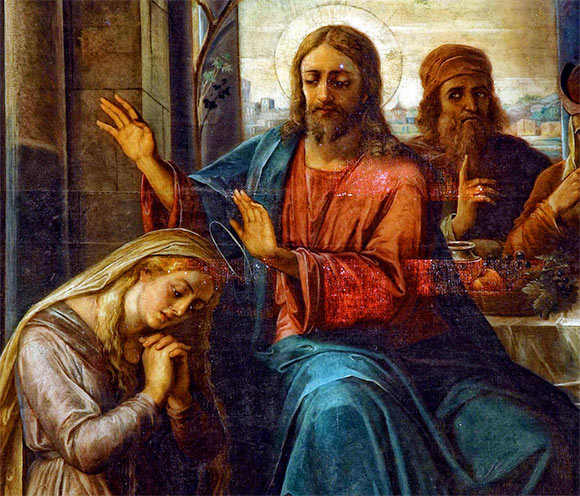
The scene of the conversion of Mary of Magdala is perhaps one of the incidents in the Gospel, which best reveals the gentleness of the Heart of the Redeemer. To Mary much is forgiven, because she loved much; this is the remedy for sinners; this is the spirit which sustains the Church Militant, wherein we may indeed see many sins caused by human frailty, but in which there may be found also a great love ready to pardon all.
From a homily on the Gospels by Gregory the Great, Pope
(Hom. 25, 1-2, 4-5:PL 76, 1189-1193)
She longed for Christ, though she thought He had been taken away

When Mary Magdalene came to the tomb and did not find the LORD’s body, she thought it had been taken away and so informed the disciples. After they came and saw the tomb, they too believed what Mary had told them. The text then says: The disciples went back home, and it adds: but Mary wept and remained standing outside the tomb.
We should reflect on Mary’s attitude and the great love she felt for Christ; for though the disciples had left the tomb, she remained. She was still seeking the One she had not found, and while she sought she wept; burning with the fire of love, she longed for Him who she thought had been taken away. And so it happened that the woman who stayed behind to seek Christ was the only one to see Him. For perseverance is essential to any good deed, as the voice of Truth tells us: Whoever perseveres to the end will be saved.
At first she sought but did not find, but when she persevered it happened that she found what she was looking for. When our desires are not satisfied, they grow stronger, and becoming stronger they take hold of their object. Holy desires likewise grow with anticipation, and if they do not grow they are not really desires. Anyone who succeeds in attaining the Truth has burned with such a great love. As David says: My soul has thirsted for the Living God; when shall I come and appear before the face of God? And so also in the Song of Songs the Church says: I was wounded by love; and again: My soul is melted with love.
Woman, why are you weeping? Whom do you seek? She is asked why she is sorrowing so that her desire might be strengthened; for when she mentions whom she is seeking, her love is kindled all the more ardently.
Jesus says to her: Mary. Jesus is not recognized when He calls her “woman”; so He calls her by name, as though He were saying: Recognize Me as I recognize you; for I do not know you as I know others; I know you as yourself. And so Mary, once addressed by name, recognizes who is speaking. She immediately calls Him rabboni, that is to say, Teacher, because the one whom she sought outwardly was the one who inwardly taught her to keep on searching.
Apostle to the Apostles, Apostle of Love
I am very ardent in love. I am Magdalen, and in some respects I believe that I resemble the foolishness of her love as recorded in the Gospel. Whenever I meet a person that desires God and is disposed to be His, I immediately begin to love that person as if we were already united in the arms of the Heavenly Father and would remain there always without fear…. If my Jesus is the One who gives me the love with which to love Him, why should I fear to love Him? No, I do not fear. When I experience that love, love itself reassures me. In the spiritual life, one reaches a point in which Jesus wants the soul to spread the wings of confidence and of love and fly to Him.
How is it possible to doubt that God is with us? That God is in you and you are in God? Let us not doubt it even for a moment. Yesterday, in choir, during the few moments of recollection before chanting the hours, I said to Jesus interiorly: “Here is Your Magdalen. I am Yours.” And I slowly repeated my name, which evokes in my soul so many tender things. And an interior voice replied in turn: “Apostle of My Love”. “But the apostle of love is Saint John”, I thought. “So also is My Magdalen”, I sensed. From this I concluded that Jesus wants me to be this, an apostle of His Love. It does not surprise me at all; whatever Jesus wants will undoubtedly be done. He has all power in Heaven and on earth.
How many things there are in love that are always new and always the same, because one alone is the Good that contains all things. The marvel of love is that in its unity it reveals surprises at every instant and will do so for all Eternity. Let us hasten to submerge ourselves in this Infinite ocean and not wait for Eternity, because we can do it now. Love surrounds us always; it is in us; it is the movement that gives life to our being.
Venerable Mary Magdalen of Jesus in the Eucharist, c.p.
Mother Mary Magdalen († 1960) was a Passionist nun from Spain and a spiritual writer. This is a letter to her spiritual director. [From Toward the Heights of Union with God, Fr. John G. Arintero, o.p., and Mother Mary Magdalen, c.p., Jordan Aumann, o.p., Tr.
DAILY MEDITATION
“Who but the Church knows the secret of this perfume?” Asks, Paulinus of Nola with Ambrose of Millan; the Church, whose numberless flowers, have all aromas; the Church, who exhales before God a thousand sweet odours, aroused by the breath of the Holy Spirit, namely, the virtues of nations, and the prayers of the saints. Mingling the perfume of her conversion with her tears of repentance, she anoints the feet of her LORD, honouring in them His humanity. Her Faith, whereby she is justified, grows equally with her love: soon the Head of the Spouse, that is, His Divinity, receives from her, the homage of the full measure of pure and precious spikenard, to wit, the consummate holiness, whose heroism goes so far as to break the vessel of mortal flesh by the martyrdom of love, if not by that of tortures.
Arrived at the height of the mystery, she forgets not even there those sacred feet, whose contact delivered her from the seven devils, representing all vices; for to the heart of the Bride, as in the bosom of the Father, her LORD is still both God and Man. The Jew, who would not own Christ either for head or foundation, found no fragrant oil for His head, not even water for His feet; she, on the contrary, pours her priceless perfume over both. And while the sweet odour of her perfect Faith fills the earth, now becomes by the victory of that Faith the house of the LORD, she continues to wipe her Master’s feet with her beautiful hair, i.e., her countless good works, and her ceaseless prayer. The growth of this mystical hair requires all her care here on earth; and in Heaven, its abundance and beauty will call forth the praise of Him Who generously counts, without losing one, all the works of His Church. Then from her own head, as from that of her Spouse, will the Fragrant unction of the Holy Spirit overflow even to the skirt of her garment.
Happy sinner to be, both in her life of sin and that of grace, the figure of the Church, even so far as to have been forseen and announced by the prophets. For such is the teaching of Saint Jerome, and Saint Cyril, of Alexandria; while Venerable Bede, gathering up, according to his wont, the traditions of his predecessors, does not hesitate to assert that “what Magdalene once did, remains the type of what the whole Church does, and of want every perfect soul must ever do.”
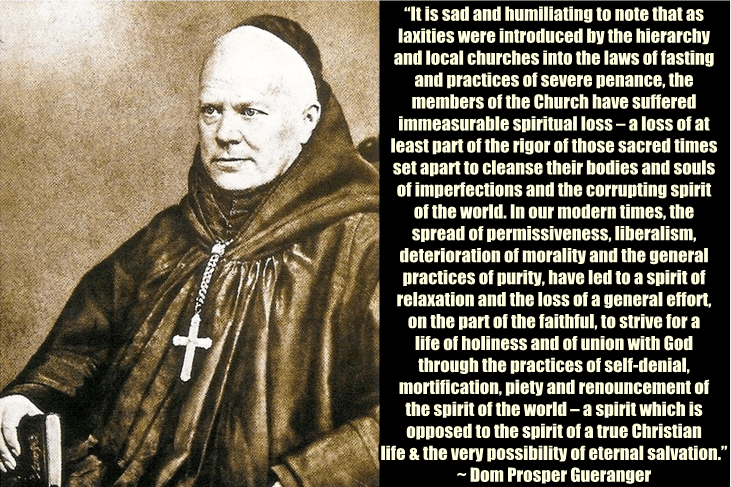
Dom Prosper Guéranger [d. 1875] – Brilliant Benedictine Priest, scholar, Abbot, and founder of what is now the Solesmes, congregation of France.
RESPONSORY
Upon returning from the LORD’s tomb,
Mary Magdalene told the disciples:
I have seen the LORD.
– How blessed is she who was worthy to be the first
to proclaim that the LORD had truly Risen.
While she was weeping, she saw her Beloved,
and then ran to announce the good news to the others.
– How blessed is she who was worthy to be the first
to proclaim that the LORD had truly Risen.
“The refusal to take sides on great moral issues is itself a decision. It is a silent acquiescence to evil. The tragedy of our time is that those who still believe in honesty lack fire and conviction, while those who believe in dishonesty are full of passionate conviction.”- Ven. Archbishop Fulton Sheen
 Daily Reflections
Leave a comment