Monday of the Sixteenth Week in Ordinary Time
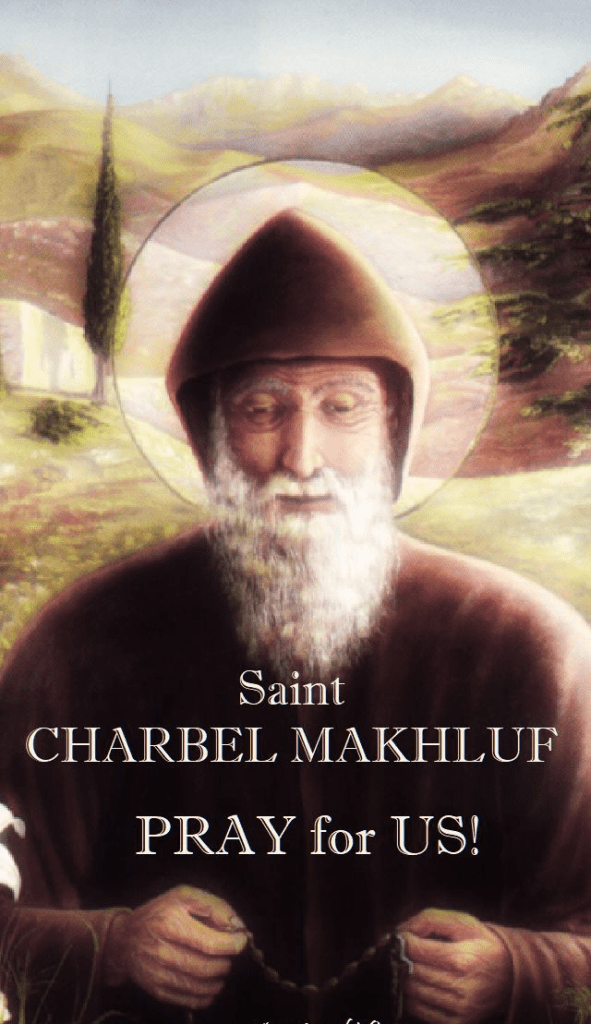
Saint Sharbel Makhlūf, Priest
Saint Declan (Ireland)
Saint Christina, Virgin, Martyr (Traditional)
SAINT SHARBEL MAKHLÛF, PRIEST
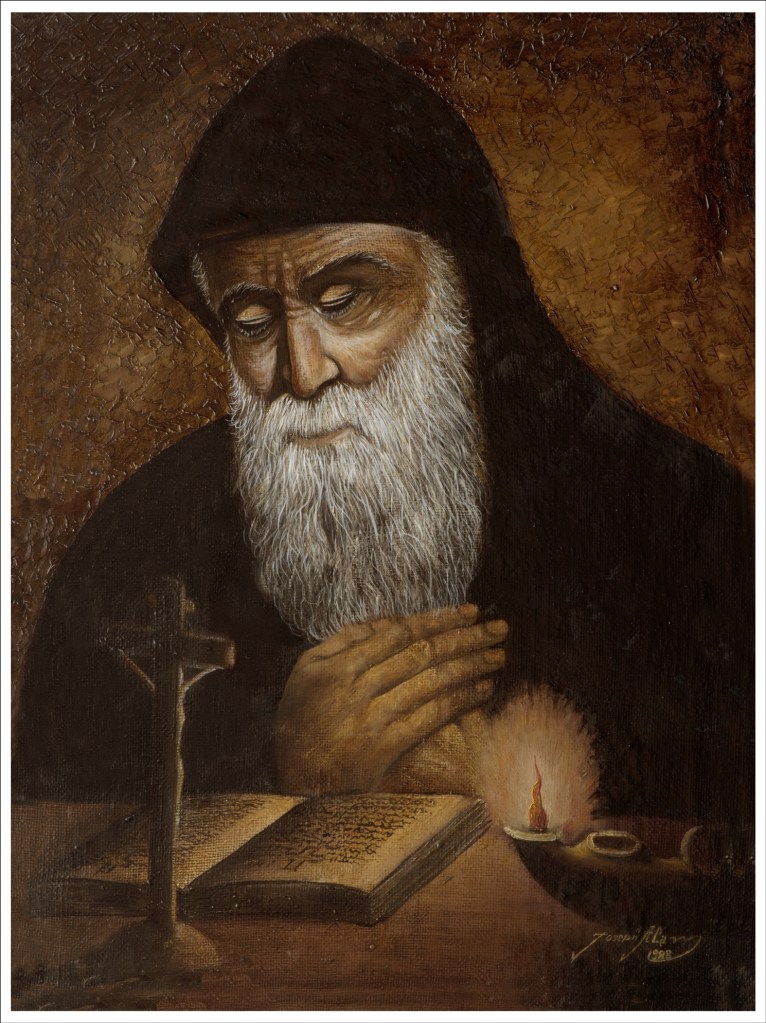
Born in 1828 in a small mountain village of Lebanon to a poor but devout family. As a boy, he tended sheep in the wilderness, where he fashioned for himself a shrine to our Lady, spending long hours in prayer. SAINT SHARBEL MAKLŪF became a monk in the Maronite Rite and was ordained a priest in 1859. In 1875, moved by the teachings of the Desert Fathers, he entered the hermitage of Saints Peter and Paul. His entire life centred on the Sacrifice of the Mass. Devoted to the Blessed Virgin Mary, he spent the last twenty-three years of his life as a hermit. Despite temptations to wealth and comfort, he taught the value of poverty, self-sacrifice, and prayer by the manner of life he lived. He received the gift of performing miracles even during his lifetime. His tomb at the monastery of Saint Maron in Annaya, Lebanon, continues to be a place of pilgrimage. Canonized by Blessed Paul VI in 1977, he is known as the “Hermit of Lebanon.” “admirable flower of sanctity blooming on the stem of the ancient monastic traditions of the East”
SAINT CHRISTINA, VIRGIN, MARTYR
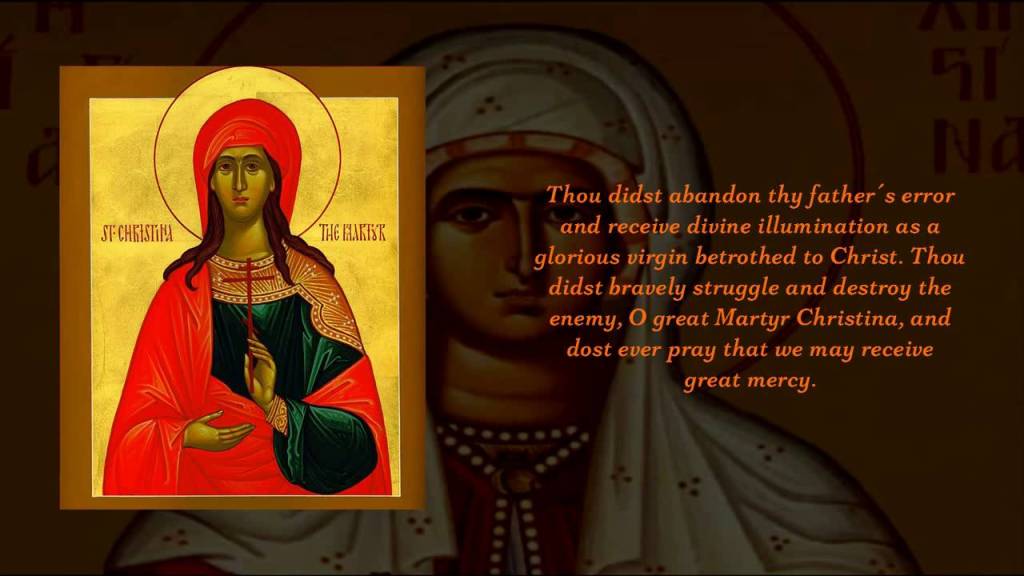
St. Christina, a Tuscan virgin, who when ten years old had taken and destroyed the silver idols in her father’s house, was in consequence tied to a post and pierced with arrows. Her tomb was discovered in 1880; an examination of her relics showed that she was scarcely more than fourteen years of age at the time of her death.
SAINT DECLAN, PRIEST
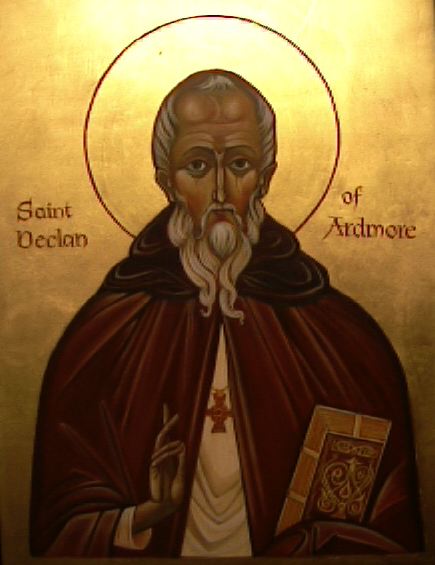
Declan was born to his father Erc Mac Trein and mother Deithin, and was of noble blood. His birthplace is thought to be around Lismore in Co. Waterford. According to a legend, on the night he was born a great ball of fire rested over the dwelling house along with a choir of angels, thus marking out the child as blessed by God from the moment of his birth. His mother lifted up her newborn baby and his head hit against a stone. Today this is called St Declan’s stone where pilgrims crawl through the cavity to dispel themselves of disease and illness. Colman, a holy priest explained to his parents that the child was blessed and told them that he must be reared with extra care and discipline.
At 7 years of age he started his studies under the care of his foster father Dobhran who was his paternal uncle. After many years with his uncle who loved him dearly and who left to Declan his dwelling place (according to some sources this may have also been Declan’s birth place) he was sent to a holy man named Dioma to further his studies. Whilst there his reputation grew and many disciples and followers came to him.
Declan decided to travel to Rome to study and there he met and became firm friends with Ailbe, the Bishop of Emly. During his stay he was ordained priest and bishop by the pope of the time. On his return journey to Ireland on an Italian highway he met Patrick who would later become the Patron Saint of Ireland. They formed a bond of friendship during this encounter.
One day as he was saying Mass, a black bell mysteriously appeared on the altar and St Declan took this as a sign of God from which he took comfort and courage for the journey ahead as he knew he would face many challenges. This bell is called ‘Duibhín Deaglán’. On one occasion when they reached the coast there was no ship available to them for their onward journey and St Declan rang his bell and mysteriously an empty ship appeared out of the mist to take them on their way. Another legend tells us that St Declan mislaid his beloved bell and whilst on a ship prayed for its return and looking overboard saw the bell sitting on a rock. He told his companions that wherever the bell would land he would build his monastery and the bell came ashore at Ardmore.
Declan built his monastery and over time it grew into a city as did his reputation as a holy man; many miracles were attributed to him from curing people of plague to giving sight to the blind and the lame walk.
Patrick, who he had met on his journey, had subsequently been appointed a bishop by pope Celestinus and as mentioned earlier, was in Cashel preaching and converting the King of Cashel and many others to Christianity. Ledban, the King of Deise, was antagonistic to Patrick and there was great trouble brewing so an Angel of the Lord appeared to Declan to tell him that he must make a journey to Cashel before matters escalated and the Irish people would gravely suffer as a result.
Declan made his way over the Knockmealdown mountains, passing through Mount Melleray, Lismore, Ardfinnan, Cahir and onwards to Cashel – the route we know today as St Declan’s Way. Arriving at Cashel he was greeted hospitably by Patrick and the King and he encouraged the people to denounce Ledban and follow Patrick instead. A new King of the Deise was selected by Declan and Patrick, who was named Fergal Mac Cormac; he led his people in the grace of God and Ledban was banished and never heard of again.
St Declan continued his mission converting multitudes of people to Christianity in the Deise and beyond. But later on in his life, in order to better commune with God in solitude, he retired to a cell (Disert Deaglán) by the sea where he could pray and grow to love God even more.
As the time of his death was approaching he left his cell and returned to his monastery. He called his priest Mac Liag to him to administer the sacraments and there he received his final communion. He spoke to his disciples and followers and told them to continue to live holy lives and to do God’s Holy will. He blessed and kissed them in a token of love and peace and drew his final breath.
He died in the Fifth Century and his grave, according to tradition, is located in what is now called St Declan’s Oratory. His Feast Day is celebrated on 24th July. So as we walk in his footsteps on August 20th – 22nd, let us pray to this wonderful saint that he might again restore the people of Ireland to the Faith they once held so dear.
THE GENERAL JUDGMENT, FOR MONDAY – EIGHT WEEK AFTER PENTECOST BY ST. ALPHONSUS LIGUORI, BISHOP, DOCTOR OF THE CHURCH
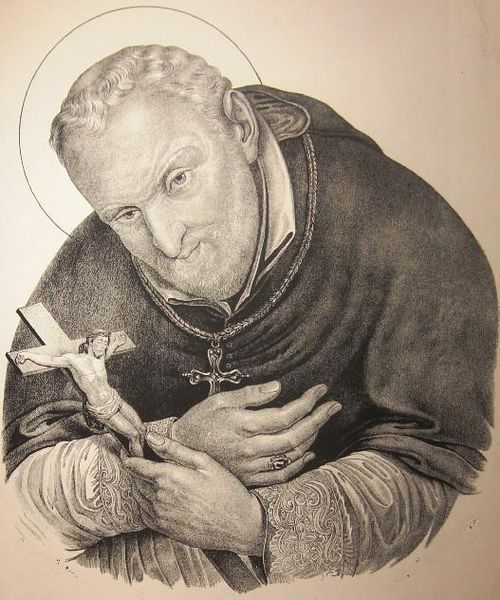
When all shall be gathered together in the Valley of Josaphet, what a glorious appearance will the Saints make who in this world were so much despised! And what a horrible appearance will so many of those great ones of earth, and kings, and princes make, who will on that day stand condemned!
O ye foolish worldlings! I look forward to your appearance in the Valley of Josaphet. There you will change your sentiments! There you will bewail your folly! But to no purpose.
And you, who are hard tried in this world, be of good heart. On that last day all your pains will be changed into the delights and enjoyments of Paradise: Your sorrow shall be turned into joy (Jo. xvi. 20).
What a glorious appearance will the Saints then make who in this world were so much despised! And what a horrible appearance will so many of those nobles and kings and princes make, who will stand condemned on that day!
My crucified and despised Jesus, I embrace Thy Cross. What is the world, what are pleasures, what are honours? O my God, Thee only do I desire; Thee alone and nothing more!
What horror will not the reprobate in that day experience at being rejected by Jesus Christ in that terrible sentence, publicly pronounced: Depart from Me, ye cursed! (Matt. xxv. 41).
O my Jesus, I also at one time deserved such a sentence. But now I hope that Thou hast pardoned me. Oh, do not suffer me to be any more separated from Thee. I love Thee, and I hope to love Thee forever.
O what joy, on the other hand will the Elect experience when they hear Jesus Christ inviting them to partake of the bliss of Heaven in those sweet words: Come ye blessed!
My beloved Redeemer, I hope in Thy precious Blood that I also shall be numbered among those happy souls, and embracing Thy feet, love Thee for all Eternity in Heaven!
Let us, then, reanimate our Faith, and reflect that one day we shall meet in that Valley of Judgment and be placed either on the right hand with the Elect, or on the left with the reprobate. Let us cast ourselves at the foot of the Crucifix and look into the state of our souls; and if we find them unprepared to appear before Jesus Christ, the Divine Judge, let us apply a remedy now whilst we have time. Let us detach ourselves from everything which is not God, and unite ourselves to Jesus Christ as much as we are able, by Meditation, the Holy Communion, mortification of the senses, and, above all, by Prayer. The use of these means which God affords us for our salvation will be a sure sign of our predestination.
O my Jesus and my Judge, I do not wish to lose Thee, but I wish to love Thee forever. I love Thee, my LORD, I love Thee; and thus I hope to be able to address Thee when I shall first behold Thee as my Judge. I now say to Thee: LORD, if Thou desirest to chastise me, as I have deserved, chastise me, but do not deprive me of Thy Love; grant that I may always love Thee, and may be always loved by Thee, and then do with me what Thou wilt.
DAILY MEDITATION

Christina, whose very name fills the Church with the fragrance of the Spouse, comes as a graceful harbinger to the feast of the elder “Son of Thunder.” The ancient, Vulsinium, seated by its lake with basalt shores, and calm clear waters, was the scene of a triumph over Etruscan paganism, when this child of ten years despised the idols of the nations, in the very place, where, according to the edict of Constantine, the false priests of Umbria, and Tuscany held a solemn annual renewal. The discovery of Christina’s tomb in our days has confirmed this particular of the age of the martyr, has given in her Acts, which were denied authenticity by the science of recent times: one more lesson given to and infatuated criticism, which mistrusts everything but itself.
As we look from the shore where the arrow a child is the lead to rest after her combat, and see the isle where Amalasonte, the noble daughter of Theodoric the Great, perished so tragically, the nothingness of mere earthly grandeur speaks more powerfully to the soul than the most eloquent discourse. In the 13th century, the spouse, continuing to exhort the little martyr above the most illustrious queens, associated her in the triumph of His Sacrament of love: it was Christina’s church He chose as the theatre of the famous miracle of Bolsena, which anticipated, by but a few months, the institution of the feast of Corpus Christi.
Dom Prosper Guéranger [d. 1875] – brilliant, Benedictine, priest, scholar, Abbott, and founder of what is now the Solesmes Congregation in France.
“In the heart of the earth”
“Yes, with My Spirit and with My Blood, I redeem you, My well-beloved.” Such is our king, who dies that we might live. He accepts humiliations and torture; a king in solidarity with those who suffer in their bodies and in their souls, those who endure all kinds of violence, disdain, oppression, threats, hunger, thirst, and poverty; in solidarity with those who believe in Him as well as those who do not. They are not alone in their difficult travails, for the light of the Resurrection will certainly arise. For after suffering will come glory, and after death, resurrection. He allowed Himself to be imprisoned in the tomb in order to free us from the prison of sin and evil….
After the entombment of Jesus and the sabbath day of rest (Lk 23:56), the three Marys went in secret to the place where the Body of the Crucified had been laid. They went in haste with the same faithfulness with which they had followed Jesus on the roads of Galilee and Judea, and straight to Golgotha (cf. Jn 19:25). They brought with them oils with which to anoint and embrace His corpse one last time before He would return to dust. But the tomb is empty; only the winding sheets remain (Lk 24:12), and they find Life ahead. The dawn they had awaited before returning to the tomb heralds the most important day in the history of mankind: the Resurrection. They don’t know it yet, but they are to be the first heralds, the living witnesses of a Truth that we live and comprehend through our Faith.
Why look among the dead for someone who is alive? He is not here (Lk 24:5-6). The two men in dazzling apparel (Lk 24:4) bring new Hope to their broken hearts. Where is He? Far from the tomb: He has Risen, as He said He would (Mt 28:6). Here they are before the triumph over death and suffering. Life, born from the shadows of the tomb, has had the final word. “By dying He has destroyed our death, and by rising, restored our life.”
Father Tony El Khoury
Father El Khoury is a Lebanese priest, professor, author, and iconographer. He is the author of A Light from the East: Meditations and Icons Illuminate the Life of Christ (Magnificat). [From A Light from the East: Meditations and Icons Illuminate the Life of Christ. ©
“The refusal to take sides on great moral issues is itself a decision. It is a silent acquiescence to evil. The tragedy of our time is that those who still believe in honesty lack fire and conviction, while those who believe in dishonesty are full of passionate conviction.” – Ven. Archbishop Fulton Sheen
 Daily Reflections
Leave a comment