John 15:15; Matthew 13:11, 16
I will not now call you servants, but I have called you friends,
– because all things whatsoever
I have heard from My Father, I have made known to you.
The mysteries of the Kingdom of Heaven have been revealed to you;
blessed are your eyes because they see
and your ears because they hear.
– because all things whatsoever
I have heard from My Father, I have made known to you.
Feast of Saint James, Apostle
St. Christopher, Martyr (Traditional)
SAINT JAMES, APOSTLE
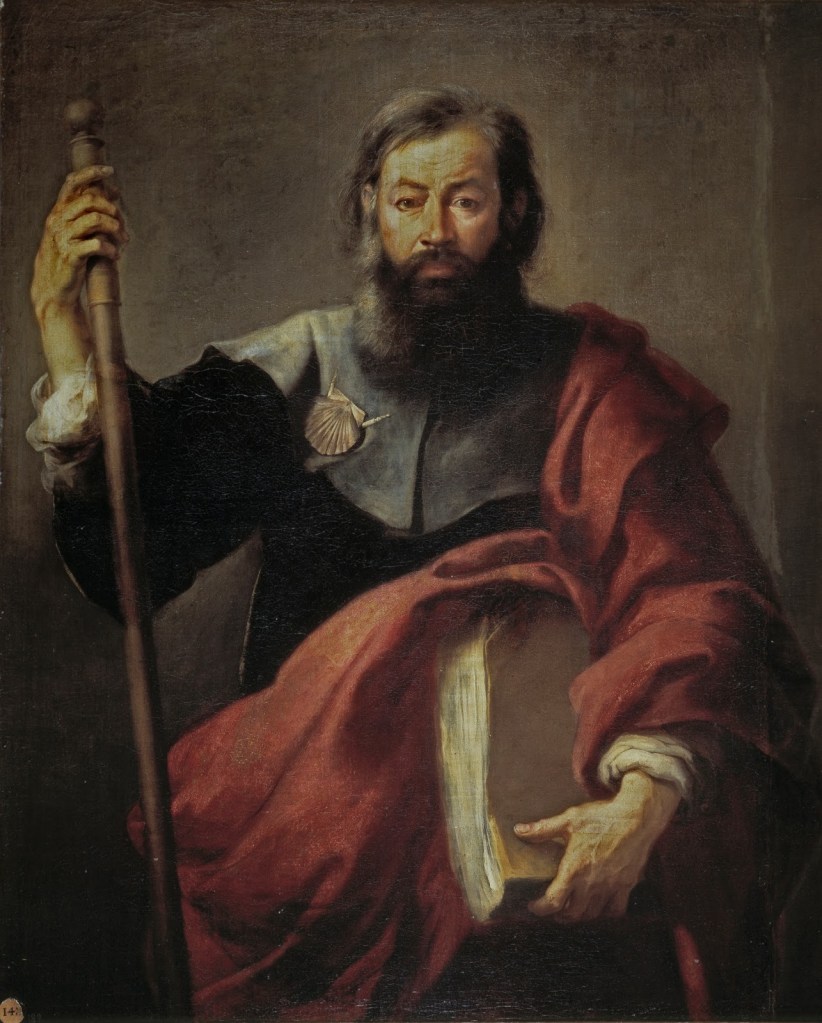
Saint James was the brother of John, and the first of the Apostolic College to suffer martyrdom. He was beheaded by Herod Agrippa about the year 43 A.D. He was one of the intimate friends of our Saviour: he witnessed the Transfiguration and the agony in the Garden of Olives. Christ foretold his martyrdom on the occasion when the mother of James and John asked for her two sons, that they be seated one on His right hand, and the other at His left in His Kingdom. James preached the Gospel in Judea and Samaria, and even in distant Spain.
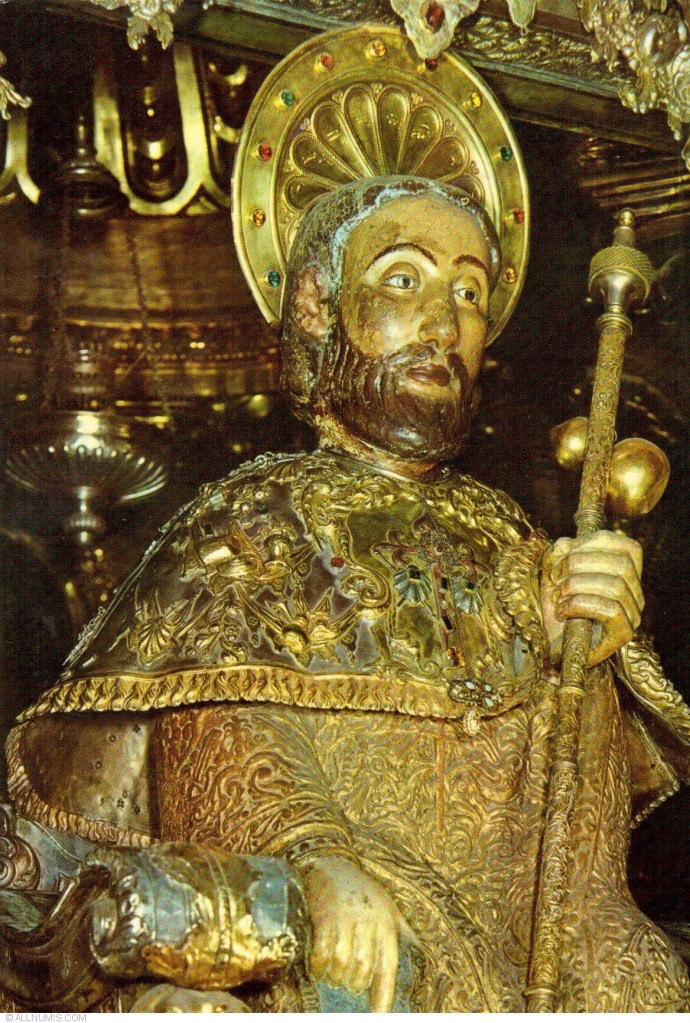
In the sixth century, the tomb of the two apostles of the name of James was still being venerated at Jerusalem. But in the ninth century we find that the relics of Saint James the Greater we were already the object of great devotion at Santiago de Compostella, whither they may have been carried after the Arabs had taken possession of the Holy City. Throughout the Middle Ages, the pilgrimage to Galicia to the tomb of Saint James was one of the most popular of all, and wholly worthy of the special place, which Saint James occupied beside our Blessed LORD.
ST. CHRISTOPHER, MARTYR
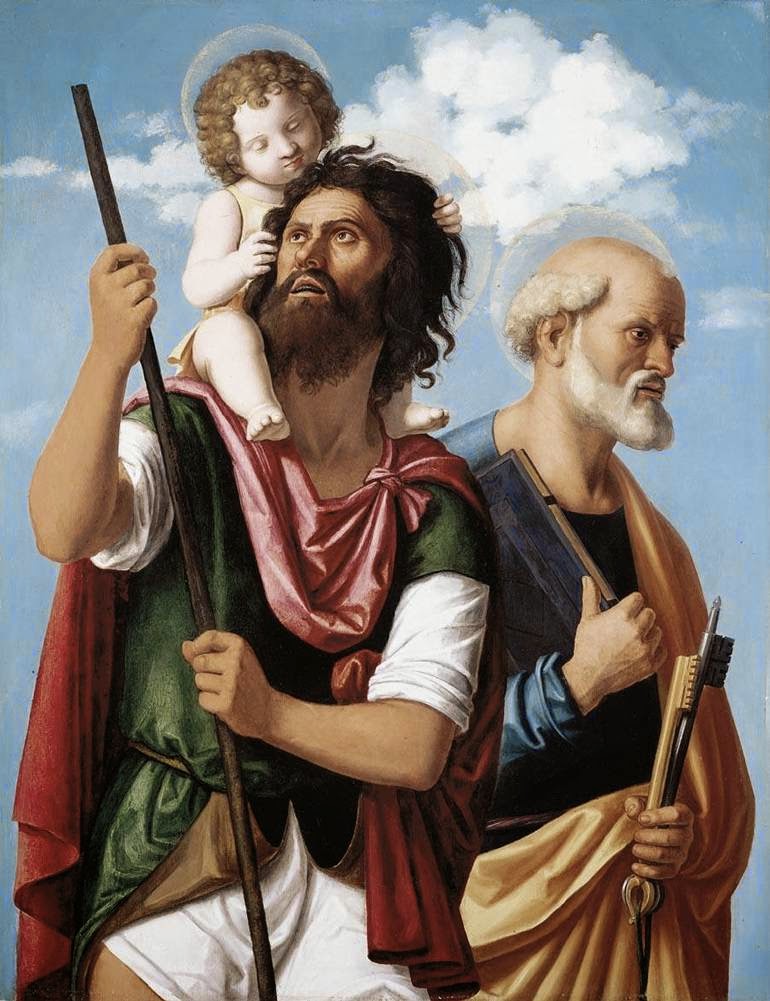
Saint Christopher, a native of Chanaan, was martyred at Lycia in the Third Century. He was greatly venerated in the East. His name, which signifies “one who carries Christ,” one for him great veneration even in the city of Rome. Many statues of Saint Christopher were placed at the entrance to cathedrals. He is the patron of travellers and is involved in storms, tempests and plagues. The medal of Saint Christopher is frequently attached to motor vehicles.
From a homily on Matthew by Saint John Chrysostom, Bishop
(Hom. 65, 2-4: PG 58, 619-622)
Sharers in the suffering of Christ
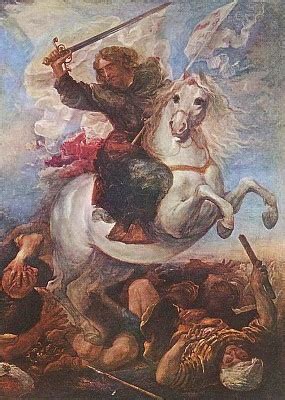

The sons of Zebedee press Christ: Promise that one may sit at your right side and the other at your left. What does He do? He wants to show them that it is not a spiritual gift for which they are asking, and that if they knew what their request involved, they would never dare make it. So He says: You do not know what you are asking, that is, what a great and splendid thing it is and how much beyond the reach even of the heavenly powers. Then He continues: Can you drink the cup which I must drink and be baptized with the Baptism which I must undergo? He is saying: “You talk of sharing honours and rewards with Me, but I must talk of struggle and toil. Now is not the time for rewards or the time for My glory to be revealed. Earthly life is the time for bloodshed, war and danger.”
Consider how by His manner of questioning he exhorts and draws them. He does not say: “Can you face being slaughtered? Can you shed your blood?” How does He put His question? Can you drink the Cup? Then He makes it attractive by adding: which I must drink, so that the prospect of sharing it with Him may make them more eager. He also calls His suffering a baptism, to show that it will effect a great cleansing of the entire world. The disciples answer Him: We can! Fervour makes them answer promptly, though they really do not know what they are saying but still think they will receive what they ask for.
How does Christ reply? You will indeed drink My Cup and be baptized with My baptism. He is really prophesying a great blessing for them, since He is telling them: You will be found worthy of martyrdom; you will suffer what I suffer and end your life with a violent death, thus sharing all with Me. But seats at My right and left are not Mine to give; they belong to those for whom the Father has prepared them. Thus, after lifting their minds to higher goals and preparing them to meet and overcome all that will make them desolate, He sets them straight on their request.
Then the other ten became angry at the two brothers. See how imperfect they all are: the two who tried to get ahead of the other ten, and the ten who were jealous of the two! But, as I said before, show them to me at a later date in their lives, and you will see that all these impulses and feelings have disappeared. Read how John, the very man who here asks for the first place, will always yield to Peter when it comes to preaching and performing miracles in the Acts of the Apostles. James, for his part, was not to live very much longer; for from the beginning he was inspired by great fervour and, setting aside all purely human goals, rose to such splendid heights that he straightway suffered martyrdom.
Drinking the Cup
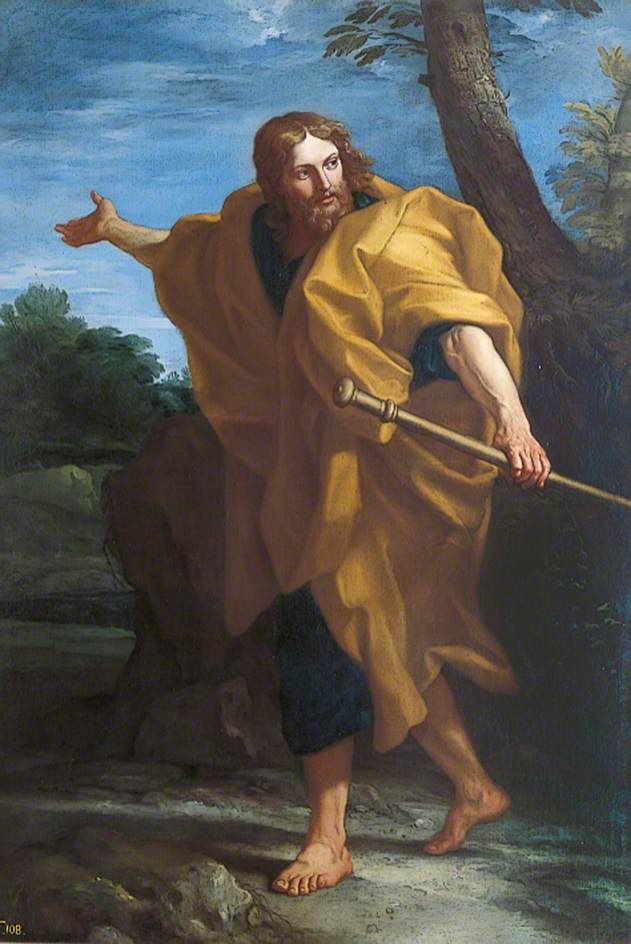
Holy Faith teaches us that in Holy Communion we join Christ with all our being. At this moment, once you have received Him, His soul is united with yours, His body with yours is combined, His mind is joined with your mind….
Holy Communion means in Polish “unification”, not only of the soul with Christ, but also of all the faithful joined together at the table of the LORD. At the time of the first Christians, the faithful used to receive Holy Communion every day, they were one heart and one soul. In those early centuries, Christians observed this recommendation to grant one another a kiss of peace before receiving Holy Communion (cf. Mt 5:23-24).
On the altar we become relatives of Christ. Who is a relative? It is a man in whom the same blood flows. That is why we are relatives of God, kindred with God, because the Son of God’s blood flows in us. Union with God transforms us into Him, makes us one with Him. The LORD God chose us to be like the image of His Son. There is no more effective means than Holy Communion. That is why the Saviour says, if you do not eat the flesh of the Son of Man and drink His Blood, you will not have Life in you (Jn 6:53), and He who eats My flesh and drinks My Blood lives in Me and I live in him (Jn 6:56).
Do you want to know what the effect of this unification is? It is a slow transformation into Jesus Christ. If a drop of water goes through a stone, what can the LORD Jesus do for a soul receiving frequent Holy Communion, even if the heart of the host is stony? As the seal reflects on the softened wax, so the image of Jesus is reflected on everyone who receives Holy Communion, especially on those who receive it often and with dignity.
Blessed Honoratus Koźmiński
Blessed Honoratus († 1916) was a Polish Capuchin Franciscan priest. He founded numerous religious congregations, including the Sisters Servants of Mary Immaculate, who have served for many years at the Basilica of the National Shrine of the Immaculate Conception in Washington, D.C. [From The Eucharist as the Treasure of the Church: Selected Thoughts from the Writings of Blessed Honorat Koźmiński, Anna Dąbrowska, Tr.
DAILY MEDITATION
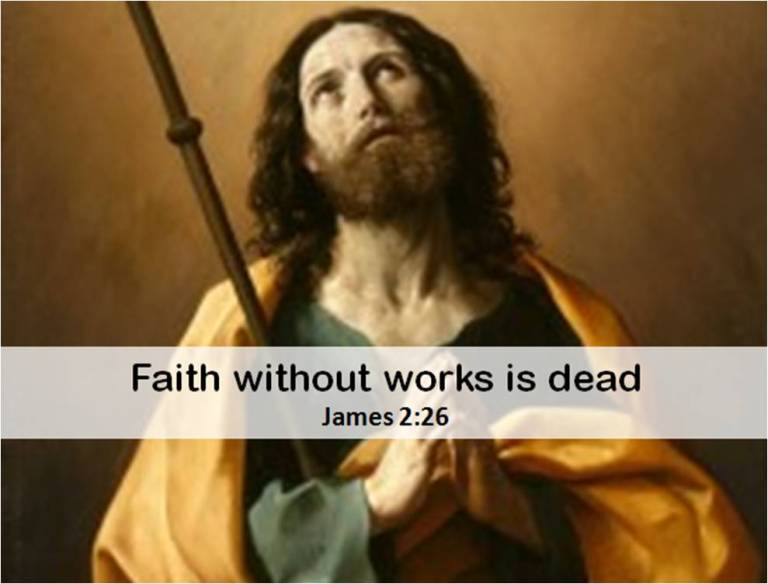
Among the Twelve, three were chosen as the familiar companions of our Blessed LORD, and of these James was one. He alone, with Peter and John, was admitted to the house of Jairus, when the dead maiden was raised to life. They alone were taken up to the high mountain apart, and saw the face of Jesus shining as the sun, and his garments, white as snow, and these three alone, witnessed the fearful agony in Gethsemane. What was it that won James a place among the favourite three? Faith, burning, impetuous and outspoken, but which needed purifying before the “Son of Thunder” could proclaim the Gospel of peace. It was James, who demanded fire from heaven, to consume the inhospitable, Samaritans, and who sought the place of honour by Christ in His Kingdom. Yet our LORD, and rebuking his perception, prophesied his faithfulness to death.
When St. James was brought before king, Herod, Agrippa, his fearless confession of Jesus, crucified, so moved the public prosecutor that he declared himself a Christian on the spot. Accused and accuser were hurried off together to execution, and, on the road, the latter begged pardon of the saint. the apostle had long sins, forgiven him, but hesitated for a moment, whether publicly to accept as a Brother one still unbaptized. God quickly record to him the churches Faith, that the blood of martyrdom supplies for every Sacrament, and, falling on his companions neck, he embraced him, with the words: “peace be with thee!“ Together then they knelt for the sword, and together received the crown.
Reflection: we must all desire, a place in the kingdom of our Father; but can we drink the Chalice, which He holds out to each? Possumus, we must say with Saint James – “We can” – but only in the strength of Him who has drunk at first for us.
John Gilmary Shea [d. 1892] – author and celebrated historian, regarded as the father of American Catholic history.
“The refusal to take sides on great moral issues is itself a decision. It is a silent acquiescence to evil. The Tragedy of our time is that those who still believe in honesty lack fire and conviction, while those who believe in dishonesty are full of passionate conviction.” – Ven. Archbishop Fulton Sheen
 Daily Reflections
Leave a comment