Friday of the Sixteenth Week in Ordinary Time
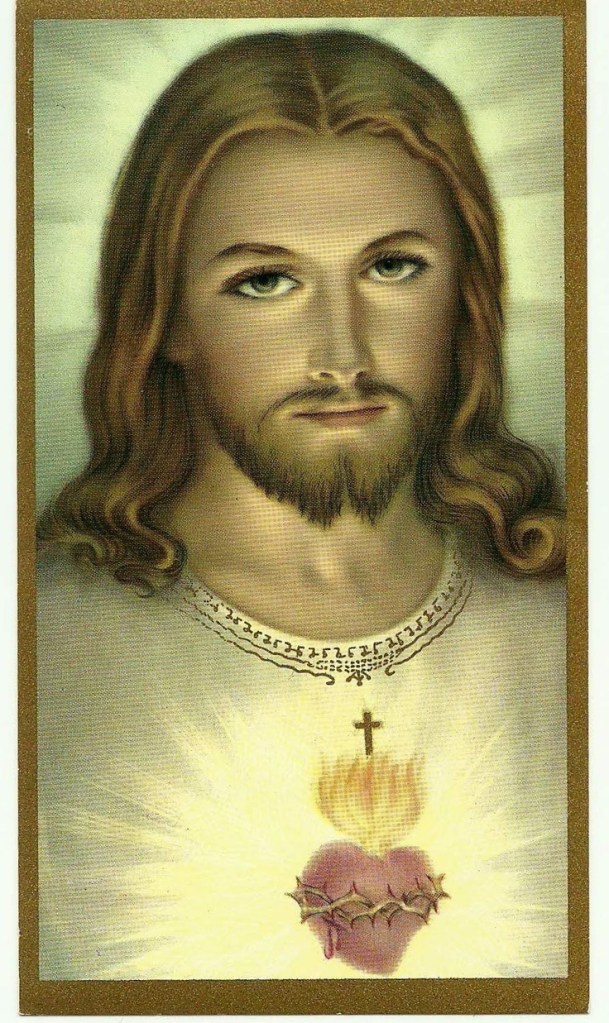
Friday of the Sacred Heart of Jesus
SS Nazarius and Celsus, Martyrs (Traditional)
Saint Victor I, Pope (Traditional)
Saint Innocent I, Pope (Traditional)
The “seed in rich soil” (Mt 13: 18-23) is the one who hears God’s Word and bears fruit a hundredfold. The Ten Commandments are the seed that God sows in the rich soil of our human nature. Our obedience to all that is good, true, and beautiful in the Decalogue naturally flowers into the most perfect of human flourishing
STS. NAZARIUS, CELSUS, VICTOR & INNOCENT, MARTYRS
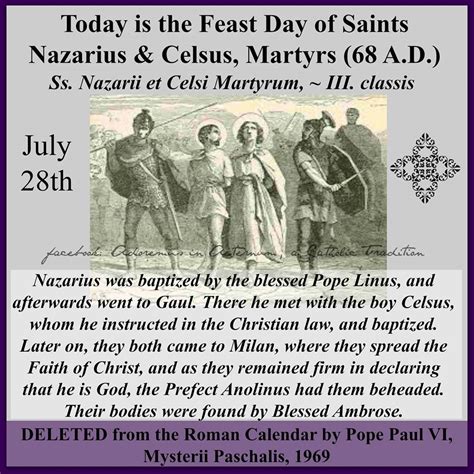
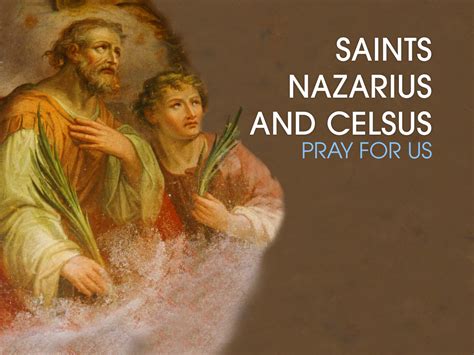
St. Nazarius was baptized by Pope Linus at Rome; in his turn he baptized the youthful Celsus. They were both beheaded at Milan about the year 68. Their bodies, buried in a garden outside the city, were found by Saint Ambrose in 395. The body of St. Nazarius appeared as if it had just been beheaded. It was placed by Saint Ambrose in the Basilica Romano. The body of the boy Celsus was found in another part of the garden, but was not removed. However, a Basilica was later built in his honour.
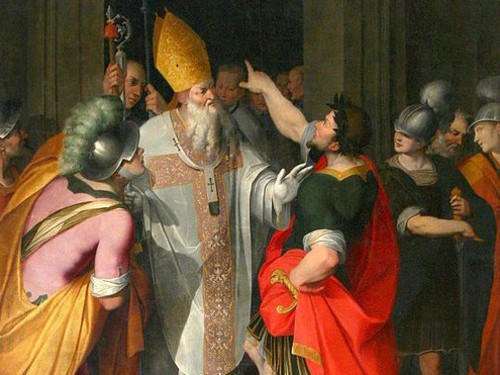
Pope St. Victor I, successor of St. Eleutherius was the thirteenth order from Saint Peter, is famous in the history of the Church of the first three centuries for his encyclicals addressed to all the churches, in which he appointed synods with a view to coming to an agreement concerning the date of the celebration of Easter. Even the bishops of the most remote dioceses of Asia Minor obeyed the Pope’s order and sent the votes to Rome, but as these were not in accordance with the Roman view, it very nearly caused a schism. He succeeded in settling the controversy about the date of Easter, and is said to have decided that in case of necessity Baptism might be given with natural water. He was the first encyclical writer to write in Latin.

Saint Innocent I, Pope, Confessor [402–417], the successor of St. Anastasius, took a vigourous part in the defence of St. John Chrysostom, upheld the rights of the Holy See, and wrote a letter on liturgical questions which remains a notable document to this day.
From the Confessions of Saint Augustine, Bishop and Doctor of the Church
(Lib. 10, 43, 68-70: CSEL 33:278-280)
Christ died for all

The true Mediator was He whom you revealed to humble men in your secret mercy, and whom you sent so they might learn that same humility by following His example. This was the Mediator between God and man, the man Christ Jesus, who intervened between sinful mortals and the Immortal Just One, Himself mortal like men, and like God, Just. Thus, since life and peace are the compensation for righteousness, He could, by a justice united with God, annul the death of sinners now justified, since He willed to share death with them.
Good Father, how You loved us, sparing not Your only Son but delivering Him up for us sinners! How You loved us, for whose sake He, thinking it no robbery to be equal with You, was made subject to death on the Cross. He alone, free among the dead, had the power to lay down His Life and the power to take it up again. For our sake He became in Your sight both Victor and Victim—Victor, indeed, because He was Victim. For our sake, too, He became before You both Priest and Sacrifice—Priest, indeed, because He was a Sacrifice, changing us from slaves to sons by being Your Son and serving us.
Rightly then have I firm Hope that You will heal all my infirmities through Him who sits at Your right hand and intercedes for us. Otherwise I should despair. For great and numerous are these infirmities of mine, great indeed and numerous, but Your medicine is mightier. We might have thought Your Word remote from any union with man, and so have despaired of ourselves, if He had not become Flesh and dwelt among us.
Crushed by my sins and the weight of my misery, I had taken thought in my heart and contemplated flight into the desert. But You stopped me and gave me comfort with the words: Christ died for all, that those who live might no longer live for themselves but for Him who died for them.
Behold, LORD, I cast upon You my concern that I may live and I shall meditate on the wonders of Your law. You know my ignorance and my weakness; teach me and heal me. Your only Son, in whom are hidden all the treasures of wisdom and knowledge, redeemed me with His Blood. Let not arrogant men speak evil of me. For I meditate on my ransom, and I eat it and drink it and try to share it with others; though poor I want to be filled with it in the company of those who eat and are filled and they shall praise the LORD who seek Him.
DAILY MEDITATION
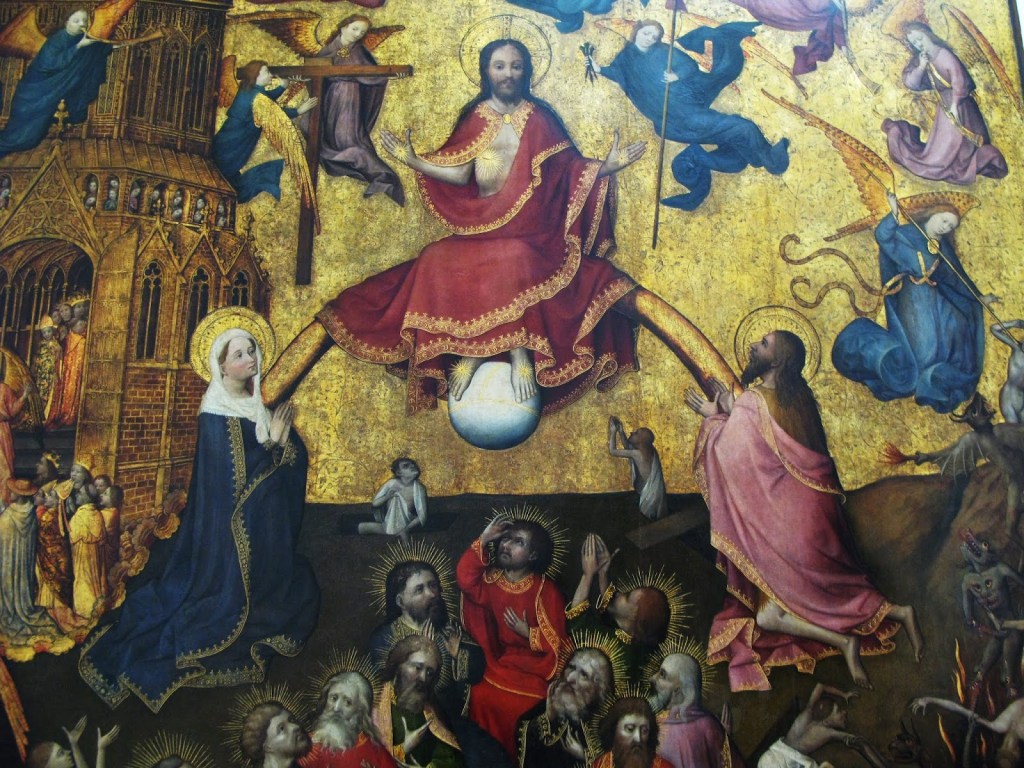
These physical cataclysms, these terrible manifestations of nature will be the work of God’s own hand, the certain signs and forebodings of the coming of the Judge. They will usher in the Day of Judgment.
Let us place ourselves in spirit in the midst of this universal confusion, disorder, and destruction, and picture to ourselves, if we can, the darkness, and the meteoric falling of the stars from heaven, and we shall understand why indescribable “dread“ and “trembling“ [tremor] will seize every human being, and many will wither away from fear, in expectation of what shall come upon the world [Luke 21:26]. But these sudden and violent changes, these strange and a natural phenomena will not be the only reason for fear and trembling.
Equally terrifying will it be the advent of the Great Judge and the rigour of His judgements. “The LORD will come in the glory of His Majesty, and accompanying Him there will be innumerable legions of angels, radiant in their splendour.” When He appears, the resurrection of the dead will have taken place. And so wonderful, so strikingly beautiful will be the sudden appearance of the Transfigured God-Man, who comes to judge, that not only men, but also the angels will be filled with fear and trembling. The effect on the elect of God, and the reprobate souls, however, would be quite different. The good will tremble in holy adoration and ecstasy, for joy and expectation, for now, indeed, they may “lift up” their heads, as their “redemption is at hand” [Luke 21:28]. For them, the final triumph, the day of eternal glory is that a hand. The sinners, on the other hand, will tremble in fear and anguish, literally overcome by the terrifying sight of the angry Judge Who has come to pass sentence upon them.
Monsignor Nicolas Gibr [d. 1924:] – German priest of the archdiocese of Freiburg, respected liturgist and dogmatic theologian of humble piety and devotion
How to Allow the Seed to Come to Fruition
Since according to Gregory [the Great] the gifts of God are easily lost unless they are preserved by the Giver, anyone who has some gift of God must have recourse to the Giver, so that He may guard it; and the one who has more must have recourse more often. It was in this sense that Gregory taught the universal Church to pray in the prayer which says, “Guard in Your new family the spirit of adoption which You have given.” Again, people especially call upon Divine help in difficult matters, and so David, considering how difficult it is to go along the narrow road…until the end, prayed, saying I kept my feet firmly in your paths (Ps 16:5)….
Know also that holy meditations…greatly benefit the one who meditates. First of all, they stir up his spirit. At night I mused within my heart (Ps 77:7), that is, by meditating. Now the exercising of the spirit is of much greater value than the exercising of the body, for this latter avails only a little. Such meditations purify the soul. Hence, the same Psalm continues: I pondered and my spirit questioned, that is, by meditations. Again, they enflame the heart. And so Psalm 38:4 says: At the thought of it, the fire blazed up. Again, they subjugate the flesh: much study wearies the body (Qo 12:12). They help in countless ways to bring about a well-ordered life. In his book On Consideration, which means much the same as “meditation”, Bernard [of Clairvaux] says this: “Consideration first of all purifies the mind in which it arises. It then governs the feelings, directs actions, corrects excesses, controls our behaviour, makes our life worthy and orderly, resolves doubts, strengthens what is slack, gathers together what is scattered, scrutinises what is hidden, investigates the Truth, tests what is plausible, determines what is false and illusory, plans our actions, and thinks over what we have done, in order that there may remain nothing in the mind which is either uncorrected or in need of correction. It is consideration that foresees trouble in peaceful times, but which heeds not the troubles when they come, thus showing both prudence and courage.”
Blessed Humbert of Romans
Blessed Humbert (c. 1200–1277) was a French Dominican friar and a prolific author who served as Master of the Order of Preachers from 1254 to 1263. [From De Oratione, Thomas Crean, o.p., Tr. Copyright
“The refusal to take sides on great moral issues is itself a decision. It is a silent acquiescence to evil. The tragedy of our time is that those who still believe in honesty lack fire and conviction, while those who believe in dishonesty are full of passionate conviction.” – Ven. Archbishop Fulton Sheen
 Daily Reflections
Leave a comment