2 Corinthians 8:9; Philippians 2:7
You are well aware of the generosity of Our LORD Jesus Christ.
Though He was rich, He became poor for your sake,
– so that through His poverty you might become rich.
He emptied Himself, assuming the condition of a slave.
– So that through His poverty you might become rich.
Monday of the Seventeenth Week in Ordinary Time
Saint Ignatius of Loyola, Confessor
SAINT IGNATIUS OF LOYOLA, CONFESSOR
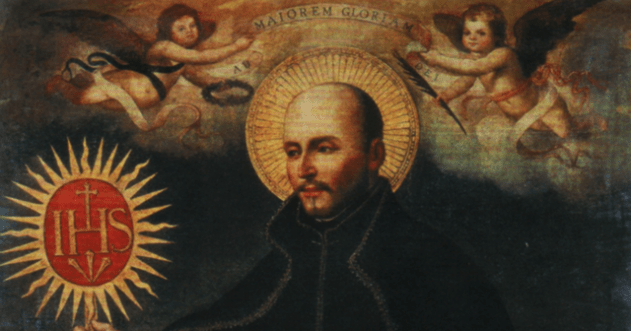
Saint Ignatius was born at Loyola in Northern Spain, in the year 1491. He served his king as a courtier and a soldier till his thirtieth year. At that age, being laid low by a traumatic leg injury, he received the call of divine grace to leave the world. During his long convalescence, he was given, in the absence of other books, the reading of the Life of Jesus and the lives of the saints revealed to him that the Church Militant needed an army of glorious soldiers, to fight the forces of Satan: pagans, Mohammedans, protestants, etc. After a period of intense penances, Ignatius went to university in Paris, where he met Francis Xavier, Peter Faber, and the other original members of the Society of Jesus. He founded the Society of Jesus (Jesuits) and as first General of this new spiritual chivalry he moved to the attack under the motto: “ Ad majorem Dei Gloriam – To the greater glory of God!” He embraced poverty and humiliation, that he might become more like to Christ, and won others to join him in the service of God. Prompted by their love for Jesus Christ, Ignatius and his companions made a vow to go to the Holy Land, but war broke out, and prevented the execution of their project. Then they turned to the Vicar of Jesus Christ, and placed themselves under his obedience. This was the beginning of the Society of Jesus. Our LORD promised Saint Ignatius that the precious heritage of His Passion should never fail his Society, a heritage of contradictions and persecutions. Saint Ignatius was cast into prison at Salamanca, on a suspicion of heresy. To a friend who expressed sympathy with him on account of his imprisonment, he replied, “It is a sign that you have but little love of Christ in your heart, or you would not deem it so hard a fate to be in chains for His sake. I declare to you that all Salamanca does not contain as many fetters, manacles, and chains as I long to wear for the love of Jesus Christ.” In the last fifteen years of his life, Ignatius led the order from Rome, writing almost seven thousand letters to encourage and guide his brethren.
With the sweet name of Jesus on his lips and in his heart, Saint Ignatius gave his soul to God on the 31st July, 1556. His body is preserved in Rome in the magnificent church built by Cardinal Alessandro Farnese and dedicated to his memory.
From the life of Saint Ignatius from his own words by Luis Gonzalez
(Cap. 1, 5-9: Acta Sanctorum, Julii, 7 [1898], 647)
Put inward experiences to the test to see if they come from God
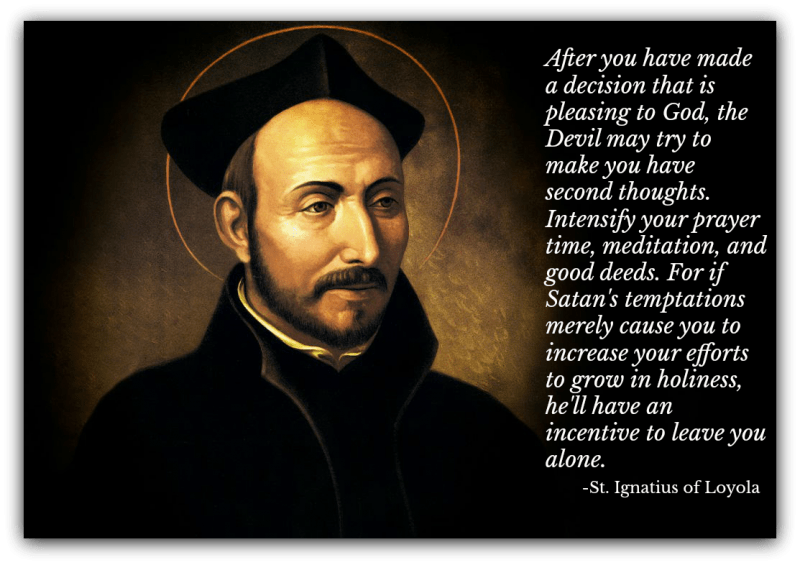
Ignatius was passionately fond of reading worldly books of fiction and tales of knight-errantry. When he felt he was getting better, he asked for some of these books to pass the time. But no book of that sort could be found in the house; instead they gave him a life of Christ and a collection of the lives of saints written in Spanish.
By constantly reading these books he began to be attracted to what he found narrated there. Sometimes in the midst of his reading he would reflect on what he had read. Yet at other times he would dwell on many of the things which he had been accustomed to dwell on previously. But at this point Our LORD came to his assistance, insuring that these thoughts were followed by others which arose from his current reading.
While reading the life of Christ Our LORD or the lives of the saints, he would reflect and reason with himself: “What if I should do what Saint Francis or Saint Dominic did?” In this way he let his mind dwell on many thoughts; they lasted a while until other things took their place. Then those vain and worldly images would come into his mind and remain a long time. This sequence of thoughts persisted with him for a long time.
But there was a difference. When Ignatius reflected on worldly thoughts, he felt intense pleasure; but when he gave them up out of weariness, he felt dry and depressed. Yet when he thought of living the rigorous sort of life he knew the saints had lived, he not only experienced pleasure when he actually thought about it, but even after he dismissed these thoughts, he still experienced great joy. Yet he did not pay attention to this, nor did he appreciate it until one day, in a moment of insight, he began to marvel at the difference. Then he understood his experience: thoughts of one kind left him sad, the others full of joy. And this was the first time he applied a process of reasoning to his religious experience. Later on, when he began to formulate his spiritual exercises, he used this experience as an illustration to explain the doctrine he taught his disciples on the discernment of spirits.
DAILY MEDITATION
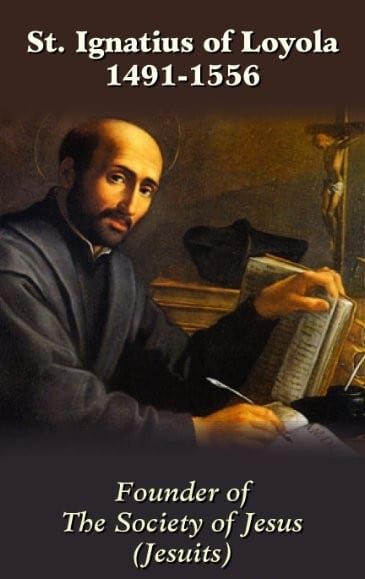
You will find much in the life of Saint Ignatius, which may serve you for instruction and example; and I will, in a few words, aid you to find some of the principle points:
The reform and holiness of the saint began by reading a devout book, the Lives of the Saints. As I told you elsewhere, the reading of pious books, especially the Lives of the Saints, is of very great spiritual benefit; while the reading of a wicked work does intense harm. The vices and consequent damnation of many are the effects of reading dangerous books; while the holiness and final salvation of others had their beginning in the lessons received while reading pious books. Judge from this in which direction your duty lies.
The purpose of all the actions of St. Ignatius was to promote the Glory of God and the salvation of souls, and as he sought in everything only the glory of God, he always selected what was agreeable, nay most agreeable to Him. To do that which is always the most pleasing to the Almighty, has always been the aim and distinguishing feature of all great saints on earth. To do that which is pleasing to God and to avoid that which is displeasing to Him is the duty of every Christian. To avoid only mortal sin is the sign of a very indifferent man, who neither loves God, nor is concerned about his salvation. Among which of these will you be ranked? Endeavour to have a place among the first, and do nothing, except for what you are convinced is pleasing to the Almighty, and avoid all that you know is displeasing to His Majesty. Perform all your works for the honour of God and the salvation of your soul.
Father Francis Xavier Weninger [d. 1888] – Austrian priest, professor, and author, joined the Jesuits as missionary preacher to the United States
Becoming “Full-Grown” in Christ
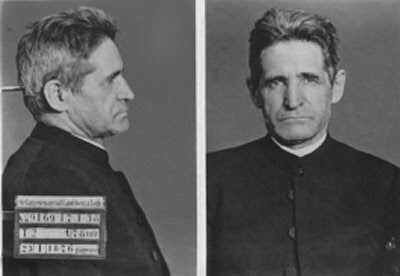
I have now passed through the most beautiful period of my life. One would not believe that possible. I have been happy, completely happy, as never before in my life. In the course of these weeks the dear LORD has let me know that He is satisfied with me. That makes me happy; all else cannot disturb me. Prison is better for me than a thousand lectures on behalf of the Catholic community, on apologetics, on the Gospel—much better than if I were to lecture on heaven knows what.
The day before yesterday I read a marvellously beautiful passage of Paul’s in the Epistle to the Philippians: I am glad to tell you, brothers, that the things that happened to me have actually been a help to the Good News. My chains, in Christ, have become famous not only all over the Praetorium but everywhere, and most of the brothers have taken courage in the LORD from these chains of mine and are getting more and more daring in announcing the Message without any fear… that makes me happy; and I shall continue being happy (Ph 1:12-14, 18-19). Is that not marvellous?
If people could only understand how little it takes to become truly happy inwardly! I have always known that God is good, but that He is good in the degree that I have been permitted to experience during the past fortnight, I should never have thought possible….
The ancients in their time used to say that it is sweet to die, likewise to suffer, for one’s native land. I have been granted this latter experience in bounteous measure, and I should not wish to have lacked it in my life. But it is even sweeter to suffer for the Holy Faith, and also to die for it. It is this that fills me with happiness here in prison, and that in turn is fortifying so many thousands of young people in Germany in their Catholic Faith. That too fills me with happiness.
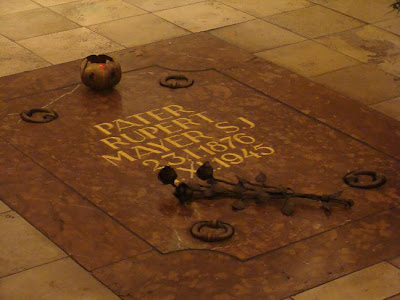
Blessed Rupert Mayer
Blessed Rupert Mayer († 1945), “the Apostle of Munich”, was a German Jesuit priest and prominent critic of the Nazis, who imprisoned him several times. He died on All Saints’ Day while celebrating Mass, and was beatified in 1987 by Saint John Paul II. [From Dying We Live: The Final Messages and Records of the Resistance, Helmut Gollwitzer, Käthe Kuhn, Reinhold Schneider, Eds., Reinhard C. Kuhn, Tr. Translation copyright
“The refusal to take sides on great moral issues is itself a decision. It is a silent acquiescence to evil. The tragedy of our time is that those who still believe in honesty lack fire and conviction, while those who believe in dishonesty are full of passionate conviction.” – Ven. Archbishop Fulton Sheen
 Daily Reflections
Leave a comment