2 Corinthians 10:3-4; Ephesians 6:16, 17
Though we live in this world,
we do not rely solely on the resources of the world to do battle.
– Our warfare is not waged with the weapons of this world.
We arm ourselves with the shield of Faith
and with the sword of the Spirit, which is the Word of God.
– Our warfare is not waged with the weapons of this world.
Wednesday of the Seventeenth Week in Ordinary Time
Saint Eusebius of Vercelli, Bishop
Saint Peter Julian Eymard, Priest
St. Alphonsus Mary Ligouri, Bishop, Confessor, Doctor of the Church (Traditional)
St. Stephen I, Pope, Martyr (Traditional)
Finding the Body of St. Stephen (Traditional)
SAINT EUSEBIUS, BISHOP
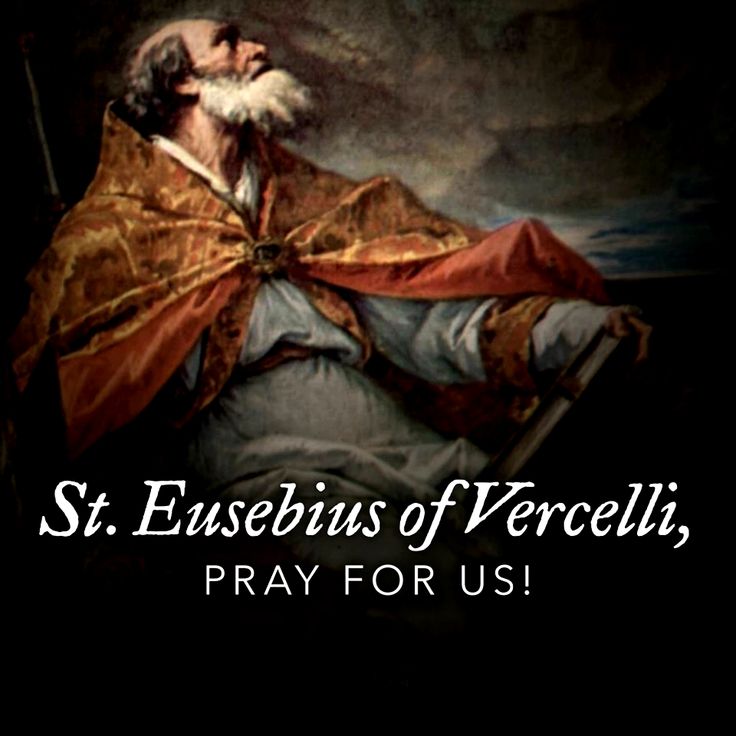
St. Eusebius was a model bishop of the 4th century: faithful, vigilant, and long-suffering. He was born at the beginning of the fourth century in Sardinia. He became a member of the Roman clergy and in 345 A.D. the people recognised Eusebius’ own ardent devotion and elected him their Bishop. Inspired by the writings of the Desert Fathers, he “brought the monastery to the city”, establishing a strict rule for the diocesan clergy. He spread religion by his preaching and established the monastic life in his diocese. He was driven into exile to Palestine by Emperor Constantius for his fidelity to the Nicene Creed and endured much suffering. In Palestine the Arian Bishop Patrophilus had him dragged through the streets and thrown into prison. Returning to his country, he worked tirelessly against the Arians for the restoration of the Faith, Eusebius urged his flock “to guard the Faith jealously, to preserve harmony, to be assiduous in prayer”. He died at Vercelli in 371.
ST. ALPHONSUS LIGOURI, BISHOP, CONFESSOR, DOCTOR OF THE CHURCH
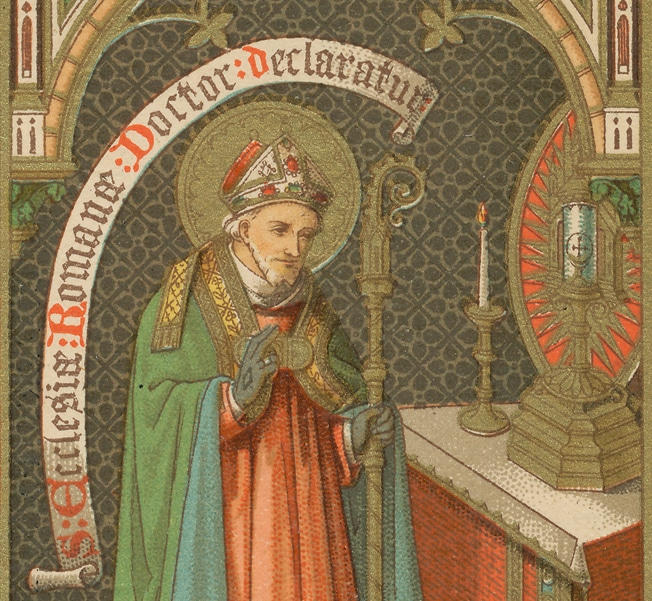
(See yesterday’s blog for his bio))
ST. STEPHEN I, POPE, MARTYR
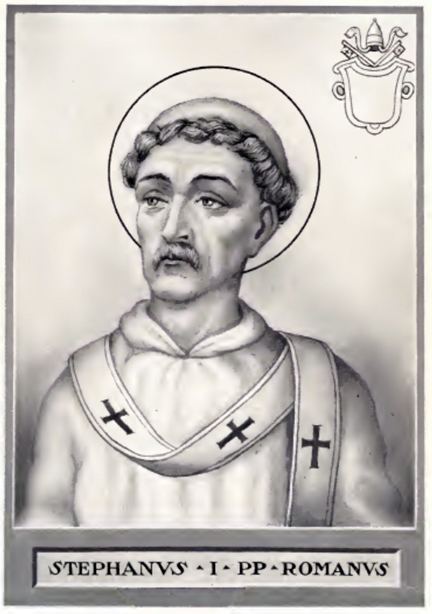
St. Stephen was beheaded by the persecutors toward the end of the Mass he was celebrating, while seated in the Episcopal chair in the catacombs in 257.
FINDING OF THE BODY OF ST. STEPHEN, MARTYR
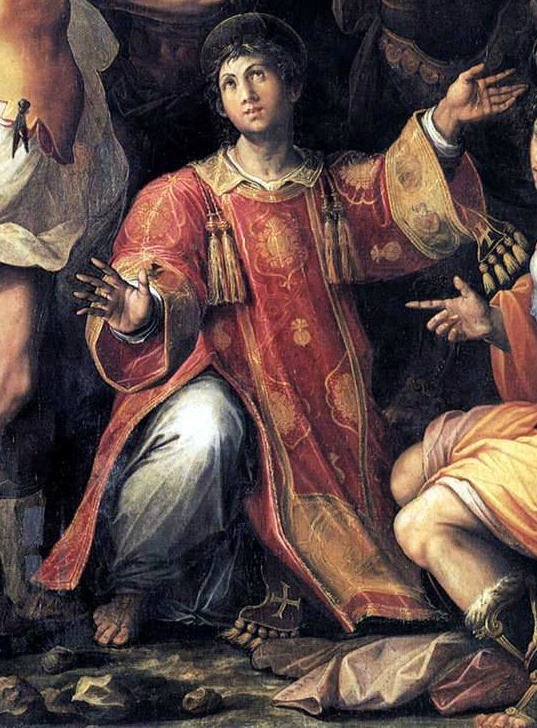
The body of St. Stephen, the first martyr, with those of some other saints, was discovered near Jerusalem in the year 415. Later the body of the saint was taken to Constantinople and finally to Rome, where it now lies beside that of St. Lawrence. The many miracles that occurred on the finding of St. Stephen’s body led to the institution of this festival, besides that of December 26th. A tradition states that Gamaliel, the teacher of St. Paul, had buried the body of St. Stephen at his country house; Nicodemus and Abibas, son of Gamaliel, and Gamaliel himself, were also buried there.
SAINT PETER JULIAN EYMARD, PRIEST
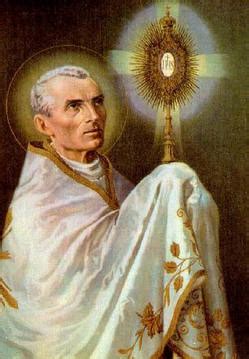
St. Peter Julian Eymard was born 4 February 1811 at La Mure, Isère. He was deeply devoted to Mary from his earliest days. In 1828 he resolved to enter the novitiate of the Oblates of Mary Immaculate but was unable to complete his studies due to illness. In 1834 he was ordained a priest for the Diocese of Grenoble. He was dissatisfied with parish work, and decided to join the Marists.
In 1837, he entered the Society of Mary and became Provincial of the Order in 1844. His new responsibilities included being in charge of the Third Order of Mary, dedicated to Marist spirituality and to the promotion of the Christian family. Saint John Vianney was a member.
His eucharistic spirituality grew progressively and desired to establish a Marist community dedicated to eucharistic adoration. When his superiors disapproved, he decided to leave the Society of Mary to begin a new religious society, the Congregation of the Blessed Sacrament.
The Congregation began working with children in Paris to prepare them to receive their First Communion. It also reached out to non-practicing Catholics, inviting them to repent and begin receiving Communion again. Pope Pius IX granted a Decree of Approbation in June 1863 and the Saint became a strong proponent of frequent Holy Communion, a practice given more authoritative backing by Pope Saint Pius X in 1905.
In 1858, together with Marguerite Guillot, he founded the Servants of the Blessed Sacrament, a contemplative congregation for women. It was reported that he said, “You take communion to become holy, not because you already are.” Saint Peter died at the age of fifty-seven in La Mure on 1 August 1868. He was declared venerable in 1908, beatified by Pope Pius XI on 12 July 1925, and canonized by Pope Saint John XXIII on 9 December 1962. Pope Saint John Paul II named Eymard “Apostle of the Eucharist.”
From the writings of Saint Peter Julian Eymard, Priest
(La Présence réelle, vol. I, Paris, 1950, pp. 270-271 and 307-308)
The Eucharist is the Sacrament of Life
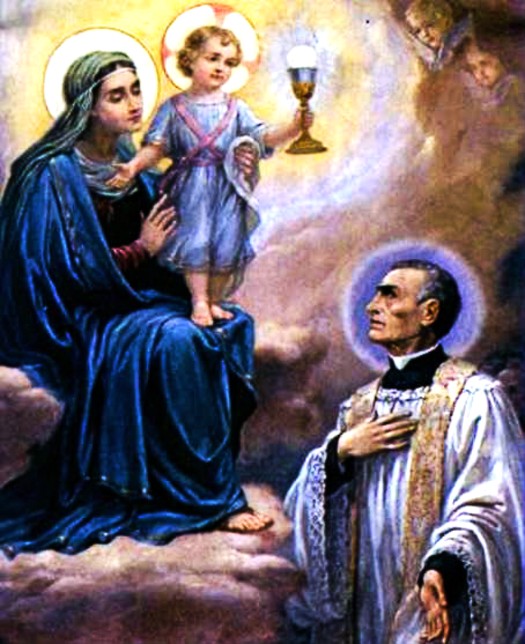
The Eucharist is the life of all nations. It affords the very principle of life. If there is no impediment, whether due to one’s nation or one’s language, all can come to the feasts of the Church. The Eucharist brings to them the law of Charity and this Sacrament is its source. For this very reason, it forms among them a common bond, that of Christian relationship. All eat of the same bread, all are Jesus Christ’s guests, and He supernaturally forms among them a certain harmony of brotherly customs. The Acts of the Apostles affirm that the primitive throng of Christians, both of converted Jews and baptized pagans, formed a single heart and soul even though coming from different regions. Why? Because they were assiduous in listening to the doctrine of the Apostles and persevering in the breaking of the bread.
The Eucharist is therefore the life of the soul as well as the life of human society, just as the sun is the life of the body as well as that of the earth. Without it the earth is sterile. The sun gladdens, adorns and fills it with good things; it gives effectiveness, strength and beauty to the body. Before the marvels of the world we ought not to do as the pagans do, which is to worship the sun as if it were a god of the world. The daystar itself obeys the uppermost Star, the divine Word, Jesus Christ. He illuminates all those who come to this world, and acts Himself through the Eucharist, Sacrament of Life, in their innermost being and by that He forms families and nations. Happy is the soul that finds this hidden treasure, and that drinks from the source of life by often eating the Bread of Life.
Furthermore, the Christian community is a family. The bond that unites them is Jesus in the Eucharist. He is the Father who prepares the family table. Christian brotherhood was promulgated at the Last Supper together with Jesus Christ’s Fatherhood. He himself called his Apostles filiolos, that is little children, and commanded them to love one another as He loved them.
At the Holy Table, all are children taking the same food. Saint Paul concluded that all make up the same family, one body, for all share the same Bread, Jesus Christ. Therefore, the Eucharist imparts on the Christian community the power to preserve the law of honour and love of neighbour. Jesus Christ orders us to honour and love His brethren. That is why He put Himself in their place: “Whenever you did this to one of the least of My brethren, you did it to Me”. And He gave Himself to each one by means of Holy Communion.
DAILY MEDITATION
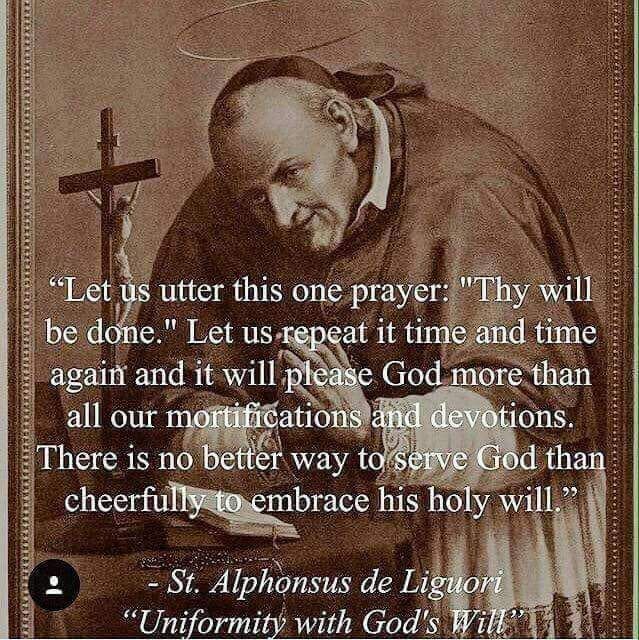
What rendered still more certain the truth of our Faith was the formation of a new people of God by the conversion of the Gentiles: this was known to have been announced beforehand in the Scriptures, and this was seen to be realized, as soon as the apostles spread throughout the world…. men devoid of instruction, of wealth, of every human assistance, and even persecuted by the magistrates and the emperors – have induced, without divine assistance, so many Christians to renounce all their property, all their honours and generously to sacrifice their lives, amid tortures, the most excruciating that the power and the cruelty of the tyrants could invent?
But what was still more marvellous was to behold so many Gentiles embrace a religion difficult to believe and difficult to practice. It was difficult to believe on the part of the intellect, for this religion teaches mysteries beyond the reach of human reason; namely, the Trinity of one God in three distinct Persons, Who have but one nature, one power, and one will; the Incarnation of the Son of God come upon earth to die for the salvation of mankind; and many other articles, regarding Original Sin, the spirituality, and the immortality of the soul, the Sacraments, especially the Sacrament of the Holy Eucharist. It was difficult to practice on the part of the will, because it commands things contrary to the inclinations of nature corrupted by sin and repugnant to the libertinism, in which the pagans were living, who were accustomed to follow their passions and to give themselves up to the pleasures of the senses. Notwithstanding these obstacles, the Christian religion show itself embraced by so many nations! From the universal consent of nations, Saint Augustine argues the Divinity of our religion, saying that had not God illuminated by His powerful grace, so many people, civilized, and barbarian, learned and illiterate, noble and plebeian, all immersed in the superstitions of their country, imbued from their earliest years with maxims so opposed to the sanity of Faith, how could they have embraced it?
Saint Alphonsus Liguori [d 1787] – erudite Bishop, philosopher, theologian, lawyer, and artist, declared a Doctor of the Church in 1871.
The Pearl of Great Price
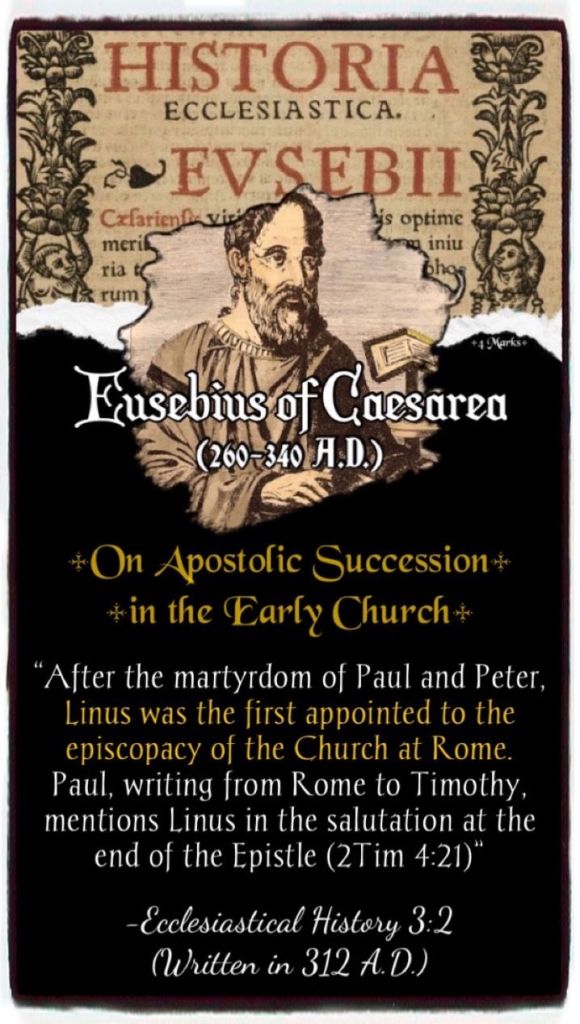
Most holy and dearly beloved, let human fear depart from your souls. You have the LORD’s own consolation, for He says to you, Do not be afraid of those who kill the body but cannot kill the soul. This is a time of testing; this is a time for those who are tested to be made known…. I beg you to protect your Faith with great vigilance, to preserve harmony, to remain steadfast in prayer, to remember us unceasingly, that the LORD will deign to grant liberty to His Church, now in labour throughout the world, and that we who are oppressed may one day rejoice in freedom with you. May I be worthy to stand before God, praying for you through Our LORD Jesus Christ who is with Him, blessed for ever and unto all ages. Amen.
Again, I beseech and beg you, for the mercy of God, that each one discover his own message in this letter. I could not write to each one of you, as I have usually done, so I address all of you: my brothers and blessed sisters, as well, sons and daughters; I speak to each sex; I greet every age. May God protect you and grant you and all your dear ones good health, now and in the future….
We congratulate you because you live according to the Creed, strong in your Faith and mindful of us. However, resolve now to remain in communion with us, since you have been steadfast until now in the same confession, shunning all association with hypocrites. Carry on these matters as best you can; apply yourself energetically to prevail over the transgressors, to rebuke the unbelievers; fear nothing from the kingdom of this world, as you have despised it until now. The One who is within us is mightier than the rulers of this world…. We have desired to endure our sufferings so that, in keeping with what has been said, we might be glorified in the Kingdom of Heaven.
Saint Eusebius of Vercelli
Saint Eusebius of Vercelli († 371) was an Italian Bishop and is honoured for his defence of the full divinity of Christ. [From The Early Church and the State, Michael Di Maio, Agnes Cunningham, sscm, Trs.
“The refusal to take sides on great moral issues is itself a decision. It is a silent acquiescence to evil. The tragedy of our time is that those who still believe in honesty lack fire and conviction, while those who believe in dishonesty are full of passionate conviction.” – Ven. Archbishop Fulton Sheen
 Daily Reflections
Leave a comment