Galatians 1:11, 12; 2 Corinthians 11:10, 7
The Gospel which I preached to you is not a human message.
– I did not receive it through any man,
but from Our LORD Jesus Christ who revealed it to me.As surely as Christ’s Truth is in me,
I have preached the Gospel to you.
– I did not receive it through any man,
but from Our LORD Jesus Christ who revealed it to me
Thursday of the Seventeenth Week in Ordinary Time
Finding of the Body of St. Stephen (Traditional)
Saint Germanus of Auxerre, Bishop (Wales)
“At the end of time”, a net will be “cast into the sea that brings in a haul of all kinds” (Matthew 13:47-53). Only then will the angels reveal who are “the wicked” and who are “the just”. The divide between good and evil crosses all of our lives: that which is evil, which is not life-giving, must be cast into “the blazing furnace”. Like the sons of Israel, we must keep our eyes on the tabernacle in order to see things in the guiding light of the LORD’s glory.
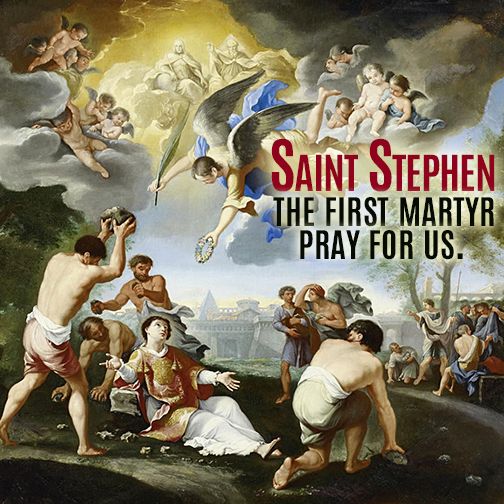
THE FINDING OF THE BODY OF ST. STEPHEN (See blog on Wednesday 2 August for more)
SAINT GERMANUS OF AUXERRE, BISHOP
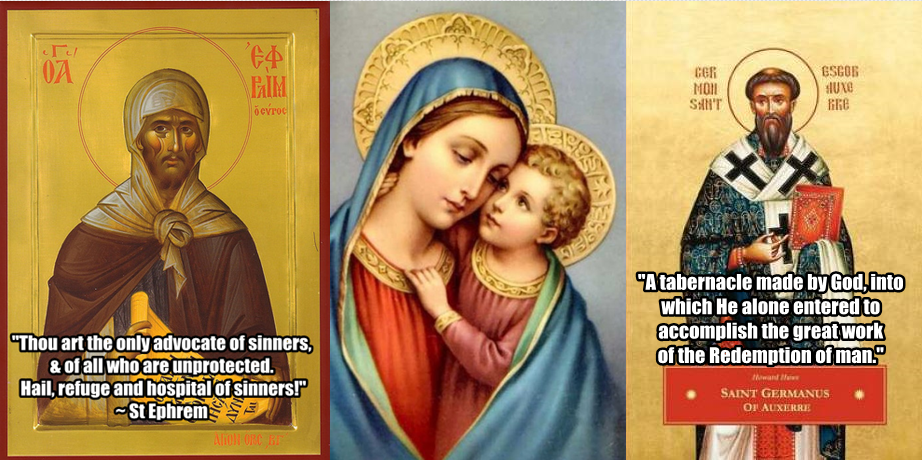
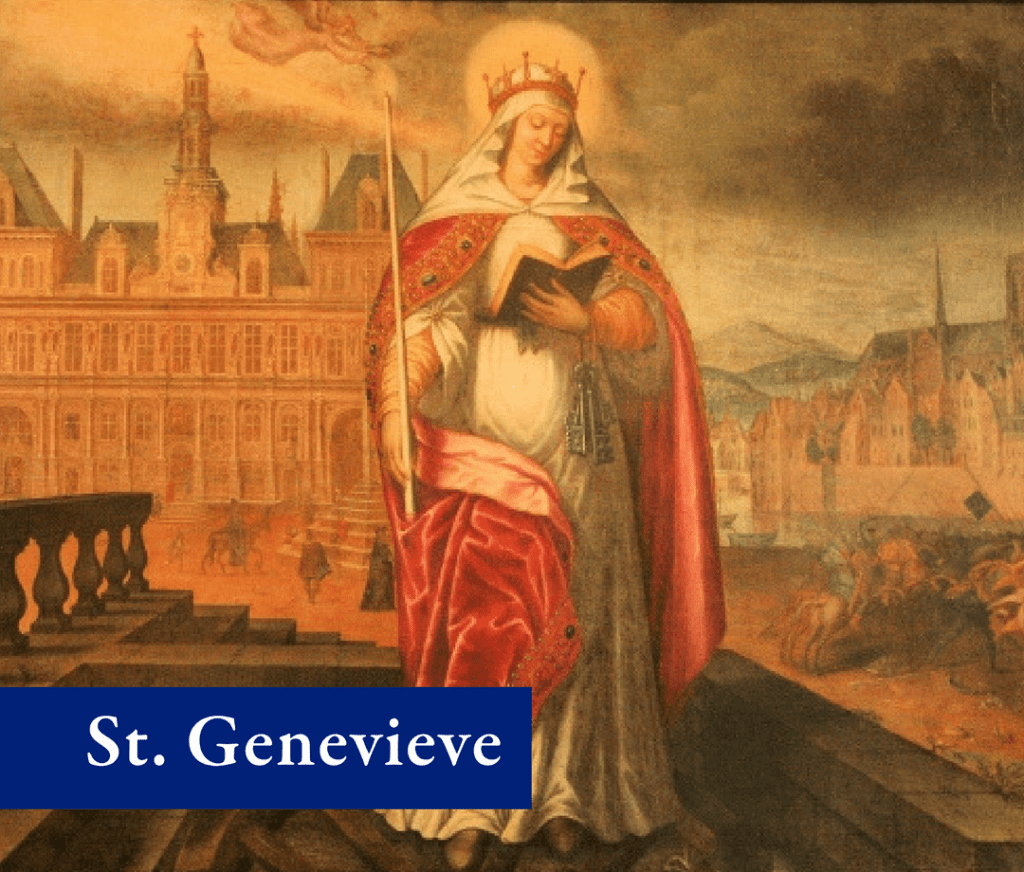
Born at Auxerre, Gaul, of Catholic parents he was also known as Germain; he studied at local schools and then law at Rome and became a lawyer. After he married, he was made governor of the Amorican border provinces of Gaul; in 418 was named Bishop of Auxerre. He changed his life to one of poverty and austerity, building a monastery, dedicated to Sts. Cosmas and Damian on the banks of the Yonne, and endowing various poor churches in the diocese. [It is unknown when his noble wife died.] In 429, he and St. Lupus, Bishop of Troyes, were sent to Britain to combat the Pelagian heresy which was raging there: they were most successful in restoring orthodoxy. On his way Germain stopped at Nanterre, where he met a young child, Genevieve, destined to become the patroness of Paris. One of the early lives of St. Patrick, Apostle of Ireland, tells us that he formed one of St. Germain’s suite on this occasion.
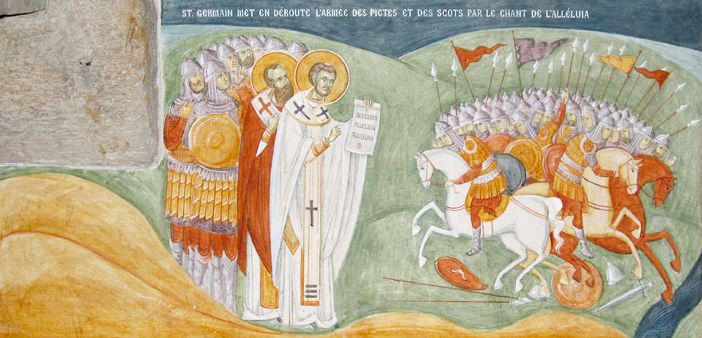
Tradition tells us that the main discussion with the representatives of Pelagianism took place at St. Alban’s, and resulted in the complete discomfiture of the heretics. Germain remained in Britain for some time preaching, and established several schools for the training of the clergy. It was on this trip that occurred the famous incident in which Germanus is reputed to have saved a force of Britons from destruction by a superior force of marauding Picts and Saxons. He led the Britons to a narrow ravine between two high mountains, and when the enemy approached had the Britons shout “Alleluia!” three times. The echoes magnified the shouts causing the invaders to believe they were confronted by a far superior force, and they fled. It was at this time that Germanus Baptized many of the Britons in the army. On his return to Gaul, he convinced Auxiliaris, prefect of Gaul, to reduce taxes when he healed Auxiliaris’ sick wife, returning Britain about 440 to combat Pelagianism once more. Again he was successful, eliminating the heresy, and founded numerous schools to teach true doctrine. When he returned to Gaul, he found that Aetius, a Roman general, had dispatched a barbarian army under Goar to put down a revolt in Amorica. Fearful of the savagery of the barbarian forces, Germanus persuaded Goar to desist and then went to Ravenna in an unsuccessful attempt to persuade Emperor Valentinian III to call off the attack. Germanus’ effort came to naught when news of another Amorican uprising reached the Emperor. Germanus died on July 31 while he was still in Ravenna, July 31 450. His body, as he requested when dying, was brought back to Auxerre and interred in the Oratory of St. Maurice, which he had built. Later the oratory was replaced by a large church, which became a celebrated Benedictine abbey known as St. Germain’s. This tribute to the memory of the Saint was the gift of Queen Clotilde, wife of Clovis. Some centuries later, Charles the Bald had the shrine opened, and the body was found intact. It was embalmed and wrapped in precious cloths, and placed in a more prominent position in the church. There it was preserved till 1567, when Auxerre was taken by the Huguenots, who desecrated the shrine and cast out the relics. It has been said that the relics were afterwards picked up and placed in the Abbey of St. Marion on the banks of the Yonne, but the authenticity of the relics in this church has never been canonically recognized. St. Germain was honoured in Cornwall and at St. Alban’s in England’s pre-reformation days, and has always been a patron of Auxerre.
From a catechetical instruction by Saint Cyril of Jerusalem, Bishop
(Cat. 18, 26-29: PG 33, 1047-1050)
The Church is the Bride of Christ
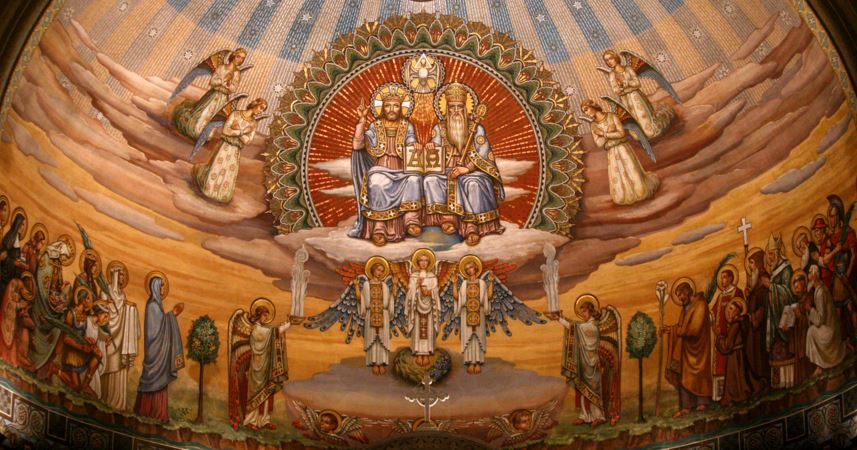
The Catholic Church is the distinctive name of this holy Church which is the Mother of us all. She is the Bride of Our LORD Jesus Christ, the Only-begotten Son of God (for Scripture says: Christ loved the Church and gave Himself up for Her). She is the type and she bears the image of the Jerusalem above that is free and is the Mother of us all, that Jerusalem which once was barren but now has many children.
The first assembly, that is, the assembly of Israel, was rejected, and now in the second, that is, in the Catholic Church, God has appointed first, Apostles, second, prophets, third, teachers then workers of miracles, then healers, helpers, administrators and speakers in various tongues, as Paul says; and together with these is found every sort of virtue—Wisdom and Understanding, Self-control and Justice, Mercy and Kindness, and invincible Patience in persecution. This Church in earlier days, when persecution and afflictions abounded, crowned her holy martyrs with the varied and many-flowered wreaths of endurance. But now when God has favoured us with times of peace, she receives her due honour from kings and men of high station, and from every condition and race of mankind. And while the rulers of the different nations have limits to their sovereignty, the holy Catholic Church alone has a power without boundaries throughout the entire world. For Scripture says: God has made peace Her border.
Instructed in this holy Catholic Church and bearing ourselves honourably, we shall gain the Kingdom of Heaven and inherit Eternal Life. For the sake of enjoying this at the LORD’s hands, we endure all things. The goal set before us is no trifling one; we are striving for Eternal Life. In the Creed, therefore, after professing our Faith “in the resurrection of the body,” that is, of the dead, which I have already discussed, we are taught to believe “in life everlasting,” and for this as Christians we are struggling.
Now real and true life is none other than the Father, who is the Fountain of Life and who pours forth His heavenly gifts on all creatures through the Son in the Holy Ghost, and the good things of Eternal Life are faithfully promised to us men also, because of His Love for us.
How to Be with the Righteous
at the End of the Age
Exult and praise your God, Who made and redeemed you and to Whom you are indebted for His many wonderful benefits and the daily gifts that He so graciously bestows on you and for which you can never give fitting or adequate thanks. Give praise and thanks as a mortal man in need of God’s mercy and as one always seeking and begging it. Though you may often fall, sin, and offend God, do not stop praying or praising Him; nor are you to yield to despair; rather, you are to humble yourself and pray. Love, and you will be loved in return, for love cleanses, heals, and makes up for all past failings. Love enlightens and inflames; it drives away sadness and creates joy of heart such as the world does not know or flesh and blood ever experienced. Praise God, and you will be praised; bless Him, and you will be blessed; sanctify His name, and you will be made holy; magnify Him, and you will be made great; glorify Him, and He will glorify you both in body and soul.
But when will this come about, LORD? When will You place perpetual praise on my lips? When will my heart and soul exult with Your saints in glory?
Hold on for a bit longer, and you will see great wonders when the last trumpet sounds. It is then that I shall give My saints rest and Eternal Life in exchange for all their pains and labours. What more do you want?
Nothing more; you are sufficient for me, my God and Saviour; You give Eternal Life to those who love and praise You. In place of insignificant deeds, You give what is all-important; for what is valueless, You give what is most valuable; and for what is perishable, you give something Eternal.
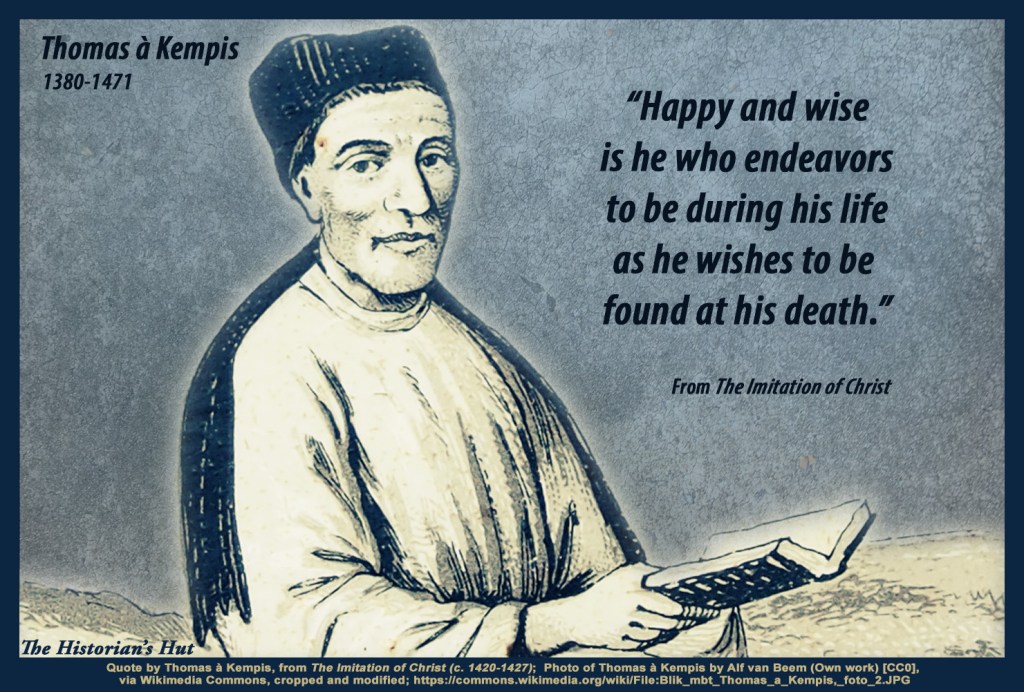
Venerable Thomas à Kempis
Thomas à Kempis († 1471) was a German priest and monk who wrote many spiritual works. [From On the Passion of Christ: According to the Four Evangelists: Prayers and Meditations, Joseph N. Tylenda, s.j., Tr.
DAILY MEDITATION
At present, I might amuse and sustain myself with the vanities of sense and time, but they will not last forever. We shall be stripped of them when we pass out of this world. All shadows will one day be gone. And what shall I do then?… He will be all in all, whether I wish it or not. What a strait I shall then be in if I do not love Him, and there is then nothing else to love; if I feel averse to Him, and He is then ever looking upon me!
Ah, my dear LORD, how can I bear to say that You will be all in all, whether I wish it or not? Should I not wish it with my whole heart? What can give me happiness but You? If I had all the resources of time and sense about me, just as I have now, should I not in course of ages, nay of years, weary of them? If this world were to last forever, would it be able ever to supply my soul with food? Is there any earthly thing that I do not weary of at length even now? Do old men love what young men love? Is there not constant change?
I am sure then, my God, that the time would come, though it might be long in coming, when I would have exhausted all the enjoyment the world could give. You alone, my dear LORD, are the Food for Eternity, and You alone. You only can satisfy the soul of man. Eternity would be misery without You, even though You did not inflict punishment. To see You, to gaze on You, to contemplate You: this alone is inexhaustible. You indeed are unchangeable, yet in You there are always more glorious depths and more varied attributes to search into; we shall ever be beginning as if we had never gazed upon You. In Your Presence are torrents of delight, and whoever tastes them will never let go. This is my true portion, O my LORD, here and hereafter!
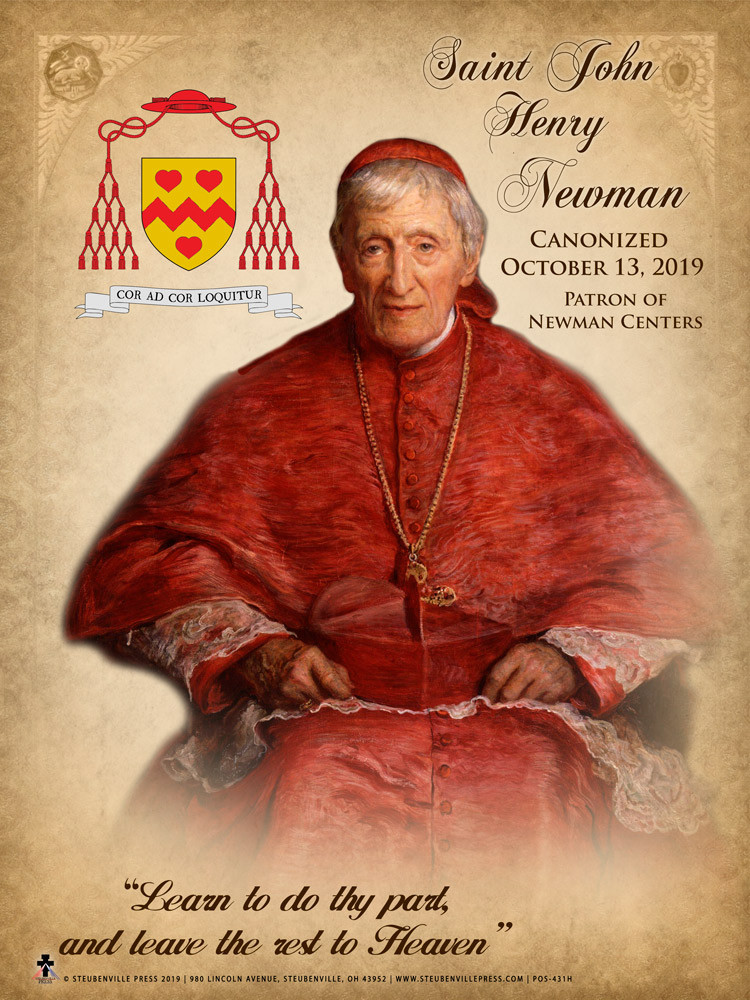
Saint John Henry Newman [+ 1890] – outstanding English convert, Priest, and theologian who led the Oxford movement of the nineteenth century.
“The refusal to take sides on great moral issues is itself a decision. It is a silent acquiescence to evil. The tragedy of our time is that those who still believe in honesty lack fire and conviction, while those who believe in dishonesty are full of passionate conviction.” – Ven. Archbishop Fulton Sheen
 Daily Reflections
Leave a comment