Matthew 10:32; John 12:26
If anyone declares himself for Me before men
– I will declare Myself for him before My Father in Heaven.
If anyone wishes to serve Me,
he must follow Me,
and where I Am,
there My servant will be with Me.
– I will declare Myself for him before My Father in Heaven.
Feast of Saint Lawrence, Deacon, Martyr
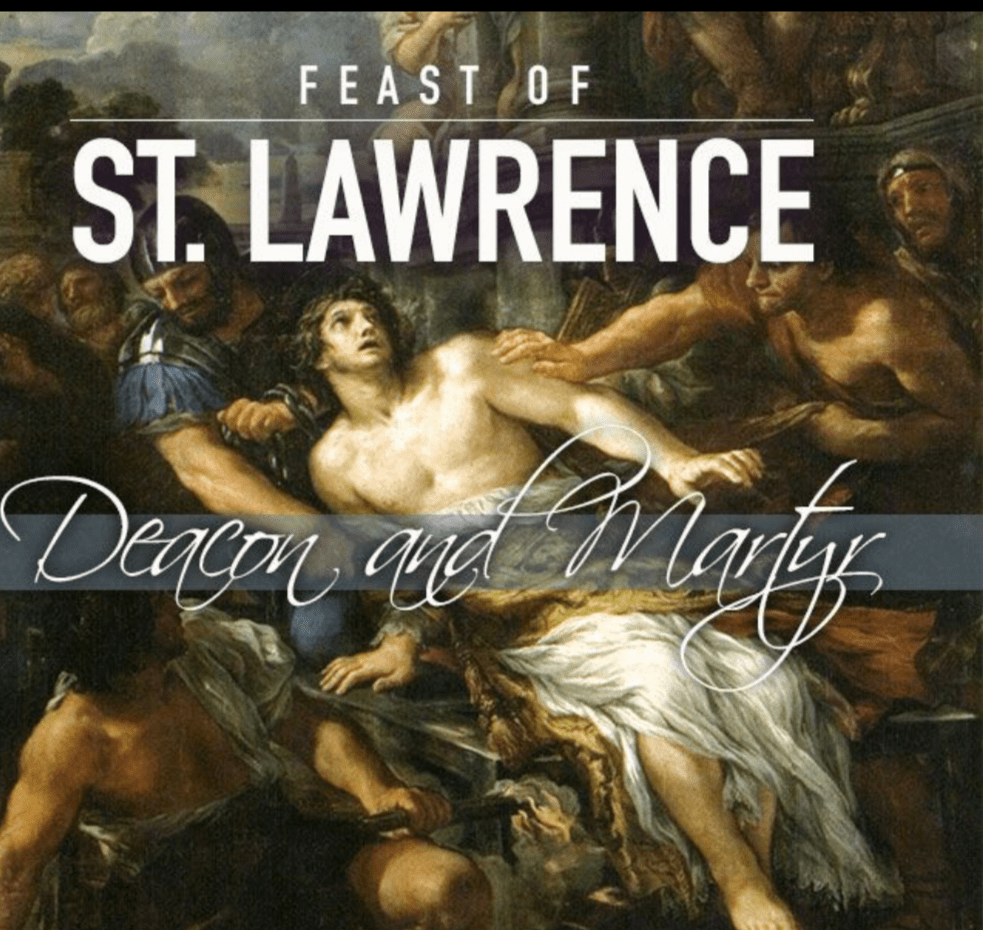
Saint Lawrence was one of the Roman Church’s seven deacons who were personally responsible for the care of the city’s poor. When the Roman clergy was rooted out and killed under the Emperor Valerian in the year 258, Lawrence saw his beloved Pope Sixtus II hauled off to martyrdom. Lawrence stood by, weeping that he could not share their fate. “I was your minister,” he said, “when you consecrated the Blood of Our LORD; why do you leave me behind now that you are about to shed your own?” The holy pope comforted him with the words, “Do not weep, my son; in three days you will follow me.” This prophecy came true.The prefect of the city knew the rich offerings which the Christians put into the hands of the clergy, and he demanded the treasures of the Roman Church from Lawrence, their guardian.The Saint promised, at the end of three days, to show him riches exceeding all the wealth of the empire, says that Lawrence at once liquidated the Church’s possessions and dispersed them to the poor. When the prefect of Rome heard of this, he demanded that Lawrence turn over the money. Three days later Lawrence brought him the “Church’s treasure”: the destitute, the orphans, the blind, the lame the infirm, and the religious who lived by the alms of the faithful. For this, Lawrence was roasted on an iron grill.
Christ, whom Lawrence had served in his poor, gave him strength in the conflict which ensued. Roasted over a slow fire, he made sport of his pains. “I am done enough,” he said, “eat, if you will.” At length Christ received him into Eternal happiness. God showed by the glory which shone around Saint Lawrence the value He set upon his love for the poor. Prayers innumerable were granted at his tomb; and he continued from his throne in Heaven his Charity to those in need, granting them, as Saint Augustine says, “the smaller graces which they sought, and leading them to the desire of better gifts.”
From a sermon by Saint Augustine, Bishop and Doctor of the Church
(Sermo 304, 1-4: PL 38, 1395-1397)
He ministered the Sacred Blood of Christ
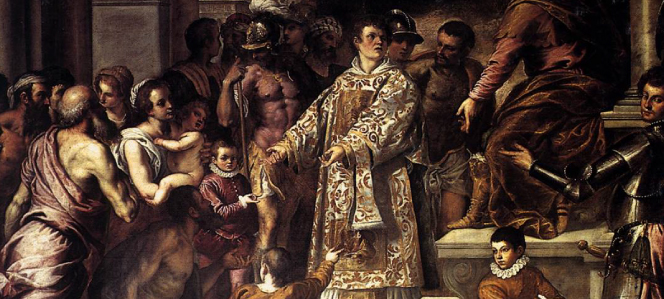
The Roman Church commends to us today the anniversary of the triumph of Saint Lawrence. For on this day he trod the furious pagan world underfoot and flung aside its allurements, and so gained victory over Satan’s attack on his Faith.
As you have often heard, Lawrence was a deacon of the Church at Rome. There he ministered the Sacred Blood of Christ; there for the sake of Christ’s name he poured out his own blood. Saint John the Apostle was evidently teaching us about the mystery of the Lord’s Supper when he wrote: Just as Christ laid down His life for us, so we ought to lay down our lives for the brethren. My brethren, Lawrence understood this and, understanding, he acted on it. Just as he had partaken of a gift of self at the table of the LORD, so he prepared to offer such a gift. In his life he loved Christ; in his death he followed in His footsteps.
Brethren, we too must imitate Christ if we truly love Him. We shall not be able to render better return on that love than by modelling our lives on His. Christ suffered for us, leaving us an example, that we should follow in His steps. In saying this, the Apostle Peter seems to have understood that Christ suffered only for those who follow in His steps, in the sense that Christ’s passion is of no avail to those who do not. The holy martyrs followed Christ even to shedding their life’s blood, even to reproducing the very likeness of His Passion. They followed Him, but not they alone. It is not true that the bridge was broken after the martyrs crossed; nor is it true that after they had drunk from it, the fountain of Eternal life dried up.
I tell you again and again, my brethren, that in the LORD’s garden are to be found not only the roses of His martyrs. In it there are also the lilies of the virgins, the ivy of wedded couples, and the violets of widows. On no account may any class of people despair, thinking that God has not called them. Christ suffered for all. What the Scriptures say of Him is True: He desires all men to be saved and to come to knowledge of the Truth.
Let us understand, then, how a Christian must follow Christ even though he does not shed his blood for Him, and his Faith is not called upon to undergo the great test of the martyr’s sufferings. The Apostle Paul says of Christ Our LORD: Though He was in the form of God He did not consider equality with God a prize to be clung to. How unrivaled His majesty! But He emptied Himself, taking on the form of a slave, made in the likeness of men, and presenting Himself in human form. How deep His humility!
Christ humbled Himself. Christian, that is what you must make your own. Christ became obedient. How is it that you are proud? When this humbling experience was completed and death itself lay conquered, Christ ascended into Heaven. Let us follow Him there, for we hear Paul saying: If you have been raised with Christ, you must lift your thoughts on high, where Christ now sits at the Right Hand of God.
DAILY MEDITATION
Since the Fourth Century, Saint Lawrence has been one of the most honoured martyrs of the Roman Church. Constantine the Great was the first to erect a little oratory over his burial place, which was enlarged and beautified by Pope Pelagius II [579–590]. Pope Sixtus III [432–440] build in large basilica with three naves, the apse leaning against the older church, on the summit of the hill where he was buried. In the thirteenth century, Honorius III made the two buildings into one, and so the Basilica of San Lorenzo remains to this day. Pope Saint Damasus [366–380] wrote a panegyric in verse, which was engraved in marble and placed over his tomb. Two contemporaries of the last-named pope, Saint Ambrose of Milan and the poet Prudentius, give particular details about Saint Lawrence’s death. Ambrose relates that when St. Lawrence was asked for the treasures of the Church he brought forward the poor, among whom he had divided the treasure, in place of alms; also that when Pope Sixtus II was lead away to his death he comforted Lawrence, who wished to share his martyrdom, by saying that he would follow him in three days. The saintly bishop of Milan also states that St. Lawrence was burned to death on a gridiron. In like manner, but with more poetical detail, Prudentius describes the martyrdom of the Roman deacon in his hymn on Saint Lawrence.
Pope Damasus build a Basilica in Rome, which he dedicated to Saint Lawrence; this is the church now known as that of San Lorenzo in Dámaso. The Church of San Lorenzo in Lucina, also dedicated to this saint, still exists. The feast day of Saint Lawrence is kept on 10 August. He is pictured in art with the gridiron on which he is supposed to have been roasted to death.
Catholic Encyclopedia [1912] – classic multi-volume reference in “the constitution, doctrine, discipline, and history of the Catholic Church.“
The Glorious Fruit of a Grain of Wheat
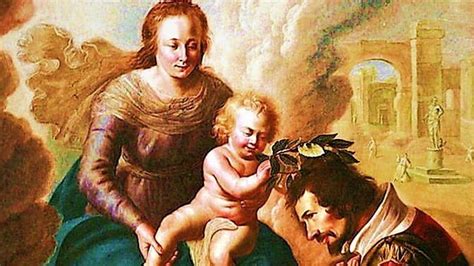
Today the Catholic Church celebrates a feast to the honour and glory of that blessed martyr of Christ, Saint Lawrence, and today’s Gospel (John 12:24-26) shows us the means by which this blessed martyr gained such glory, both in Heaven with God and His angels and on earth with men. These are, in fact, the same means by which Christ gained His own glory, for He says: Was it not ordained that the Christ should suffer and so enter into His Glory? Paul also tells us that He was humbler yet, even to accepting death, death on a Cross. But God raised Him high… It was through a holy Life and a holy Death that Christ entered into His Heavenly Glory, i.e., attained to the highest glory and honour before God and men.
All creatures in Heaven, therefore, fittingly sing: The Lamb that was sacrificed is worthy to be given power, riches, wisdom, strength, honour, glory and blessing. Paul writes further: every tongue should acclaim Jesus Christ as LORD, to the glory of God the Father—that is, appointed likeGod to be the King of Heaven and seated at the Right Hand of the Father.He is a king with supreme authority and power. He is a King supremely rich, wise, powerful, endowed with the greatest dignity,honour, and glory and worthy of every praise, and is to be believed and to beproclaimed as such. All this Christ won through His Cross. This is also the meaning found in today’s Gospel: unless a wheat grain falls on the ground and dies.
However, it should be pointed out that immediately before these words Christ had said: Now the hour has come for the Son of Man to be glorified. With this example Christ clarifies the way to the attainment of this glory, namely, that the Son of Man will be glorified by way of His Passion and death. Christ says, therefore, that unless the grain of wheat falls to the ground and dies when sown, but remains whole and incorrupt instead, it cannot produce any fruit but remains just a sterile and unfruitful grain of wheat. But if it dies it produces much fruit—that is, many grains in the ear, and sometimes even many ears can arise from a single grain. The fruit is like the glory of that grain of wheat. Christ, therefore, because He lived a most holy life and died a most holy death by accepting death, death on a Cross, has attained to the highest glory before both God and men and has given us Himself as our example and guide.
Saint Lawrence of Brindisi
Saint Lawrence of Brindisi († 1619) was a minister general of the Capuchin Franciscans and preached throughout Europe. He is a Doctor of the Church. [From Feastday Sermons, Vernon Wagner, o.f.m. cap., Tr
RESPONSORY
Blessed Lawrence cried out:
I worship my God
and serve only Him.
– So I do not fear your torture.
God is my Rock; I take refuge in Him.
– So I do not fear your torture.
“The refusal to take sides on great moral issues is itself a decision. It is a silent acquiescence to evil. The tragedy of our time is that those who still believe in honesty lack fire and conviction, while those who believe in dishonesty are full of passionate conviction.” – Ven. Archbishop Fulton Sheen
 Daily Reflections
Leave a comment