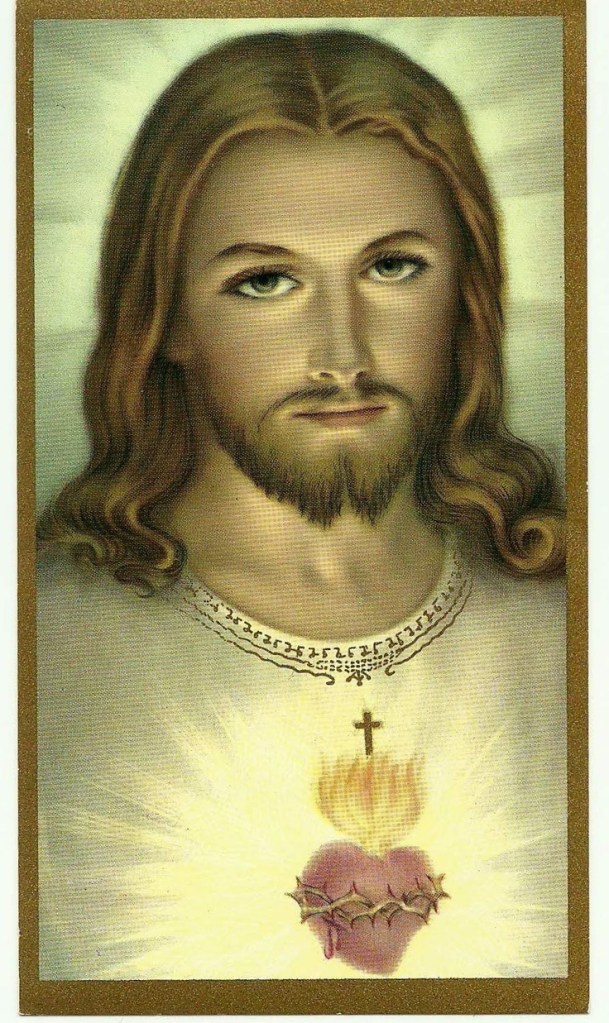
St. Bonaventure’s Opusculum 3, Lignum vitae (a part from which is the reading for the Divine Office on the Solemnity of the Sacred Heart) refers to the Heart as the Fountain from which God’s love poured into one’s life:
Take thought now, redeemed man, and consider how great and worthy is He who hangs on the Cross for you. His death brings the dead to life, but at His passing Heaven and earth are plunged into mourning and hard rocks are split asunder. It was a divine decree that permitted one of the soldiers to open His Sacred side with a lance. This was done so that the Church might be formed from the side of Christ as He slept the sleep of death on the Cross, and so that the Scripture might be fulfilled: ‘They shall look on Him Whom they pierced’. The Blood and water, which poured out at that moment, were the price of our salvation. Flowing from the secret abyss of Our LORD’s Heart as from a fountain, this stream gave the Sacraments of the Church the power to confer the life of grace, while for those already living in Christ it became a spring of living water welling up to Life Everlasting.
Revelation 19:7-9; Hosea 2:20
This is the wedding day of the Lamb;
His bride has made herself ready.
– Blessed are those invited to the marriage feast of the Lamb.
I will betroth you to Myself in faithfulness,
and you shall know the LORD.
– Blessed are those invited to the marriage feast of the Lamb.
Friday of the Eighteenth Week in Ordinary Time
Friday of the Sacred Heart of Jesus
Saint Clare, Religious
Saint Tiburtius, Martyr (Traditional)
Saint Susanna, Virgin, Martyr (Traditional)
SAINT CLARE, RELIGIOUS
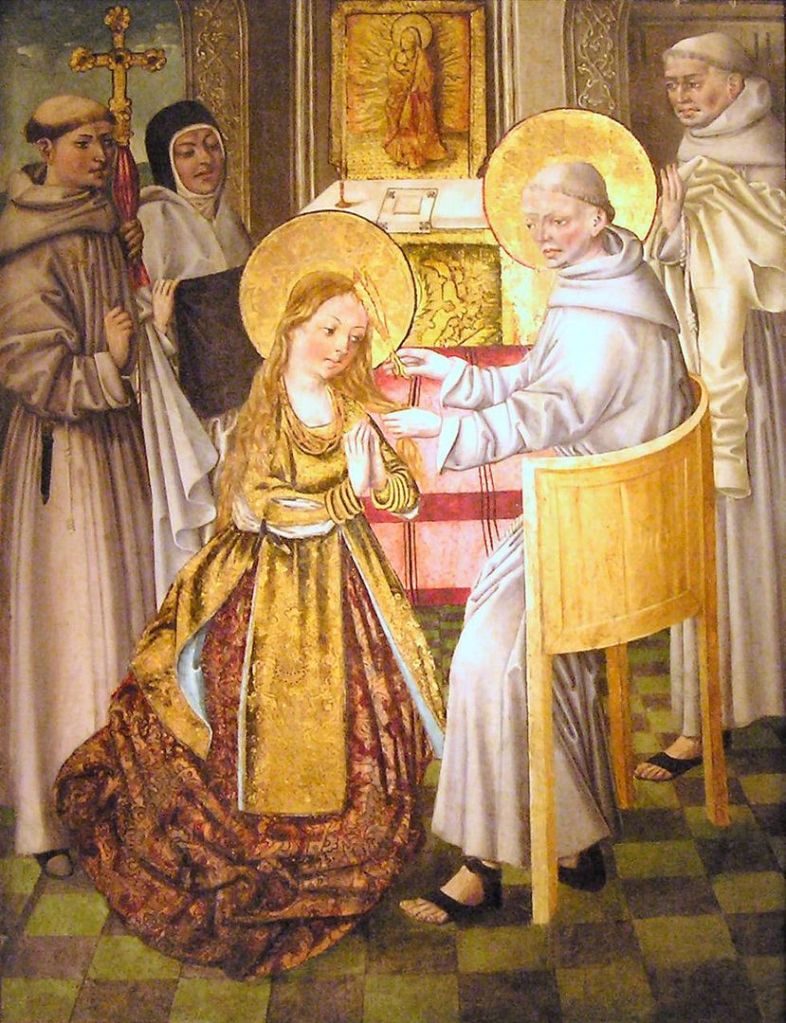
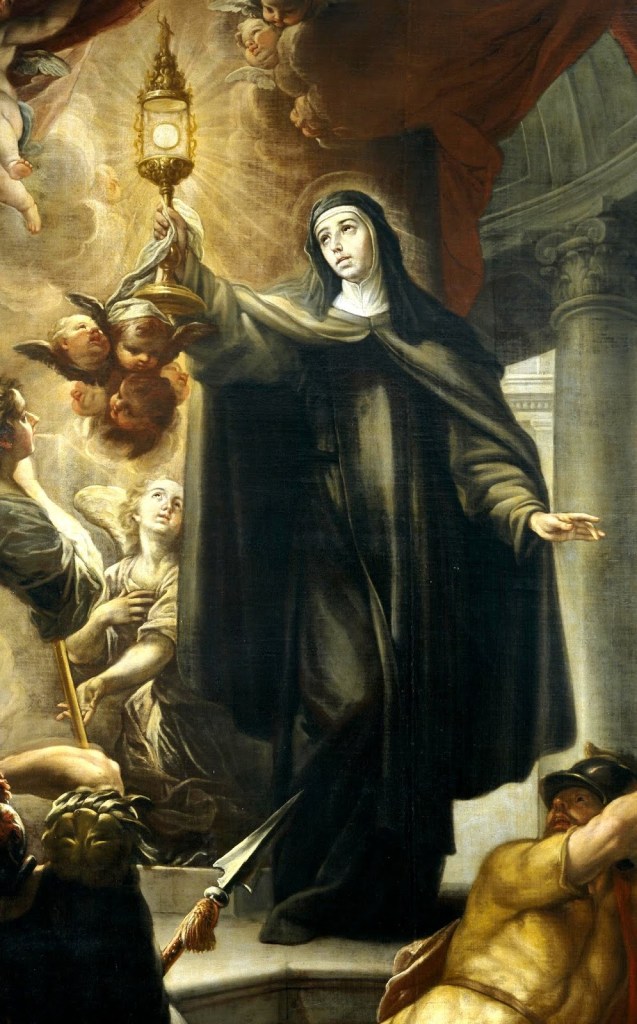
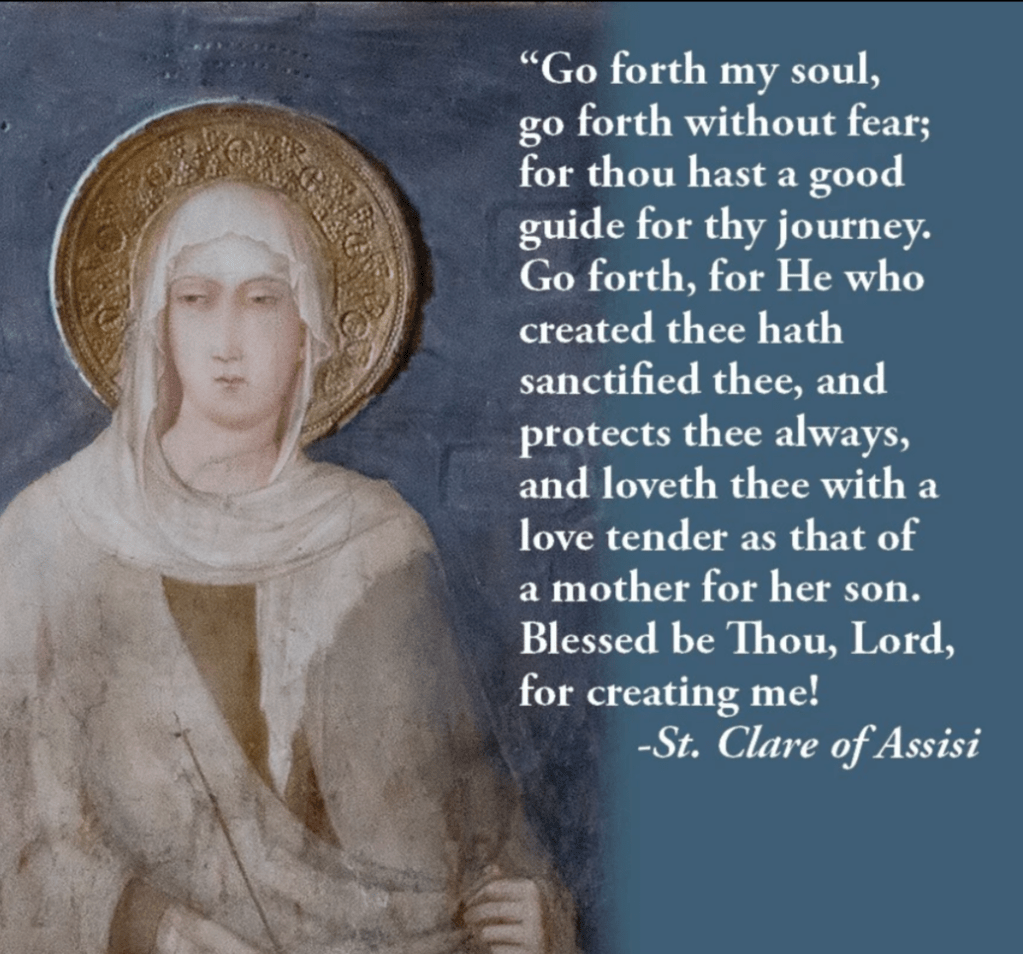
On Palm Sunday, March 17, 1212, the Bishop of Assisi left the altar to present a palm to a noble maiden, eighteen years of age, whose bashfulness had kept her in her place. This maiden was Saint Clare. Already she had learned from Saint Francis to hate the world, and was secretly resolved to live for God alone. The same night she escaped, with one companion, to the Church of the Portiuncula, where she was met by Saint Francis and his friars. At the altar of Our Lady, Saint Francis cut off her hair, clothed her in his habit of penance, a piece of sack-cloth, with his cord as a cincture. Thus she was espoused to Christ. In a miserable house outside Assisi she co- founded her Order, the Poor Clares, establishing their first house at San Damiano. and was joined by her sister, fourteen years of age, and afterwards by her mother and other noble ladies. They went barefoot, wore rough tunics, observed perpetual abstinence, constant silence, and perfect poverty. While the Saracen army of Frederick II was ravaging the valley of Spoleto, a body of infidels advanced to assault Saint Clare’s convent, which stood outside Assisi. The Saint caused the Blessed Sacrament to be placed in a monstrance, above the gate of the monastery facing the enemy, and prostrating herself before it, prayed, “Deliver not to beasts, O LORD, the souls of those who confess to You.” A voice from the host replied, “My protection will never fail you.” A sudden panic seized the foreign army, which took to flight, and the Clare’s convent was spared. During her illness of twenty-eight years the Holy Eucharist was her only support and spinning linen for the altar the one work of her hands. She died in 1253, as the Passion was being read and was canonised only two years later.
SAINT TIBURTIUS, DEACON, MARTYR

The Roman deacon Tiburtius, son, of the prefect of Rome, Being accused of professing the Christian religion, was beheaded outside the walls of Rome, after suffering many cruel torments in 286.
SAINT SUSANNA, VIRGIN, MARTYR
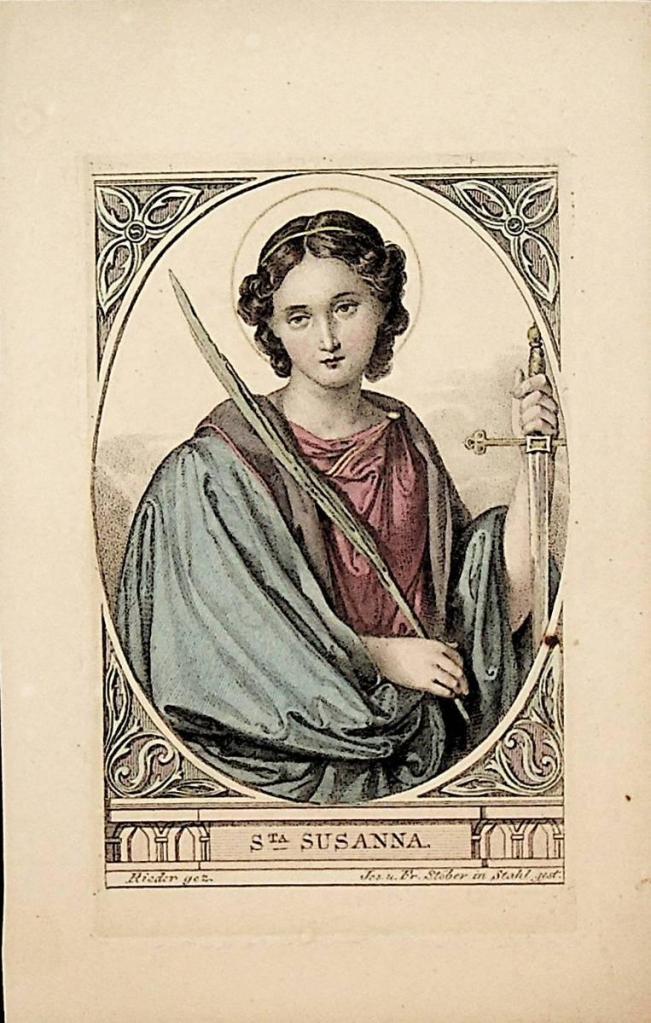
Susanna, a holy virgin of high lineage, refused to marry the son of Diocletian, and was beheaded after grievous torments in 295.
From a letter from Saint Clare of Assisi, Virgin, to Saint Agnes of Prague
(Edit. I. Omaechevarria, Escritos de Santa Clara, Madrid 1970, pp. 339-341)
Behold the poverty, humility and love of Christ
Happy indeed is she who is granted a place at the Divine Banquet, for she may cling with her inmost heart to Him whose beauty eternally awes the blessed hosts of Heaven; to Him whose love inspires love, whose contemplation refreshes, whose generosity satisfies, whose gentleness delights, whose memory shines sweetly as the dawn; to Him whose fragrance revives the dead, and whose glorious vision will bless all the citizens of that Heavenly Jerusalem. For His is the splendour of Eternal glory, the brightness of Eternal light, and the mirror without cloud.
Queen and bride of Jesus Christ, look into that mirror daily and study well your reflection, that you may adorn yourself, mind and body, with an enveloping garment of every virtue, and thus find yourself attired in flowers and gowns befitting the daughter and most chaste bride of the King on high. In this mirror blessed poverty, holy humility and ineffable love are also reflected. With the grace of God the whole mirror will be your source of contemplation.
Behold, I say, the birth of this mirror. Behold His poverty even as He was laid in the manger and wrapped in swaddling clothes. What wondrous humility, what marvellous poverty! The King of angels, the LORD of Heaven and earth resting in a manger! Look more deeply into the mirror and meditate on His humility, or simply on His poverty. Behold the many labours and sufferings He endured to redeem the human race. Then, in the depths of this very mirror, ponder His unspeakable love which caused Him to suffer on the wood of the Cross and to endure the most shameful kind of death. The mirror Himself, from His position on the Cross, warned passersby to weigh carefully this act, as He said: All of you who pass by this way, behold and see if there is any sorrow like mine. Let us answer His cries and lamentations with one voice and one spirit: I will be mindful and remember, and my soul will be consumed within me. In this way, queen of the King of Heaven, your love will burn with an ever brighter flame.
Consider also His indescribable delights, His unending riches and honours, and sigh for what is beyond your love and heart’s content as you cry out: Draw me on! We will run after You in the perfume of Your ointment, Heavenly Spouse. Let me run and not faint until You lead me into Your wine cellar; Your left hand rests under my head, Your right arm joyfully embraces me, and You kiss me with the sweet kiss of Your lips. As you rest in this state of contemplation, remember your poor mother and know that I have indelibly written Your happy memory into my heart, for you are dearer to me than all the others.
DAILY MEDITATION
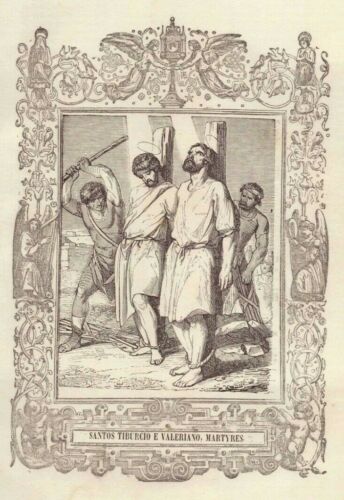
Agrestius Chromatius was vicar to the prefect of Rome, and had condemned several martyrs, in the reign of Carinus; and in the first years of Diocletian, St. Tranquillinus, being brought before him, assured him that, having been afflicted with the gout, he had recovered a perfect state of health by being baptized. Chromatius was troubled with the same distemper, and being convinced by this miracle of the Truth of the Gospel, sent for a priest, and, receiving the Sacrament of Baptism, was freed from the corporal infirmity. Chromatius’ son Tiburtius, was ordained subdeacon, and was soon after betrayed to the persecutors, condemned to many torments, and at length beheaded on the Lavican Road, three miles from Rome, where a church was afterward built. His father, Chromatius, retiring into the country, lived there concealed, in the fervent practice of all Christian virtues.
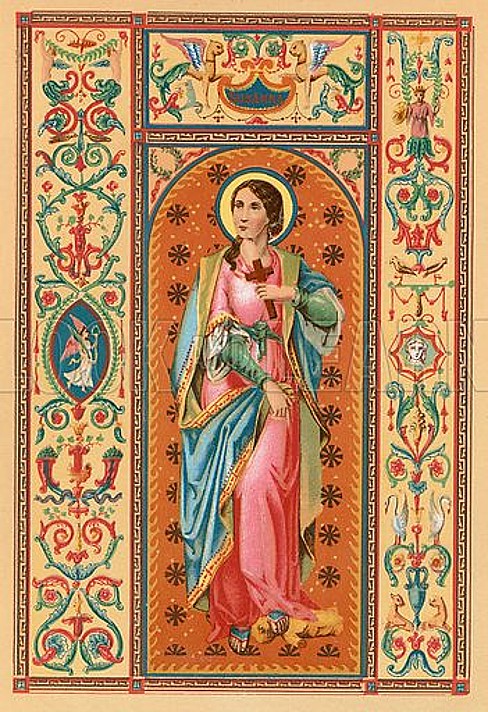
Saint Susanna was nobly born in Rome, and is said to have been niece of Pope Caius. Having made a vow of virginity, she refused to marry, on which account she was impeached as a Christian, and suffered with heroic constancy, a cruel martyrdom. St. Susanna suffered toward the beginning of Diocletian‘s reign, about the year 295.
Reflection: Sufferings were to the martyrs the most distinguishing mercy, extraordinary graces, and sources of the greatest crowns and glory. All afflictions which God sends are in like manner the greatest mercies and blessings; they are the most precious talents to be improved by us to the increasing of our love and affection to God, and the exercise of the most heroic virtues of self-denial, patience, humility, resignation, and penance.
John Gilmary Shea [d. 1892] – American author and celebrated historian, regarded as the father of American Catholic history.
The Profit of the Cross
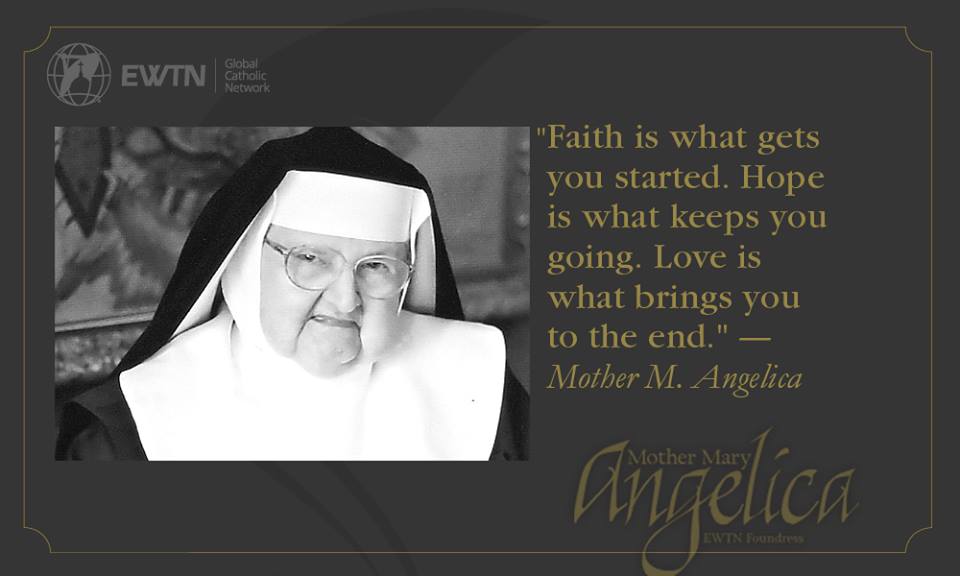
The Christian may suffer unjustly, but if he keeps his eyes on Jesus, God will work wonders in his soul. The glory that is to come is so magnificent, and our souls so imperfect and complex, that only the Creator of our souls knows what is needed for the carrying of a weight of Eternal glory (2 Co 4:17). As children of a loving Father, we must trust His Wisdom in regard to the kind of cross that is necessary for the purification of our particular weakness. Only He knows the degree of glory He desires for us, and what graces and sufferings are needed to arrive at that sublime destiny. Jesus assured us of the Father’s continual Providence by telling us that not a hair falls from our head that the Father is not aware of. A small strand of hair, unnoticed by ourselves or flicked from our shoulder in disdain, is seen by the Father. His love extends to every cross, every joy, every moment of our existence. There is nothing that escapes His eye, and He permits nothing to happen to us that does not have some hidden good within it. Suffering, Saint Paul reminds us, is part of your training; God is treating you as His sons (He 12:7).
We cannot choose a cross. We cannot decide what suffering is best for the training of our invisible souls. We must grow strong in a way known only to God, for few of us know ourselves or our weaknesses well enough to choose the suffering best suited to change us. We prefer happiness to pain, health to sickness, plenty to poverty, and success to failure. There are few of us who treasure suffering, and if we had to choose our own cross we would choose the least painful. Such is the wisdom of man in contrast to the wisdom of God. The Father chose suffering for His Son from His birth to His death, and Jesus reminded us that the servant is not above the master. If He, as God-Man, had to suffer and so enter into His glory (Lk 24:26), then we too must suffer in order to prepare ourselves for our glory.
Mother Angelica of the Annunciation, p.c.p.a.
Mother Angelica († 2016) was a Poor Clare nun and founder of the Eternal Word Television Network. [From Mother Angelica on Suffering and Burnout. ©
Psalm 73:26; Philippians 3:8-9
Though my flesh and my heart may fail,
– God is my strength
and my portion for ever.
I count all that this world offers as worthless,
that I may gain Christ
and be found in Him.
– God is my strength
and my portion for ever.
“The refusal to take sides on great moral issues is itself a decision. It is a silent acquiescence to evil. The tragedy of our time is that those who still believe in honesty lack fire and conviction, while those who believe in dishonesty are full of passionate conviction.” – Ven. Archbishop Fulton Sheen
 Daily Reflections
Leave a comment