Monday of the Nineteenth Week in Ordinary Time
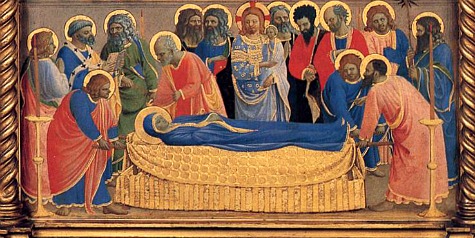
The Vigil of the Assumption of the Blessed Virgin Mary (Traditional)
Saint Maximilian Kolbe, Priest, Martyr
St. Eusebius, Priest (Traditional)
THE VIGIL OF THE ASSUMPTION OF THE BLESSED VIRGIN MARY
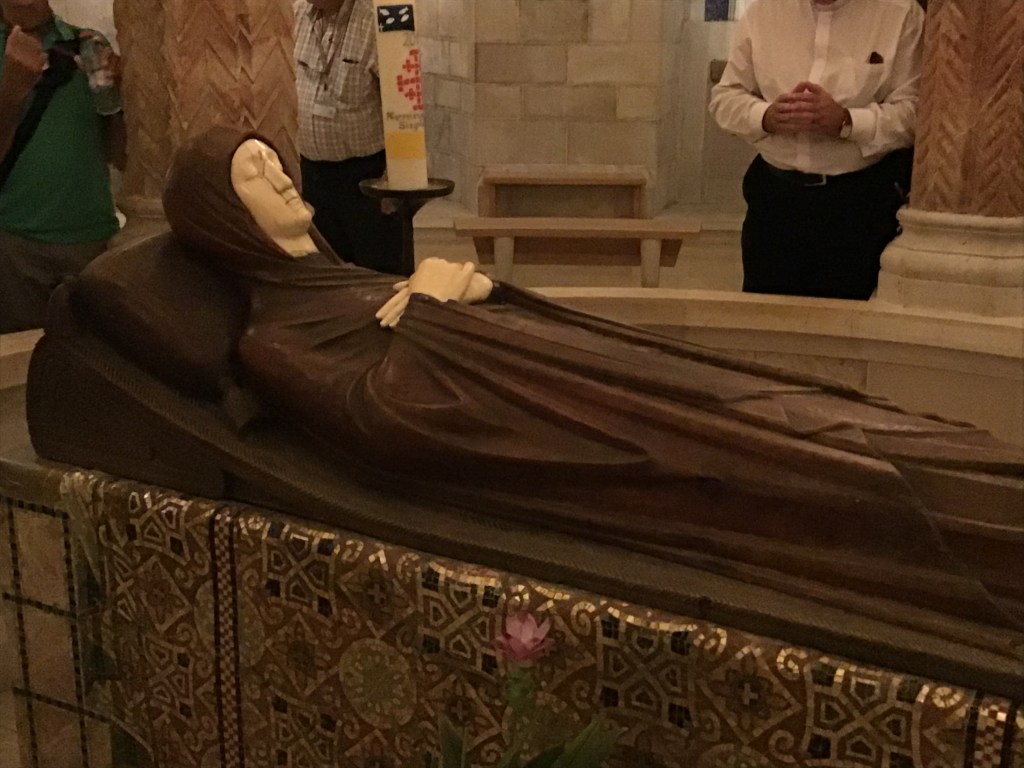
As early as the seventh century the preparation, by a solemn fast, for keeping devoutly the great festival of the Assumption, is described as a custom of great antiquity. In many parts of the Church the strict fast enjoined lasted over several days. The Mass celebrated on this day is of Our Blessed Lady, on account of its being that of a vigil, and is said in purple vestments, and the hymn Gloria in excelsis is omitted.
SAINT MAXIMILIAN KOLBE, PRIEST, MARTYR

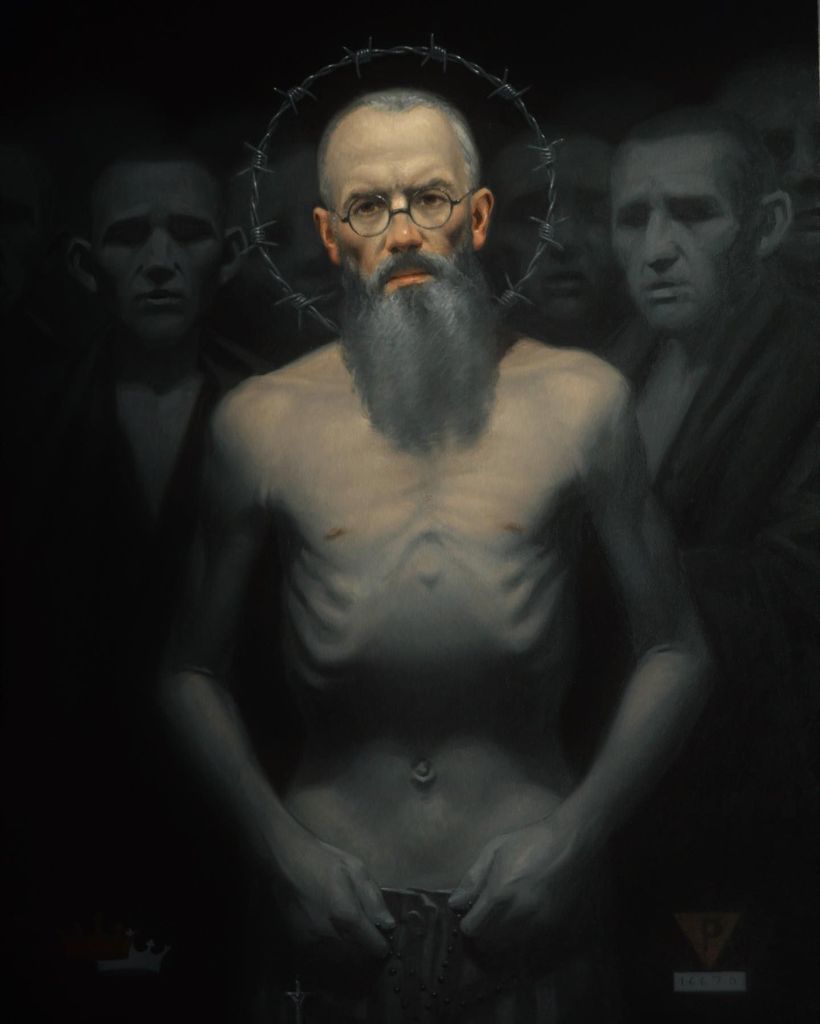
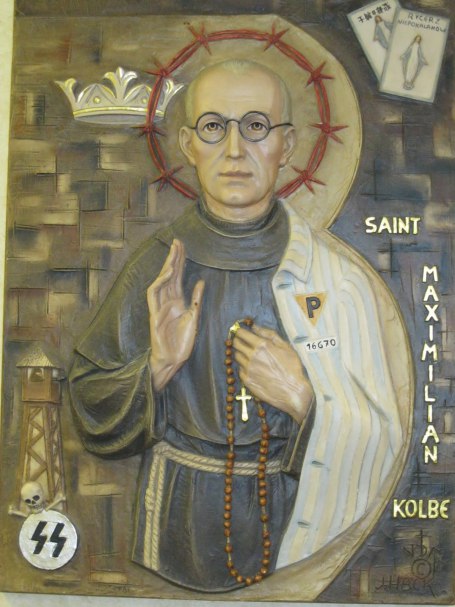
St. Maximilian was born in 1894 in Russia-ruled Poland to a young labourer and his wife and became a Franciscan. He contracted tuberculosis and, though he recovered, he remained frail all his life. Mary appeared to the ten-year old Maximilian and offered him two crowns: a red one for martyrdom, and a white one for purity. He chose both. Before his ordination as a priest, Maximilian founded the Militia of the Immaculata Movement, the worldwide movement of Marian consecration devoted to Our Lady. After receiving a doctorate in theology, he spread the Movement through a magazine entitled “The Knights of the Immaculata” and helped form a community of 800 men, the largest in the world.
Maximilian went to Japan where he built a comparable monastery and then on to India where he furthered the Movement. In 1936 he returned home because of ill health. After the Nazi invasion in 1939, he was imprisoned and released for a time. But in 1941 he was arrested again and sent to the concentration camp at Auschwitz.
On July 31, 1941, in reprisal for one prisoner’s escape, ten men were chosen to die. Father Kolbe offered himself in place of a young husband and father sentenced to the starvation bunker. And he was the last to die, enduring two weeks of starvation, thirst, and neglect. He died as a “martyr of charity” on 14 August 1941 he was canonized by Pope Saint John Paul II in 1982
COMMEMORATION OF SAINT EUSEBIUS, CONFESSOR

St. Eusebius was a Roman priest distinguished for his zeal in the cause of orthodoxy against the Arians. He lived in the fourth century of our era. He appears to have died in prison by order of Emperor Constanatius. The universal veneration in which he was held led to his immediate canonization.
From the Letters of Saint Maximilian Mary Kolbe, Priest and Martyr
(Scritti del P. Massimiliano M. Kolbe, Italian translation, vol. I, pt. 1 [Padua, 1971], 75-77; 166)
Apostolic zeal for the salvation and sanctification of souls
The burning zeal for God’s glory that motivates you fills my heart with joy. It is sad for us to see in our own time that indifferentism in its many forms is spreading like an epidemic not only among the laity but also among religious. But God is worthy of glory beyond measure, and therefore it is of absolute and supreme importance to seek that glory with all the power of our feeble resources. Since we are mere creatures we can never return to Him all that is His due.
The most resplendent manifestation of God’s glory is the salvation of souls, whom Christ redeemed by shedding His Blood. To work for the salvation and sanctification of as many souls as possible, therefore, is the preeminent purpose of the apostolic life. Let me, then, say a few words that may show the way toward achieving God’s glory and the sanctification of many souls.
God, Who is All-knowing and All-wise, knows best what we should do to increase His glory. Through His representatives on earth He continually reveals His will to us; thus it is obedience and obedience alone that is the sure sign to us of the Divine Will. A superior may, it is true, make a mistake; but it is impossible for us to be mistaken in obeying a superior’s command. The only exception to this rule is the case of a superior commanding something that in even the slightest way would contravene God’s Law. Such a superior would not be conveying God’s Will.
God alone is Infinitely Wise, Holy, Merciful, Our LORD, Creator, and Father; He is Beginning and End, Wisdom and Power and Love; He is all. Everything other than God has value to the degree that it is referred to Him, the Maker of all and our own Redeemer, the final end of all things. It is He Who, declaring His adorable Will to us through His representatives on earth, draws us to Himself and Whose Plan is to draw others to Himself through us and to join us all to Himself in an ever deepening love.
Look, then, at the high dignity that by God’s mercy belongs to our state in life. Obedience raises us beyond the limits of our littleness and puts us in harmony with God’s Will. In boundless wisdom and care, His Will guides us to act rightly. Holding fast to that Will, which no creature can thwart, we are filled with unsurpassable strength.
Obedience is the one and the only way of wisdom and prudence for us to offer glory to God. If there were another, Christ would certainly have shown it to us by word and example. Scripture, however, summed up His entire life at Nazareth in the words: He was subject to them; Scripture set obedience as the theme of the rest of His life, repeatedly declaring that He came into the world to do His Father’s Will.
Let us love our loving Father with all our hearts. Let our obedience increase that love, above all when it requires us to surrender our own will. Jesus Christ Crucified is our sublime Guide toward growth in God’s love.
We will learn this lesson more quickly through the Immaculate Virgin, whom God has made the dispenser of His mercy. It is beyond all doubt that Mary’s will represents to us the Will of God Himself. By dedicating ourselves to her we become in her hands instruments of God’s mercy even as she was such an instrument in God’s hands. We should let ourselves be guided and led by Mary and rest quiet and secure in her hands. She will watch out for us, provide for us, answer our needs of body and spirit; she will dissolve all our difficulties and worries.
DAILY MEDITATION
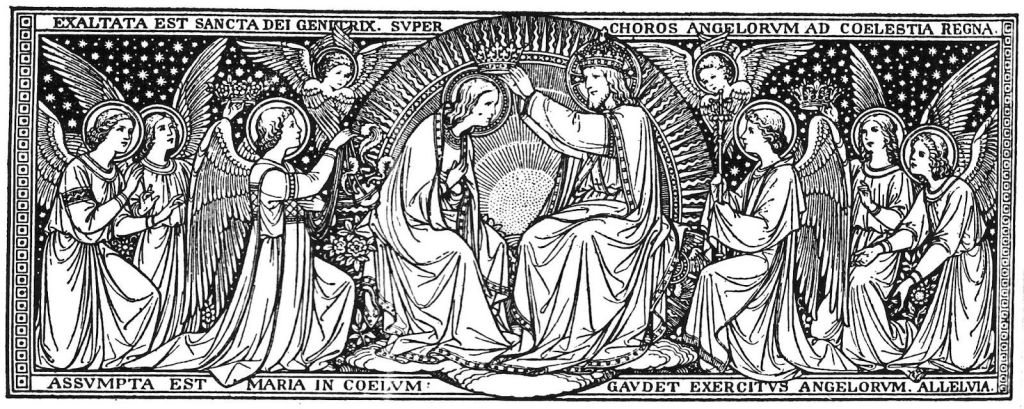
This glorious Queen alone is dearer to her divine Spouse than all the rest of His Heavenly court together. And in saying this, I should say no more than what has been expressly asserted by Saint Bonaventure, Saint Anslem, and Saint Augustine, amongst the holy Fathers; and amongst modern divines, but no one more confidently than by the devout and learned Suarez, when he says that, “God loves the Virgin alone more than all the other saints together.“ What other proof of the proposition before us could I undertake to produce that is not already contained in this? For, if Christ loves everyone of the elect in particular, more than all of the elect together can possibly love Him, as is, undoubtedly the case, what an excess of love must that be which He bears to the Blessed Virgin Mary?
For He loves her more than He loves all the apostles, all the patriarchs, all the prophets, all those millions of martyrs, who have suffered such cruel deaths for His sake; more than all the angels, all the archangels, all the highest choirs of seraphim: in a word, more than all the whole Church, whether Militant on earth, or Triumphant in Heaven. So that if, to make an impossible supposition, He were under the necessity of losing either the Blessed Virgin, or all those I have mentioned, and millions more, He would sooner part with them all than with her….
I say then that the Blessed Virgin Mary is that great firstborn in the order of nature, in the order of grace, and in the order of glory, who, in each of these three characters, enjoys most justly not only the largest portion of the inheritance of Almighty God, but also the best and greatest share of His paternal affections: “My perfect one is but one, she is the only one“ [Canticle 6:8].
Fr. Paulo Segneri [died 1694] – Italian Jesuit missionary preacher, ascetical, writer, and one of Italy’s greatest orators.
The Grace to Overcome Our Grief
You must be prepared for moments of darkness, anguish, uncertainty, fear, sometimes very insistent temptations, and suffering of the body and of the soul—that are a hundred times more severe. In fact, if there were nothing to bear, for what would you go to Heaven? Without struggle victory would be impossible and without victory there can be no crown, there can be no reward. Therefore, from now on be prepared for anything. However, we must not be afraid of anything, because we can and we must win. But how? Here is how: by not trusting ourselves in any way and by offering all of ourselves, all the temptations, and our difficulties to the Immaculata, surely we will always be victorious…. The Immaculata cannot abandon her children….
Serving the Immaculata with fidelity, we can give the best service to our family. In fact, is she not able to help our families incomparably better than we can ourselves?Let us entrust to her all of those close to our hearts, and she, the best among mothers, will help them in the best way possible.
Imagine how we will be happy on our deathbed, when we can say with all sincerity: “Oh Immaculata, for your mercy I consecrated all my life to you, I worked for you, for you I suffered, and now I die for you. I am yours!” What peace, what serene Joy will fill our hearts in the Hope of seeing her soon….
I finish here—because I have written too much—wishing that you love the Immaculata so much that you are no longer able to live without her.
Saint Maximilian Kolbe
Saint Maximilian Kolbe († 1941) was a Conventual Franciscan priest who spread devotion to the Blessed Virgin Mary through print and radio in Japan and his native Poland. He was martyred in Auschwitz. [From The Writings of St. Maximilian Maria Kolbe, Volume I Letters. ©
“The refusal to take sides on great moral issues is itself a decision. It is a silent acquiescence to evil. The tragedy of our time is that those who still believe in honesty lack fire and conviction, while those who believe in dishonesty are full of passionate conviction.” – Ven. Archbishop Fulton Sheen
 Daily Reflections
Leave a comment