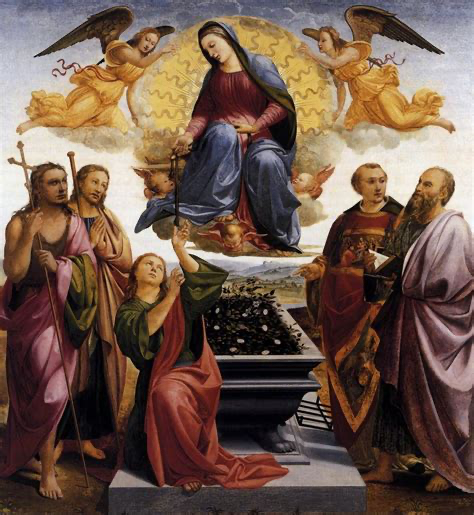
You have left this world to be joined with Christ. The angels rejoice, and the archangels sing your praises, O Virgin Mary. Adorned with heavenly power you shine forth like the sun among the saints.
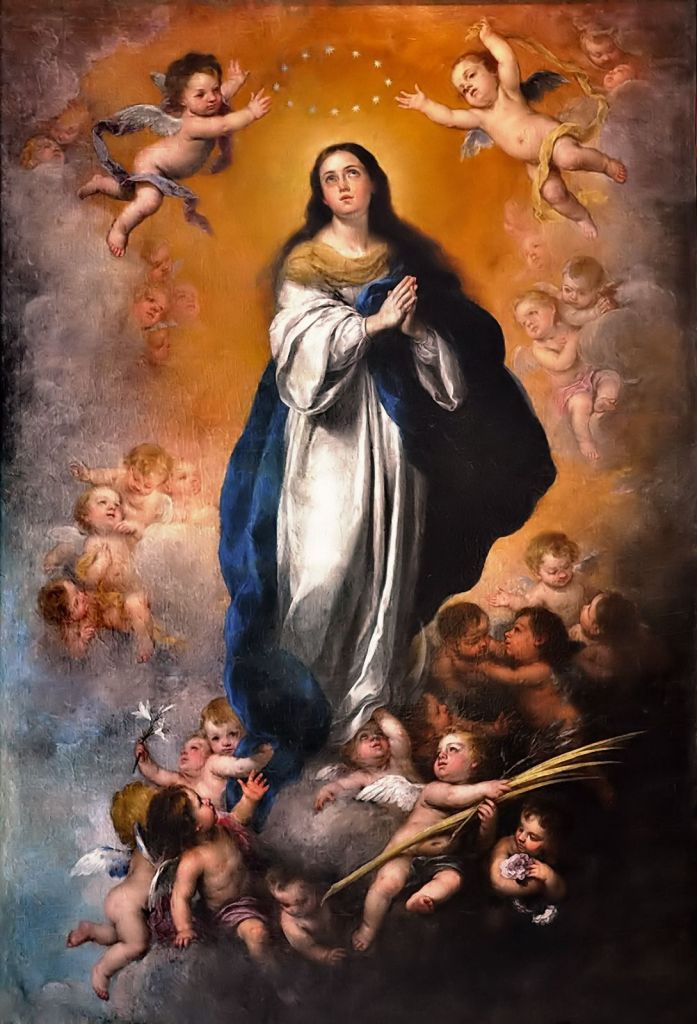
On November 1, 1950, Venerable Pius XII defined the Assumption of Mary to be a Dogma of Faith: “We pronounce, declare and define it to be a divinely revealed Dogma that the immaculate Mother of God, the ever Virgin Mary, having completed the course of her earthly life, was assumed body and soul to Heavenly Glory.” The pope proclaimed this Dogma only after a broad consultation of Bishops, theologians and laity. There were few dissenting voices. What the Pope solemnly declared was already a common belief in the Catholic Church.
We find homilies on the Assumption going back to the sixth century. In following centuries the Eastern Churches held steadily to the doctrine, but some authors in the West were hesitant. However, by the thirteenth century there was universal agreement. The feast was celebrated under various names (Commemoration, Dormition, Passing, Assumption) from at least the fifth or sixth century.
Scripture does not give an account of Mary’s Assumption into Heaven. Nevertheless, Revelation 12 speaks of a woman who is caught up in the battle between good and evil. Many see this woman as God’s people. Since Mary best embodies the people of both Old and New Testament, her Assumption can be seen as an exemplification of the woman’s victory.
Mary was cared for by Saint John for twelve years after Our LORD’s Resurrection. Her life was spent in helping the apostles and in praying for the conversion of the world. On the third day after Mary’s death, when the apostles gathered around her tomb, they found it empty. The sacred body had been carried up to the celestial paradise. Jesus Himself came to conduct her thither, the whole court of Heaven came to welcome with songs of triumph the Mother of the Divine Word.
From the apostolic constitution Munificentissimus Deus by Venerable Pius XII, Pope
(AAS 42 [1950], 760-762, 767-769)
Your body is holy and excelling in splendour

In their homilies and sermons on this feast the holy fathers and the great doctors spoke of the Assumption of the Mother of God as something already familiar and accepted by the faithful. They gave it greater clarity in their preaching and used more profound arguments in setting out its nature and meaning. Above all, they brought out more clearly the fact that what is commemorated in this feast is not simply the total absence of corruption from the dead body of the Blessed Virgin Mary but also her triumph over death and her glorification in Heaven, after the pattern set by her only Son, Jesus Christ.
Thus Saint John Damascene, preeminent as the great preacher of this Truth of tradition, speaks with powerful eloquence when he relates the bodily Assumption of the loving Mother of God to her other gifts and privileges: “It was necessary that she who preserved her virginity inviolate in childbirth should also have her body kept free from corruption after death. It was necessary that she who carried the Creator as a child on her breast should dwell in the tabernacles of God. It was necessary that the bride espoused by the Father should make her home in the bridal chambers of Heaven. It was necessary that she, who had gazed on her Crucified Son and been pierced in the heart by the sword of sorrow which she had escaped in giving Him birth, should contemplate Him seated with the Father. It was necessary that the Mother of God should share the possessions of her Son, and be venerated by every creature as the Mother and handmaid of God.”
Saint Germanus of Constantinople considered that it was in keeping not only with her Divine Motherhood but also with the unique sanctity of her virginal birth that it was incorrupt and carried up to Heaven: “In the words of Scripture, you appear in beauty. Your virginal body is entirely holy, entirely chaste, entirely the House of God, so that for this reason also it is henceforth a stranger to decay: a body changed, because a human body, to a preeminent life of incorruptibility, but still a living body, a body inviolate and sharing in the perfection of life.”
Another early author declares: “Therefore, as the most glorious Mother of Christ, our God and Saviour, the Giver of Life and Immortality, she is enlivened by Him to share an eternal incorruptibility of body with Him who raised her from the tomb and took her to Himself in a way He alone can tell.”
All these reasonings and considerations of the holy Fathers rest on Scripture as their ultimate foundation. Scripture portrays the loving Mother of God, almost before our very eyes, as most intimately united with her Divine Son and always sharing in His destiny.
Above all, it must be noted that from the second century the holy Fathers present the Virgin Mary as the new Eve, most closely associated with the new Adam, though subject to Him in the struggle against the enemy from the nether world. This struggle, as the first promise of a Redeemer implies, was to end in perfect victory over sin and death, always linked together in the writings of the Apostle of the Gentiles. Therefore just as the glorious Resurrection of Christ was an essential part of this victory and its final trophy, so the struggle shared by the Blessed Virgin and her Son was to end in the glorification of her virginal body. As the same Apostle says: When this mortal body has clothed itself in Immortality, then will be fulfilled the word of Scripture: Death is swallowed up in victory.
Hence, the august Mother of God, mysteriously united from All Eternity with Jesus Christ in one and the same decree of predestination, immaculate in her conception, a virgin inviolate in her divine Motherhood, the wholehearted companion of the divine Redeemer who won complete victory over sin and its consequences, gained, at last the supreme crown of her privileges—to be preserved immune from the corruption of the tomb, and, like her Son, when death had been conquered, to be carried up body and soul to the exalted Glory of Heaven, there to sit in splendour at the right hand of her Son, the immortal King of the ages.
DAILY MEDITATION
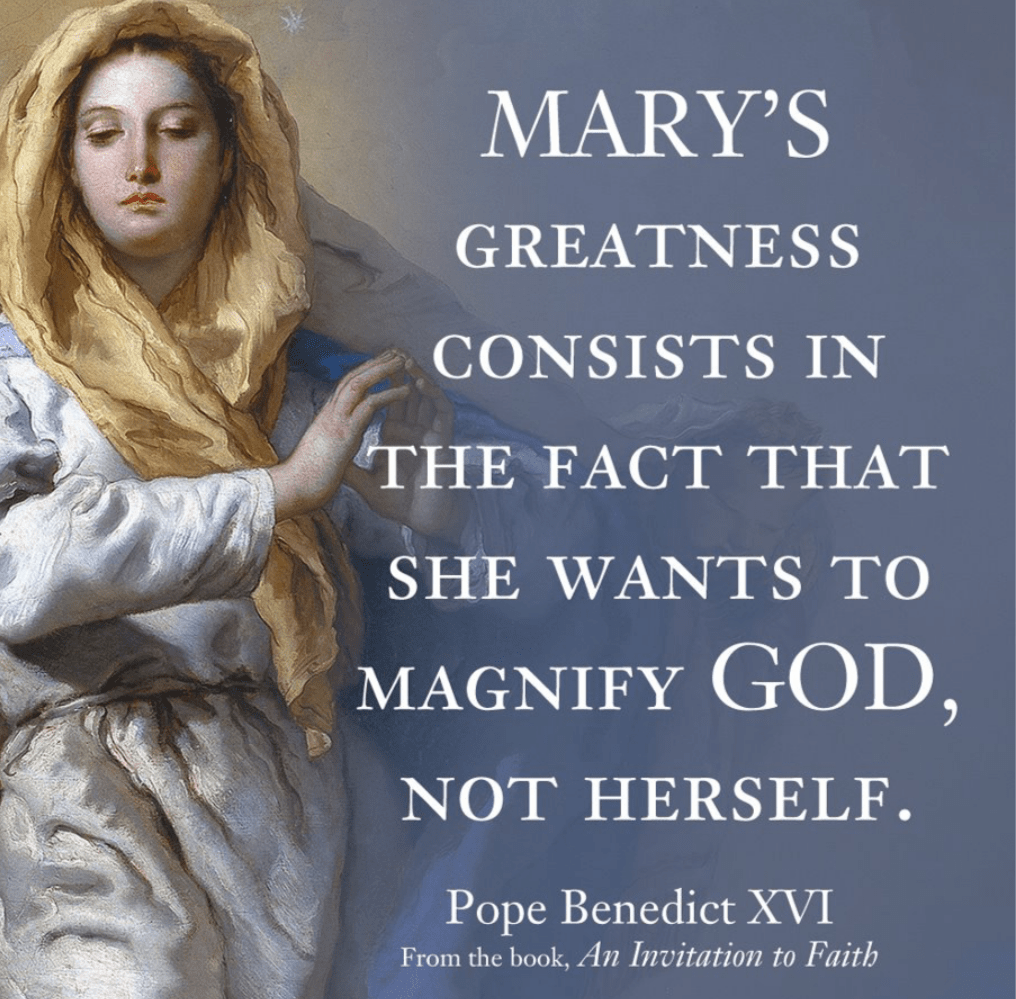
It is certain that the Blessed Virgin was not absolutely the first born amongst creatures in the order of time, since her actual birth was many ages later than the formation of the world. Yet she is said to be the first, and even to have been created “from the beginning, and before the world“ [Ecclesiasticus 24:14] because, though she was not first in the execution of the divine decrees, yet she was first in their intention; and, being the highest in the rank of all the pure creatures sent God’s omnipotence was to produce, she was, in a manner, the end of all the rest of His creation. “For her,” says Saint Bernard, “the whole world was made.“ Not indeed, for her as its final end, for that can be no other than God, Himself, but for her, as the secondary end of this vast universe, designed by its Creator, with this very intention, that it should be subject to her as it’s Queen.
If anyone is surprised at what I here advance, he shows himself to be little acquainted with the merits of Mary…. For she alone ascended much higher by contemplation, than the whole world, besides, and never was she known to descend again, by the abuse of any grace bestowed on her, as all others do by sin, and thus depart from the highest good by those same steps, which should have raised them nearer to it. But now that leaving our world, where she spent her life as one unknown, she has ascended her throne in Heaven, with far greater homage do all creatures serve her….
… Almighty God has created two worlds: one for man, which is the earth, we know, inhabit, and the other for Himself, which is the soul of Mary. And this latter, as the more exact copy of the uncreated Idea, served as a kind of original, after which to model the other. If this be allowed, we shall not be inclined to question the truth of another opinion, no less sublime than pious, proposed by Saint Bernadine, who does not hesitate to affirm that, if Almighty God, after the notorious disobedience of our first parents, in the terrestrial paradise, did not immediately destroy the world, which He had so lately created, it was in a very special manner for the Blessed Virgin Mary‘s sake.
Fr. Paolo Segneri [d.1694] – Italian Jesuit, missionary preacher, ascetical writer, and one of Italy’s greatest orators.
Crowned with the Stars and Glorious in Heaven
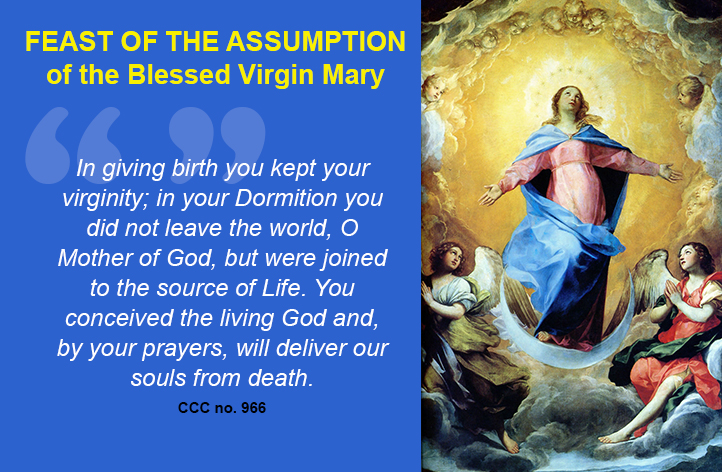
With her fiat, the King of kings, Christ, her Son and Son of God, was in her womb. Once the Holy Spirit exclaimed, in the Canticle of Canticles: Daughters of Zion, come and see King Solomon wearing the diadem with which his mother crowned him on his wedding day, on the day of his heart’s joy. Centuries later Saint Ambrose saw at the Annunciation the crown of a king come to Christ in the moment of Mary’s consent. And in return a crown was here, by which she was sovereign also of the same kingdom. She was His and He was hers and all that He could give, He gave. Henceforth, no man could call him King and deny to her the Queenship.
Before she heard from Simeon of the sword of sorrow, Mary heard of the Kingdom of Christ. The angel told her: The LORD God will give Him the throne of His ancestor David; He will rule over the House of Jacob for ever and His reign will have no end. Later she heard John the Baptist as he preached: Repent, for the Kingdom of Heaven is close at hand. Still later from the lips of her beloved Son, she heard of the Kingdom of Heaven, and the Kingdom of My Father. And she kept all these things in her heart. To her there was no need, as to Pilate, for Jesus to say: Mine is not a kingdom of this world. His Kingdom was hers, a Kingdom purchased by blood, His Blood; a Kingdom conquered in His giving up of life, the life He had begun in her. By that sacrifice He was King anew, by right of conquest. By that sacrifice was she the Queen, offering Him as he offered Himself. Upon the Cross the Man of Sorrows was Our LORD; beneath the Cross the Mother of Sorrows was our Lady. Only she who was His Mother and His Queen could be so one with Him in redeeming men—one in knowledge, sorrow, love, and triumph. All things were His and He was God’s. And, in the moment of giving Himself and all to God, He gave Himself and all to her.
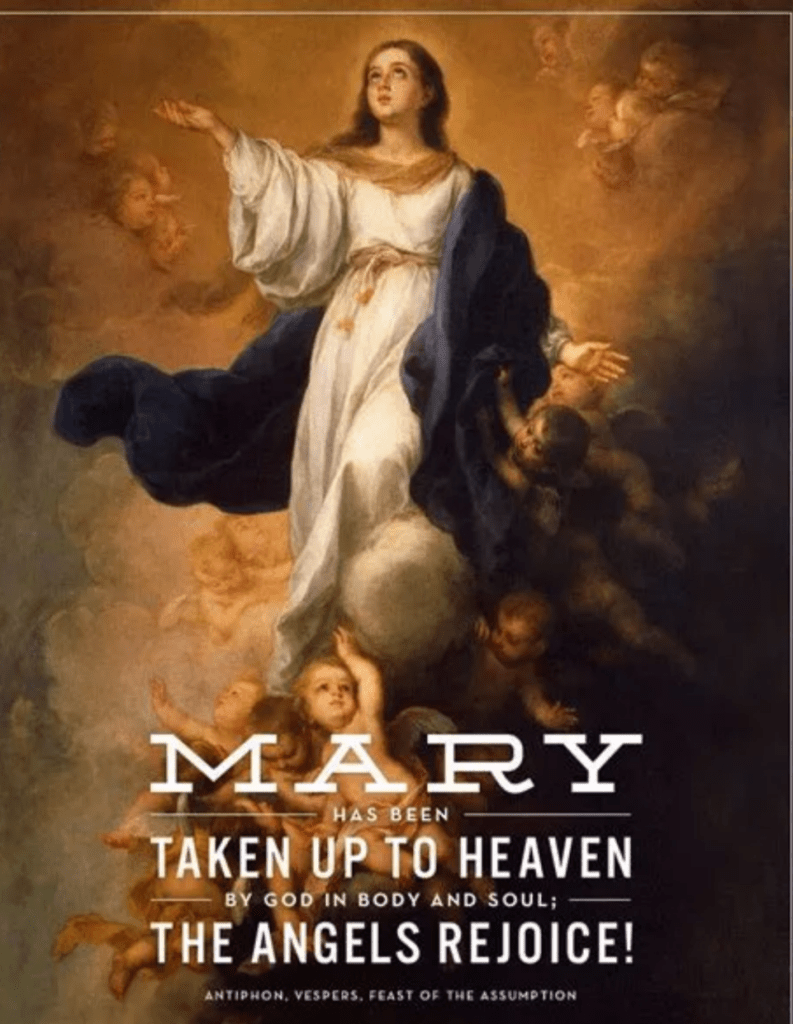
Heaven hungered for its own. God drew her into glory. To her did the angels minister on earth; before her they rejoice in Heaven. By the Eternal Trinity was she glorified: the Father asked her pleasure; the Spirit took her to bride; the Son acknowledges her to be His Mother. Truly, the Almighty has done great things for me. And, on the island of Patmos, John had a vision: a woman, adorned with the sun, standing on the moon, and with the twelve stars on her head for a crown.
Father Elwood Ferrer Smith, o.p.
Father Smith († 1992) was an American Dominican priest, theologian, professor, and author. [From The Mariological Institute Lectures, Theological Series, Volume 1. © 1959
 Daily Reflections
Leave a comment