Micah 5:2, 4, 5; Zechariah 9:10
Bethlehem, City of God Most High,
from you will come forth a ruler for Israel,
one whose origin will go back to the distant past, to ancient times.
His greatness will reach to the ends of the earth,
– and He will be our peace.
He will proclaim peace to the nations;
His dominion will extend from sea to sea.
– And He will be our peace.
Thursday of the Nineteenth Week in Ordinary Time
Our Lady of Knock (Ireland)
Saint Hyacinth, Confessor (Traditional)
The key to forgiving others is to remember just how much we ourselves have been forgiven despite our own unworthiness. Our recollection of such a miracle of mercy moves us eagerly to forgive “seventy-seven times” (Matthew 18:21-19:1) those who offend us, delighting to see their sins “flowing down” like the waters of the Jordan until they disappear altogether (Book of Joshua3:7-10a, 11, 13-17).
SAINT HYACINTH, CONFESSOR
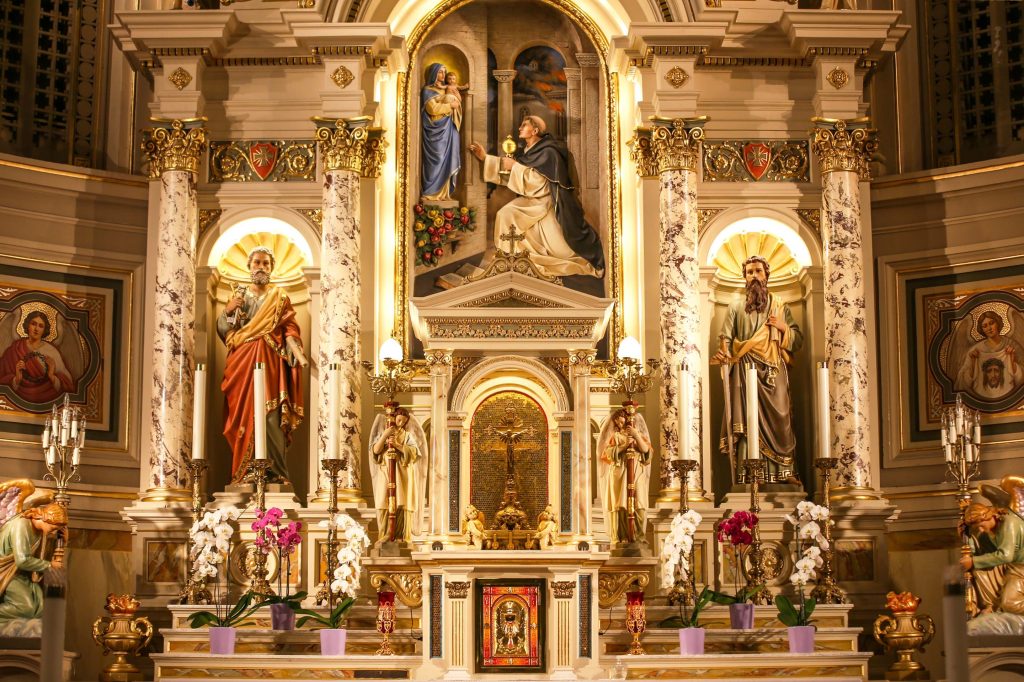
Hyacinth Ronski, a Pole, was originally a canon of the Cathedral of Cracow. Having gone to Rome, he became acquainted with St. Dominic and was admitted into the Order of Friars Preachers by the Holy Founder himself. He laboured for the establishment of the Order in Poland and died in 1257.
OUR LADY OF KNOCK
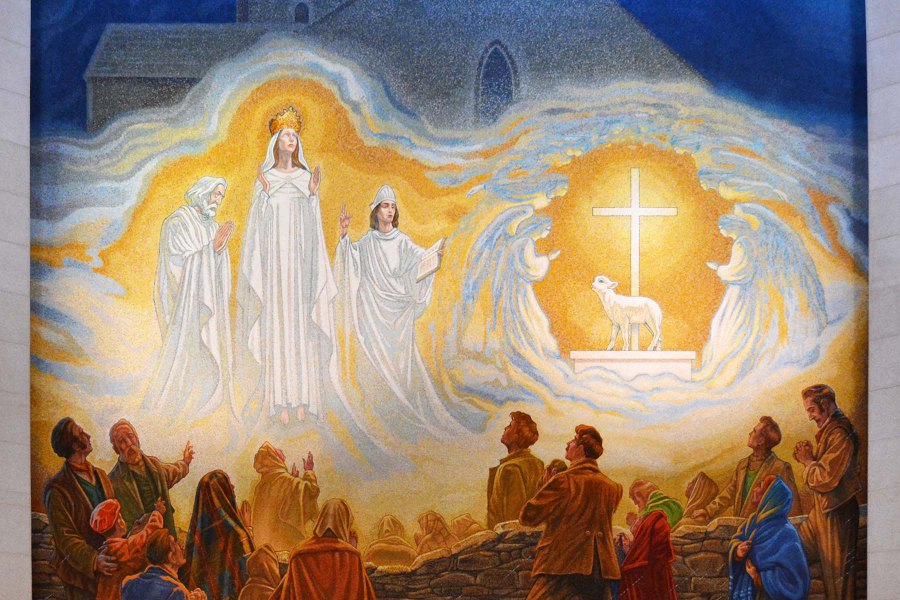
“ Although not a word was spoken by Our Lady, St. Joseph and St. John during the silent apparition at Knock, the vision spoke louder than words with an eloquent message uniting earth and heaven.“
Father Stan Smolenski, August 22, 2021
On the rainy evening of Aug. 21, 1879, 15 persons saw a two-hour vision on the gable of St. John the Baptist church in the humble village of Knock, County Mayo, Ireland. Whoever came, saw. Ranging from 5-75 years of age, they acknowledged seeing the same religious tableaux.
The figures, all robed in white, were raised a couple of feet above the perfectly dry ground. In the centre of the gable was a simple altar with a young lamb standing in front of a cross. Angels encircled this area.
To the left were three figures. In the centre was Mary, robed and mantled in white with a crown on her unveiled head. There was a rose where the crown touched her forehead. Her eyes were looking upward while her arms were outstretched in the “Orans” position, similar to that of the priest at Mass.
To her right was a side view of St. Joseph, slight bowing toward her. To her left was St. John the Apostle, robed as a mitred bishop, looking forward, holding an open book in one hand and pointing heavenward with the other.
From a treatise on Christian Perfection by Saint Gregory of Nyssa, Bishop
(PG 46, 259-262)
We possess Christ, our Peace, our Light
He is our peace, for He has made both one. Since we think of Christ as our peace, we may call ourselves true Christians only if our lives express Christ by our own peace. As the Apostle says: He has put enmity to death. We must never allow it to be rekindled in us in any way but must declare that it is absolutely dead. Gloriously has God slain enmity, in order to save us; may we never risk the life of our souls by being resentful or by bearing grudges. We must not awaken that enmity or call it back to life by our wickedness, for it is better left dead.
No, since we possess Christ who is Peace, we must put an end to this enmity and live as we believe He lived. He broke down the separating wall, uniting what was divided, bringing about peace by reconciling in His single person those who disagreed. In the same way, we must be reconciled not only with those who attack us from outside, but also with those who stir up dissension within; flesh then will no longer be opposed to the spirit, nor the spirit to the flesh. Once we subject the wisdom of the flesh to God’s law, we shall be re-created as one single man at peace. Then, having become one instead of two, we shall have peace within ourselves.
Now peace is defined as harmony among those who are divided. When, therefore, we end that civil war within our nature and cultivate peace within ourselves, we become peace. By this peace we demonstrate that the name of Christ, which we bear, is authentic and appropriate.
When we consider that Christ is the True Light, having nothing in common with deceit, we learn that our own life also must shine with the rays of that True Light. Now these rays of the Sun of Justice are the virtues which pour out to enlighten us so that we may put away the works of darkness and walk honourably as in broad daylight. When we reject the deeds of darkness and do everything in the light of day, we become light and, as light should, we give light to others by our actions.
If we truly think of Christ as our Source of Holiness, we shall refrain from anything wicked or impure in thought or act and thus show ourselves to be worthy bearers of His name. For the quality of holiness is shown not by what we say but by what we do in life.
Receiving Mercy, Giving Mercy
Without the Truth, love could not survive. In love, I want to see my brothers and sisters with God’s eyes, not with my own.
God sees my brothers and sisters much differently than I do. God sees the errors of their past, yet at the same time God’s gaze embraces their sincere desire for conversion. How then can their past exist?
Our sincerity, repentance, and love are met by God’s mercy. It is similar to the confidence a mother inspires in her fragile child as she lovingly protects it from the danger of falling. If my whole being is not full of mercy for others, I am not worthy to call myself a Christian. Without mercy, I cannot hope to receive the LORD’s mercy. Blessed are the merciful, for they shall have mercy shown them.
You have loved me, LORD, who created me from clay. You know my fragility and my weakness, and show me Your tender mercy.
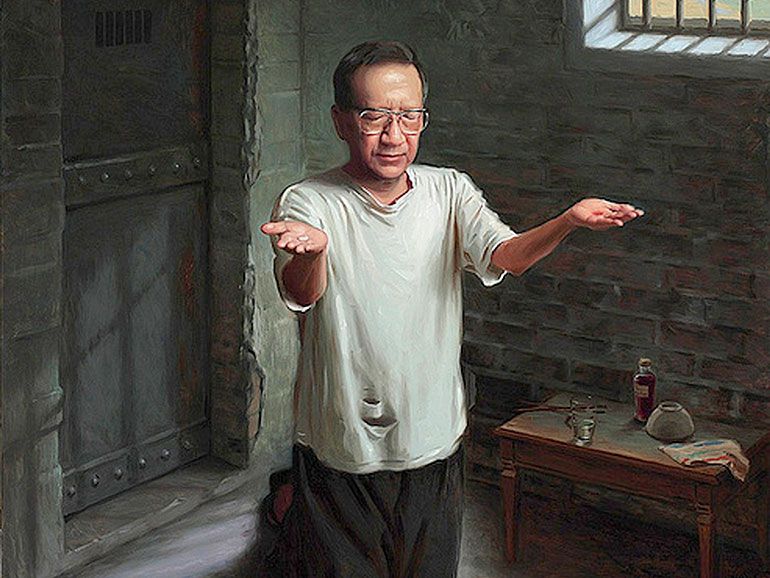
Venerable Francis Xavier Nguyên Văn Thuân
Cardinal Nguyên Văn Thuân († 2002) was imprisoned by the Vietnamese government for thirteen years, during which time he secretly celebrated Mass, sent prayers and spiritual writings to his flock. [From Prayers of Hope: Words of Courage, English edition. Copyright
DAILY MEDITATION
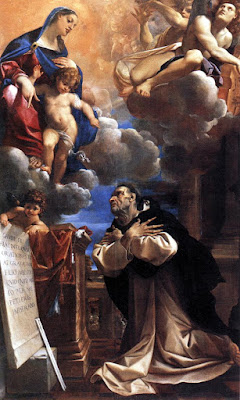
Hyacinth, the glorious Apostle of Poland and Russia, was born of noble parents in Poland, about the year 1185. In 1218, being already canon of Cracow, he accompanied his uncle, the Bishop of that place, to Rome. There he met Saint Dominic, and received the habit of the Friar Preachers from the Patriarch himself, of whom he became a living copy.
So wonderful was his progress in virtue that, within a year, Dominic sent him to preach and plant the order in Poland, where he founded two houses. His apostolic journeys extended over numerous regions Austria, Bohemia, Livonia, the shores of the Black Sea, Tartary, and northern China on the east, and Sweden and Norway to the west, were evangelized by him, and he is said to have visited Scotland. Everywhere mulitudes were converted, churches and convents were built; one hundred and twenty thousand pagans and infidels were baptized by his hands. He worked numerous miracles, and in Krakow raised a dead youth to life. He had inherited from Saint Dominic, a most filial confidence in the Mother of God; to her he ascribed his success, and to her aid he looked for his salvation. When St. Hyacinth was at Kiev, the Tartars attacked the town, but it was only as he finished Mass that the saint heard of the danger. Without waiting to unvest, he took the ciborium in his hands, and was leaving the church. As he passed by an image of Mary, voice said: “Hyacinth, my son, why dost thou leave me behind? Take me with thee, and leave me not to mine enemies.“ The statue was of heavy alabaster, but, when hyacinths took it in his arms, it was light as a reed. With the Blessed Sacrament and the image, he came to the River Dnieper, and walked in dry-shod over the surface of the waters. On the eve of Assumption, he was warned of his coming death. In spite of a wasting fever, he celebrated Mass on the feast, and communicated as a dying man. He was anointed at the foot of the altar, and died the same day, A. D. 1257.
Reflection: St. Hyacinth teachers us to employ every effort in the service of God, and to rely for success not on our own industry, but on the prayer of his Immaculate Mother.
John Gilmary Shea [d.1892] – American, author and celebrated historian, regarded as the father of American Catholic history
“The refusal to take sides on great moral issues is itself a decision. It is a silent acquiescence to evil. The tragedy of our time is that those who still believe in honesty lack fire and conviction, while those who believe in dishonesty are full of passionate conviction.” – Ven. Archbishop Fulton Sheen
 Daily Reflections
Leave a comment