Revelation 4:8; Isaiah 6:3
Holy, holy, holy, LORD God Almighty,
Who was, and Who is, and Who is to come;
– all the earth is full of His glory.
The seraphim cried out to one another:
Holy, holy, holy is the LORD God of hosts.
– All the earth is full of His glory.
Twentieth Sunday in Ordinary Time
The Twelfth Sunday after Pentecost (Traditional)
Saint Bernard of Clairvaux, Abbot and Doctor of the Church
TRADITIONAL READINGS: Epistle: 2 Cor 3:4-9; Gospel: Luke 10:23-37
We have been initiated into spiritual life by the Sacrament of Baptism, and strengthened – perfected – by the Sacrament of Confirmation. The feast of Pentecost has celebrated the efficaciousness of Baptism and Confirmation: the graces and fruits given by the Holy Ghost. The Church recalls in the Liturgy today the duty of charity which derives from them.
DAILY MEDITATION
The Liturgy of the Twelfth Sunday after Pentecost recalls again, the splendour of the Easter mystery, revealing to us our happy lot in belonging to Christ and His Kingdom through the Sacrament of Baptism. It reminds us also of the duties which we assumed through the reception of this Sacrament…. The Old Testament was a “ ministration of death“ [Epistle], since it could make clear to us only the nature of death [sin] and could pass judgement by punishing sin and sinners; it was, however, unable by itself to restore the spirit, the supernatural life of grace. How different is the New Covenant, the covenant of life-giving Spirit, the Giver of graces! How different the new state of interior justification of the soul before God! We have become members of this covenant, and, for this privilege, “I will bless the LORD at all times“ [Gradual]. By means of this union, life is given again to man, wounded and tortured unto death by sin. Like the priest in today’s Gospel, the Old Testament passes by the wounded man. But Christ, the New Covenant, pours oil and wine into the wounds [Baptism and the Eucharist], brings the half-dead man to an inn, the inn of the Church, and takes care of him so that he may regain full strength and a robust life.
The parable of the good Samaritan is fulfilled in us, the children of the Church. We ourselves are the wanderer who fell among the robbers and upon whom Christ looked down, full of compassion, taking him into His Church in the Sacrament of Baptism…. A second Moses, He implores God on our behalf, offering with His prayers His own flesh and blood, His heart, Himself wholly to the Father as a gift of sacrifice…. How much more acceptable is the sacrifice and prayer of Christ than that of Moses, the mediator of the Old Covenant! How much more acceptable is our sacrifice, the sacrifice of the baptized, than the sacrifices of men of ancient times, who did not possess Christ! “Blessed are the eyes that see the things which you see“ [Gospel].
Dom Benedict Baur [d1963] – German Benedictine, respected theologian, and archabbot of Saint Martin’s Abbey, in Bueron.
From a homily on Matthew by Saint John Chrysostom, Bishop
(Hom. 16:6,7: PG 57, 231-232)
Salt of the earth and Light of the world
You are the salt of the earth. It is not for your own sake, He says, but for the world’s sake that the Word is entrusted to you. I am not sending you into two cities only or ten or twenty, not to a single nation, as I sent the prophets of old, but across land and sea, to the whole world. And that world is in a miserable state. For when He says: You are the salt of the earth, he is indicating that all mankind had lost its savour and had been corrupted by sin. Therefore, He requires of these men those virtues which are especially useful and even necessary if they are to bear the burdens of many. For the man who is kindly, modest, merciful and just will not keep his good works to himself but will see to it that these admirable fountains send out their streams for the good of others. Again, the man who is clean of heart, a peacemaker and ardent for Truth will order his life so as to contribute to the common good.
Do not think, He says, that you are destined for easy struggles or unimportant tasks. You are the salt of the earth. What do these words imply? Did the disciples restore what had already turned rotten? Not at all. Salt cannot help what is already corrupted. That is not what they did. But what had first been renewed and freed from corruption and then turned over to them, they salted and preserved in the newness the LORD had bestowed. It took the power of Christ to free men from the corruption caused by sin; it was the task of the Apostles through strenuous labour to keep that corruption from returning.
Have you noticed how, bit by bit, Christ shows them to be superior to the prophets? He says they are to be teachers not simply for Palestine but for the whole world. Do not be surprised, then, He says, that I address you apart from the others and involve you in such a dangerous enterprise. Consider the numerous and extensive cities, peoples and nations I will be sending you to govern. For this reason I would have you make others prudent, as well as being prudent yourselves. For unless you can do that, you will not be able to sustain even yourselves.
If others lose their savour, then your ministry will help them regain it. But if you yourselves suffer that loss, you will drag others down with you. Therefore, the greater the undertakings put into your hands, the more zealous you must be. For this reason He says: But if the salt becomes tasteless, how can its flavour be restored? It is good for nothing now, but to be thrown out and trampled by men’s feet.
When they hear the words: When they curse you and persecute you and accuse you of every evil, they may be afraid to come forward. Therefore He says; “Unless you are prepared for that sort of thing, it is in vain that I have chosen you. Curses shall necessarily be your lot but they shall not harm you and will simply be a testimony to your constancy. If through fear, however, you fail to show the forcefulness your mission demands, your lot will be much worse, for all will speak evil of you and despise you. That is what being trampled by men’s feet means.”
Then He passes on to a more exalted comparison: You are the light of the world. Once again, “of the world”: not of one nation or twenty cities, but of the whole world. The light He means is an intelligible light, far superior to the rays of the sun we see, just as the salt is a spiritual salt. First salt, then light, so that you may learn how profitable sharp words may be and how useful serious doctrine. Such teaching holds in check and prevents dissipation; it leads to virtue and sharpens the mind’s eye. A city set on a hill cannot be hidden; nor do men light a lamp and put it under a basket. Here again He is urging them to a careful manner of life and teaching them to be watchful, for they live under the eyes of all and have the whole world for the arena of their struggles.
A Prayer of Great Faith
May God’s Will be done. May you be blessed for everything, O God, and give me your pardon and your grace. Bless my beloved ones, all of them; grant them conversion and holiness. May my nephews and my niece be Christians and apostles.
Give your grace to those I love, give light and spiritual life to everyone. Bless and guide Your Church and make Her priests holy, my spiritual father among them. And take me totally to Yourself, in life, in death, and for Eternity. Amen.
O God, I offer you this trial for my intentions, which you already know. May it bear fruit a hundredfold and let me place in your heart my sufferings, desires, and prayers, for you to do with them as I have asked. O Mary, pray for me, for us, now and at the hour of our death. Amen.
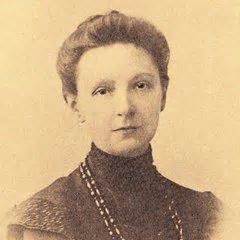
Servant of God Elisabeth Leseur
Elisabeth Leseur († 1914) was a French laywoman whose atheist husband, after reading her spiritual journal after her death, experienced a profound conversion and later became a Dominican priest. [From Elisabeth Leseur: Selected Writings, edited, translated and introduced by Janet K. Ruffing, r.s.m.
SAINT BERNARD, ABBOT AND DOCTOR OF THE CHURCH
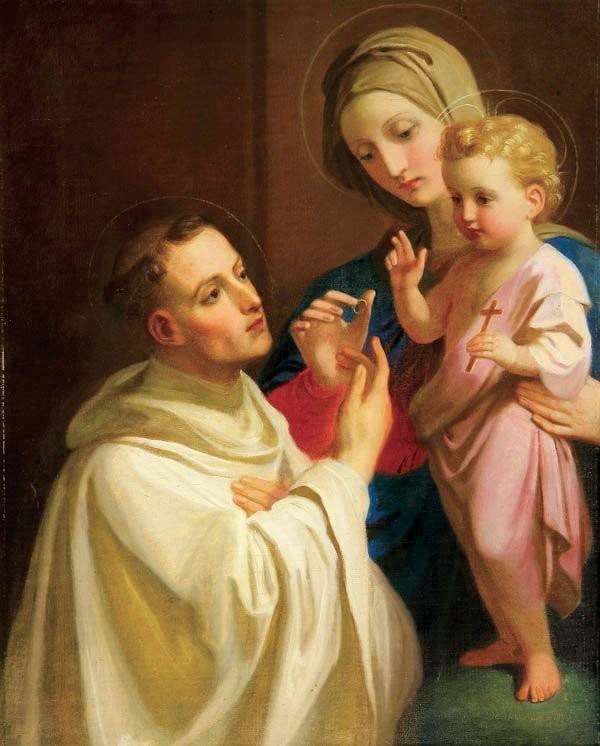
St. Bernard was born at the castle of Fontaines, in Burgundy. The grace of his person and the vigour of his intellect filled his parents with the highest hopes, and the world lay bright and smiling before him when he renounced it forever and joined the monks at Cîteaux. All his brothers followed Bernard to Cîteaux except Nivard, the youngest, who was left to stay with his father in his old age. “You will now be heir of everything,” they said to him, as they departed. “Yes,” said the boy; “you leave me earth, and keep Heaven for yourselves; do you call that fair?” And he too left the world. At length their aged father came to exchange wealth and honour for the poverty of a monk of Clairvaux. One only sister remained behind; she was married, and loved the world and its pleasures. Magnificently dressed, she visited Bernard; he refused to see her, and only at last consented to do so, not as her brother, but as the minister of Christ. The words he then spoke moved her so much that, two years later, she retired to a convent with her husband’s consent, and died in the reputation of sanctity.
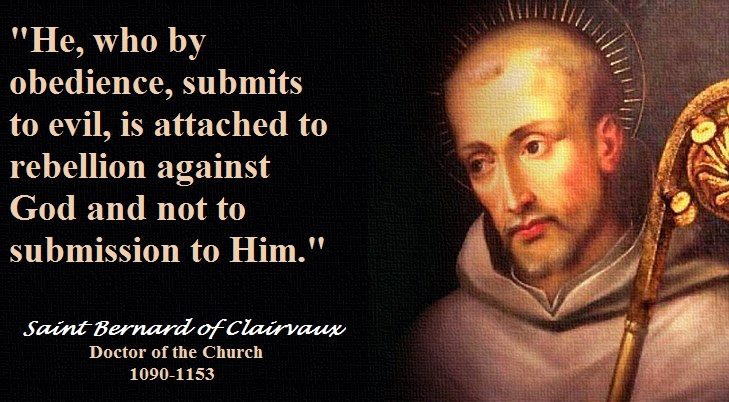
Bernard’s holy example attracted so many novices that other monasteries were erected, and our Saint was appointed abbot of that of Clairvaux. Unsparing with himself, he at first expected too much of his brethren, who were disheartened at his severity; but soon perceiving his error, he led them forward, by the sweetness of his correction and the mildness of his rule, to wonderful perfection. In spite of his desire to lie hid, the fame of his sanctity spread far and wide, and many churches asked for him as their Bishop. Through the help of Pope Eugenius III, his former subject, he escaped this dignity; yet his retirement was continually invaded: the poor and the weak sought his protection; bishops, kings, and popes applied to him for advice; and at length Eugenius himself charged him to preach the second crusade. By his fervour, eloquence, and miracles Bernard kindled the enthusiasm of Christendom, and two splendid armies were dispatched. Their defeat was only due, said the Saint, to their own sins. Bernard died in 1153. His most precious writings have earned for him the titles of the last of the Fathers and a Doctor of Holy Church.
Acts 1:8; Matthew 5:16
But you shall receive the power of the Holy Ghost coming upon you,
– And you shall be witnesses unto Me to the uttermost part of the earth.
So let your light shine before men,
that they may see your good works,
and glorify your Father Who is in Heaven.
– And you shall be witnesses unto Me to the uttermost part of the earth.
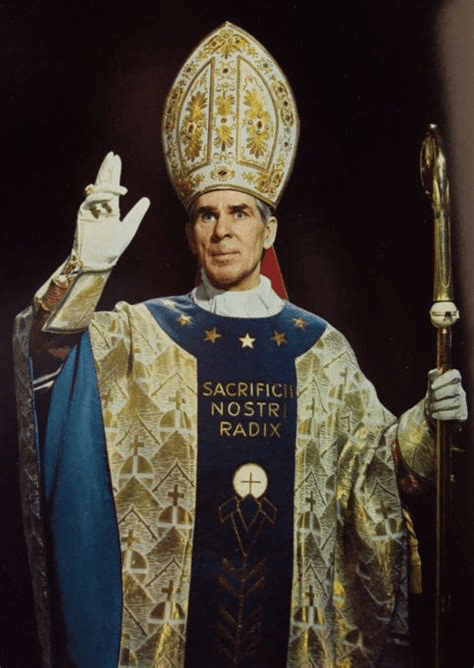
“The refusal to take sides on great moral issues is itself a decision. It is a silent acquiescence to evil. The tragedy of our time is that those who still believe in honesty lack fire and conviction, while those who believe in dishonesty are full of passionate conviction.” – Ven. Archbishop Fulton Sheen
 Daily Reflections
Leave a comment