Isaiah 3:10, 11, 13
Say to the just man that it is well,
for he shall eat the fruit of his doings.
– Woe to the wicked unto evil: for the reward of his hands shall be given himThe LORD standeth up to judge,
and He standeth up to judge the people.
– Woe to the wicked unto evil: for the reward of his hands shall be given him.
Monday of the Twentieth Week in Ordinary Time
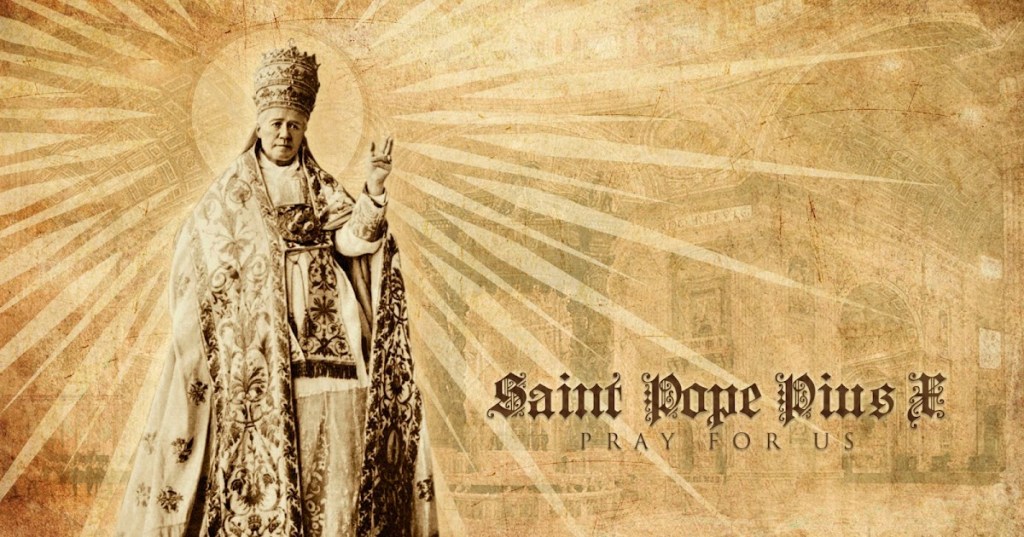
Saint Pius X, Pope, Confessor
Saint Jane Frances de Chantal, Widow
POPE PIUS X, POPE, CONFESSOR
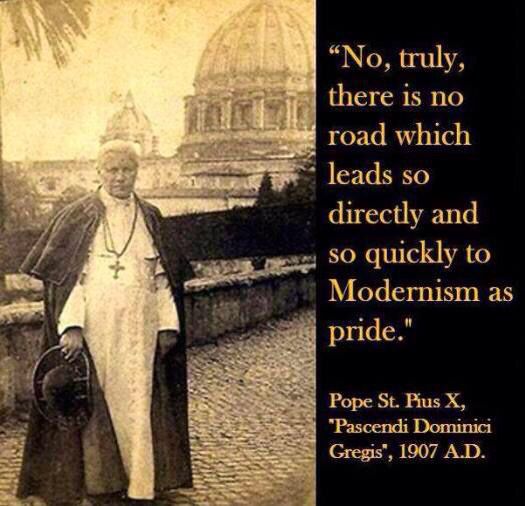
Pius X was born Giuseppe Melchiorre Sarto in Riese in Venetia, Italy, on June 2, 1835 of poor, hardworking parents. Before his election as pontiff in 1903, he laboured unceasingly as curate, parish chaplain, bishop of Mantua, and then Patriarch of Venice to enliven the Faith of the people. He also waged an unwavering war against the heresy and evils of Modernism, gave great impetus to biblical studies, and brought about the codification of Canon Law. His overriding concern was “to renew all things in Christ” and promoted the catechesis of adults and children. He also promoted priestly formation and encouraged frequent reception of the Eucharist. He allowed First Communion to be given to children as young as seven.
As chief pastor of the Church he realized to the full the value of the liturgy as the prayer of the Church and spared no effort to propagate the practice of frequent and daily Communion. In his encyclical, Pascendi Dominici Gregis, he exposed and condemned the modernist heresy with force and clarity [1907]. Many miraculous cures were attributed to this “pope of the Eucharist” during his lifetime. He died on August 20, 1914, and he who had become the two hundred fifty-ninth pope was canonized by Venerable Pope Pius XII on May 29, 1954.
Above all, his holiness shone forth conspicuously. From Saint Pius X we learn again that “the folly of the Cross”, simplicity of life, and humility of heart are still the highest wisdom and the indispensable conditions of a perfect Christian life, for they are the very source of all apostolic fruitfulness.
His last will and testament bears the striking sentence: “I was born poor, I have lived in poverty, and I wish to die poor.”
SAINT JANE FRANCES DE CHANTAL, WIDOW

Born Dijon, France, Jane Frances Fremiot was married to Baron de Chantal. she made her house the model of a Christian home. She was a bright example as daughter, spouse, mother, and widow. She founded the Order of the Visitation, guided by Saint Francis de Sales of which she became the first superior. She died at Moulins in 1641.
(See August 12 blog for more)
From the apostolic constitution Divino afflatu of Saint Pius X, Pope
(AAS 3 [1911], 633-635)
The song of the Church
The collection of Psalms found in Scripture, composed as it was under divine inspiration, has, from the very beginnings of the Church, shown a wonderful power of fostering devotion among Christians as they offer to God a continuous sacrifice of praise, the harvest of lips blessing His name. Following a custom already established in the Old Law, the Psalms have played a conspicuous part in the sacred Liturgy itself, and in the Divine Office. Thus was born what Basil calls the voice of the Church, that singing of Psalms, which is the daughter of that hymn of praise (to use the words of our predecessor, Urban VIII) which goes up unceasingly before the throne of God and of the Lamb, and which teaches those especially charged with the duty of divine worship, as Athanasius says, the way to praise God, and the fitting words in which to bless Him. Augustine expresses this well when he says: God praised Himself so that man might give Him fitting praise; because God chose to praise Himself man found the way in which to bless God.
The Psalms have also a wonderful power to awaken in our hearts the desire for every virtue. Athanasius says: Though all Scripture, both Old and New, is divinely inspired and has its use in teaching, as we read in Scripture itself, yet the Book of Psalms, like a garden enclosing the fruits of all the other books, produces its fruits in song, and in the process of singing brings forth its own special fruits to take their place beside them. In the same place Athanasius rightly adds: The P salms seem to me to be like a mirror, in which the person using them can see himself, and the stirrings of his own heart; he can recite them against the background of his own emotions. Augustine says in his Confessions: How I wept when I heard your hymns and canticles, being deeply moved by the sweet singing of your Church. Those voices flowed into my ears, Truth filtered into my heart, and from my heart surged waves of devotion. Tears ran down, and I was happy in my tears.
Indeed, who could fail to be moved by those many passages in the Psalms which set forth so profoundly the infinite majesty of God, His Omnipotence, His justice and goodness and clemency, too deep for words, and all the other infinite qualities of His that deserve our praise? Who could fail to be roused to the same emotions by the prayers of thanksgiving to God for blessings received, by the petitions, so humble and confident, for blessings still awaited, by the cries of a soul in sorrow for sin committed? Who would not be fired with love as he looks on the likeness of Christ, the Redeemer, here so lovingly foretold? His was the Voice Augustine heard in every Psalm, the voice of praise, of suffering, of joyful expectation, of present distress.
Rich with the Goodness of God
The times have indeed greatly changed. But as we have more than once repeated, nothing is changed in the life of the Church. From her Divine Founder she has inherited the virtue of being able to supply at all times, however much they may differ, all that is required not only for the spiritual welfare of souls, which is the direct object of her mission, but also everything that aids progress in true civilisation, for this follows as a natural consequence of that same mission. For it cannot but be that the Truths of the supernatural order, of which the Church is the depository, promote also everything that is true, good, and beautiful in the order of nature, and this the more efficaciously in proportion as these truths are traced to the Supreme Principle of all Truth, Goodness, and Beauty, which is God….
Since for our moral discipline the divine Redeemer proposes as our supreme model of perfection His Heavenly Father, that is, the Divine Goodness Itself, who can fail to see the mighty impulse thence accruing to the ever more perfect observance of the natural law inscribed in our hearts, and consequently to the greater welfare of the individual, the family, and universal society? The ferocity of the barbarians was thus transformed to gentleness, woman was freed from subjection, slavery was repressed, order was restored, justice was recognised, the true liberty of souls was proclaimed, and social and domestic peace assured.
Finally, the arts modelled on the Supreme Exemplar of all beauty—which is God Himself, from whom is derived all the beauty to be found in nature—are more securely withdrawn from vulgar concepts and more efficaciously rise towards the ideal, which is the life of all art. And how fruitful of good has been the principle of employing them in the service of divine worship and of offering to the LORD everything that is deemed to be worthy of Him, by reason of its richness, its goodness, its elegance of form…. The whole human race, fed on this sublime ideal, raises magnificent temples, and here in the House of God, as in its own house, lifts up its heart to heavenly things in the midst of the treasures of all beautiful art, with the majesty of liturgical ceremony and to the accompaniment of the sweetest of song.
Saint Pius X
Saint Pius X († 1914) was pope from 1903 to 1914, and was canonised on 29 May 1954. [From Encyclical Lucunda Sane, #33-34, 36-37.
DAILY MEDITATION
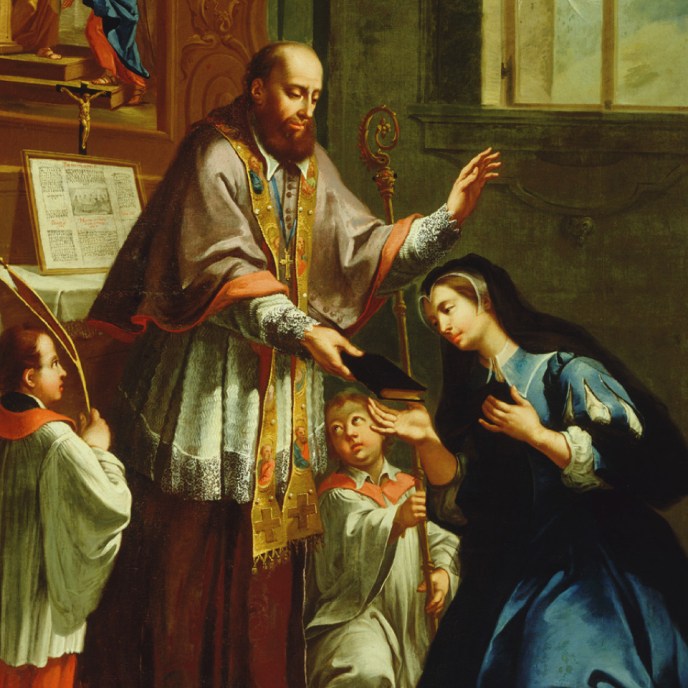
Dearest daughter, you must leave yourself wholly in the hands of God, so that your dear soul and the souls of those you guide may be, as far as you can make them, independent of all that is not God; aiming straight and with such singleness of purpose that friendships, looks, words may never be wasted in frivolous amusement with creatures. By walking in the perfect way of exact observance of the rules of the Institute, all impediments are left behind on the road, and not given a thought; for in all things the eye of God, only, that is, His divine good pleasure, is considered. This is a road without bypaths, daughter; but it is solid, short, simple, and safe, and by it the soul quickly attains to a rare union with God which is her end. Let us then faithfully pursue this way. Truly it cuts short multiplicity and leads us to that unity which is the one thing necessary. I know that you are attracted to this happiness. Give yourself up to it, then, and you will repose quite at your ease in the bosom of divine Providence; for souls who cast aside every aim and end but that of pleasing God are bound to dwell in peace in this tabernacle.
Abraham [I do love this Patriarch] left his country and his family to obey God, but, my daughter dearest, the only Son of God accomplished the Will of His Heavenly Father, by remaining in the country of His birth and working there. Be satisfied, then, to imitate the Saviour, for no perfection can equal His. And do not look elsewhere, but apply yourself with diligence to do lovingly and cheerfully the works that Providence and obedience put into your hands.
Saint Jane Frances de Chantal [d. 1641] – Foundress of the Order of the Visitation, friend and directee of Saint Francis de Sales.
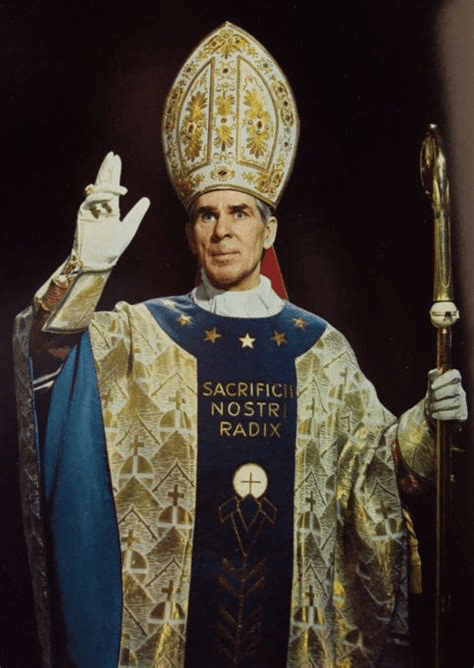
“The refusal to take sides on great moral issues is itself a decision. It is a silent acquiescence to evil. The tragedy of our time is that those who still believe in honesty lack fire and conviction, while those who believe in dishonesty are full of passionate conviction.” – Ven. Archbishop Fulton Sheen
 Daily Reflections
Leave a comment