Zephaniah 2:3; Luke 6:20
Seek the LORD, you humble of the earth,
who obey His Law.
– Seek righteousness, seek humility.
Blessed are you poor, for yours is the Kingdom of Heaven,
– Seek righteousness, seek humility.
Twenty-First Sunday in Ordinary Time
Thirteenth Sunday After Pentecost (Traditional)
Saint Monica, Widow
Peter can declare with certainty that Jesus is the Messiah, the Son of the Living God (Matthew 16:13-20), because God Himself has chosen Peter and prepared him for a new and unique vocation. Only God, His motives “impossible to penetrate” (Romans 11:33-36), could bestow on Peter such clarity in the midst of the many false claims about the identity of Christ. Christ begins to use Peter as an instrument—a Vicar—by which the LORD will open Heaven to the world, so that whatever he binds “on earth shall be considered bound in Heaven”. All that Peter is and does is rooted in Christ: “All that exists comes from Him; all is by Him and for Him.”
TRADITIONAL
The Liturgy shows us that by Faith, we put all our Hope in Jesus, for He is our refuge; and we ask for the virtue of Charity, which renders us lovers of the Divine Law, and practicers of it. Let us pray for an increase of Faith, Hope, and Charity.
Epistle: Galatians 3:16-22
The Apostle of the Gentiles shows that the Mosaic law is not the law which gives holiness to souls, since, before the law, Abraham, father of the Hebrews; was sanctified by his Faith in Jesus. All Jews or pagans, therefore, who enter into the Church and put their faith in the merits of the Passion of Christ, will be saved.
Gospel: (Luke 17:11-19)
Our Divine Redeemer heals ten lepers, both Jews and Samaritans, who have recourse to Him. “Arise, thy faith hath made thee whole.“ Through His Church Our LORD gives back health to the souls, Jews and Gentiles, who have recourse to Him.
SAINT MONICA, WIDOW
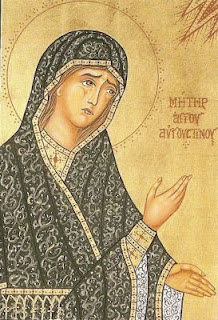
Monica, the mother of Saint Augustine, was born in 332. After a childhood of singular innocence and piety, she was given in marriage to Patritius, a pagan. She at once devoted herself to his conversion, praying for him always, and winning his reverence and love by the holiness of her life and her affectionate forbearance. She was rewarded by seeing him baptized a year before his death. When her son Augustine went astray in faith and manners her prayers and tears were incessant. She was once very urgent with a learned Bishop that he would talk to her son in order to bring him to a better mind, but he declined, despairing of success with one at once so able and so headstrong. However, on witnessing her prayers and tears, he told her to be of good courage; for it might not be that the child of those tears should perish. By going to Italy, Augustine could for a time free himself from his mother’s importunities; but he could not escape from her prayers, which encompassed him like the Providence of God. She followed him to Italy, where he came under the influence of Saint Ambrose, and there by, his marvellous conversion, her sorrow was turned into joy. At Ostia, on their homeward journey, as Augustine and his mother sat at a window conversing of the life of the blessed, she turned to him and said, “Son, there is nothing now I care for in this life. What I shall now do or why I am here, I know not. The one reason I had for wishing to linger in this life a little longer was that I might see you a Catholic Christian before I died. This has God granted me superabundantly in seeing you reject earthly happiness to become His servant. What am I to do here?” A few days afterwards she had an attack of fever, and died in the year 387.
From the Confessions of Saint Augustine, Bishop, Confessor and Doctor of the Church
(Lib. 9, 10-11: CSEL 33, 215-219)
Let us gain Eternal Wisdom
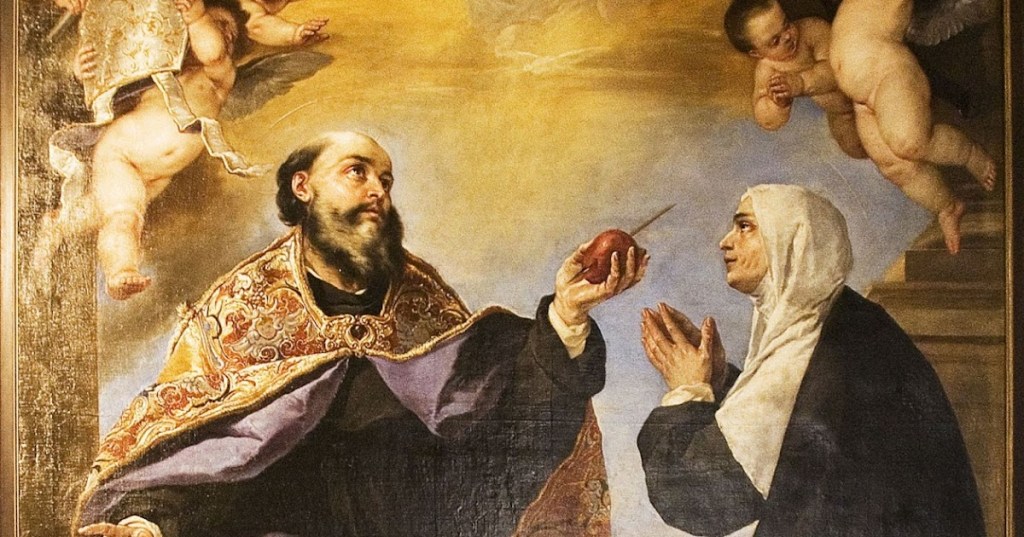
The day was now approaching when my mother Monica would depart from this life; you know that day, LORD, though we did not. She and I happened to be standing by ourselves at a window that overlooked the garden in the courtyard of the house. At the time we were in Ostia on the Tiber. And so the two of us, all alone, were enjoying a very pleasant conversation, forgetting the past and pushing on to what is ahead. We were asking one another in the presence of the Truth—for you are the Truth—what it would be like to share the Eternal Life enjoyed by the saints, which eye has not seen, nor ear heard, which has not even entered into the heart of man. We desired with all our hearts to drink from the streams of Your Heavenly Fountain, the Fountain of Life.
That was the substance of our talk, though not the exact words. But You know, O LORD, that in the course of our conversation that day, the world and its pleasures lost all their attraction for us. My mother said, “Son, as far as I am concerned, nothing in this life now gives me any pleasure. I do not know why I am still here, since I have no further hopes in this world. I did have one reason for wanting to live a little longer: to see you become a Catholic Christian before I died. God has lavished his gifts on me in that respect, for I know that you have even renounced earthly happiness to be His servant. So what am I doing here?”
I do not really remember how I answered her. Shortly, within five days or thereabouts, she fell sick with a fever. Then one day during the course of her illness she became unconscious and for a while she was unaware of her surroundings. My brother and I rushed to her side, but she regained consciousness quickly. She looked at us as we stood there and asked in a puzzled voice: “Where was I?”
We were overwhelmed with grief, but she held her gaze steadily upon us, and spoke further: “Here you shall bury your mother.” I remained silent as I held back my tears. However, my brother haltingly expressed his Hope that she might not die in a strange country but in her own land, since her end would be happier there. When she heard this, her face was filled with anxiety, and she reproached him with a glance because he had entertained such earthly thoughts. Then she looked at me and spoke: “Look what he is saying.” Thereupon she said to both of us, “Bury my body wherever you will; let not care of it cause you any concern. One thing only I ask you, that you remember me at the altar of the LORD wherever you may be.” Once our mother had expressed this desire as best she could, she fell silent as the pain of her illness increased.
“Who do you say I am?”
When Jesus inquires concerning the opinion of people in general, He refers to Himself obliquely as the Son of Man. But when He asks his disciples the question, what He says is, Who do you say I am?… As the focus shifts from people in general to the apostles themselves, Jesus’ manner of referring to Himself likewise shifts from a third-person objective title to the first-person intimate pronoun. It is as if he were saying: “I can understand it if people out there, outside my circle of familiarity, are mistaken in how they view Me. But you who have lived with Me day by day now for so long a while, you who have heard Me speak and pray and teach and who have sat with Me at table and witnessed My miracles and been with Me through storms on the lake and the persecution of the Pharisees: Who do you say I am?”
The Apostles have had ample opportunity to experience the rays of Jesus’ inmost being shining upon their persons like the sun, in contrast to the multitude that have merely heard rumours about Him or have projected their own expectations onto this itinerant rabbi. Therefore, Jesus’ question to the disciples is not so much an official examination at the end of a period of scholastic training as it is a hopeful query by a Lover who needs to know to what extent He is known, understood, and accepted in His deepest identity by those He loves, those to whom He has been at pains to manifest Himself.
To the happy (and indifferent) eclecticism of “John the Baptist, Elijah, Jeremiah, or one of the prophets”, Jesus reacts by saying to those sitting by Him: “But you, my dear friends: you who know the contour of My face and the sound of My voice and the smell of My skin and hair…. Could you pick Me out in the confusion of a dark room full of prophets as your (and God’s!) one and only Beloved? Am I present to you as the total person that I am? It is, after all, to reveal the Father that I came, and you can know the Father only if you know who I am!”
Erasmo Leiva-Merikakis
Erasmo Leiva-Merikakis, now known as Father Simeon, is a Trappist monk. He is the author of Fire of Mercy, Heart of the Word, a four-volume commentary on Matthew’s Gospel. [From Fire of Mercy, Heart of the Word: Meditations on the Gospel According to Saint Matthew, Volume Two (Chapters 12-18). ©
DAILY MEDITATION
We must understand what today’s mass wishes to convert to us. We believe in Christ and we wish to stand by Him, for in Christ, and in Christ alone, can we be saved. Faith in Christ alone, makes us partakers of the fruit of Redemption and assures us of Eternal Life. It must be a faith, however, “that worketh by charity” [Galatians 5:6]. “Without Faith it is impossible to please God” [Hebrews 11:6]. But it’s still remains ever true that the greatest virtue is charity. “If I should have all faith so that I could remove mountains, and have not charity, I am nothing“ [1 Corinthians 13:2].
In the ten lepers of the Gospel (Luke 17:14-19), we recognize ourselves. In Baptism, the LORD, out of pure mercy, and without any credit of ours, cleansed us from the leprosy of our sins; and time and again He has repeated our cleansing through His priests in the second baptism, the Sacrament of Penance. “Go, show yourselves to the priests.“
Today we come to the Holy Sacrifice in order to thank God worthily for the Infinite love, which He has shown us through so many graces. He never ceases to shower us with His graces, even when we do not think of them, or even when we have made ourselves unworthy of new graces, because of our pride and self-esteem.
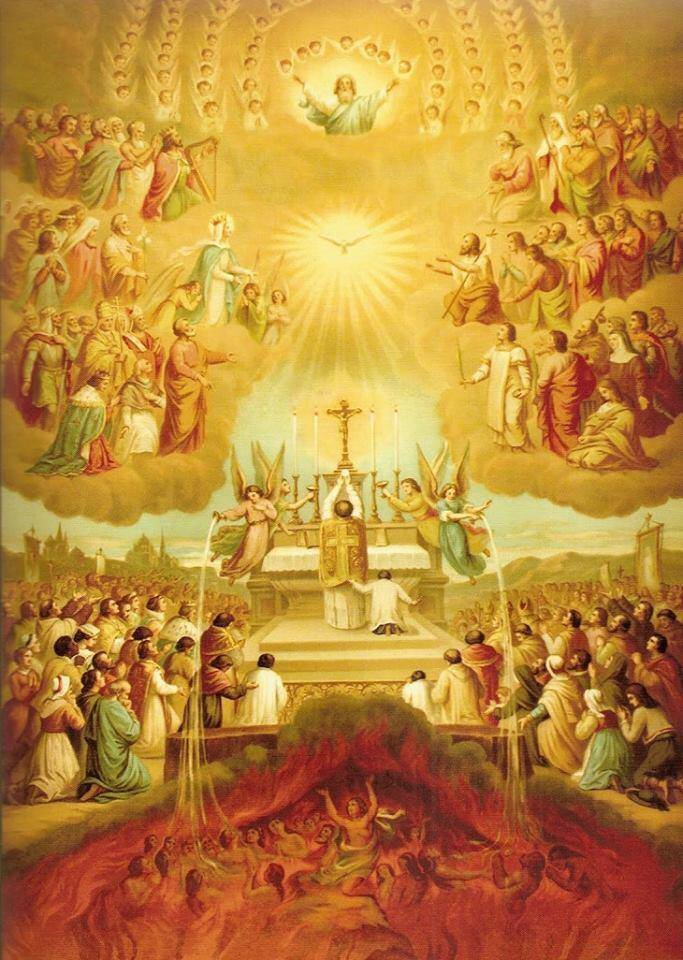
We thank the Heavenly Father for all His love and graces especially by offering to Him in the Mass the Flesh and Blood of Our Saviour. “Through Him, and with Him, and in Him, be unto Thee, O God, the Father Almighty in the unity of the Holy Ghost, all honour and glory, world without end.”
We thank the LORD for the grace of Baptism, for the Sacrament of Penance, and for the Holy Eucharist with our prayers, but especially with our lives: with the resolution to be faithful to the graces and promises of Baptism. We promise to be faithful in fulfilling our duties of praying and working, by sincerely, endeavouring to keep ourselves undefiled by sin and free from voluntary faults and imperfections, trying to spend our lives in pure love for Him.
Dom Benedict Baur [d.1963] – German Benedictine, respected theologian, and archabbot of Saint Martin’s Abbey in Bueron.
“The refusal to take sides on great moral issues is itself a decision. It is a silent acquiescence to evil. The tragedy of our time is that those who still believe in honesty lack fire and conviction, while those who believe in dishonesty are full of passionate conviction.” – Ven. Archbishop Fulton Sheen
 Daily Reflections
Leave a comment