Mark 6:17-27
Herod sent out a band of men to arrest John
and had him chained and imprisoned
– on account of his brother Philip’s wife, Herodias, whom he had married.
And sending an executioner, he commanded that his head should be brought in a dish.
– On account of his brother Philip’s wife, Herodias, whom he had married.
The Passion of Saint John the Baptist
The Beheading of St. John the Baptist (Traditional)
THE BEHEADING OF ST. JOHN THE BAPTIST
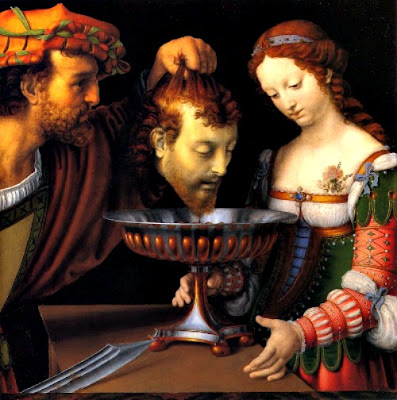
Besides the chief feast of Saint John the Baptist, that of his nativity, the Church commemorates on the twenty-ninth of August, his glorious death and birth into Heaven. Ever since the fourth century in Africa, in the East, in Syria, and in many places all over the world, the beheading of Saint John the Baptist has been commemorated on August 29.
The drunken oath of a king with a shallow sense of honour, a seductive dance and the hateful heart of a queen combined to bring about the martyrdom of John the Baptist. The greatest of prophets suffered the fate of so many Old Testament prophets before him: rejection and martyrdom. The “voice crying in the desert” did not hesitate to accuse the guilty, did not hesitate to speak the Truth. But why? What possesses a man that he would give up his very life?
This great religious reformer was sent by God to prepare the people for the Messias. His vocation was one of selfless giving. The only power that he claimed was the Spirit of Yahweh. “I am baptizing you with water, for repentance, but the One Who is coming after me is mightier than I. I am not worthy to carry His sandals. He will baptize you with the Holy Ghost and fire” (Matthew 3:11). Scripture tells us that many people followed John looking to him for Hope, perhaps in anticipation of some great messianic power. John never allowed himself the false honour of receiving these people for his own glory. He knew his calling was one of preparation. When the time came, he led his disciples to Jesus: “The next day John was there again with two of his disciples, and as he watched Jesus walk by; he said, ‘Behold, the Lamb of God.’ The two disciples heard what he said and followed Jesus” (John 1:35-37). It is John the Baptist who has pointed the way to Christ. John’s life and death were a giving over of self for God and other people. His simple style of life was one of complete detachment from earthly possessions. His heart was centred on God and the call that he heard from the Spirit of God speaking to his heart. Confident of God’s grace, he had the courage to speak words of condemnation or repentance, of salvation.
When in 362, pagans violated the tomb and burned his remains, some parts were saved by monks, and taken to Saint Athanasius at Alexandria. The head is said to have been preserved at Jerusalem, and may later have been brought to Rome.
COMMEMORATION OF SAINT SABINA, MARTYR

Saint Sabina, a Roman widow of high birth suffered martyrdom under Emperor Hadrian, early in the Second Century, and was buried in the same grave with St. Seraphia, her maid-servant who had instructed her in the Faith.
From a homily by Saint Bede the Venerable, Priest
(Hom. 23: CCL 122, 354, 356-357)
Precursor of Christ in birth and death
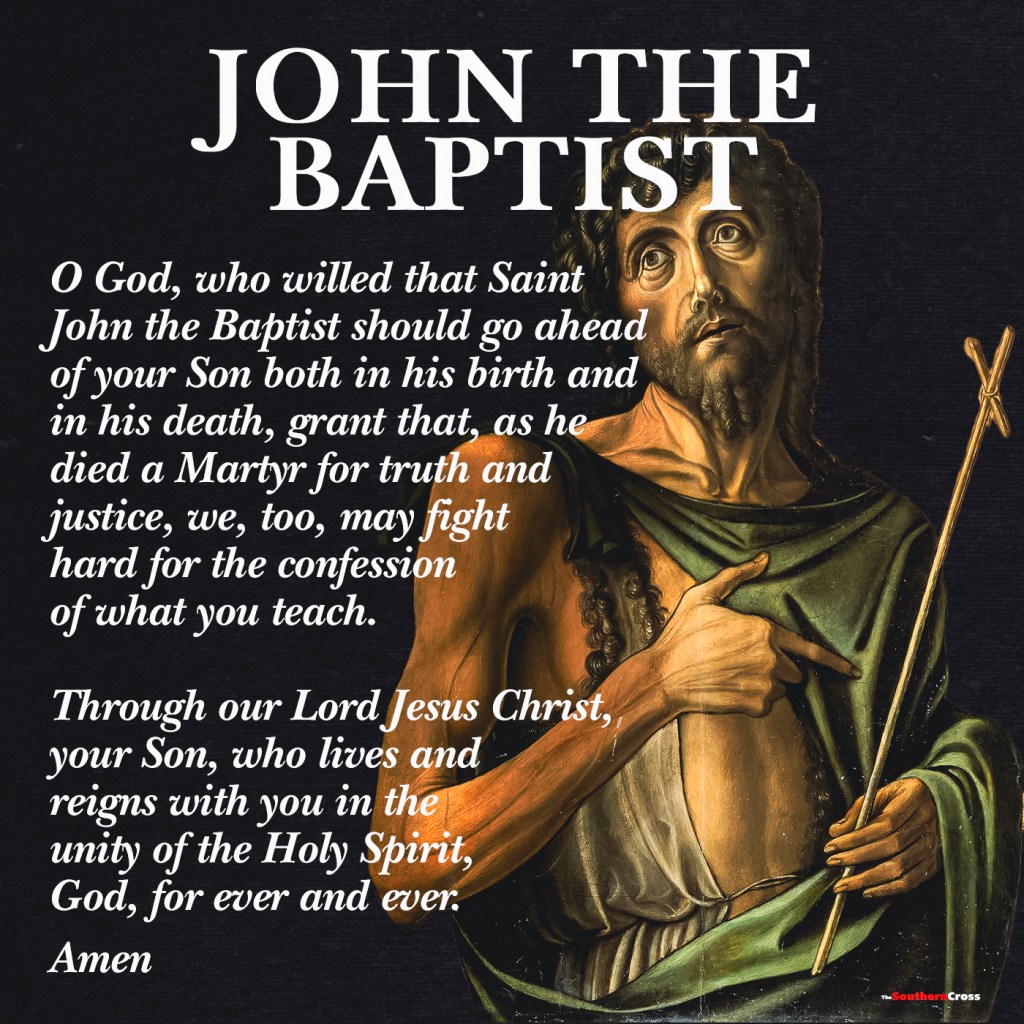
As forerunner of Our LORD’s birth, preaching and death, the blessed John showed in his struggle a goodness worthy of the sight of Heaven. In the words of Scripture: Though in the sight of men he suffered torments, his Hope is full of Immortality. We justly commemorate the day of his birth with a joyful celebration, a day which he himself made festive for us through his suffering and which he adorned with the crimson splendour of his own blood. We do rightly revere his memory with joyful hearts, for he stamped with the seal of martyrdom the testimony which he delivered on behalf of Our LORD.
There is no doubt that blessed John suffered imprisonment and chains as a witness to Our Redeemer, whose forerunner he was, and gave his life for Him. His persecutor had demanded not that he should deny Christ, but only that he should keep silent about the Truth. Nevertheless, he died for Christ. Does Christ not say: I am the Truth? Therefore, because John shed his blood for the Truth, he surely died for Christ.
Through his birth, preaching and baptizing, he bore witness to the coming birth, preaching and Baptism of Christ, and by his own suffering he showed that Christ also would suffer.
Such was the quality and strength of the man who accepted the end of this present life by shedding his blood after the long imprisonment. He preached the freedom of heavenly peace, yet was thrown into irons by ungodly men; he was locked away in the darkness of prison, though he came bearing witness to the Light of life and deserved to be called a bright and shining lamp by that Light Itself, which is Christ. John was baptized in his own blood, though he had been privileged to baptize the Redeemer of the world, to hear the voice of the Father above him, and to see the grace of the Holy Ghost descending upon him. But to endure temporal agonies for the sake of the Truth was not a heavy burden for such men as John; rather it was easily borne and even desirable, for he knew Eternal Joy would be his reward.
Since death was ever near at hand through the inescapable necessity of nature, such men considered it a blessing to embrace it and thus gain the reward of Eternal Life by acknowledging Christ’s name. Hence the Apostle Paul rightly says: You have been granted the privilege not only to believe in Christ but also to suffer for His sake. He tells us why it is Christ’s gift that his chosen ones should suffer for Him: The sufferings of this present time are not worthy to be compared with the Glory that is to be revealed in us.
DAILY MEDITATION
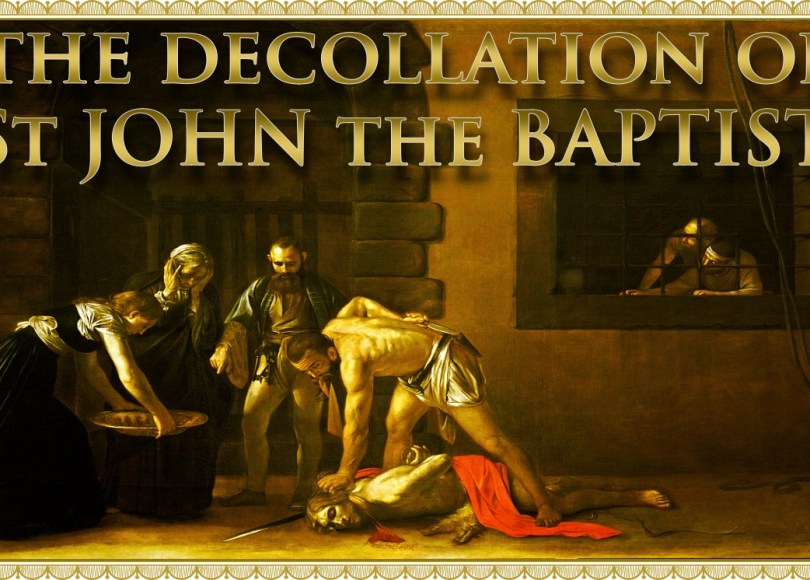
The sacred head is buried by the unchaste Herodias in her palace, where it remained concealed for many years, when it was discovered by an apparition of the saint himself, and has ever since been greatly venerated by the Christians… St. John was cast innocently into prison, and, after having been there for sometime, he was decapitated; and during this time, the godless king Herod was sitting up on his throne, and the wicked Herodias and her daughter lived in joy and pleasure. Even at the present time, the life of many wicked persons is full of temporal comforts, while pious often innocently suffer great trials. Some, observing this, are surprised, and even doubt, the Justice of God; but they err. For God, Who knows best, permits, or ordains all these things justly. He allows the pious to suffer, in order to increase their reward in Heaven, or to give them an opportunity to atone, in this world, for the sins they have committed. To the wicked he gives temporal goods, to recompense them for the few good works they have done, and for which He cannot reward them in Heaven, because the works were done in a state of sin. Who, therefore, can reasonably murmur at the decrees of God?
Thus will the pious, who suffer much upon this earth, if they bear their suffering, patiently, as St. John did, be eternally happy in Heaven; while the godless will suffer eternally in hell. Hence, behold and admire the Justice of God, and never permit yourself to question His decrees. He is just and all His Judgements are full of divine wisdom.
Father Francis Xavier Weninger [d 1888] – Austrian priest, professor, and author; joined the Jesuits as missionary preacher to the United States.
Following the Example of the Baptist
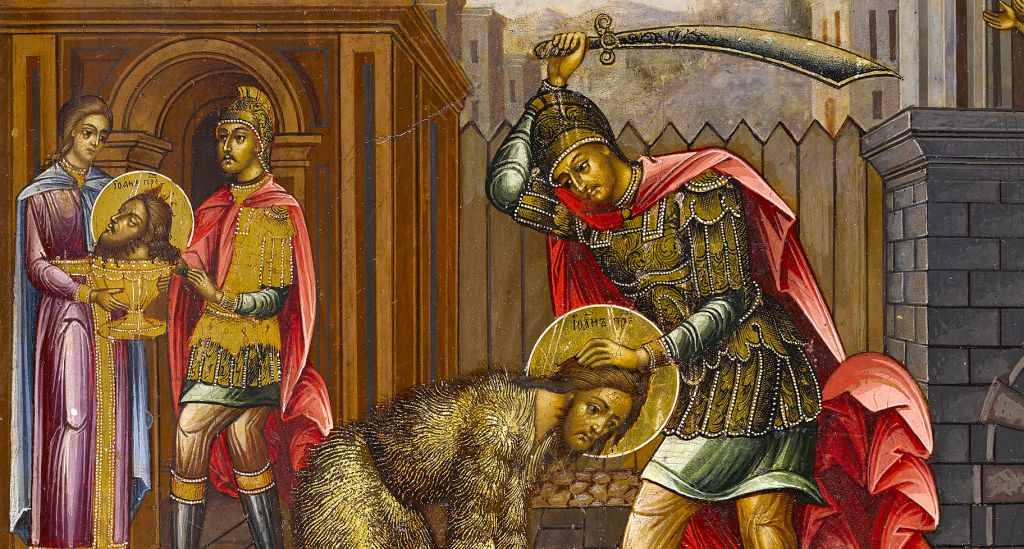
The king provided an unworthy spectacle on his birthday. He brought forward on a platter the head of the man who had been killed, to be gazed on by the rulers, tribunes, and leaders of his nation, who had been invited to the meal. The invited guests were equally unworthy, as bad as their host. None of them was found to object to a man being punished at a festival dinner, to a just man being punished by adulterers, to the judge being beheaded by the guilty. Particularly when the king was protesting, by his pretended appearance of sadness, that he was doing this under compulsion, it would have been appropriate that he should have been released from his promised wicked deed at the urging of the diners….
At this point we might consider and commit more actively to memory how Almighty God allows His chosen ones and beloved servants, those He has predestined to life and His Eternal Kingdom, to be so stricken in this life…. This is so that we may grieve less over the adversities that perhaps have happened to us, and learn instead to esteem it complete joy when we fall into various kinds of temptations, keeping in mind that, the LORD trains the ones that He loves and He punishes all those that He acknowledges as His sons. (He 12:6)….
One who was so preeminent reached the end of his earthly life by shedding his blood after a long period of affliction in chains. He who brought the good news of the freedom of Heavenly peace was thrust into chains by wicked people; he who came to bear testimony to the Light, and who merited to be called a burning and shining lamp by the very Light which is Christ, was shut up in the darkness of prison; he to whom it was granted to baptise the world’s Redeemer, to hear the Father’s voice above him, and to see the grace of the Holy Ghost descending upon him was baptised in his own blood….
What remains for us to do under these circumstances, except to humble ourselves the more in the sight of our benevolent Maker and Redeemer? Let us become humble with John, and fast, and make our entreaties unceasingly; let us exult at decreasing in the sight of human beings; let us be tested so that by advancing in good deeds we may be capable of growing in His sight, and of being exalted with Him who deigned to come from Heaven to earth to raise us who are of the earth to Heaven: Jesus Christ Our LORD.
Saint Bede the Venerable
Saint Bede the Venerable († 735) was an English Benedictine monk, a biblical scholar, and the first English historian. [From Homilies on the Gospels, Book Two: Lent to the Dedication of the Church, Lawrence T. Martin and David Hurst, o.s.b., Trs. Copyright © 1991, Cistercian Publications, Inc. ©
Jeremias 1:5, 9; Isaias 42:6
Before I formed thee in the bowels of thy mother, I knew thee;
and before thou camest out of the womb, I sanctified thee;
– Behold I have given my words in thy mouth.
I the LORD have called thee in justice; and taken thee by the hand, and preserved thee.
And I have given thee for a covenant of the people, for a light of the Gentiles.
– Behold I have given my words in thy mouth.
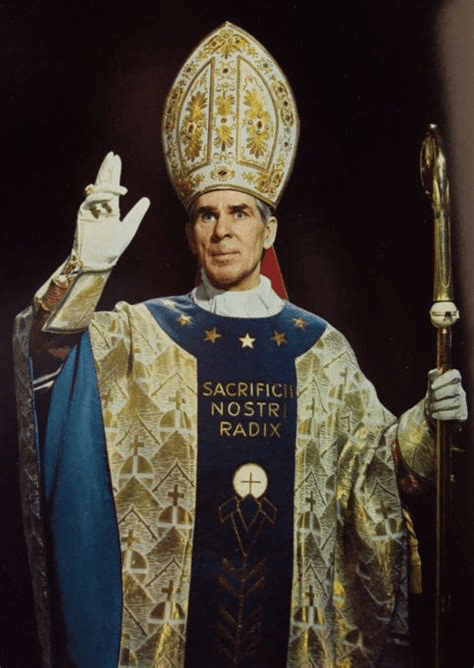
“The refusal to take sides on great moral issues is itself a decision. It is a silent acquiescence to evil. The tragedy of our time is that those who still believe in honesty lack fire and conviction, while those who believe in dishonesty are full of passionate conviction.” – Ven. Archbishop Fulton Sheen
 Daily Reflections
Leave a comment