Jeremiah 2:21; Matthew 21:43; Isaiah 5:7
I planted you, a choice vine, sprung from the soundest stock.
Now you have turned into a vine degenerate and repulsive to Me.
– So the Kingdom of God will be taken away from you
and given to a people who will produce a rich harvest.
I looked for justice and I saw only bloodshed,
for righteousness, and I heard only a cry of distress.
– So the Kingdom of God will be taken away from you
and given to a people who will produce a rich harvest.
Wednesday of the Twenty-First Week in Ordinary Time
Saint Rose of Lima, Virgin (Traditional)
Saint Fiacre (Ireland)
Saints Margaret Clitherow,
Anne Line, and Margaret Ward, Martyrs (England)
Saints Felix and Adauctus, Martyrs (Traditional)
To “live a life worthy of God” as believers of the Gospel of Christ means treating others “as a father treats his children”. Jesus declares that the scribes’ and Pharisees’ “own evidence tells against” them precisely because their actions are devoid of that love. We beg to be receptive of God’s Word so that it will be “a living power” in us now, converting us from hypocritical attitudes.
SAINT ROSE OF LIMA, VIRGIN
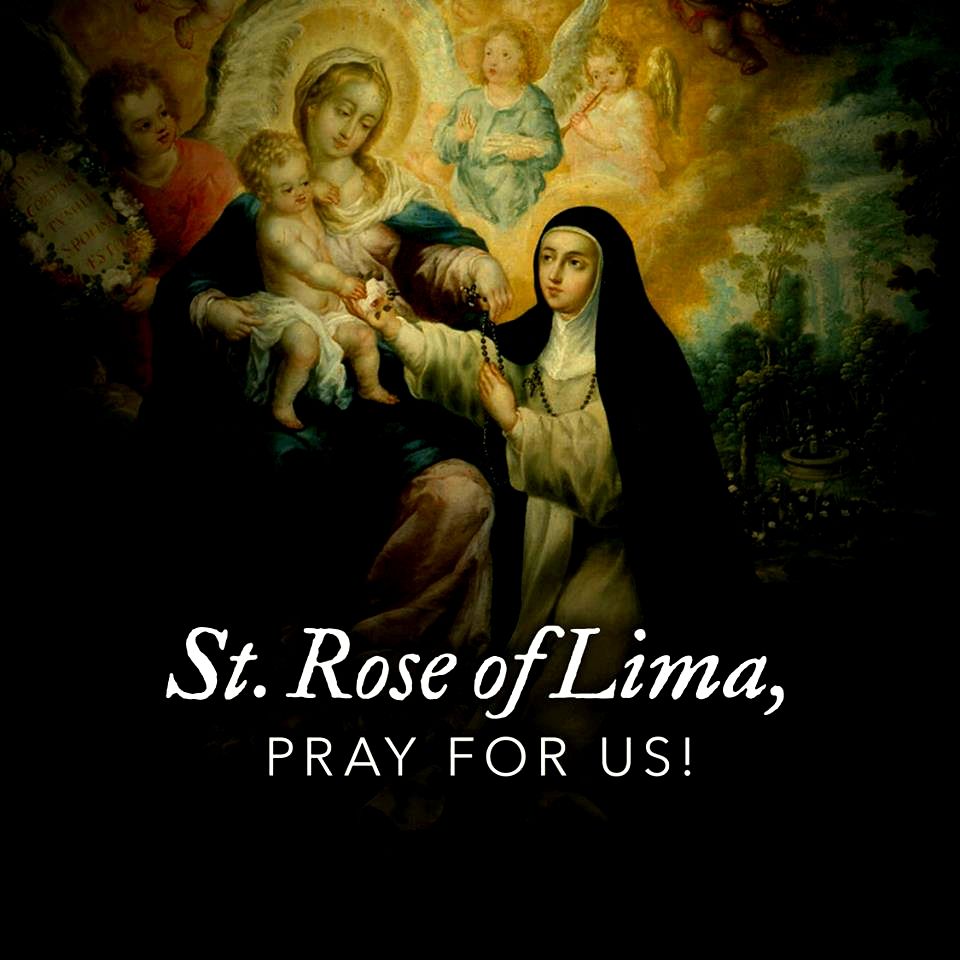
Saint Rose, the first flower of holiness, which bloomed in South America, and the first canonized saint of the New World, was born at Lima, Peru in 1586. She received the name of Isabella in Baptism, but one day her mother saw a beautiful rose drooping over the baby’s cradle, and ever afterwards called her Rose. She was an obedient child; her mortifications were most severe. Rose felt chosen by God. She resorted to disfiguring her face by rubbing it with pepper to ward off would-be suitors. She led a virtuous life at home and, after receiving the habit of the Third Order of Saint Dominic, she made great progress in a life of penance and contemplation. She prayed, worked, and wept for the conversion of sinners; she excelled in her love for holy purity. She lived a life of simplicity, and prayed in a small hut in a corner of her father’s garden; the birds would visit her and sing with her the praises of God. She cared tenderly for the poor in a room of her parents’ house. She was frequently criticised by her neighbours, but also frequently consoled by profound experiences of Christ’s presence. Her devotion to the Passion of Our LORD, was remarkable as were her own sufferings. Her bed was strewn with glass shards, with nails and thorns; she wore chafing hair-cloth; her head was crowned with painful thorns skilfully concealed by roses. She died August 26, 1617. Her office was written by the eminent Cardinal Bona.
SAINTS FELIX AND ADAUCTUS, MARTYRS
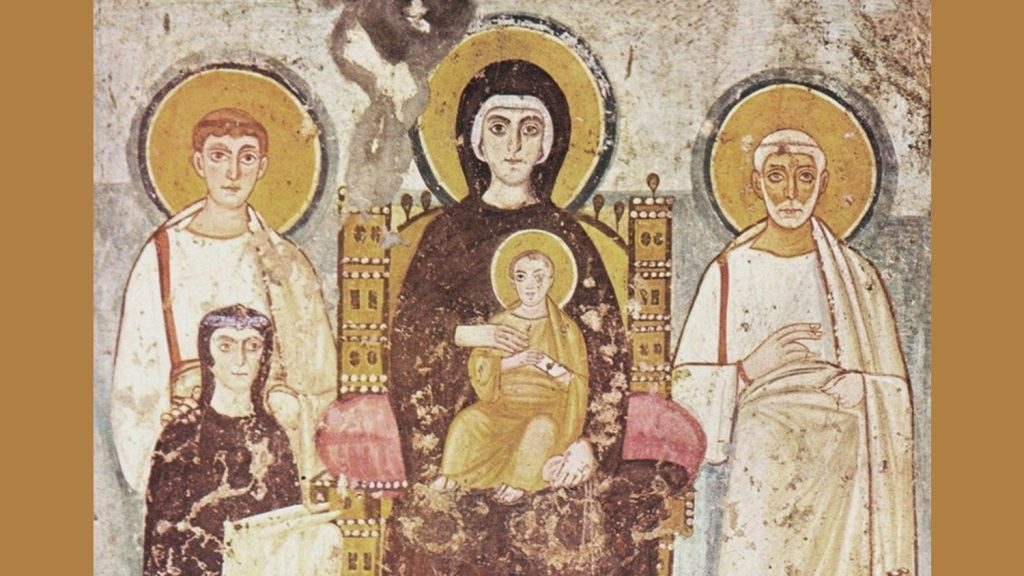
Saint Felix, a Roman priest, was martyred under the emperors Diocletian and Maximian. An unknown Christian joined him at the last moment. The Church called him Adauctus [Added]. They were beheaded in 303. A painting of the Sixth Century depicts both of them with a priestly tonsure. Felix is an old man, but Adauctus stands on the right hand side, although he is young and beardless.
SAINTS MARGARET CLITHEROW, ANNE LINE, AND MARGARET WARD, MARTYRS
The three martyrs we commemorate on August 30th are numbered amongst the Forty Martyrs of England and Wales, who suffered death for the Catholic Faith which had been outlawed in the kingdom. These three women – St. Margaret Clitherow, St. Anne Line, and St. Margaret Ward – were all martyred because they protected Catholic priests from the Elizabethan authorities, who were seeking out all Catholic priests for execution. During this dark time in history, it was illegal for priests to be in the country, as it was illegal for Catholics to receive the Sacraments of the Catholic Church.
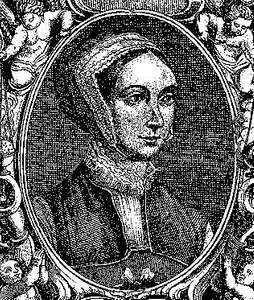
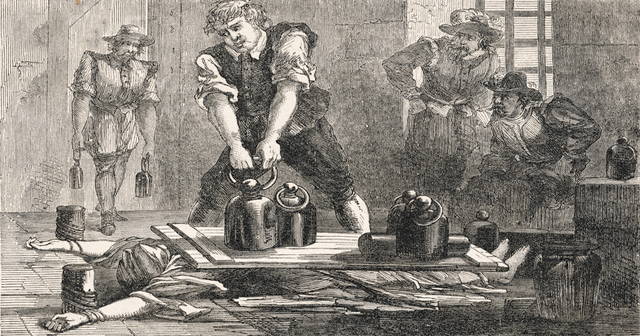
ST. MARGARET CLITHEROW was a convert to the Faith. She became a Catholic when she was eighteen. Although her husband was not a Catholic, he supported her in the practice of her faith, along with their son Henry, who was studying for the priesthood. Margaret’s husband even went so far all to allow her to welcome priests into their home for the celebration of Mass, and 1586 she was arrested for giving shelter to a priest. She was condemned to the horrifying death of being slowly crushed to death, being made to lay upon a sharp stone with a door placed upon her while nearly eight hundred pounds of stone were gradually added on top of the door. This took place on Good Friday in 1586. She died with the name of Jesus upon her lips.
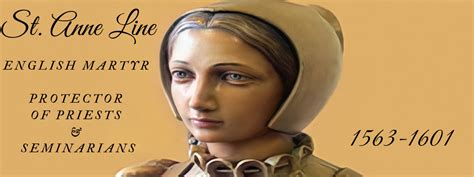

ST. ANNE LINE was also a convert, and was completely disowned by her family. In 1586 she married a man who was also a convert to the faith, but who was soon exiled from the country, leaving Anne by herself. She eventually managed two “safe houses” where travelling priests could hide, but was arrested on February 2, 1601, when she assisted a priest in escaping arrest. When she was brought to court, she fully admitted what she had done, and told the judge that her only regret was that she had not helped more priests. St. Anne Line was hanged in London, and before her death she repeated what she had said in court, stating clearly that she did not repent for her actions, but that she wished she could have done it a thousand times.
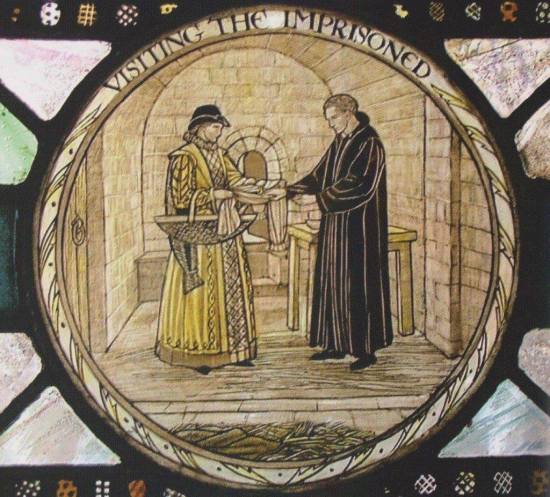
ST. MARGARET WARD was an unmarried woman, and so is a virgin-martyr. She helped a priest escape from the prison where he was being held by smuggling him a length of rope with which he could lower himself over the prison wall. She was eventually accused of giving assistance to the priest because it was known that she was the last person to have visited him, and therefore was the most obvious person to have given the rope to the prisoner. St. Margaret Ward was bound by chains, hung up by her hands, and was brutally scourged, as the authorities demanded to know where the priest had gone. She steadfastly refused, and was hanged publicly in London on August 30, 1588.
Although these three martyrs were canonized in 1970 among the Forty Martyrs of England and Wales, they are commemorated on a separate day because of the particular reason for their deaths; namely, their deep respect for the priesthood, and their zealous protection of priests.
Steadfast God, as we honour the fidelity in life and constancy in death of Thy holy Martyrs Margaret Clitherow, Anne Line, and Margaret Ward: we pray Thee to raise up in our day women of courage and resource to care for Thy household the Church; through Jesus Christ thy Son Our LORD, who liveth and reigneth with Thee, in the unity of the Holy Spirit, ever one God, world without end. Amen. (Article posted on August 29, 2018 on: https://frchristophergphillips.blogspot.com)
SAINT FIACRE, MONK, GARDENER

St. Fiacre (Fiachra) is not mentioned in the earlier Irish calendars, but it is said that he was born in 600 in Ireland and that he sailed over into France in quest of closer solitude, in which he might devote himself to God, unknown to the world. He arrived at Meaux, where Saint Faro, who was the Bishop of that city, gave him a solitary dwelling in a forest which was his own patrimony, called Breuil, in the province of Brie. There is a legend that St. Faro offered him as much land as he could turn up in a day, and that St. Fiacre, instead of driving his furrow with a plough, turned the top of the soil with the point of his staff. The anchorite cleared the ground of trees and briers, made himself a cell with a garden, built an oratory in honour of the Blessed Virgin, and made a hospice for travelers which developed into the village of Saint-Fiacre in Seine-et-Marne. Many resorted to him for advice, and the poor, for relief. His charity moved him to attend cheerfully those that came to consult him; and in his hospice he entertained all comers, serving them with his own hands, and sometimes miraculously restored to health those that were sick. He never allowed any woman to enter the enclosure of his hermitage, and Saint Fiacre extended the prohibition even to his chapel; several rather ill-natured legends profess to account for it. Others tell us that those who attempted to transgress, were punished by visible judgements, and that, for example, in 1620 a lady of Paris, who claimed to be above this rule, going into the oratory, became distracted upon the spot and never recovered her senses; whereas Anne of Austria, Queen of France, was content to offer up her prayers outside the door, amongst the other pilgrims.The fame of Saint Fiacre’s miracles of healing continued after his death and crowds visited his shrine for centuries. He died 18 August, 670.
From an instruction by Saint Columban, Abbot
(Instr. 13, De Christo fonte vitae, 1-2: Opera, Dublin 1957, 116-118)
Whoever thirsts, let him come to Me and drink his fill
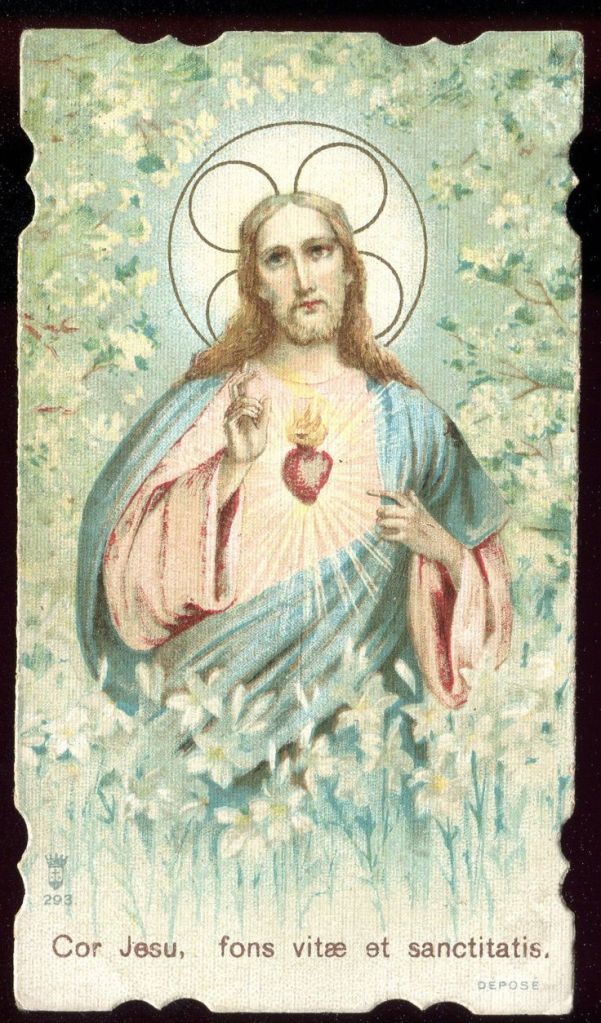
My dear brethren, listen to my words. You are going to hear something that must be said. You quench your soul’s thirst with drafts of the ivine Fountain. I now wish to speak of this. Revive yourself, but do not extinguish your thirst. Drink, I say, but do not entirely quench your thirst, for the Fountain of Life, the fountain of love calls us to Him and says: Whoever thirsts, let him come to Me and drink.
Understand well what you drink. Jeremiah would tell us; the Fountain of Life would Himself tell us: For they abandoned Me, the Fountain of Living Water, says the LORD. The LORD Himself, our God Jesus Christ, is the Fountain of Life, and accordingly He invites us to Himself as to a fountain, that we may drink. Whoever loves Him, drinks Him; he drinks who is filled with the Word of God, he drinks who loves Him fully and really desires Him. He drinks Who is on fire with the love of wisdom.
Consider the Source of the fountain; bread comes down to us from the same place, since the same One is the Bread and the Fountain, the Only-begotten Son, our God, Christ the LORD, for Whom we should always hunger. We may even eat Him out of love for Him, and devour Him out of desire, longing for Him eagerly. Let us drink from Him, as from a fountain, with an abundance of love. May we drink Him with the fullness of desire, and may we take pleasure in His sweetness and savour.
For the LORD is sweet and agreeable; rightly then let us eat and drink of Him yet remain ever hungry and thirsty, since He is our Food and Drink, but can never be wholly eaten and consumed. Though He may be eaten, He is never consumed; one can drink of Him and He is not diminished because our Bread is Eternal and our Fountain is sweet and everlasting. Hence the prophet says: You who thirst, go to the Fountain. He is the Fountain for those who are thirsty but are never fully satisfied. Therefore He calls to Himself the hungry whom He raised to a blessed condition elsewhere. They were never satisfied in drinking; the more they drank, the greater their thirst.
It is right, brothers, that we must always long for, seek and love the Word of God on high, the Fountain of Wisdom. According to the Apostle’s words all the hidden treasures of wisdom and knowledge are in Him, and He calls the thirsty to drink.
If you thirst, drink of the Fountain of Life; if you are hungry, eat the Bread of Life. Blessed are they who hunger for this Bread and thirst for this Fountain, for in so doing they will desire ever more to eat and drink. For what they eat and drink is exceedingly sweet and their thirst and appetite for more is never satisfied. Though It is ever tasted It is ever more desired. Hence the prophet-king says: Taste and see how sweet, how agreeable is the LORD.
DAILY MEDITATION
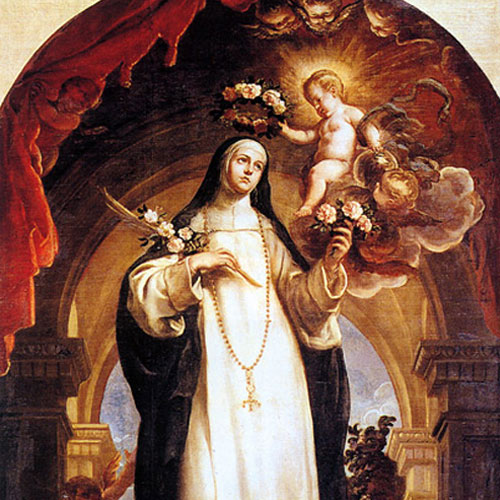
This lovely flower of sanctity, the first canonized saint of the New World, was born at Lima in 1586. She was christened Isabel, but the beauty of her infant face earned her the title of Rose, which she ever after bore. As a child, while still in the cradle, her silence under a painful surgical operation proved the thirst for suffering already consuming her heart. At an early age, she took service to support her impoverished parents, and worked for them day and night. In spite of hardships and austerities, her beauty ripened with increasing age, and she was much and openly admired. From fear of vanity, she cut off her hair, blistered her face with pepper, and her hands with lime. For further security, she enrolled herself in the Third Order of Saint Dominic, took Saint Catherine of Siena as her model, and redoubled her penance. Her cell was a garden hut, her couch a box of broken tiles. Under her habit, Rose wore a hairshirt studded with iron nails, while, concealed by her veil, a silver crown armed with 90 points encircled her head. More than once, when she shuttered at the prospect of a night of torture, a Voice said: “My Cross was yet more painful.” The Blessed Sacrament seemed almost her only food. Her love for it was intense. When the Dutch fleet prepared to attack the town, Rose took her place before the tabernacle, and wept that she was not worthy to die in its defence. All of her sufferings were offered for the conversion of sinners, and the thought of the multitudes in hell was ever before her soul. She died A.D. 1617, at the age of 31.
Reflection: Rose, pure as the driven snow, was filled with deepest contrition and humility, and did constant and terrible penance. Our sins are continual, our repentance, passing, our contrition slight, our penance nothing. How will it fare us?
John Gilmary Shea [d. 1892] – American author and celebrated historian, regarded as the father of American Catholic history.
How to Appear—and Be—Truly Righteous

Two ways there are, one of life and one of death, and there is a great difference between the two ways. The way of life is this: First, love the God who made you; secondly, love your neighbour as yourself. Do not do to another what you do not wish to be done to yourself. The lesson of these words is as follows: bless those who curse you, pray for those who treat you badly…. If you love those who love you, what thanks can you expect? Even sinners love those who love them. For your part, love your enemies. In fact, have no enemy…. do good, and lend without any hope of return; the Father wants His own bounties to be shared with all. Happy the giver who complies with the Commandment, for he goes unpunished….
Do not calumniate; do not bear malice. Do not be double-minded or double-tongued, for a double tongue is a deadly snare. Your speech must not be false or meaningless, but made good by action. Do not be covetous or rapacious or hypocritical or malicious or arrogant. Hate no man, but correct some, pray for others, for still others sacrifice your life as a proof of your love.
My child, shun evil of any kind and everything resembling it. Do not be prone to anger, for anger leads to murder…. On the contrary, be gentle, for the gentle will inherit the land. Be long-suffering and merciful and guileless and quiet and good. And, with trembling, treasure the instructions you have received. Do not carry your head high or open your heart to presumption. Do not be on intimate terms with the mighty, but associate with holy and lowly folk. Accept as blessings the casualties that befall you, assured that nothing happens without God.
From the Didache
The Didache, or the “Teaching of the Twelve Apostles”, is one of the earliest documents describing the teaching and worship of the early Church. [From Ancient Christian Writers: The Works of the Fathers in Translation, No. 6. Translated and annotated by James A. Kleist, s.j., Ph.D. Copyright © 1948 by Rev. Johannes Quasten and Rev. Joseph C. Plumpe.
John 7:37-38
Jesus stood up, and cried out:
– If anyone thirsts, let him come to Me and drink.
Streams of Living Water will flow
from the heart of whoever believes in Me.
– If anyone thirsts, let him come to Me and drink.

“The refusal to take sides on great moral issues is itself a decision. It is a silent acquiescence to evil. The tragedy of our time is that those who still believe in honesty lack fire and conviction, while those who believe in dishonesty are full of passionate conviction.” – Ven. Archbishop Fulton Sheen
 Daily Reflections
Leave a comment