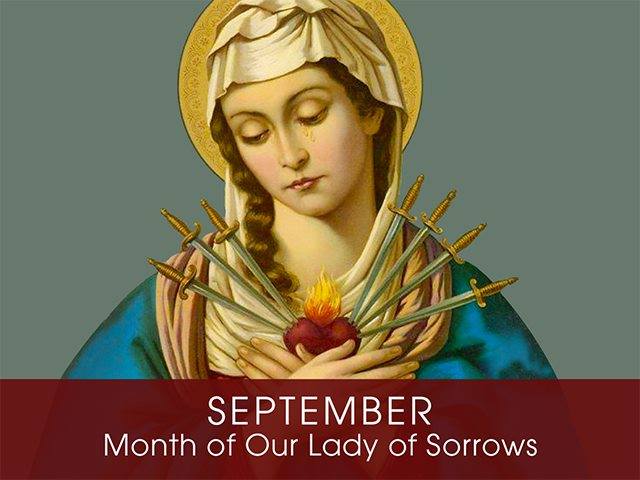
Matthew 23:37; Jeremias 19:15
Jerusalem, Jerusalem, thou that killest the prophets, and stonest them that are sent unto thee,
– How often would I have gathered together thy children, as the hen doth gather her children under her wings, and thou wouldest not?
…they have hardened their necks, that they might not hear My words.
– How often would I have gathered together thy children, as the hen doth gather her children under her wings, and thou wouldest not?
PRAYER OF THE DAY: MONDAY 4 SEPTEMBER
Selflessness
O Dearly beloved Word of God, teach me to be generous, to serve Thee as Thou dost deserve, to give without counting the cost, to fight without fretting at my wounds, to labour without seeking rest, to spend myself without looking for any reward other than that of knowing that I do Thy holy Will. Amen. (catholic.org/prayers/prayeroftheday)
Monday of the Twenty-Second Week in Ordinary Time
Saint Cuthbert, Bishop (England)
“We shall stay with the LORD for ever.” Saint Paul commands us to “comfort one another” with these words (1 Thess 4:14-17) . Those who were “astonished by the gracious words that came” (Luke 4:16-30) from the mouth of Jesus were amazed precisely because His words are the basis of Paul’s promise. We who are poor, held captive, or oppressed shall always be with the LORD, for it is His Will always to be with us.
SAINT CUTHBERT, BISHOP
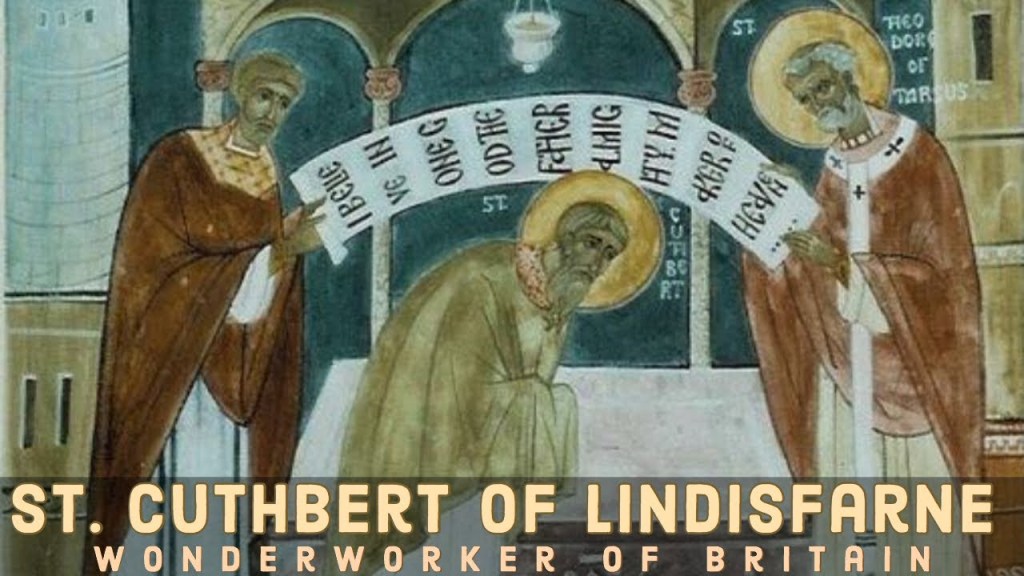
Saint Cuthbert (634 – 687) was thought by some to be Irish and by others, a Scot. Bede, the noted historian, says he was a Briton. Orphaned when a young child, he was a shepherd for a time, possibly fought against the Mercians, and became a monk at Melrose Abbey.
In 661, he accompanied St. Eata to Ripon Abbey, which the abbot of Melrose had built, but returned to Melrose the following year when King Alcfrid turned the abbey over to St. Wilfrid, and then became Prior of Melrose. Cuthbert engaged in missionary work and when St. Colman refused to accept the decision of the Council of Whitby in favour of the Roman liturgical practices and immigrated with most of the monks of Lindisfarn to Ireland, St. Eata was appointed Bishop in his place and named Cuthbert Prior of Lindisfarn.
He resumed his missionary activities and attracted huge crowds until he received his abbot’s permission to live as a hermit, at first on a nearby island and then in 676, at one of the Farnes Islands near Bamborough. Against his will, he was elected Bishop of Hexham in 685, arranged with St. Eata to swap Sees, and became Bishop of Lindisfarn but without the monastery. He spent the last two years of his life administering his See, caring for the sick of the plague that decimated his diocese, working numerous miracles of healing, and gifted with the ability to prophesy. He died at Lindisfarn.
From The Imitation of Christ by Thomas Á Kempis, Priest
Lib. (3, 3)
I taught My prophets
My son, says the LORD, listen to My words, the most delightful of all words, surpassing all the knowledge of the philosophers and wise men of this world. My words are Spirit and Life and cannot be comprehended by human senses alone.
They are not to be interpreted according the vain pleasure of the listener, but they must be listened to in silence and received with all humility and great affection.
And I said: Blessed is the man whom You teach, LORD, and whom You instruct in Your law; for him You soften the blow of the evil day, and You do not desert him on the earth.
The LORD says, I have instructed my prophets from the beginning and even to the present time I have not stopped speaking to all men, but many are deaf and obstinate in response.
Many hear the world more easily than they hear God; they follow the desires of the flesh more readily than the pleasure of God.
The world promises rewards that are temporal and insignificant, and these are pursued with great longing; I promise rewards that are Eternal and Unsurpassable, yet the hearts of mortals respond sluggishly.
Who serves and obeys Me in all matters with as much care as the world and its princes are served?
Blush, then, you lazy, complaining servant, for men are better prepared for the works of death than you are for the works of life. They take more joy in vanity than you in Truth.
Yet they are often deceived in their Hope, while My promise deceives no one, and leaves empty-handed no one who confides in Me. What I have promised I shall give; what I have said I will fulfill for any man who remains faithful in My love unto the very end. I am the Rewarder of all good men, the One who rigorously tests the devoted.
Write my words in your heart and study them diligently, for they will be absolutely necessary in the time of temptation. Whatever you fail to understand in reading my words will become clear to you on the day of your visitation.
I am accustomed to visit My elect in a double fashion, that is, with temptation and with consolation. And I read to them two lessons each day: one to rebuke them for their faults; the other to exhort them to increase their virtue.
He who possesses My words yet spurns them earns his own judgment on the last day.
DAILY MEDITATION
Consider the further admonition Our LORD gives us: “Behold the birds of the air, for they neither sow, nor do they reap, nor gather into barns, and your heavenly Father feedeth them“ [Matthew 6:26]. By directing our attention to the birds of the air, who take no thought, He does not intend to prohibit all labour and solicitude on our part. Work is the lot, the duty of the sons of Adam; to them as to him, the words apply: “In the sweat of thy face thou shalt eat bread” [Genesis 3:19]. It is still more of the bounden duty of the children of Saint Francis to labour, since, shortly before his death, our Seraphic Father declared:“I have laboured, and I will labour with my hands, and is my expressed wish that the other brethren should all occupy themselves with some honest work.“ By what He here says, our LORD supposes, that man should work, and His meaning is that we should not be too careful and anxious over our work, and think ourselves entirely dependent on the labour of our own hands for our sustenance, instead of looking for our maintenance from the hands of our heavenly Father.
In respect of this, Saint Augustine, remarks: “If we are really unable to work, and provide for ourselves, then our Heavenly Father will provide for us, as He feeds the birds of the air, who do not distress themselves about the future.“ Yes, my soul, you will do well to take example of the birds of heaven, whom our Seraphic Father, liked much better than the ants, because they do not lay up a store for the winter time as the ants do. Nor should you borrow in the earth like the ants, or in your restlessness you will never seek rest in God; but when you have built your nest as the birds do, that is to say, when you have provided for your most pressing needs, then imitate them, in singing the praises of God, soar aloft on the pinions of meditation and the contemplative life, wing your flight to God, and do not be careful as to what you shall eat and what you shall drink, since you serve Him who feedeth the birds.
Father Augustine Maria Ilg [d. 1881] – Capuchin Priest, author, and redactor of one of the classic German Works of daily meditation.
Proverbs 23:26; 1:9; 5:1; 4:20
My son, give me thy heart: and let thy eyes keep My ways.
– That grace may be added to thy head.
My son, attend to my wisdom, and incline thine ear to My prudence. Hearken to My words.
– That grace may be added to thy head
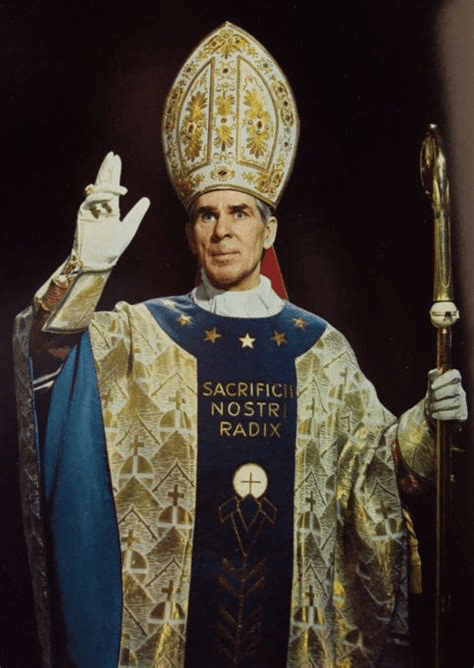
“The refusal to take sides on great moral issues is itself a decision. It is a silent acquiescence to evil. The tragedy of our time is that those who still believe in honesty lack fire and conviction, while those who believe in dishonesty are full of passionate conviction.” – Ven. Archbishop Fulton Sheen
 Daily Reflections
Leave a comment