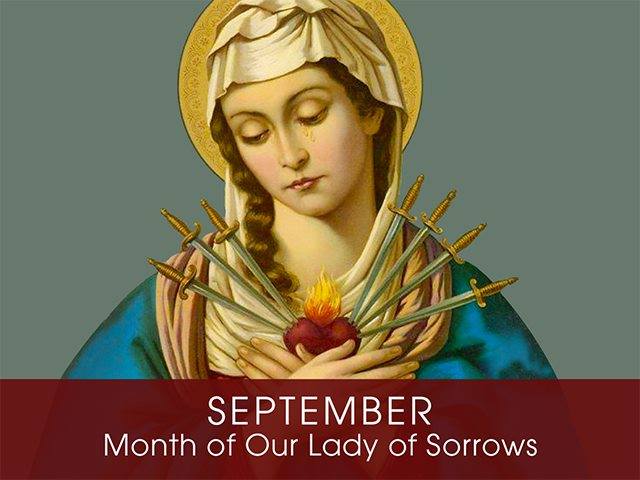
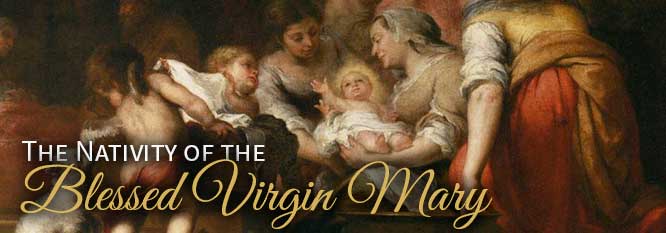
Nativity of the Blessed Virgin Mary
St. Hadrian, Martyr (Traditional)
We celebrate the birthday of the Blessed Virgin Mary because our Lady’s birth portends the birth of the Saviour. Mary, graced by a singular honour and vocation, was preserved from the slightest taint of original sin from the first moment of her conception. In celebrating her birthday, we celebrate the beginning of a life of total and yet ever-deepening union with God—a union that allowed Mary to become God’s own Mother. Thus we “see with what sentiments of tender devotion the LORD would have us honour Mary, in whom He has placed the plenitude of all good” (Saint Bernard of Clairvaux).
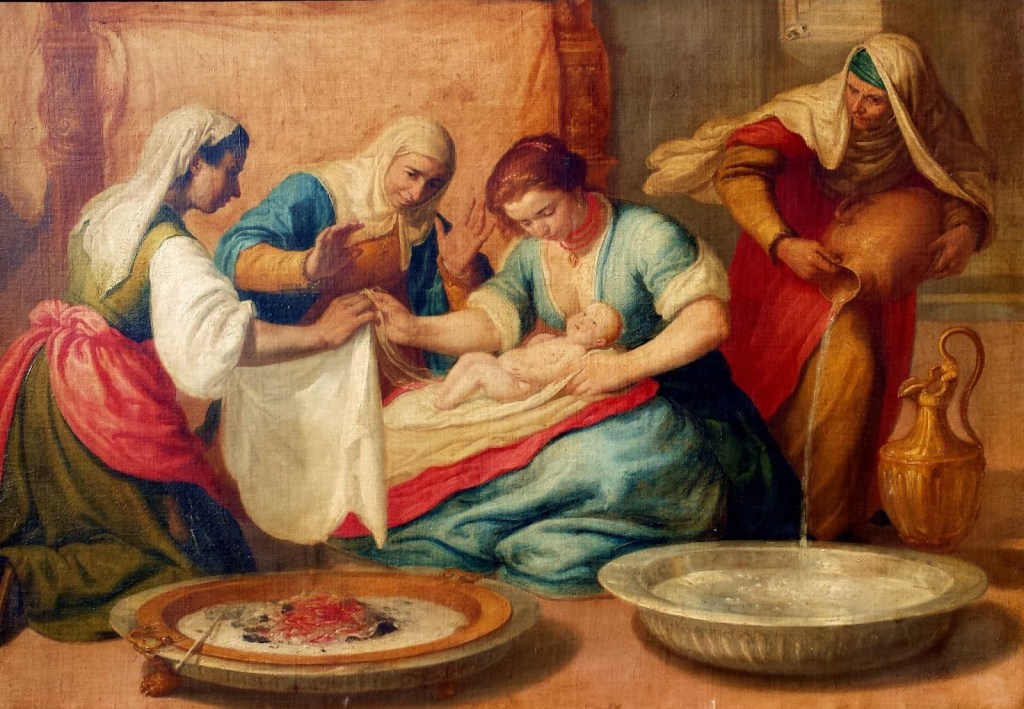
At the time of Mary’s birth, the whole world was plunged in darkness. The heathen nations were steeped in vice and pride. The Jews, too, had corrupted their ways and departed from God. Everywhere there was sin and gloom, no bright spot on the face of the earth. But when Mary was born, a light arose amid the darkness: the dawn of the glorious day that was to usher in the Redeemer. So, too, the darkness of the sinner’s soul is dispersed by Mary’s holy influence. Where the love of her is born in the soul, all becomes full of light, and Jesus comes to make His habitation there. Mary, in the first hour of her life, brought more glory to God than all the Saints of the Old Testament. In her were made perfect the obedience of Abraham, the Chastity of Joseph, the patience of Job, the meekness of Moses, the prudence of Josue (Joshua). It is because she is the model and pattern of these and all other virtues that she can communicate them to us.
This festival originated in the East where it is mentioned very early. At Rome it was not observed before the reign of Pope Sergius I. As Eve, our first mother, arose from the side of Adam, dazzling with light and innocence, so Mary came forth, bright and immaculate from the heart of the Eternal Word, Who, by the cooperation of the Holy Ghost, as the Liturgy teaches us, was pleased to form that body and soul which were to be, one day, His tabernacle and altar. This is the sublime meaning of the feast of the birthday of the Blessed Virgin Mary. It is the dawn foretelling the day which already breaks behind the eternal hills, the mystic rod which rises from the venerable root of Jesse; the stream Which springs from Paradise; it is the symbolic fleece, Which is stretched on our dry earth to catch the miraculous dew. This is the new Eve, that is to say, the life and the Mother of all the living, who is born today for those to whom the first Eve became the mother of sin and death.
COMMEMORATION OF SAINT HADRIAN, MARTYR:
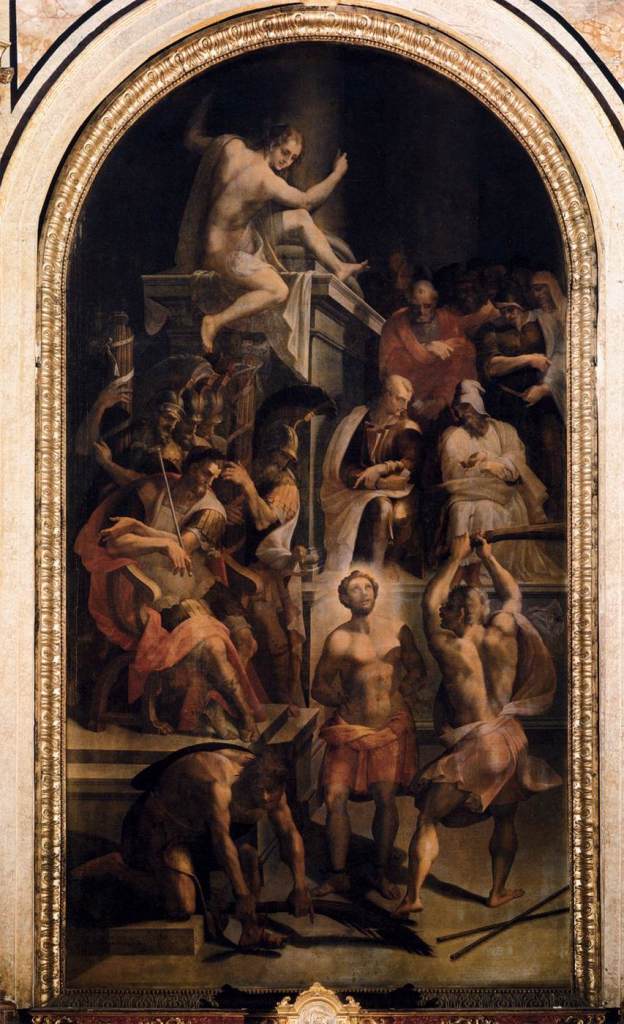
Saint Hadrian was an officer in the Roman army; from persecuting Christians, he was so moved by their constancy that he embraced the Faith and suffered martyrdom toward the end of the Third Century.
Birth of Mary from the “Glories of Mary” by St. Alphonsus Liguori, Priest, Discourse 2, pgs. 281-284
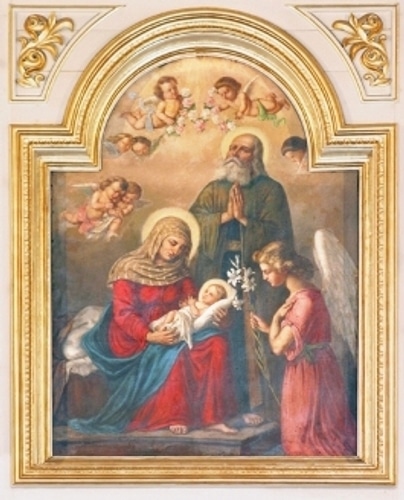
It is indeed right, however, to celebrate with festivity and universal joy the birth of our infant Mary; for she first saw the light of this world a babe, it is true, in point of age, but great in merit and virtue. Mary was born a saint, and a great saint. But to form an idea of the greatness of her sanctity, even at this early period, we must consider, first, the greatness of the first grace with which God enriched her; and secondly, the greatness of her fidelity in immediately corresponding to it. I. To begin with the first point, it is certain that Mary’s soul was the most beautiful that God had ever created: nay more, after the work of the Incarnation of the Eternal Word, this was the greatest and most worthy of himself that an omnipotent God ever did in the world. St. Peter Damian calls it “a work only surpassed by God” (“Videbis solum Opificem opus istud supergredi”—In Nat. B. V. s. 1). Hence it follows that divine grace did not come into Mary by drops as in other saints, but like rain on the fleece (“Sicut pluvial in vellus”—Ps. lxxi. 6), as it was foretold by David. The soul of Mary was like fleece, and imbibed the whole shower of grace, without losing a drop. St. Basil of Seleucia says, “that the holy Virgin was full of grace, because she was elected and pre-elected by God, and the Holy Spirit was about to take full possession of her” (“Virgo Sancta totam sibi hauserat Spiritus gratiam”—Cat. aur. In Luc. i. 47). Hence she said, by the lips of Ecclesiasticus, My abode is in the full assembly of saints (“In plenitudine Sanctorum detention mea”—Ecclus. xxiv. 16); that is, as St. Bonaventure explains it, “I hold in plenitude all that other saints have held in part” (“Totum teneo in plenitudine, quod alii Sancti tenent in parte”—De B. V. s. 3). And St. Vincent Ferrer, speaking particularly of the sanctity of Mary before her birth, says “that the Blessed Virgin was sanctified” (surpassed in sanctity) “in her mother’s womb above all saints and angels” (“Virgi fuit sanctificata super omnes Sanctos et Angelos”—De Nat. B. M. s. 1). The grace that the Blessed Virgin received exceeded not only that of each particular saint, but of all the angels and saints put together, as the most learned Father Francis Pepe, of the Society of Jesus, proves in his beautiful work on the greatness of Jesus and Mary. And he asserts that this opinion, so glorious for our Queen, is now generally admitted, and considered as beyond doubt by modern theologians (such as Carthagena, Suarez, Spinelli, Recupito, and Guerra, who have professedly examined the question, and this was never done by the more ancient theologians). And besides this, he relates that the divine Mother sent Father Martin Guttierez to thank Father Suarez, on her part, for having so courageously defended this most probable opinion, and which, according to Father Segneri, in his “client of Mary,” was afterwards believed and defended by the University of Salamanca. But if this opinion is general and certain, the other is also very probable; namely, that Mary received this grace, exceeding that of all men and angels together, in the first instance of her Immaculate Conception. Father Suarez (De Inc. p. 2, d. 4, s. 1) strongly maintains this opinion, as do also Father Spinelli (M. Deip. c. 4), Father Recupito (Sign. Praed 3), and Father La Colombière (Imm. Conc. s. 1). But besides the authority of theologians, there are two great and convincing arguments, which sufficiently prove the correctness of the above-mentioned opinion. I. The first is, that Mary was chosen by God to be the Mother of the divine Word. Hence Denis the Carthusian says (De Laud V. l. 1i. 3, passim), that as she was chosen to an order superior to the of all other creatures (for in a certain sense the dignity of Mother of God, as Father Suarez asserts (De Inc. p. 2, d. 1, s. 2), belongs to the order of hypostatic union), it is reasonable to suppose that from the very beginning of her life gifts of a superior order were conferred upon her, and such gifts as must have incomparably surpassed those granted to all other creatures. And indeed it cannot be doubted that when the Person of the Eternal Word was, in the divine decrees, predestined to make himself man, a Mother was also destined for him, from whom he was to take this human nature; and this Mother was our infant Mary. Now St. Thomas teaches that “God gives every one grace proportioned to the dignity for which he destined him” (“Unicuique a Deo datur gratia secundum hoc ad quod eligitur”—P. 3, q. 27, a. 5). And St. Paul teaches us the same thing when he says, Who also hath made us fit ministers of the New Testament (“Qui et idoneos nos fecit ministros Novi testamenti”—2 Cor. iii. 6); that is, the apostles received gifts from God, proportioned to the greatness of the office with which they were charged. St. Bernardine of Sienna adds, “that it is an axiom in theology, that when a person is chosen by God for any state, he receives not only the dispositions necessary for it, but even the gifts which he needs to sustain that state with decorum (“Regula firma est in sacra theologia, quod, quandocunque Deus aliquem eligit ad aliquem statum, omnia dona illi dispensat, quae illi statui necessaria sunt et illum copiose decorant”—Pro Fest. V. M. s. 10, a. 2, c. 1). But as Mary was chosen to be the Mother of God, it was quite becoming that God should adorn her, in the first moment of her existence, with an immense grace, and one of a superior order to that of all other men and angels, since it had to correspond to the immense and most high dignity to which God exalted her. And all theologians come to this conclusions with St. Thomas, who says, “the Blessed Virgin was chosen to be the Mother of God; and therefore it is not to be doubted that God fitted her for it by his grace” (“Virgo fuit electa Mater Dei; et ideo non est dubitandum quin Deus, per suam gratiam, eam ad hoc idoneam reddidit”); so much so that Mary, before becoming Mother of God, was adorned with a sanctity so perfect that it rendered her fit for this great dignity. The holy Doctor says, “that in the Blessed Virgin there was a preparatory perfection, which rendered her fit to be the Mother of Christ, and this the perfection of sanctification” (“In Beata Virgine fuit perfectio quasi dispositiva, per quam reddebatur idonea ad hoc, quod esset Mater Christi, et haec fuit perfectio sanctificationis”—P. 3. q. 27, a. 4. 5).
DAILY MEDITATION
Joachim and Anne, the parents of Mary, came from an illustrious line of chosen servants of God. They were saints themselves; and in their old age, as a special answer to prayer, Mary was born. All creatures claimed a share in the joy of that hour. The angels rejoiced in the birth of one more godlike than Lucifer, who was to crush the rebel chief and reign over them in His stead. Men rejoiced, for the flesh of Mary, of like substance with their own, was to become the flesh of Jesus, in Whom they were to be born anew to the life of grace, and be once more heirs of Heaven. The earth, with all upon it, had been placed under Adam’s dominion, to use, not for himself, but for God; and after his sin, creatures ministered no more to their Maker‘s glory, but to the passions of fallen man. Under this servitude, the groaned and travailed, till, by the advent of Mary Immaculate, they were restored to their original purpose before God.
All things were renewed and made glad – the manifold life and beauty of hill, plain, and forest. But whatever in nature was stately and fair– the cedar of Lebanon, and the cypress of Sion, the rose of Saron and the lily of the field – feebly typified the perfection of the sinless infant, the second world which God has created for His own dwelling place. The reign of darkness was ended, for the Morning Star had risen which preceded the “Sun of Justice“ and announced the Eternal day. – Stella, matutina, ora pro nobis.
Fr. Henry Sebastian Bowden [d. 1920] – English convert, Oratorian priest, and celebrated author of several works on the English martyrs.
HAPPY BIRTHDAY, BLESSED MOTHER OF GOD!
“The refusal to take sides on great moral issues is itself a decision. It is a silent acquiescence to evil. The tragedy of our time is that those who still believe in honesty lack fire and conviction, while those who believe in dishonesty are full of passionate conviction.” – Ven. Archbishop Fulton Sheen
 Daily Reflections
Leave a comment