Romans 2:12; 3:23; 11:32
Sinners who were not under the law,
will also perish outside of the law;
sinners subject to the law
will be judged in accordance with it.
– All have sinned
and are deprived of God’s glory.
God has imprisoned all in their disobedience,
that he might show mercy to all.
– All have sinned
and are deprived of God’s glory.
Wednesday of the Twenty-Third Week in Ordinary Time
Saint John Chrysostom, Bishop, Confessor, Doctor of the Church
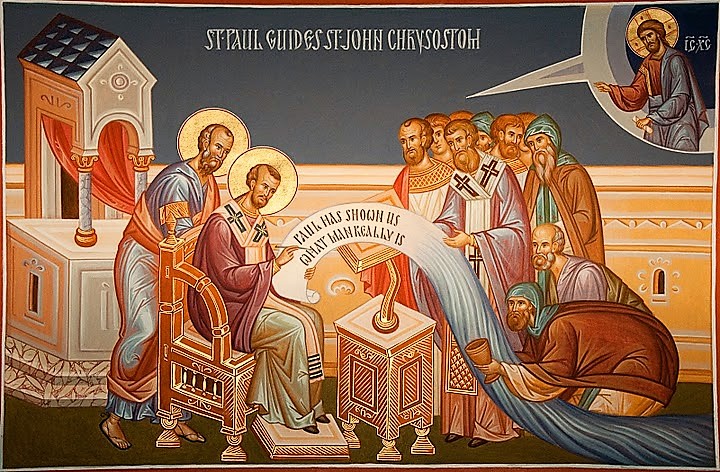
ST JOHN CHRYSOSTOM, BISHOP, CONFESSOR, DOCTOR OF THE CHURCH
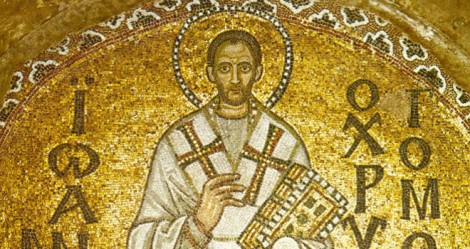
John was born in 344 at Antioch in Asia Minor. His father died when he was young, and he was raised by a very pious mother. He was well-educated, having studied rhetoric under Libanius, one of the most famous orators of his day. He then spent some time in uninterrupted contemplation of the Word of God as a hermit. He became a monk, then a preacher and priest for a dozen years in Syria. While there he developed a stomach ailment that troubled him the rest of his life.
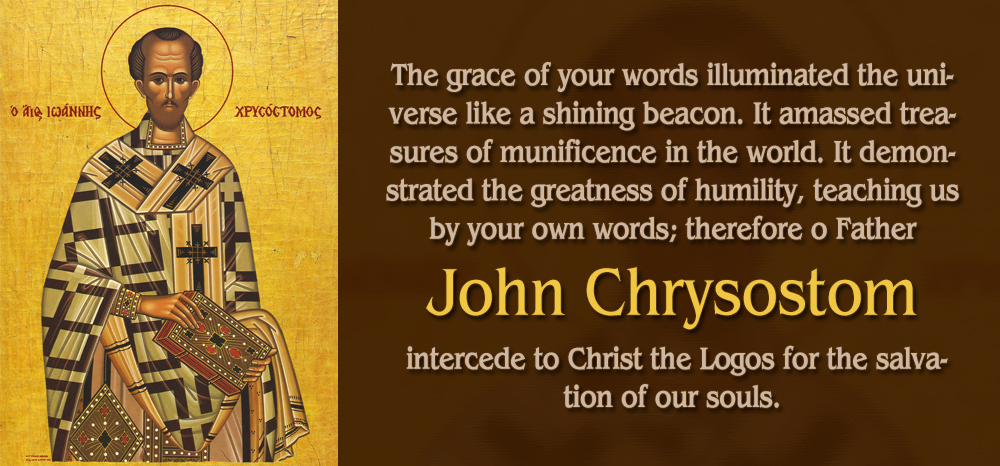
He eventually found his true calling as a priest in Antioch. It was for his sermons that John earned the title Chrysostom [“golden mouthed”]. They were always on point, explaining the Scriptures with clarity, and sometimes went on for hours. Reluctantly he was made Bishop of Constantinople in 398, a move that involved him in imperial politics. He criticized the rich for not sharing their wealth, fought to reform the clergy, prevented the sale of ecclesiastical offices, called for fidelity in marriage, and encouraged practices of justice and charity. Archbishop and Patriarch of Constantinople, he revised the Greek Liturgy. Because John’s sermons advocated a change in their lives, some nobles and bishops worked to remove him from his diocese. He was twice exiled from his diocese. Banished to Pythius, after suffering bitter persecution by the empress Eudoxia, and her courtiers. According to Pope Benedict XVI, John’s “perfectly pastoral theology” addressed everyday problems with doctrinal depth and clarity. His homilies on marriage and family life spoke to perennial issues faced by husbands and wives. “There is nothing which so welds our life together as the love of man and wife”, he wrote.
St. John Chrysostom died in 407. Greek Father of the Church, proclaimed Doctor of the Church in 451.
From a homily by Saint John Chrysostom, Bishop, Doctor of the Church
(Ante exsilium, nn. 1-3; PG 52, 427*-430)
Life to me means Christ, and death is gain
The waters have risen and severe storms are upon us, but we do not fear drowning, for we stand firmly upon a Rock. Let the sea rage, it cannot break the Rock. Let the waves rise, they cannot sink the boat of Jesus. What are we to fear? Death? Life to me means Christ, and death is gain. Exile? The earth and its fullness belong to the LORD. The confiscation of goods? We brought nothing into this world, and we shall surely take nothing from it. I have only contempt for the world’s threats, I find its blessings laughable. I have no fear of poverty, no desire for wealth. I am not afraid of death nor do I long to live, except for your good. I concentrate therefore on the present situation, and I urge you, my friends, to have confidence.
Do you not hear the LORD saying: Where two or three are gathered in My name, there am I in their midst? Will He be absent, then, when so many people united in love are gathered together? I have His Promise; I am surely not going to rely on my own strength! I have what He has written; that is my Staff, my Security, my peaceful harbour. Let the world be in upheaval. I hold to His Promise and read His message; that is my protecting wall and garrison. What message? Know that I am with you always, until the end of the world!
If Christ is with me, whom shall I fear? Though the waves and the sea and the anger of princes are roused against me, they are less to me than a spider’s web. Indeed, unless you, my brothers, had detained me, I would have left this very day. For I always say: LORD, Your Will be done; not what this fellow or that would have me do, but what You want me to do. That is my strong Tower, my immovable Rock, my Staff that never gives way. If God wants something, let it be done! If He wants me to stay here, I am grateful. But wherever He wants me to be, I am no less grateful.
Yet where I am, there you are too, and where you are, I am. For we are a single body, and the body cannot be separated from the head nor the head from the body. Distance separates us, but love unites us, and death itself cannot divide us. For though my body die, my soul will live and be mindful of my people.
You are my fellow citizens, my fathers, my brothers, my sons, my limbs, my body. You are my light, sweeter to me than the visible light. For what can the rays of the sun bestow on me that is comparable to your love? The sun’s light is useful in my earthly life, but your love is fashioning a crown for me in the Life to come.
DAILY MEDITATION
One day, a word, an incident, or a light from God, reveals the truth to us, and then our conversion takes place. The first action of the gift of Knowledge is to reveal in a profoundly intuitive manner, and with irresistible conviction, the vanity of things. after this vision, we turn earnestly to God, and begin to walk the road of Christian perfection.
Spiritual writers speak at times of the second conversion, in addition to that first one by which we leave sin, and enter upon the way of grace. In the second conversion, when the soul takes a new route in the spiritual life, when God calls it to a higher perfection, the gift of knowledge produces an even deeper and more perfect conviction that the things of the earth are vain. At times, this effect is bitter, painful, even terrible. Virtue is not always sweet; sometimes it seems cruel. There are virtues, that tear the heart to pieces, that disconcert us, that disillusion us; but that is the way the gift of knowledge fills us with complete scorn for the things of earth. Here is the “night of the senses” of which St. John of the Cross speaks – the long and tremendous purification to which God subjects a soul when He wishes to lift it up to great heights.
To such a soul, all creatures have suddenly lost their charm; their former allure is gone. No longer does the soul find rest in the old delights. It is night, a dark night in which shines not a single star – a blessed night, for the soul has been preserved from the charm of creatures, to find itself on the straight and sure Way that leads to God.
… The created thing is vain because it is deficient, because it is limited, because it will never be able to fill our heart. But there is also in every creature, from the highest of the seraphim to the lowest atom of matter, a flash of divinity. In a magnificent poetic figure already quoted, St. John of the Cross describes God as He passes through the universe, showering graces and covering all created things with His Light as His divine Countenance is reflected in them.
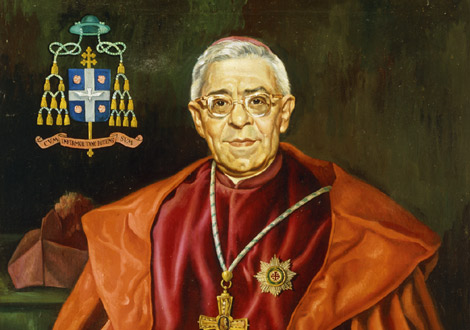
Archbishop Luis M. Martinez [died 1956] – Mexican seminary dean, author, poet, and respected Archbishop, named the first honorary Primate of Mexico in 1951.
Awaiting “that day”
In a theatre of this world at midday, the stage is set and many actors enter, playing parts, wearing masks on their faces, retelling some old story, narrating the events. One becomes a philosopher, though he is not a philosopher. Another becomes a king, though he is not a king, but has the appearance of a king for the story. Another becomes a physician without knowing how to handle even a piece of wood, but wearing the garments of a physician. Another becomes a slave, though he is free; another a teacher, though he does not even know his letters. They appear something other than what they really are, and they do not appear what they really are….
As long as the audience remain in their seats, the masks are valid; but when evening overtakes them, and the play is ended, and everyone goes out, the masks are cast aside. He who is king inside the theatre is found to be a coppersmith outside. The masks are removed, the deceit departs, the truth is revealed. He who is a free man inside the theatre is found to be a slave outside; for as I said the deceit is inside, but the truth is outside. Evening overtakes them, the play is ended, the truth appears.
So it is also in life and its end. The present world is a theatre, the conditions of men are roles: wealth and poverty, ruler and ruled, and so forth. When this day is cast aside, and that terrible night comes, or rather day—night indeed for sinners, but day for the righteous—when the play is ended, when the masks are removed, when each person is judged with his works, not each person with his wealth, not each person with his office, not each person with his authority, not each person with his power, but each person with his works, whether he is a ruler or a king, a woman or a man, when He requires an account of our life and our good deeds, not the weight of our reputation…when the masks are removed, then the truly rich and the truly poor are revealed.
Saint John Chrysostom
Saint John Chrysostom († 407), Archbishop of Constantinople, was a famed preacher and commentator on Scripture. [From On Wealth and Poverty, Catharine P. Roth, Tr. ©
2 Timothy 2:9-10; Psalm 27:1
Wherein I labour even unto bands, as an evildoer; but the Word of God is not bound.
– Therefore I endure all things for the sake of the elect, that they also may obtain the salvation.
The LORD is my light and my salvation;
whom shall I fear?
– Therefore I endure all things for the sake of the elect, that they also may obtain the salvation.
“The refusal to take sides on great moral issues is itself a decision. It is a silent acquiescence to evil. The tragedy of our time is that those who still believe in honesty lack fire and conviction, while those who believe in dishonesty are full of passionate conviction.” – Ven. Archbishop Fulton Sheen
 Daily Reflections
Leave a comment