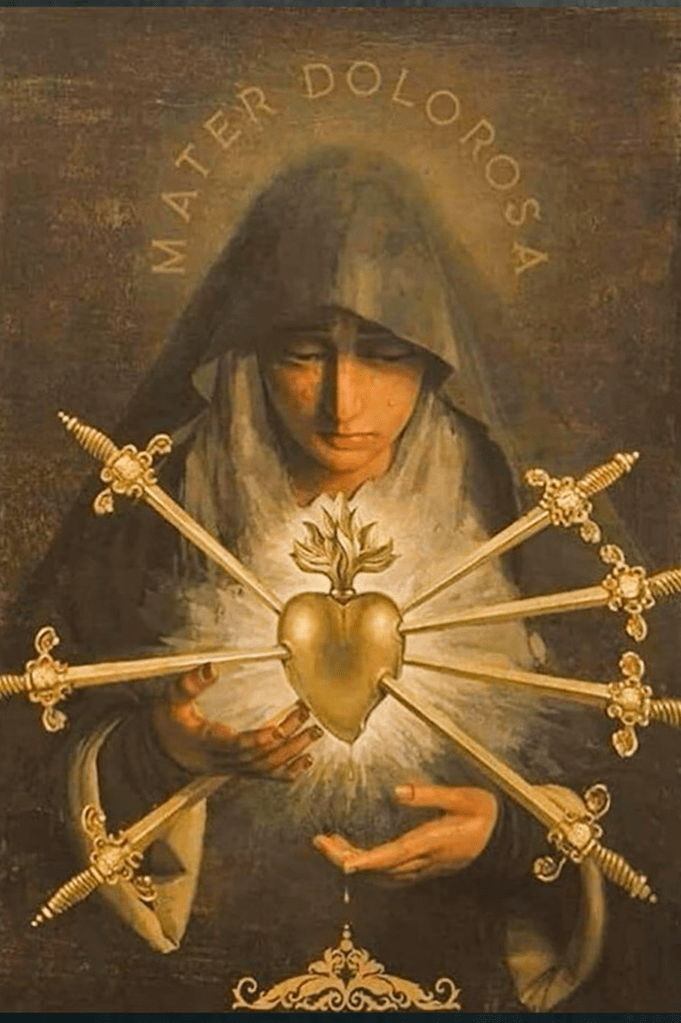
Our Lady of Sorrows
The Seven Sorrows of the Blessed Virgin Mary (Traditional)
The Blessed Virgin was born to be the Mother of God. From the moment of her conception, Our Lady has led us to her Son. From the Cross, Christ commands, “This is your mother.” We need the maternal closeness of the Sorrowful Mother to sustain us when we are overcome by the terrifying trials of life. We receive the courage to face life’s sufferings, certain in the secure embrace of Divine Providence, through Mary’s compassionate presence at the Cross and her presence to us throughout our lives. Whenever Mary loves us, she gives us Jesus. By obeying the LORD in our devout beholding of the Mother of God, we give Mary the chance to speak her fiat to the “Annunciation” uttered from the Cross: “This is your son.”
What words can never describe the unspeakable anguish that rent the Sacred Heart of Mary as she looked upon her Divine Son hanging on the Cross! Every wound in Jesus’ Body was also a wound in the heart of Mary: every fibre, every nerve throbbing in agony, every pang He suffered re-echoed in her heart. She endured by her compassion a share in all of the anguish of His Passion. Why did Mary suffer all of this? That she might be our Mother, the Mother of mankind. She brought forth her Divine Son without a pang, suffered many a piercing pang when from the Cross her dying Son commended to her the sinful sons of men. It was indeed a Motherhood of sorrow that she suffered for our sins: for mine.
For a while there were two feasts in honour of the Sorrowful Mother: one going back to the 15th century, the other to the 17th century. For a while both were celebrated by the universal Church: one on the Friday before Palm Sunday, the other in September.
The principal biblical references to Mary’s sorrows are in Luke 2:35 and John 19:26-27. The Lucan passage is Simeon’s prediction about a sword piercing Mary’s heart; the Johannine passage relates Jesus’ words to Mary and to the beloved disciple.
Many early Church writers interpret the sword as Mary’s sorrows, especially as she saw Jesus die on the Cross. Thus, the two passages are brought together as prediction and fulfillment.
From a sermon by Saint Bernard, Abbot
(Sermo in dom. infra oct. Assumptionis, 14-15: Opera omnia, Edit. Cisterc. [1968], 273-274
His Mother stood by the Cross
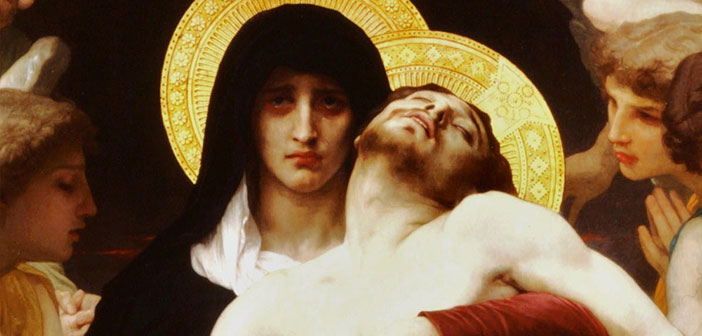
The martyrdom of the Virgin is set forth both in the prophecy of Simeon and in the actual story of Our LORD’s Passion. The holy old man said of the infant Jesus: He has been established as a sign which will be contradicted. He went on to say to Mary: And your own heart will be pierced by a sword.
Truly, O blessed Mother, a sword has pierced your heart. For only by passing through your heart could the sword enter the flesh of Your Son. Indeed, after Your Jesus—who belongs to everyone, but is especially yours—gave up His life, the cruel spear, which was not withheld from His lifeless body, tore open His side. Clearly it did not touch His soul and could not harm Him, but it did pierce your heart. For surely His soul was no longer there, but yours could not be torn away. Thus the violence of sorrow has cut through your heart, and we rightly call you more than martyr, since the effect of compassion in you has gone beyond the endurance of physical suffering.
Or were those words, Woman, behold your Son, not more than a word to you, truly piercing your heart, cutting through to the division between soul and spirit? What an exchange! John is given to you in place of Jesus, the servant in place of the LORD, the disciple in place of the Master; the son of Zebedee replaces the Son of God, a mere man replaces God Himself. How could these words not pierce your most loving heart, when the mere remembrance of them breaks ours, hearts of iron and stone though they are!
Do not be surprised, brothers, that Mary is said to be a martyr in spirit. Let him be surprised who does not remember the words of Paul, that one of the greatest crimes of the Gentiles was that they were without love. That was far from the heart of Mary; let it be far from her servants.
Perhaps someone will say: “Had she not known before that He would not die?” Undoubtedly. “Did she not expect Him to rise again at once?” Surely. “And still she grieved over her crucified Son?” Intensely. Who are you and what is the source of your wisdom that you are more surprised at the compassion of Mary than at the Passion of Mary’s Son? For if He could die in body, could she not die with Him in spirit? He died in body through a love greater than anyone had known. She died in spirit through a love unlike any other since His.
Our Lady of Sorrows
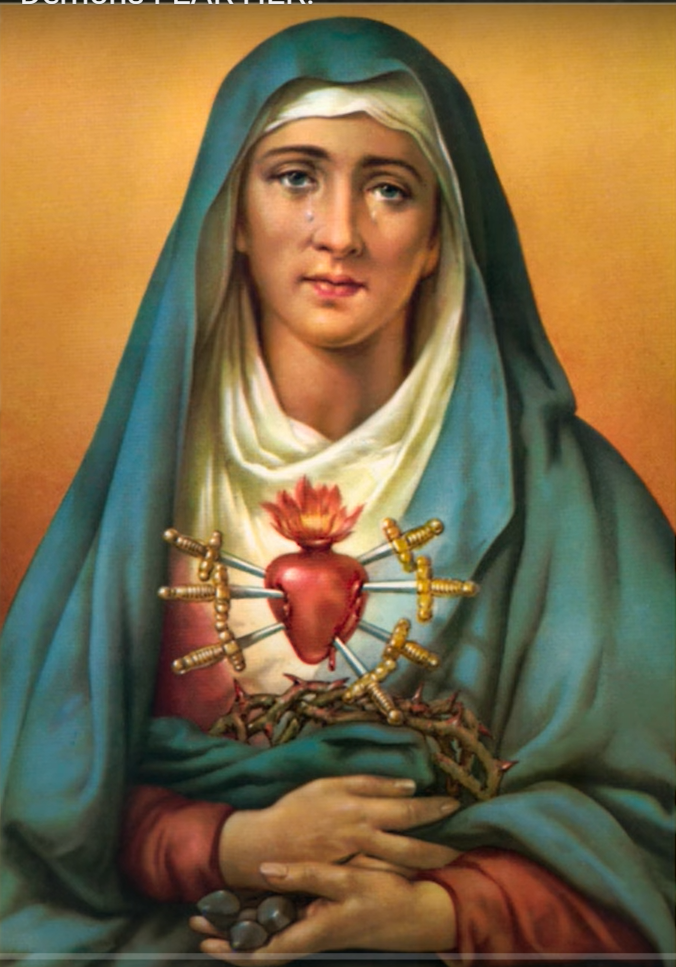
The Gospel tells us nothing about the childhood of Mary. It seems that God willed jealously to hide this diamond of greatest beauty. And Mary, all her life, kept her love of reticence, of self-effacement, of the hidden life, under the veil of simplicity, like a marvellous treasure. Think of her at Nazareth, the wife of a carpenter, keeping the household…she, the Queen of Heaven. She appears later as if lost in the midst of the holy women, having nothing to distinguish her. I do not see Mary fainting in the arms of Saint John or Mary Magdalene, but standing—stabat Mater—in immense sorrow and in divine peace at the foot of the Cross. After laying Jesus in the tomb, Saint John brought Mary back to his own home, where she was to live, until the Assumption, the same life she had led at Nazareth. I picture to myself Mary during the discourse of Saint Peter on the morning of Pentecost. No one in the crowd of hearers had any idea that the Mother of this Resurrected Jesus—of whom Saint Peter told them, the Mother of God, the Spouse of the Holy Spirit who inflamed their hearts—was there, silent, in their midst….
Jesus told Saint Margaret Mary, “From the first moment of My Incarnation, the Cross was planted in My heart.” We might well think that at the same moment it was also planted in the heart of Mary. She knew the Scriptures too well not to know that her Son would be the man of sorrows of Isaiah, that she would see Him one day without beauty, without majesty…no looks to attract our eyes; a thing despised and rejected by men…pierced through for our faults, crushed for our sins. She very soon received confirmation from Simeon’s announcement: a sword will pierce your own soul too. What must she not have felt at the time of the massacre of the Innocent One whom she carried in her arms and pressed to her heart?…
The Gospel does not speak of it, but we can picture to ourselves the first departure of Jesus from Nazareth. She had the certainty of His coming death. Finished were the long conversations with her Son, the unspeakable sweetness of the exchanges between two hearts so marvellously exquisite, sensitive, delicate, radiant with tenderness, as were the Heart of Jesus and the Heart of Mary. Then there was the separation of Calvary, when she witnessed with her eyes, with her broken heart, the full reality. She saw the soldiers strip Him of His clothes, tear to shreds the adorable flesh she had given Him, pound nails into the hands she had so often held in her own and kissed with adoration…. But Mary said, without hesitation, in her spirit, in her will, in her heart, Fiat, magnificat. She knew that all these crosses were, in the Divine Plan, necessary for the salvation of men and the greatest proof of love Jesus could give her.
Father Jean du Cœur de Jésus d’Elbée
Father d’Elbée († 1982) was a French priest and spiritual author. He was a member of the Congregation of the Sacred Hearts of Jesus and Mary. [From I Believe in Love: Retreat Conferences on the Interior Life, Marilyn Teichert with Madeleine Stebbins, Trs. ©
DAILY MEDITATION
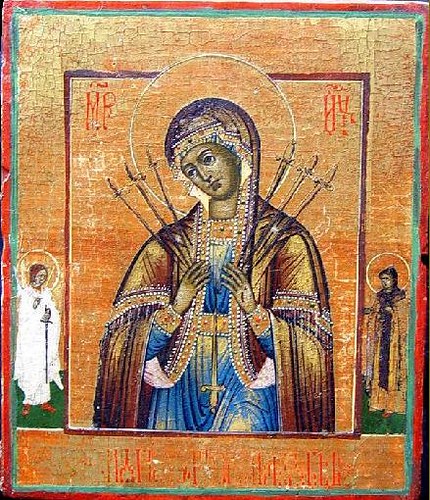
Devotion to the sorrows of Our Blessed Lady dates from Calvary. The apostolic Church clung round her, whom Jesus had given to be its Mother, and ever remembered that it was amid the pains, the blood, and the agonies of the Passion that it had become the child of Mary – literally “the Child of her sorrows“. the chief characteristic, then, of the Church’s, first love to Our Lady was a deep, tender, loving, and childlike devotion, to her sorrows, and the apostolic age bequeathed this exquisite feeling to succeeding times. But it was reserved for the thirteenth century, in many respects the grandest period In the history of religion, to develop this intuitive affection, by giving it, as it were, a form, and uniting those most attached to this devotion, in a confraternity, strongly recommended by the Church, and richly endowed with indulgences, and other favours by the Supreme Pontiffs.
It was in the year 1234 that seven holy men of Florence, retiring from that city into the cloister, founded a religious order, under the name of the Servites, or Servants of Mary, whose especial object was to honour the sorrows of the Blessed Virgin; nor was it long before Heaven miraculously proved that Our Blessed LORD, the Man of Sorrows, was well pleased with this affectionate devotion to her who had the most nearly and bitterly shared in His Passion.
This tender sympathy, and the consequent graces richly bestowed by Jesus and Mary, were however not to be confined to the cloister. A lay affiliation of the Servites of Mary was soon established; the habit, or scapular of Our Lady of Sorrows, enriched with numerous indulgences, was eagerly sought after by thousands of all ranks. The Crown or Rosary of the “Sorrows“ began to emulate the Dominican Rosary; in short, the confraternity of the “Sorrows,“ like the great society of Mount Carmel, spread through Christendom, was in like manner, encouraged by holy Popes, and in like manner drew down the favours of God, and the blessings of Mary, on untold thousands of rich and poor.
… We confidently believe Mary will show us a grateful love, and, with her own most marvellous blessing, will bless those who, by compassionating her sorrows, show themselves the most truly to be her children, and give the sweetest consolation to her afflicted Heart.
Anonymous, Manual of Devotions, in honour of Our Lady of Sorrows [1868]
RESPONSORY
When they came to a place called Calvary,
they crucified Jesus there.
– His mother stood beside the Cross.
A sword of sorrows pierced her blameless heart.
– His mother stood beside the Cross.
“The refusal to take sides on great moral issues is itself a decision. It is a silent acquiescence to evil. The tragedy of our time is that those who still believe in honesty lack fire and conviction, while those who believe in dishonesty are full of passionate conviction.” – Ven. Archbishop Fulton Sheen
 Daily Reflections
Leave a comment