Matthew 24:15, 21, 22; Apocalypse 7:3
When therefore you shall see the “abomination of desolation”, standing in the holy place,
For there shall be then great tribulation,
And unless those days had been shortened,
no flesh should be saved,
– but for the sake of the elect those days shall be shortened.
Hurt not the earth, nor the sea, nor the trees,
till we sign the servants of our God in their foreheads.
– but for the sake of the elect those days shall be shortened.
Tuesday of the Twenty-Fourth Week in Ordinary Time
Saint Januarius, Bishop, Martyr and his Companions, Martyrs
Saint Theodore of Canterbury, (England)
ST. JANUARIUS, BISHOP, MARTYR, AND HIS COMPANIONS, MARTYRS
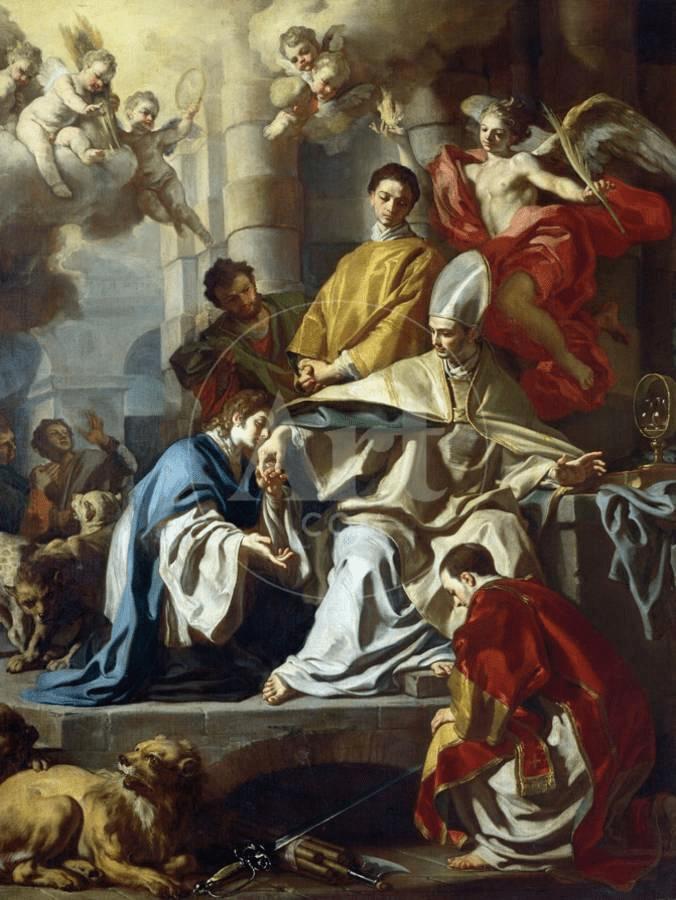
St. Januarius, Bishop of Beneventum, received word that two deacons and two laymen were imprisoned under the brutal emperor Diocletian. Januarius was preparing to visit the men in prison when the Romans arrested him and his companions on their way to perform this work of mercy. The imprisoned men, including Januarius and his companions, Acutius, Eutychius, Desiderius, Festus, Proculus, and Socius, were all sentenced to death and exposed to wild beasts at Puteoli. When the beasts refused to attack them, the men were beheaded in 305.
In the great church at Naples are preserved some of the blood of St. Januarius in two glass phials, and also his head. The blood is congealed, but every year up to the present it liquefies when placed near the martyr’s head. This miracle has been verified both by scientists, and by many pious and learned persons. Cardinal Schuster, Archbishop of Milan, was able to observe it closely and, like others who have studied it, was obliged to confess that there seems to be no possible natural explanation of this event. It may be that in this manner, God is pleased to show to the people of Naples that the blood of their great Patron is still active and powerful, in the sight of the LORD, for with God there is no past, but all is present and living in His sight. He is remembered in New York City at the yearly festival of San Gennaro. Januarius is the patron saint of the City of Naples.
SAINT THEODORE OF CANTERBURY, BISHOP
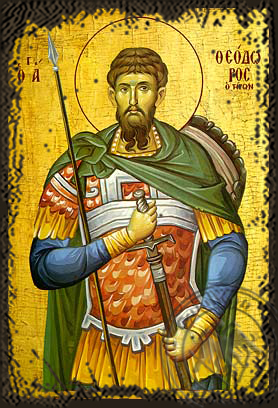
Archbishop of Canterbury, England, and a memorable figure in the English Church. A native of Tarsus, Turkey, he was a Greek by descent. After studying in Tarsus and Athens, Greece, he went to Rome, where he became so respected that Pope St. Vitalian (r. 657-672) appointed him to succeed to the See of Canterbury in 667. After receiving consecration on March 26, 668, he set out for England in the company of Sts. Dominic Biscop and Hadrian the African, both of whom were to provide assistance and helped guarantee that Theodore’s administration remained entirely orthodox. They arrived at Canterbury in May 669 and Theodore moved immediately to consolidate his position as Primate of England and the metropolitan status of the See of Canterbury. To promote further unity, he convened two synods, at Hereford in 673 and at Hatfield in 680. Such was the success of his programs that the Venerable Bede wrote that Theodore was “the first Archbishop obeyed by all the English Church.”
From a Sermon by Saint Augustine, Bishop and Doctor of the Church
(Sermo 340,1: PL 38, 1483-1484)
For you I am a Bishop; with you I am a Christian
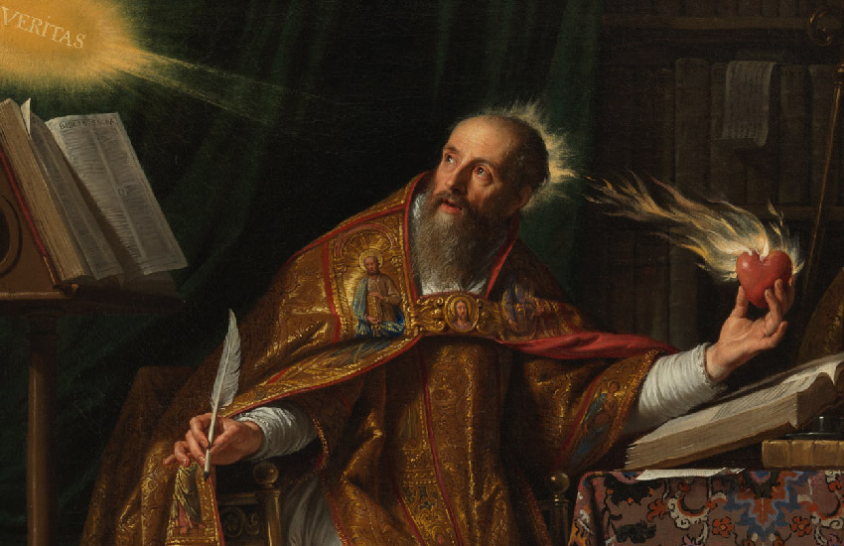
The day I became a Bishop, a burden was laid on my shoulders for which it will be no easy task to render an account. The honours I receive are for me an ever present cause of uneasiness. Indeed, it terrifies me to think that I could take more pleasure in the honour attached to my Office, which is where its danger lies, than in your salvation, which ought to be its fruit. This is why being set above you fills me with alarm, whereas being with you gives me comfort. Danger lies in the first; salvation in the second.
To be honest with you, my obligations involve me in so much turmoil that I feel as though I were tossed by storms on a great ocean. When I remember by Whose Blood I have been redeemed, this thought brings me peace, as though I were entering the safety of a harbour; and I am consoled, as I carry out the arduous duties of my own particular office, by the blessings which we all have in common. By finding my chief joy therefore in the redemption, which I share with you, and not in my office, which has placed me over you, I shall the more truly be your servant; and so not only fulfill the LORD’s command, but also show myself not ungrateful to Him for making me your fellow servant. For my Redeemer has a claim upon my love, and I do not forget how He questioned Peter, and asked: Do you love Me, Peter? Then feed My sheep. He asked this once, then again and then a third time. He inquired about his love, and then He gave him work to do; for the greater one’s love is, the easier is the work.
How shall I repay the LORD for all the blessings He has given me? I could say perhaps that I repay Him by feeding His sheep, but even though I do this, it is not really I who do it, but the Grace of God within me. So when all that I do is the gift of God’s Grace, how can I possibly repay Him? As a matter of fact, I hope to be repaid myself, and this for the very reason that I love Him freely and feed His sheep. But, you may ask, if I feed His sheep because I love Him freely, how can I demand payment for feeding them? It is indeed unthinkable to ask for a recompense for love freely given unless that recompense is the loved one Himself.
But even if feeding His sheep could repay Him for redeeming me, what could repay Him for having made me His shepherd? To be a good shepherd I depend entirely on His Grace, for without His help I should be a very bad one, there is so much evil in me. Pray, then, that I may not be a bad shepherd, but a good one.
And for you, my brothers, I also pray and warn you against failing to cooperate with the grace you receive from God. Make my ministry a fruitful one. You are God’s garden, and you should therefore welcome the labourer who does the visible work of planting and watering the seed, even though the growth comes from One Who works invisibly within you. Help me both by your prayers and by your obedience, for then it will be a pleasure for me, not to preside over you, but to serve you.
DAILY MEDITATION
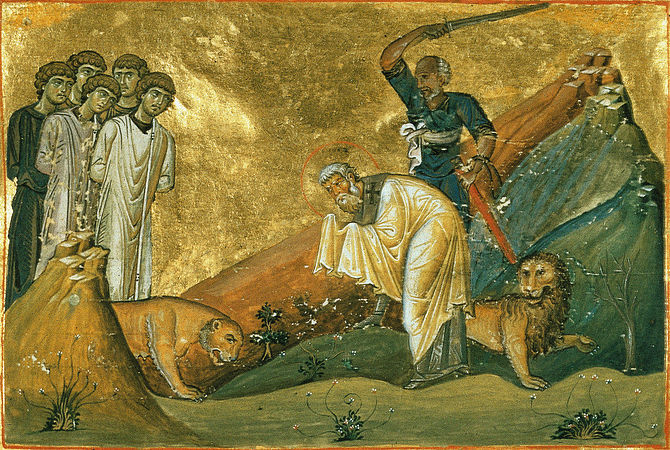
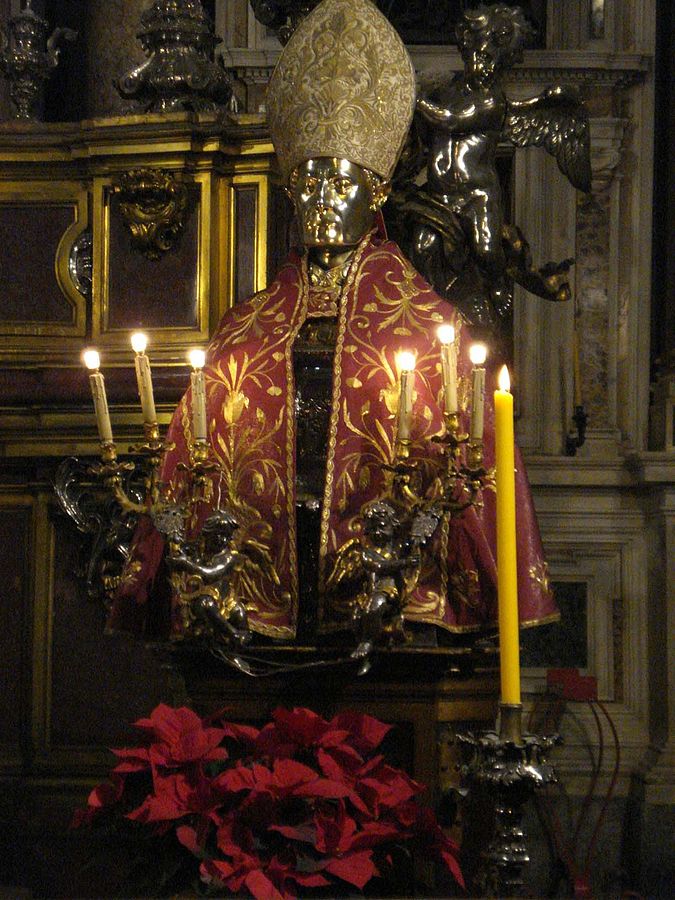
The holy Bishop, St. Januarius, was a native of Benevento, a city in the Neapolitan territory. His parents, not less virtuous than of high lineage, gave him from his earliest youth a most pious education, and he was so earnest in his endeavours to lead a blameless life, that the clergy and laity, after the death of their bishop, desired no other successor than Januarius. He alone opposed the election and could not be persuaded to consent, until obedience to the command of the pope forced him to yield. Great, as had been the struggle it cost the holy man to accept the high dignity conferred upon him, he was equally zealous and untiring in discharging his duties when installed into his see. At that period, the tyrants Diocletian and Maximian raged against the faithful, endeavouring to destroy all Christendom. The holy Bishop, therefore, used all his powers to strengthen his flock in the true Faith to encourage them to allow neither torments nor death to make them forsake their God. The teachings the holy bishop gave to others, he exemplified in his own life, thus showing to his flock how to endure martyrdom.
… the body of the saint was first brought to Benevento, but later, to Naples, where it is held in great veneration, on account of the protection, which, by the intercession of St. Januarius, the city enjoys from the eruption of Mount Vesuvius. It has a happened several times that when the relics of the saint were carried in solemn procession, toward the burning waves of lava which was ejected by this mountain and came rolling onward to destroy the city, the eruption ceased, and Naples was saved. To this day, the blood of the Saint is preserved at Naples, in a glass vial. The blood is congealed; but when placed near the head of the saint, it melts and bubbles up. This miracle, which has continued until the present time, has been witnessed by many, both Catholics and non-Catholics, and although several of the latter have ascribed it to deceit, it is impossible for them to prove their assertion.
Father Francis Xavier Weninger [d. 1888] – Austrian priest, professor, and author, joined the Jesuits as missionary preacher to the United States.
Raised Up with Christ

Dear Mama, it is very cold this morning and not a wisp of sunlight. Yesterday, during our walk, I was able to bask a little like a lizard. Today I’m going to have to hop around. Yesterday was a gloomy day. It was the feast of the Seven Sorrows of our Lady at the foot of Calvary and I meditated on it at length. Saturday, I received your two letters with the prayers. They are very good, especially the Fiat voluntas tua [“Let it be done according to Your will”]. Put them into practice and you will see God.
Why can’t I be outside this prison? I would have so many things to do and perhaps [people] to save or at least to protect! But you see, God has decided otherwise. Once I am in Heaven, I shall pray for Veronica until her death. Do you see God’s design? He made use of me to bring a child into the world, because He wanted to call me to Himself. I am very sure her name is written in the Book of Life…. I put all my cares at the feet of the Blessed Virgin, and I am sure that she will help me so that my anguish will be turned into joy.
It is very difficult to get used to the idea. There is something terrifying about passing so swiftly from life to death…. Our sins are shown up in the Divine Light. We see them with horror, and insofar as we are guilty we absolutely cannot bear to see ourselves in God. This is why it is indispensable to be completely purified at the moment of death. Do you understand why I must suffer, and why, very often, the death of the just is accompanied with these necessary agonies? And then we should remember too that our corruptible flesh will rise on the last day, incorruptible. We will have glorious bodies and will be like the angels! May we all be able to say with Our LORD, I have finished the work You gave Me to do; My Father, glorify Your Son. Dear Mama, until tomorrow, I embrace you with all my heart.
Servant of God Jacques Fesch
Jacques Fesch († 1957) was a murderer who experienced a profound conversion before his execution in a French prison. He wrote these words shortly before he died. [From Light over the Scaffold: Prison Letters of Jacques Fesch and Cell 18: Unedited Letters of Jacques Fesch, Sr. Mary Thomas Noble, o.p., Tr.]©
“The refusal to take sides on great moral issues is itself a decision. It is a silent acquiescence to evil. The tragedy of our time is that those who still believe in honesty lack fire and conviction, while those who believe in dishonesty are full of passionate conviction.” – Ven. Archbishop Fulton Sheen
 Daily Reflections
Leave a comment