Cf. 2 Cor 6:9-10
These are the martyrs who bore witness to Christ.
Praising the LORD, they feared no evil.
– The blood of martyrs is the seed of the Church.They are as unknown, yet well known, as dying, yet living still,
as having nothing, yet possessing all things.
– The blood of martyrs is the seed of Church.
Wednesday of the Twenty-Fourth Week in Ordinary TimeEmber Wednesday in September (Traditional) Saints Andrew Kim Tae-gŏn, Priest, Paul Chŏng Ha-sang, and companions, Martyrs Saint Eustace and Companions, Martyrs (Traditional)
ST. ANDREW KIM TAE-GÔN, PRIEST, PAUL CHŌNG HA-SANG, AND COMPANIONS, MARTYRS
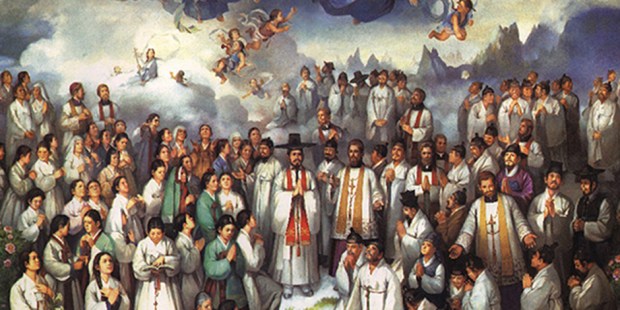
Unique among the national churches, the Church in Korea arose not through the efforts of outside missionaries but rather through the determination of Korean laypersons. Yi Seung-hun was the first to be baptised when he received the Sacrament in 1784, in Beijing. Returning to Korea with rosaries, statues, and catechisms, he evangelised his brethren. The martyrs remembered today were among the second and third generation of Catholics. Greatly desiring the sacraments, Paul Chŏng Ha-sang repeatedly risked his life to smuggle missionaries into the country.
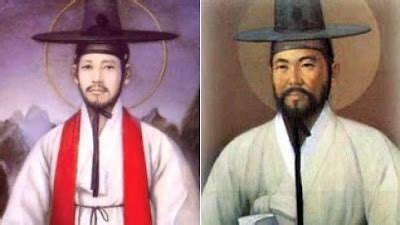
Andrew Kim Tae-gŏn, the first native Korean priest was the son of Korean converts. His father, Ignatius Kim, was martyred during the persecution of 1839 and was beatified in 1925. After Baptism at the age of 15, Andrew traveled 1,300 miles to the seminary in Macao, China. After six years he managed to return to his country through Manchuria. That same year he crossed the Yellow Sea to Shanghai and was ordained a priest. Home again, he was assigned to arrange for more missionaries to enter by a water route that would elude the border patrol. He was arrested, tortured and finally beheaded at the Han River near Seoul, the capital.“My Eternal life is beginning now”, he proclaimed in his last sermon, just before he was beheaded. Paul Chong Hasang was a seminarian, aged 45. One hundred and three martyrs are revered as the Martyrs of Korea.
Christianity came to Korea during the Japanese invasion in 1592 when some Koreans were baptized, probably by Christian Japanese soldiers. Evangelization was difficult because Korea refused all contact with the outside world except for bringing taxes to Beijing annually. On one of these occasions, around 1777, Christian literature obtained from Jesuits in China led educated Korean Christians to study. A home Church began. When a Chinese priest managed to enter secretly a dozen years later, he found 4,000 Catholics, none of whom had ever seen a priest. Seven years later there were 10,000 Catholics. Religious freedom came in 1883.
SAINT EUSTACE AND HIS COMPANIONS, MARTYRS
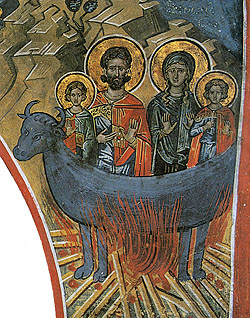
Eustace was commander-in-chief in the army of the Emperor Trajan. Having refused to thank the gods for a triumph, he was burned to death with his wife and two children, after undergoing many cruel tortures in 120 A.D.
From the final exhortation of Saint Andrew Kim Taegŏn, Priest and Martyr
(Pro Corea Documenta, ed. Mission Catholique Séoul, Séoul/Paris, 1938, vol. 1, 74-75)
Love and perseverance are the crown of Faith
My brothers and sisters, my dearest friends, think again and again on this: God has ruled over all things in Heaven and on earth from the beginning of time: then reflect on why and for what purpose He chose each one of us to be created in His own image and likeness.
In this world of perils and hardship, if we did not recognize the LORD as our Creator, there would be no benefit either in being born or in our continued existence. We have come into this world by God’s grace; by that same grace we have received Baptism, entrance into the Church and the honour of being called Christians. Yet what good will this do us if we are Christians in name alone and not in fact? We would have come into the world for nothing, we would have entered the Church for nothing, and we would have betrayed even God and His grace. It would be better never to have been born than to receive the grace of God and then to sin against Him.
Look at the farmer who cultivates his rice fields. In season he plows, then fertilizes the earth; never counting the cost, he labours under the sun to nurture the seed he has planted. When harvest time comes and the rice crop is abundant, forgetting his labour and sweat, he rejoices with an exultant heart. But if the crop is sparse and there is nothing but straw and husks, the farmer broods over his toil and sweat and turns his back on that field with a disgust that is all the greater the harder he has toiled.
The LORD is like a farmer and we are the field of rice that He fertilizes with His grace and by the Mystery of the Incarnation and the Redemption irrigates with His Blood, in order that we will grow and reach maturity. When harvest time comes, the Day of Judgment, those who have grown to maturity in the grace of God will find the Joy of adopted children in the Kingdom of Heaven; those who have not grown to maturity will become God’s enemies, and, even though they were once His children, they will be punished according to their deeds for all Eternity.
Dearest brothers and sisters: when He was in the world, the LORD Jesus bore countless sorrows and by His own Passion and Death founded the Church; now Ie gives it increase through the sufferings of the faithful. No matter how fiercely the powers of this world oppress and oppose the Church, they will never bring it down. Ever since His Ascension (into Heaven) and from the time of the apostles to the present, the LORD Jesus has made His Church grow even in the midst of tribulation.
For the last fifty or sixty years, ever since the coming of the Church to our own land of Korea, the faithful have suffered persecution over and over again. Persecution still rages and as a result many who are friends in the household of the Faith, myself among them, have been thrown into prison and like you are experiencing severe distress. Because we have become the One Body, should not our hearts be grieved for the members who are suffering? Because of the human ties that bind us, should we not feel deeply the pain of our separation?
But, as the Scriptures say, God numbers the very hairs on our head and in His All-embracing Providence He has care over us all. Persecution, therefore, can only be regarded as the command of the LORD or as a prize He gives or as a punishment He permits.
Hold fast, then, to the Will of God and with all your heart fight the good fight under the leadership of Jesus; conquer again the diabolical power of this world that Christ has already vanquished.
I beg you not to fail in your love for one another, but to support one another and to stand fast until the LORD mercifully delivers us from our trials.
There are twenty of us in this place and by God’s grace we are so far all well. If any of us is executed, I ask you not to forget our families. I have many things to say, yet how can pen and paper capture what I feel? I end this letter. As we are all near the final ordeal, I urge you to remain steadfast in Faith, so that at last we will all reach Heaven and there rejoice together. I embrace you all in love.
The Wisdom of the Korean Martyrs
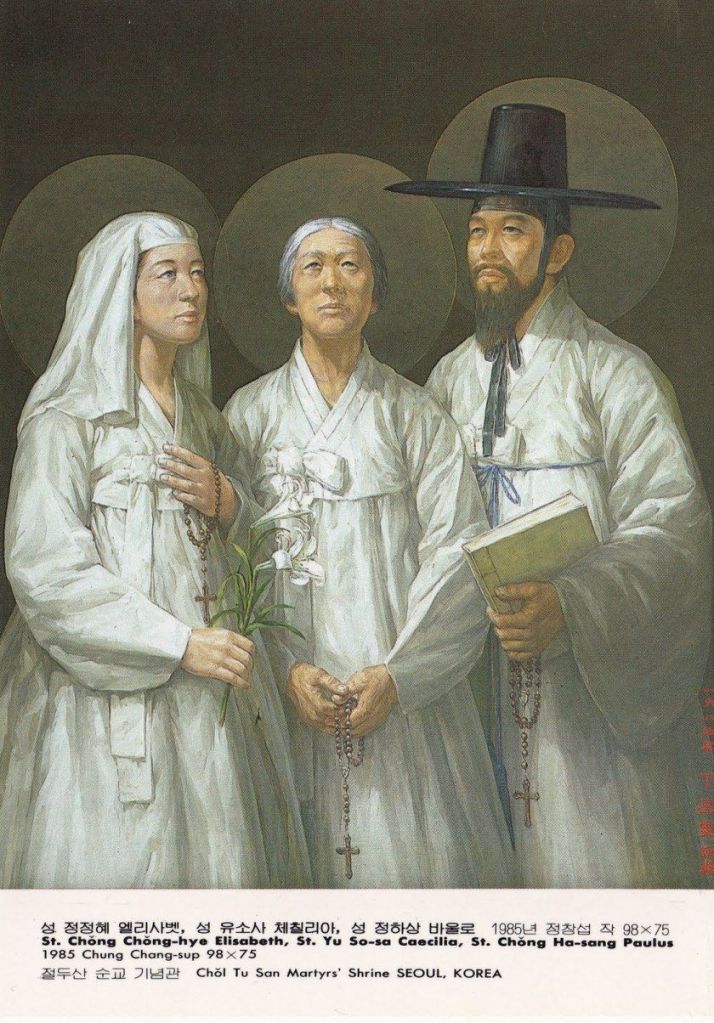
These Korean martyrs are true sons and daughters of your nation, and they are joined by a number of missionaries from other lands. They are your ancestors according to the flesh, language, and culture. At the same time they are your fathers and mothers in the Faith, a faith to which they bore witness by the shedding of their blood. From the thirteen-year-old Peter Yu to the seventy-two-year-old Mark Chong, men and women, clergy and laity, rich and poor, ordinary people and nobles, many of them descendants of earlier unsung martyrs—they all gladly died for the sake of Christ.
Listen to the last words of Teresa Kwon, one of the early Martyrs: “Since the LORD of Heaven is the Father of all mankind and the LORD of all creation, how can you ask me to betray Him? Even in this world anyone who betrays his own father or mother will not be forgiven. All the more may I never betray Him who is the Father of us all.” A generation later, Peter Yu’s father, Augustine, firmly declares: “Once having known God, I cannot possibly betray Him.” Peter Cho goes even further and says: “Even supposing that one’s own father committed a crime, still one cannot disown him as no longer being one’s father. How then can I say that I do not know the Heavenly LORD Father Who is so good?” And what did the seventeen-year-old Agatha Yi say when she and her younger brother were falsely told that their parents had betrayed the Faith? “Whether my parents betrayed or not is their affair. As for us, we cannot betray the LORD of Heaven whom we have always served.” Hearing this, six other adult Christians freely delivered themselves to the magistrate to be martyred. In addition, there are countless other unknown, humble martyrs who no less faithfully and bravely served the LORD. The Korean Martyrs have borne witness to the Crucified and Risen Christ. Through the sacrifice of their own lives they have become like Christ in a very special way. The words of Saint Paul the Apostle could truly have been spoken by them: always, wherever we may be, we carry with us in our body the Death of Jesus, so that the Life of Jesus, too, may always be seen in our body…. we are consigned to our death every day, for the sake of Jesus, so that in our mortal flesh the Life of Jesus, too, may be openly shown.
Saint John Paul II
Saint John Paul II († 2005) was Pope from 1978 until 2005. The above words are from his homily during the Mass for the canonisation of the Korean Martyrs in 1984. [From Homily, Mass for the canonisation of the Korean Martyrs, 6 May, 1984, Youido Place, Seoul
DAILY MEDITATION – EMBER DAYS
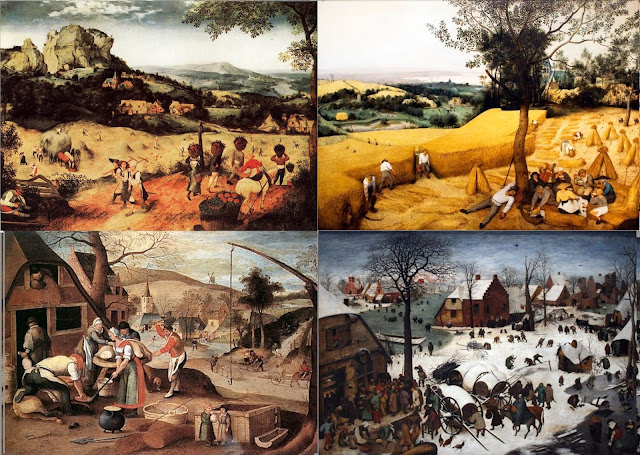
Ember days [corruption from Latin Quatuor Tempora, four times] are the days at the beginning of the seasons ordered by the Church as days of fast and abstinence. They were definitely arranged and prescribed for the entire Church by Pope Gregory VII [1073–1085] for the Wednesday, Friday, and Saturday after 13 December [S. Lucia], after Ash Wednesday, after WhitSunday, and after 14 September [Exaltation of the Cross]. The purpose of their introduction, besides the general one intended by all prayer and fasting, was to thank God for the gifts of nature, to teach men to make use of them in moderation, and to assist the needy. The immediate occasion was the practice of the heathens of Rome. The Romans were originally given to agriculture, and their native gods belonged to the same class. At the beginning of the time for seeding and harvesting, religious ceremonies were performed to implore the help of their deities: in June for a bountiful harvest, in September for a rich vintage, and in December for the seeding; hence the feriæ sementivæ, feriæ messis, and feri vindimiales.
The Church, when converting heathen nations, has always tried to sanctify any practices which could be utilized for a good purpose. At first, the Church in Rome had fasts in June, September, and December; the exact days were not fixed, but were announced by the priests. The Liber Pontificalis ascribes to Pope Callistus [217–222), a law ordering the fast, but probably it is older. Leo the Great.[440–461] considers it an apostolic institution. When the fourth season was added, cannot be ascertained, but Gelasius [492–496] speaks of all four. This Pope also permitted the conferring of priesthood and deaconship on the Saturdays of Ember week – these were formally given only at Easter. Before Gelasius, the Ember days were known only in Rome, and after his time their observance spread.
They were brought into England by Saint Augustine; into Gaul and Germany by the Carlovingians. Spain adopted them with the Roman Liturgy in the eleventh century. They were introduced by Saint Charles Borromeo into Milan. The Eastern Church does not know them. The present Roman Missal, in the formulary for the Ember days, retains in part the old practice of Lessons from Scripture, in addition to the ordinary two; for the Wednesdays three, for the Saturdays six, and seven for the Saturday in December. Some of these lessons contain promises of a bountiful harvest for those that serve God.
Catholic Encyclopedia [1912] – classic multi – volume reference on “the constitution, doctrine, discipline, and history of the Catholic Church.”
“The refusal to take sides on great moral issues is itself a decision. It is a silent acquiescence to evil. The tragedy of our time is that those who still believe in honesty lack fire and conviction, while those who believe in dishonesty are full of passionate conviction.” – Ven. Archbishop Fulton Sheen
 Daily Reflections
Leave a comment