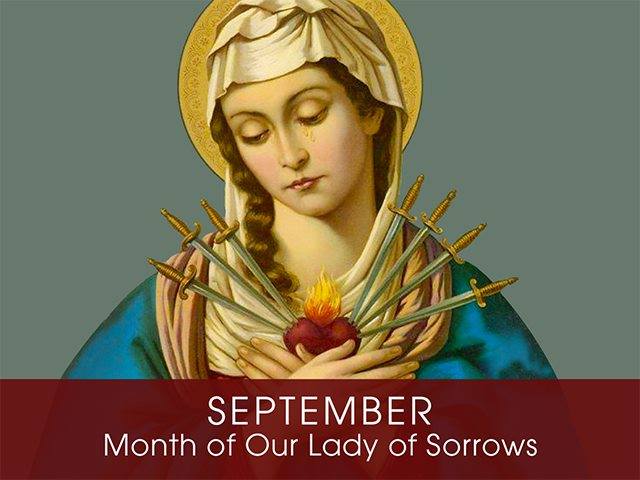
Ezechiel 34:12, 13, 14; John 10:10
I will visit my sheep, and will deliver them out of all the places
where they have been scattered in the cloudy and dark day.
and I will bring them to their own land,
– and I will feed them in the mountains of Israel, …and in the habitations of the land.
I am come that they may have life,
and may have it more abundantly.
– and I will feed them in the mountains of Israel, …and in the habitations of the land.
Monday of the Twenty-Fifth Week in Ordinary Time
Feria after Pentecost (Traditional)
Saint Finbarr, Bishop (Ireland)
Whoever belongs to any part of God’s people is instructed by King Cyrus to go up and help build the house of the LORD in Jerusalem. Jesus teaches us: “anyone who has will be given more” (Luke 8:16-18). The sign of belonging to God’s people is the lavish self-donation and generosity that we exhibit. By giving of ourselves, we make room to receive more of Christ.
ST. FINBARR, BISHOP
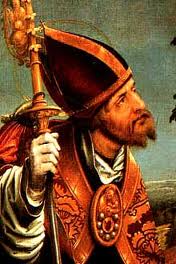
He was the son of an artisan and a lady of the Irish royal court. Born in Connaught, Ireland, and baptized Lochan, he was educated at, Kilmacahil, Kilkenny, where the monks named him Fionnbharr (white head) because of his light hair; he is also known as Bairre and Barr. He went on pilgrimage to Rome with some of the monks, visiting St. Dave in Wales on the way back. Supposedly, on another visit to Rome the Pope wanted to consecrate him a bishop but was deterred by a vision, notifying the pope that God had reserved that honour to Himself, and Finbar was consecrated from Heaven and then returned to Ireland. At any rate, he may have preached in Scotland, definitely did in southern Ireland, lived as a hermit on a small island at Lough Eiroe, and then, on the river Lee, founded a monastery that developed into the city of Cork, of which he was the first Bishop. His monastery became famous in southern Ireland and attracted numerous disciples. Many extravagant miracles are attributed to him, and supposedly, the sun did not set for two weeks after he died at Cloyne about the year 633. His feast day is September 25th.
From a sermon On Pastors by Saint Augustine, Bishop and Doctor of the Church
(Sermo 46, 14-15: CCL 41, 541-542)
Welcome or unwelcome, insist upon the message
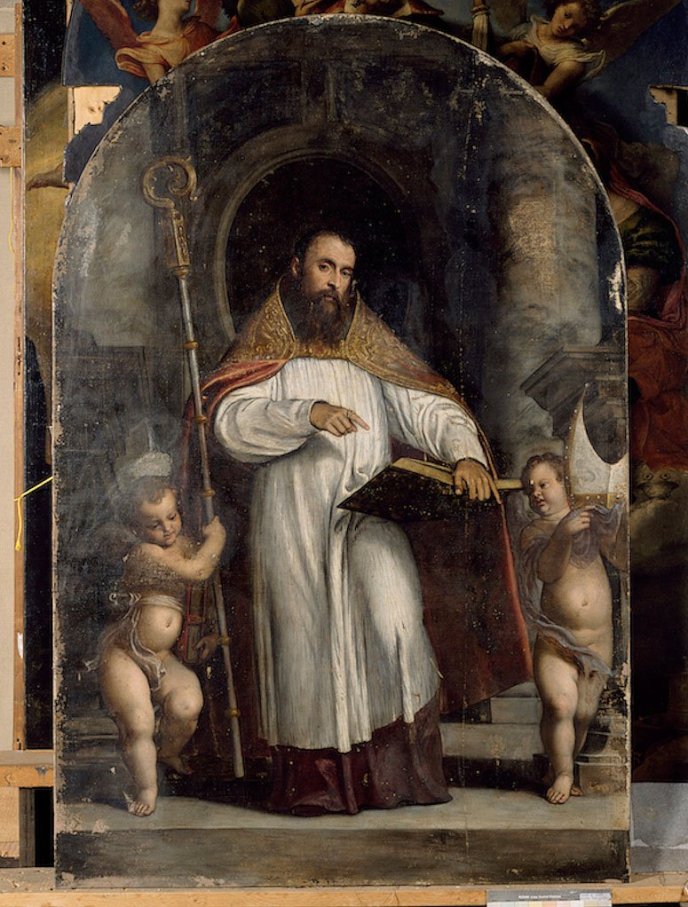
The straying sheep you have not recalled; the lost sheep you have not sought. In one way or another, we go on living between the hands of robbers and the teeth of raging wolves, and in light of these present dangers we ask your prayers. The sheep moreover are insolent. The shepherd seeks out the straying sheep, but because they have wandered away and are lost they say that they are not ours. “Why do you want us? Why do you seek us?” they ask, as if their straying and being lost were not the very reason for our wanting them and seeking them out. “If I am straying,” he says, “if I am lost, why do you want me?” You are straying, that is why I wish to recall you. You have been lost, I wish to find you. “But I wish to stray,” he says: “I wish to be lost.”
So you wish to stray and be lost? How much better that I do not also wish this. Certainly, I dare say, I am unwelcome. But I listen to the Apostle who says: Preach the word; insist upon it, welcome and unwelcome. Welcome to whom? Unwelcome to whom? By all means welcome to those who desire it; unwelcome to those who do not. However unwelcome, I dare to say: “You wish to stray, you wish to be lost; but I do not want this.” For the One whom I fear does not wish this. And should I wish it, consider His words of reproach: The straying sheep you have not recalled; the lost sheep you have not sought. Shall I fear you rather than Him? Remember, we must all present ourselves before the Judgement Seat of Christ.
I shall recall the straying; I shall seek the lost. Whether they wish it or not, I shall do it. And should the brambles of the forests tear at me when I seek them, I shall force myself through all straits; I shall put down all hedges. So far as the God whom I fear grants me the strength, I shall search everywhere. I shall recall the straying; I shall seek after those on the verge of being lost. If you do not want me to suffer, do not stray, do not become lost. It is enough that I lament your straying and loss. No, I fear that in neglecting you, I shall also kill what is strong. Consider the passage that follows: And what was strong you have destroyed. Should I neglect the straying and lost, the strong one will also take delight in straying and in being lost.
DAILY MEDITATION
Why should we love God? Because, first, He is God; that is to say, the Supreme Being, the necessary and Eternal Being, the Being, Who is Infinitely perfect, infinite Goodness and Beauty, Wisdom and Holiness in their essence; our Father, our All, to Whom belongs so essentially all the love of which our heart is capable, that God Himself could not dispense us from loving Him. Wherefore should we love God? It is because love is the means of becoming perfect. When we really love God, we have no other will than His; we only love what He loves, and only hate what He hates; we do all of that He commands, nothing that He forbids; and thus we accomplish the whole law. Wherefore love God? It is because we find all good things in this one sole good. We find therein the most perfect satisfaction of our soul and our mind, and there remains nothing to desire.“Give me thy love, my God,“ said, St. Ignatius, “and that suffices me.” We may do without all other knowledge; we cannot do without the knowledge of divine love. Possessed of the knowledge of all the sciences, we may yet be unhappy; with the love of God, we are always happy; and the most ignorant of men, who knows how to love God, is worth more than the wise one who does not love Him…. O God, how just it is to love Thee with all the love of our hearts!
We must avoid, as much as possible, even slight faults. Faults, however, slight they may be, cool the heart of God and our own heart, weaken love, diminish grace. Second, we must watch over our heart continually in order to hinder it from attaching itself to creatures. The love of God, and the love of creatures are incompatible things; it is for us to choose between these two loves.
Fr. Andre Jean M. Hamon (d. 1874] – French Sulpician professor of dogmatics and author of several spiritual and a historical Works.
Living in the Light
Yesterday Saint Paul lifted the veil a little and allowed me to gaze on the saints and with them to inherit the light (Col 1:12), that I might see what their occupation is and try, as far as possible, to conform my life to theirs…. Today, it is Saint John, the disciple whom Jesus loved (cf. Jn 13:23), who partially opens the Eternal Gates for me, that I may rest my soul in the heavenly Jerusalem, sweet vision of peace! First of all he tells me there are no lights in the city since it was lit by the radiant glory of God and the Lamb was a lighted torch for it (Rv 21:23). If I want my interior city to have some similarity and likeness to that of the Eternal King (1 Tm 1:17) and to receive this great illumination from God, I must extinguish every other light and, as in the holy city, the Lamb must be its only light. Here faith, the beautiful light of faith, appears. It alone should light my way as I go to meet the Bridegroom.
The Psalmist sings that he made the darkness his covering (cf. Ps 17:12). Then in another place he seems to contradict himself by saying that he is wrapped in light as in a robe (cf. Ps 103:2). What stands out for me in this apparent contradiction is that I must immerse myself in the sacred darkness by putting all my powers in darkness and emptiness; then I will meet my Master, and the light that surrounds him like a cloak will envelop me also, for He wants His bride to be luminous with His Light, His Light alone, which is the glory of God.
It was said of Moses that he held to his purpose like a man who could see the Invisible (cf. He 11:27). It seems to me that this should be the attitude of [one] who wishes to continue her hymn of thanksgiving through everything: unshakable in her Faith, as if she had seen the Invisible, unshakable in her faith in the God who loves us with so much love (cf. Ep 2:4). We ourselves have known and put our faith in God’s Love towards ourselves (1 Jn 4:16). Faith, Scripture says, can guarantee the blessings that we hope for, or prove the existence of the realities that at present remain unseen (He 11:1)…. It seems to me that to this soul, unshakable in its faith in the God of Love, may be addressed these words of the Prince of Apostles: you are already filled with a joy so glorious that it cannot be described, because you believe (1 P 1:8).
Saint Elizabeth of the Trinity
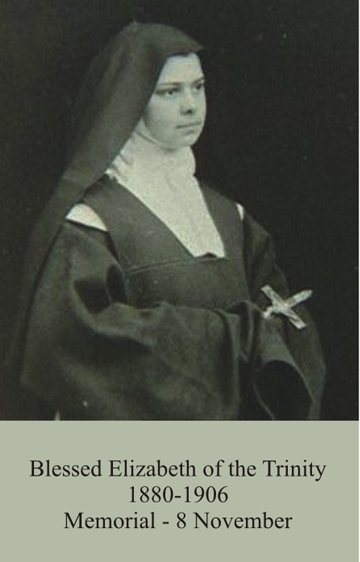
Saint Elizabeth of the Trinity († 1906) was a French Carmelite nun whose writings focused on the indwelling of the Trinity. She died from Addison’s disease at the age of twenty-six. [From I Have Found God: Complete Works, Volume I, General Introduction: Major Spiritual Writings, Sister Aletheia Kane, o.c.d., Tr. ©
“The refusal to take sides on great moral issues is itself a decision. It is a silent acquiescence to evil. The tragedy of our time is that those who still believe in honesty lack fire and conviction, while those who believe in dishonesty are full of passionate conviction.” – Ven. Archbishop Fulton Sheen
 Daily Reflections
Leave a comment