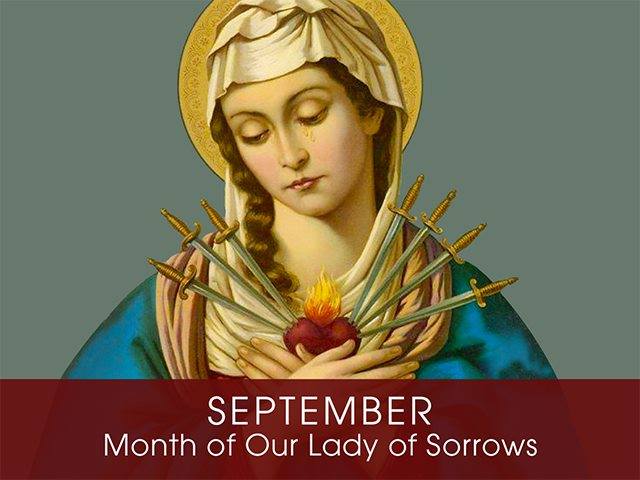
Ezechiel 37:12, 13, 5; John 11:25
Behold I will open your graves,
and will bring you out of your sepulchres, – And you shall know that I am the LORD.
I am the Resurrection and the Life:
he that believeth in me, although he be dead,
shall live.
– And you shall know that I am the LORD.
Wednesday of the Twenty-Fifth Week in Ordinary Time
Saint Vincent de Paul, Confessor
Saints Cosmas and Damian, Martyrs (Traditional)
ST. VINCENT DE PAUL, CONFESSOR
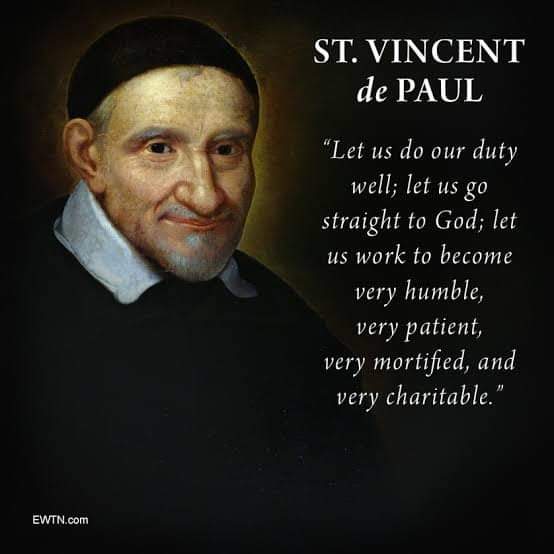
Born 24 April 1581 to a peasant family in Ranquine, Gascony near Dax, southwest France (now known as Saint-Vincent-de-Paul, Landes), a highly intelligent youth, VINCENT, spent four years with the Franciscan friars at Acq, France, receiving an education. He was tutor to children of gentlemen in Acq. He began divinity studies in 1596 at the University of Toulouse, and ordained at the age of 20.
Taken captive by Turkish pirates to Tunis, he was sold into slavery. He was freed in 1607 when he converted one of his owners to Christianity.
Returning to France, he served as parish priest near Paris where he started organizations to help the poor, nurse the sick, found jobs for the unemployed, etc. He was appointed chaplain at the court of Henry IV of France. With Louise de Marillac, they founded the Congregation of the Daughters of Charity. He instituted the Congregation of Priests of the Mission (Lazarists). He spent his life always labouring for the poor, the enslaved, the abandoned, the ignored, the pariahs.
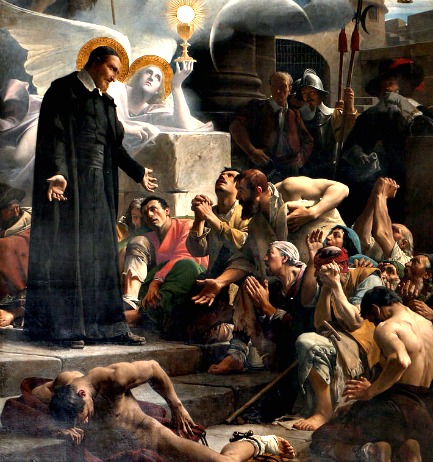
Through his many efforts, Vincent ministered to the whole spectrum of human need: the sick, prisoners, foundlings, prostitutes, slaves, beggars, and outcasts. He instructed his followers, “If a needy person requires medicine or other help during prayer time, do whatever has to be done with peace of mind. Offer the deed to God as your prayer.” Vincent died in 1660. He is the universal patron of all works of charity.
He died on 27 September 1660 in Paris, of natural causes, and is venerated in a chapel on the Rue de Sèvres.
SAINTS COSMAS AND DAMIAN, MARTYRS
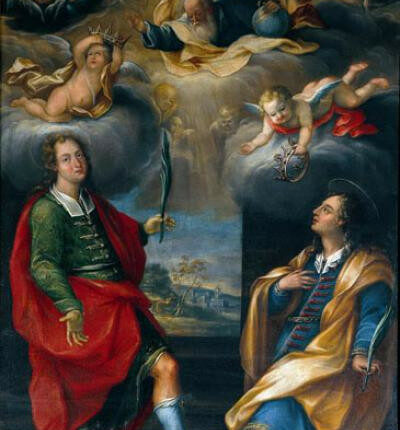
Cosmas and Damian, born in Egæa (Arabia) said to have been brothers and physicians, were martyred in the Diocletian persecutions of the late 3rd and early 4th centuries. Since ancient times they have been widely venerated in both the East and the West. The magnificent murals of the church that Pope Felix VI dedicated to them are still to be seen in Rome. In Florence, the great early Renaissance artist Fra Angelico painted a series of altarpiece panels (now in several museums) featuring the saints in their traditional roles as doctors who provided for their patients free of charge, and as stalwart martyrs who were beheaded after all manner of tortures in Cilicia, under Diocletian, by order of prefect Lysias in 283, for the love of Christ.
All for the Kingdom
Christ said: If anyone wants to be a follower of mine, let him renounce himself and take up his cross and follow me and Saint Paul added, in the same vein: If you do live in that [unspiritual] way, you are doomed to die; but if by the Spirit you put an end to the misdeeds of the body you will live.. Each one, therefore, should be most conscientious in accepting the overruling of his personal wishes and opinion, and in disciplining the gratification of each of his senses…. Each one should show a great eagerness in that sort of openness to God’s Will which Christ and the saints developed so carefully. This means that we should not have a disproportionate liking for any ministry, person, or place, especially our native land, or for anything of that sort….
Our LORD came into the world to reestablish the reign of His Father in all persons. He won them back from the devil who had led them astray by the cunning deceit of a greedy desire for wealth, honour, and pleasure. Our loving Saviour thought it right to fight His enemy with the opposite weapons, poverty, chastity, and obedience, which he continued to do right up to His death. The little Congregation of the Mission came into existence in the Church to work for the salvation of people, especially the rural poor. This is why it has judged that no weapons would be more powerful or more suitable than those which Eternal Wisdom so tellingly and effectively used…. Christ Himself, the LORD of all, lived in poverty to such an extent that He had nowhere to lay his head. He formed His apostles and disciples, His co-workers in His mission, to live in the same sort of way so that individually they did not own anything. In that way they were freer to combat greed for wealth in a better and more practical way, a greed which is ruining almost the whole world. That is why each confrere must try, weak as he is, to imitate Christ in developing this virtue of poverty. We must all realise that it is the unbreachable rampart by which the Congregation, with the help of God’s grace, will be defended.
Saint Vincent de Paul
Saint Vincent de Paul († 1660) founded the Congregation of the Mission, known as the Vincentians, and devoted his priestly life to alleviating human suffering and caring for the poor. [From Vincent de Paul and Louise de Marillac: Rules, Conferences and Writings. Edited by Francis Ryan, d.c., and John E. Rybolt, c.m.; introduced by Hugh F. O’Donnell, c.m., Frances Ryan, d.c., Louise Sullivan, d.c., Vie Thorgren and Edward R. Udovic, c.m. ©
DAILY MEDITATION
Our Blessed LORD began His public life on the Mount of the Beatitudes, by preaching: “Blessed are the meek, for they shall possess the land“ [Matthew 5:4]. He finished His public life on the Hill of Calvary, by practising that meekness:“Father, forgive them, for they know not what they do“ (Luke 23:34].
How different this is from the beatitude of the world! The world blesses not the meek, but the vindictive; it praises not the one who turns the other cheek, but the one who renders evil for evil; it exalts not the humble, but the aggressive. Communism has carried that spirit of violence, class struggle, and the clenched fist to an extreme, the likes of which the world has never seen. To correct such a warlike attitude of the clenched fist, Our LORD both preached and practised meekness.
When they swore to kill Him, He did not use His power to strike dead even a single enemy; and now on the Cross, meekness reaches its peak, when to those who dig the hands that feed the world, and to those who pierce the feet that shepherd souls, He pleads: “Father, forgive them, for they know not what they do.”
Which is right – the violence of Communism, or the meekness of Christ? Communism says meekness is weakness. But that is because it does not understand the meaning of Christian meekness…. The meek man is not a man who refuses to fight, nor is he a man who will never become angry. A meek man is a man who will never do one thing: he will never fight when his conceit is attacked, but only when a principal is at stake. And there is the keynote to the difference between the anger of the Communist and the anger of the meek man.
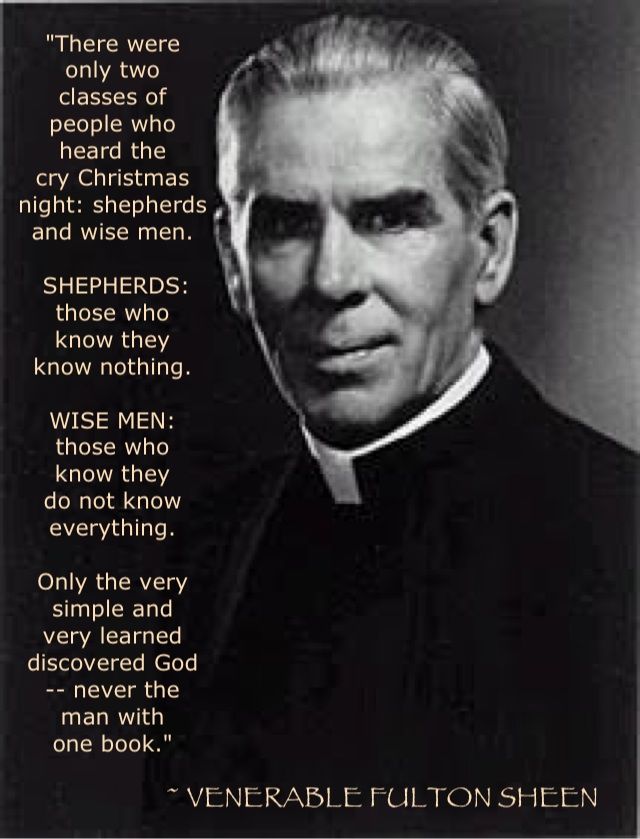
Archbishop Fulton J. Sheen [d. 1979] – American archbishop, author, and widely known television and radio program host
“The refusal to take sides on great moral issues is itself a decision. It is a silent acquiescence to evil. The tragedy of our time is that those who still believe in honesty lack fire and conviction, while those who believe in dishonesty are full of passionate conviction.” – Ven. Archbishop Fulton Sheen
 Daily Reflections
Leave a comment