Ezechiel 37:21, 22; John 10:16, 11
I will take the children of Israel
and I gather them on every side,
And I will make them one nation,
– and there shall be one fold and one shepherd.
The good shepherd giveth his life for his sheep.
– And there shall be one fold and one shepherd.
Thursday of the Twenty-Fifth Week in Ordinary Time
Saint Wenceslaus, Duke, Martyr
Saint Lawrence Ruiz and Companions, Martyrs
SAINT WENCESLAUS, DUKE, MARTYR

Saint Wenceslaus was born in 907 at Prague, Bohemia (Czech Republic). Wenceslaus’ father Duke Vratislav I and his grandmother Ludmila were among the first Catholics of Bohemia to have been converted by Saints Cyril and Methodius, and Drahomira, his mother, daughter of a pagan chief. She was baptized on her wedding day, but who apparently never seriously took to the faith. In addition to being the grandson he was also a student of Saint Ludmilla. He became the Duke of Bohemia, when his father was killed during a pagan backlash against Christianity, which he fought against with prayer and patience. In the midst of these family intrigues, Wenceslaus’ “gaze never moved from Jesus Christ” (Pope Benedict XVI). He pursued peace among his people, justice for the oppressed, and supported the growth of the Church. Upon his father’s death, Wenceslaus’ mother had Ludmila murdered, and kindled the animosity of his brother Boleslaus towards Wenceslaus. Murdered by Boleslaus and his associates at the door of a church for political reasons, he is listed as a martyr since the politics arose from his Faith.When run through by the sword, he responded, “Brother, may God forgive you.”
Miracles were soon reported at his tomb. Martyred on 28 September, 938, at Brandýs nad Labem-Stará Boleslav, Bohemia (Czech Republic).
Wenceslaus was in the habit of sowing and reaping with his own hands the wheat from which the hosts were to be made, and he used to rise in the night, even during the coldest seasons, to visit the Blessed Sacrament.
His devotion to the Holy Eucharist is mentioned by Saint Alphonsus in his book, Visits to the Blessed Sacrament.
ST. LAWRENCE RUIZ AND HIS COMPANIONS, MARTYRS

Born c.1600 at Binondo, Manila, Philippines, to a Chinese father and Filipino mother, both Christians, LORENZO learned Chinese and Tagalog at home, Spanish from the Dominicans whom he served as altar boy and sacristan. A professional calligrapher and document transcriptionist, he was a member of the Confraternity of the Holy Rosary. Married layman, he was the father of two sons and a daughter.
For unclear reasons, Lorenzo was accused of murder. He sought asylum on board a ship with three Dominican priests, Saint Antonio Gonzalez, Saint Guillermo Courtet, and Saint Miguel de Aozaraza, a Japanese priest, Saint Vicente Shiwozuka de la Cruz, and a layman named Saint Lazaro of Kyoto, a leper. Only when they were at sea did he learn that they were going to Japan during a time of intense Christian persecution.
Lorenzo could have gone to Formosa (modern Taiwan), but feared the Spaniards there would hang him, and so stayed with the missionaries as they landed at Okinawa. The group was soon exposed as Christian, arrested, and taken to Nagasaki, Japan. They were tortured in several ways for days. Lorenzo and the Japanese priest broke at one point, and were ready to renounce their faith in exchange for release, but after their moment of crisis, they reclaimed their faith and defied their tormentors. They died 29-30 September 1637 at Nagasaki, Japan by being crushed over a period of three days while hanging upside-down. Lawrence’s body was burned and his ashes thrown into the Pacific Ocean. He is the first Filipino martyr to be canonized.
From a homily of Saint John Paul II, Pope
(Homily in Manila at the Mass of beatification of the Venerable Servant of God Lawrence Ruiz and companions: AAS 73 [1981], 340-342)
In shedding their blood they offered God the greatest act of worship and love
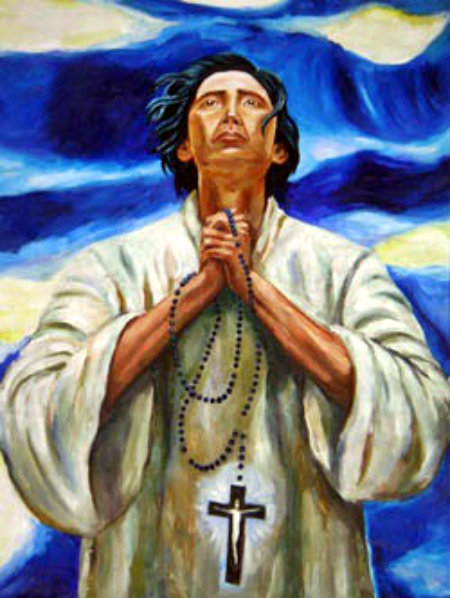
According to His Gospel promise, Christ truly acknowledges, in the presence of His Father in Heaven, those faithful martyrs who acknowledged Him before men and women.
The hymn of glory to God which has just been sung by numberless voices is an echo of the Te Deum sung in the Church of Santo Domingo on the evening of 27 December 1637, when the news arrived of the martyrdom at Nagasaki of a group of six Christians. Among them were the head of the mission, Father Antonio Gonzales, a Spanish Dominican from Leon, and Lawrence Ruiz, a married man with a family, born in Manila “extra muros,” in the suburb of Binondo.
These witnesses had also in their turn sung Psalms to the LORD of mercy and power, while they were in prison and when they were put to death, a martyrdom that lasted three days. Faith conquers the world. The preaching of this faith enlightens like the sun all who wish to attain the knowledge of Truth. For, although there are different languages in the world, the Christian Tradition remains one and the same.
The LORD Jesus by His Blood truly redeemed His servants, gathered from every race, tongue, people, and nation, to make them a royal priesthood for our God.
The sixteen blessed martyrs, by the exercise of their priesthood—that of baptism or of holy orders—performed the greatest act of worship and love of God by the shedding of their blood, united with Christ’s sacrifice of the Cross. In this way they imitated Christ the Priest and Victim in the most perfect way possible to human creatures. It was at the same time an act of the greatest possible love for their brothers and sisters, for whose sake we too are all called to sacrifice ourselves, following the example of the Son of God who sacrificed hHimself for us.
This is what Lawrence Ruiz did. Guided by the Holy Spirit to an unexpected goal after an adventurous journey, he told the judges that he was a Christian, and must die for God: “Had I a thousand lives I would gladly offer them all for Him. Never shall I apostatize. You may kill me, if that is what you want. To die for God—such is my will.”
Here we have a summary of his life; here we have a description of his Faith and the reason for his death. It was at this moment that this young father of a family professed and brought to completion the Christian catechesis that he had received in the Dominican Friars’ school in Binondo: a catechesis that has its sole centre in Christ, for Christ is its object, and it is Christ who teaches through the lips of His messenger.
The example of Lawrence Ruiz, the son of a Chinese father and Tagala mother, reminds us that everyone’s life and the whole of one’s life must be Christ-directed. For this is what it means to be a Christian: to offer oneself daily in response to the gift of Christ, who came into the world so that all might have life and have it to the full.
How We Can See the Risen One

My beloved parents, brothers, and sisters: Before throwing myself into the arms of the just and merciful God, I want to embrace you all once more here on earth. Forgive me for the weight of sorrow that I must inflict upon you and please do not weep and lament for me, for I am going to the Father, to God, who made my youth so joyful. For twenty-two months I have been cut off from the whole world, and at last I can say: Indeed the snare has been broken and we have escaped (Ps 123:7).
My beloved Mother! I owe everything to you, everything that has been great and beautiful in my life. Now this sorrow. I have felt you close to me all day long. O Mother, how greatly blessed we have been, and how happy too, despite many tribulations. Now let us accept whatever burden our Father lays upon us, the Cross of His beloved Son: If anyone wants to be a follower of mine, let him renounce himself and take up his cross and follow Me. I want to try to do that now, for the most efficacious thing in the world is suffering. Farewell until we meet again there where all tears dry up, until we meet again in the Presence of our heavenly Father. Mary, who stood beneath the Cross of her Son, is standing at my side, helping me in my weakness.
My dear ones all! I spread my hands wide over all of you and in my priestly function I send you my priestly blessing: “In the name of the Father and of the Son and of the Holy Ghost. Amen.” In my blessing in this house I include all of you, together with our holy Church and my beloved fatherland, that peace, blessing, and happiness may reign everywhere. How happy I was when I was told, “Now we are going into the house of the LORD!” Farewell, until we meet again in God.
With heartfelt love for you all. Your son and brother, Herbert.
Father Herbert Simoleit
Father Herbert Simoleit († 1944) was a German priest who was killed by the Nazis for his outspoken resistance. [From Dying We Live: The Final Messages and Records of the Resistance, Helmut Gollwitzer, Käthe Kuhn, Reinhold Schneider, Eds., Reinhard C. Kuhn, Tr. Translation copyright ©
DAILY MEDITATION
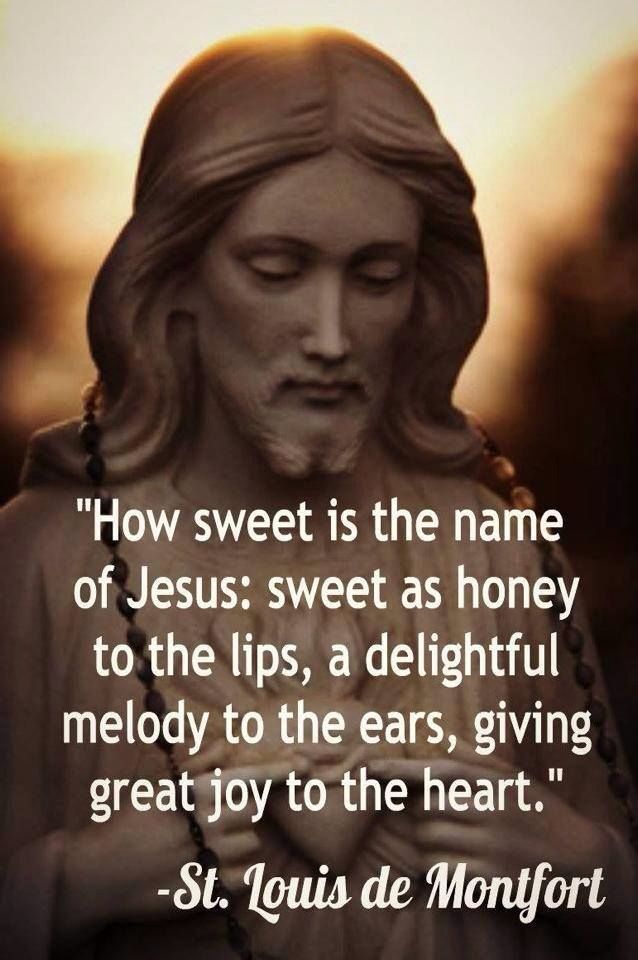
In order to draw closer to men and give them a more convincing proof of His love, Eternal Wisdom went so far as to become man, even to become a little child, to embrace poverty, and to die upon a Cross for them…. Eternal Wisdom, on the one hand, wished to prove His love for man by dying in His place in order to save him; but, on the other hand, He could not bear the thought of leaving him. So He devised a marvellous way of dying and living at the same time, and of abiding with man until the end of time. So, in order fully to satisfy His love, He instituted the Sacrament of the Holy Eucharist and went to the extent of changing and overturning nature itself.
He does not conceal himself under a sparkling diamond, or some other precious stone, because He does not want to abide with men in an ostentatious manner. But He hides himself under the appearance of a small piece of bread – man’s ordinary nourishment – so that, when received, He might enter the heart of man, and there take His delight. Ardenter amantium hoc est – Those who love ardently act in this way. “O, eternal Wisdom,” says a saint, “O God, Who is truly lavish with Himself in His desire to be with man”…..
Above all else, let us seek and long for divine Wisdom. “All of the things that are desired, are not to be compared with Wisdom“ [see Proverbs 3:15). And again, “ Nothing that you desire can be compared with Him“ [Proverbs 8:11). You may desire the gifts of God and even heavenly treasures, but if you do not desire Wisdom, you desire always something far less worth.
If only we could realize what Wisdom actually is, i.e., an infinite Treasure made for man – and I must confess that what I have said about Him really amounts to nothing at all – we would be longing for Him night and day. We would fly as fast as we could to the ends of the earth, we would cheerfully endure fire and sword, if need be, to merit this Infinite Treasure.
St. Louis Marie Grignion de Montfort [d.1716] – French priest, Missionary Apostolic, and zealous promoter of Marian devotion and consecration.
RESPONSORY
These holy men and women poured out their blood for the LORD;
they loved Christ in life; they followed Him in His Death.
– They have won the Glorious Crown.
They shared the One Spirit;
they held fast to One Faith.
– They have won the Glorious Crown.
“The refusal to take sides on great moral issues is itself a decision. It is a silent acquiescence to evil. The tragedy of our time is that those who still believe in honesty lack fire and conviction, while those who believe in dishonesty are full of passionate conviction.” – Ven. Archbishop Fulton Sheen
 Daily Reflections
Leave a comment