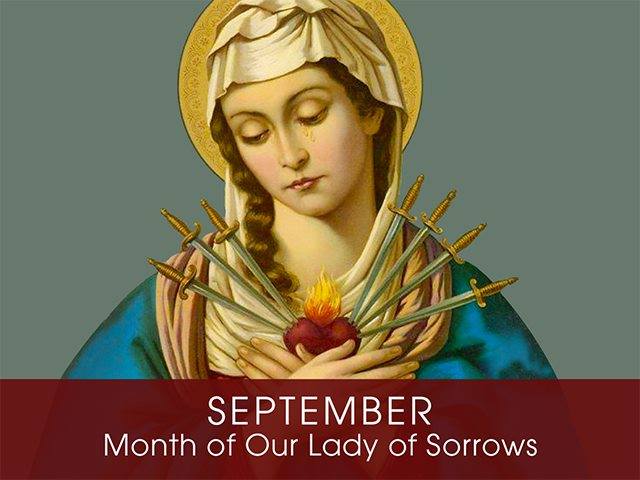
SATURDAY OF THE BLESSED VIRGIN MARY
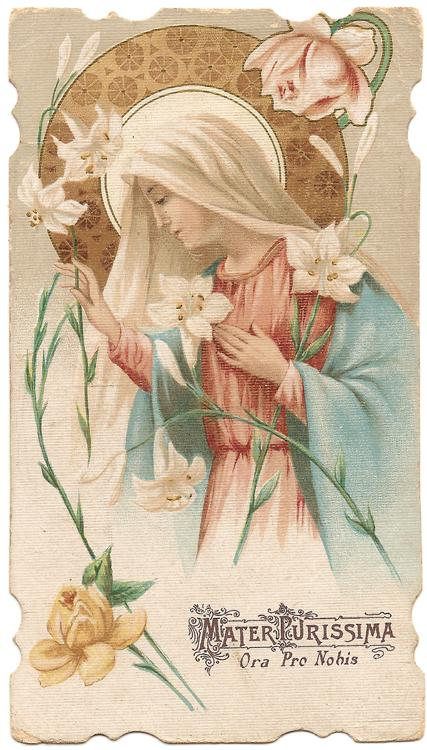
“Look, My daughter, at My Heart, surrounded with thorns with which ungrateful men pierce Me at every moment by their blasphemies and ingratitude. Do you, at least, try to console Me and announce in My name that I promise to assist at the moment of death, with all the graces necessary for salvation, all those who, on the first Saturday of five consecutive months shall confess, receive Holy Communion, recite five decades of the Rosary, and keep Me company for fifteen minutes while meditating on the fifteen mysteries of the Rosary, with the intention of making reparation to Me.”
(Revelation of Our Lady of Fatima to Sr. Lucia)
Ezechiel 47:1, 9; John 4:14
And behold waters issued out from under the threshold of the house toward the east.
– And all things shall live to which the torrent shall come.
But the water I shall give him, shall become in him a fountain of water springing up into life everlasting .
– And all things shall live to which the torrent shall come.
Saturday of the Twenty-Fifth Week in Ordinary Time
Saint Jerome, Priest, Doctor of the Church
SAINT JEROME, PRIEST, DOCTOR OF THE CHURCH
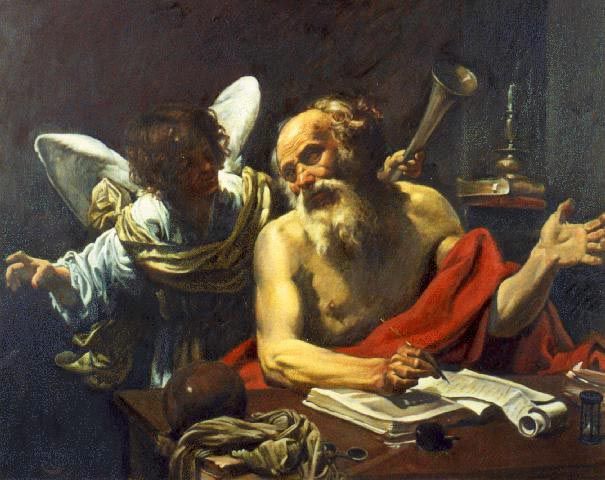
In paintings, Jerome sometimes holds a large rock, a symbol of mortification. Saint Jérôme, born in Dalmatia in 329, born to a rich pagan family, educated at Rome, was soon led into the gravest disorders. Inspired by Heaven, he was converted and was baptised in 365 after receiving a fine education in the classics in Rome. He moved from Rome to different places before finally settling in a cave in Bethlehem, out of an intense devotion to Christ’s life. He studied Hebrew in penance for temptations. The greatest fruit of his lifelong study and writing was the Vulgate, the popular Latin translation of the Bible commissioned by Pope Damasus I. “Ignorance of Scripture is ignorance of Christ”, wrote Jerome. He died in 420 and is one of the four great Latin Fathers of the Church.

Even during his life, he was renowned as a doctor and interpreter of holy scripture. He defended Catholic teaching against many heresies; his chief aim was to be a perfect monk and lived for years as a hermit in the Syrian deserts. He was reported to have drawn a thorn from a lion‘s paw; the animal stayed loyally at his side for years. Before he would consent to be raised to the priesthood, he exacted a promise from Paulinus, Bishop of Antioch, that this new dignity should in no wise interfere with his monastic vocation.
He was a student of Saint Gregory of Nazianzen and Secretary to Pope Damasus I who commissioned him to revise the Latin text of the Bible. The result of his 30 years of work was the Vulgate translation, which is still in use. Friend and teacher of Saint Paula, Saint Marcella, and Saint Eustochium, an association that led to so much gossip that Jerome left Rome to return to the desert solitude. He lived his last 34 years in the Holy Land as a semi-recluse. Wrote translations of histories, biographies, the works of Origen, and much more. Doctor of the Church, Father of the Church. Since his own time, he has been associated in the popular mind with scrolls, writing, cataloging, translating, which led to those who work in such fields taking him as their patron — a man who knew their lives and problems.
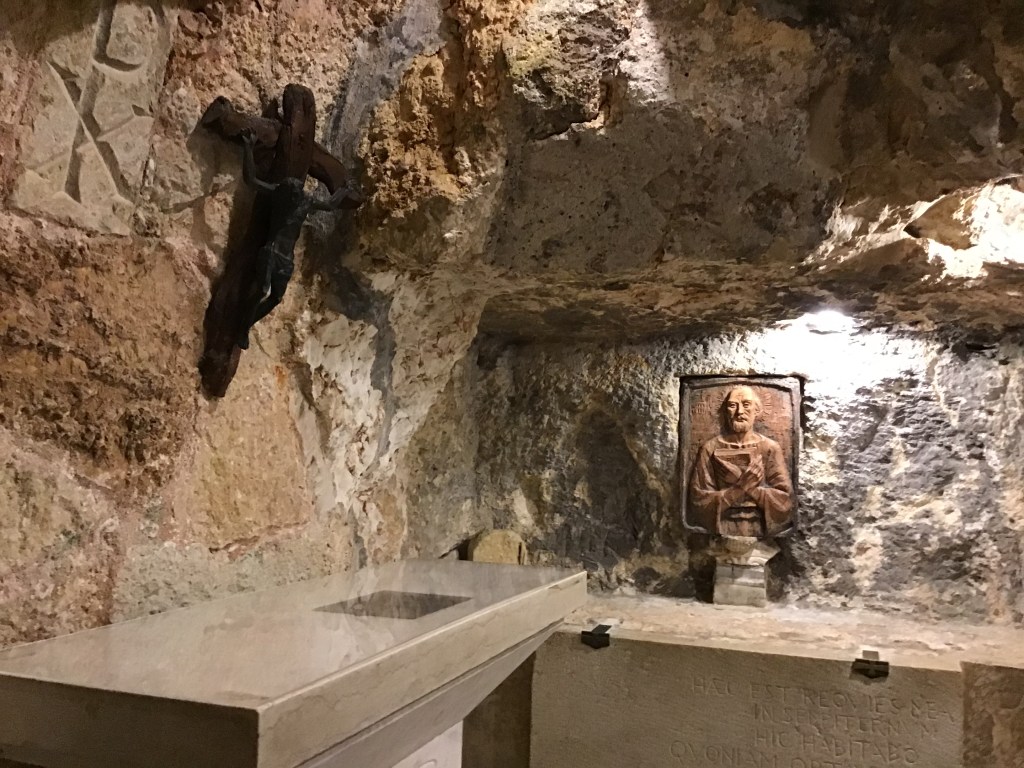
To him we owe the translation of Holy Scriptures, the introduction of Alleluia chant into the Sunday mass, the spread of monastic life among the aristocracy, and lastly, the daily recital of the Divine Office. After important services to the pope of his time, Saint Jerome retired to Bethlehem, where he died September 30, 420. His relics are kept at the Basilica of Saint Mary Major in Rome, Italy.
From the prologue of the commentary on Isaiah by Saint Jerome, Priest and Doctor of the Church
(Nn. 1-2; CCL 73, 1-3)
Ignorance of Scripture is ignorance of Christ
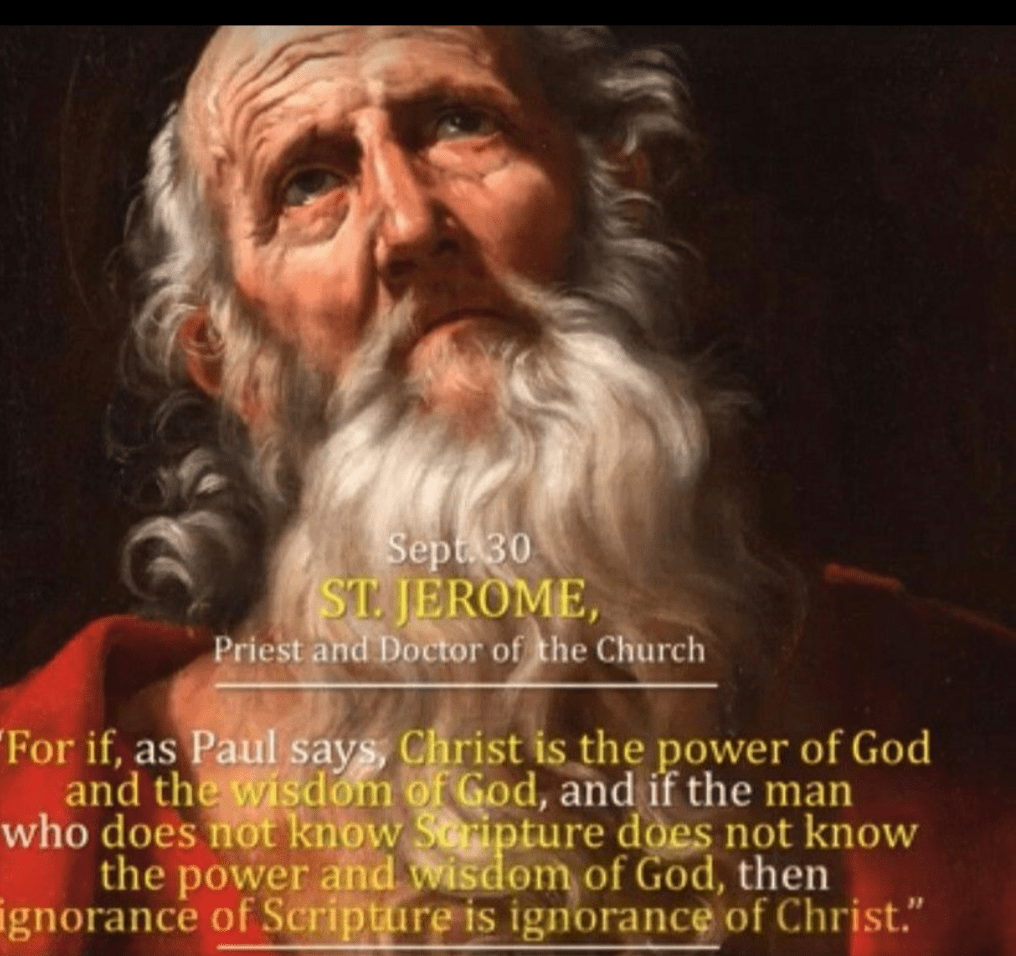
I interpret as I should, following the command of Christ: Search the Scriptures, and Seek and you shall find. Christ will not say to me what He said to the Jews: You erred, not knowing the Scriptures and not knowing the power of God. For if, as Paul says, Christ is the Power of God and the Wisdom of God, and if the man who does not know Scripture does not know the power and wisdom of God, then ignorance of Scripture is ignorance of Christ.
Therefore, I will imitate the head of a household who brings out of his storehouse things both new and old, and says to his spouse in the Song of Songs: I have kept for you things new and old, my beloved. In this way permit me to explain Isaiah, showing that he was not only a prophet, but an evangelist and an Apostle as well. For he says about himself and the other evangelists: How beautiful are the feet of those who preach good news, of those who announce peace. And God speaks to him as if he were an Apostle: Whom shall I send, who will go to My people? And he answers: Here I am; send me.
No one should think that I mean to explain the entire subject matter of this great book of Scripture in one brief sermon, since it contains all the mysteries of the LORD. It prophesies that Emmanuel is to be born of a virgin and accomplish marvellous works and signs. It predicts His Death, burial and Resurrection from the dead as the Saviour of all men. I need say nothing about the natural sciences, ethics and logic. Whatever is proper to Holy Scripture, whatever can be expressed in human language and understood by the human mind, is contained in the book of Isaiah. Of these mysteries the author himself testifies when he writes: You shall be given a vision of all things, like words in a sealed scroll. When they give the writings to a wise man, they will say: Read this. And he will reply: I cannot, for it is sealed. And when the scroll is given to an uneducated man and he is told: Read this, he will reply: I do not know how to read.
Should this argument appear weak to anyone, let him listen to the Apostle: Let two or three prophets speak, and let others interpret; if, however, a revelation should come to one of those who are seated there, let the first one be quiet. How can they be silent, since it depends on the Spirit who speaks through His prophets whether they remain silent or speak? If they understood what they were saying, all things would be full of wisdom and knowledge. But it was not the air vibrating with the human voice that reached their ears, but rather it was God speaking within the soul of the prophets, just as another prophet says: It is an angel who spoke in me and again, and I shall listen to what the LORD God says within me.
DAILY MEDITATION
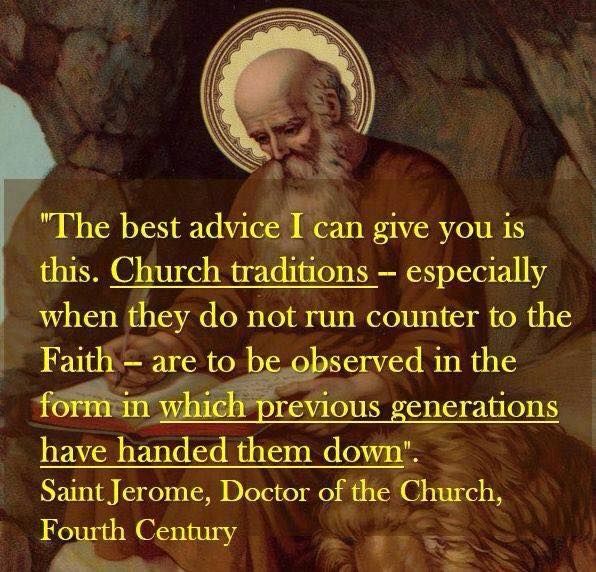
In the Gospel, the LORD says, “The lamp of the body is the eye: if therefore your eye be single, your whole body shall be full of light” (Mt. 6:22]. For when the bishop preaches the true Faith, the darkness is scattered from the hearts of all. “Neither do men light a lamp, and put it under the bushel, but on the stand; and shines unto all that are in the house“ [Matthew 5:15]. That is, God’s motive for lighting the fire of His knowledge in the bishop is that he may not shine for himself only, but for the common benefit. And then the next sentence: “if,” says He, “your eye be evil, your whole body shall be full of darkness. If therefore the light that is in you be darkness, how great is the darkness!” [Matthew 6:23]. And rightly; for since the bishop is appointed in the Church that he may restrain the people from error, how great will the error of the people be when he himself who teaches them errs?
Saint Jerome [d. 420] – Theologian and translator of scripture, Author of the Latin Vulgate, and one of the Four Great Doctors of the Church.
Understanding the LORD’s Death and Resurrection

I have not the power to bring forth in words what I conceive in my mind, nor does my tongue give full expression to the joy that is in my heart. To me, it seems that this day is brighter beyond all other days. A brighter sun has begun to shine upon the world. The stars, too, and all the elements rejoice, and those that had withdrawn their proper light during the LORD’s Passion and had fled, refusing to look upon their Creator Crucified, now fulfil their appointed duty and are in attendance upon Him, the Victor, as He rises from the dead…. This day was made by the LORD; we rejoice and are glad (Ps 117:24). Just as the Virgin Mary, the Mother of the LORD, holds the first place among all women, even so, this day is the mother of days among all days….
We say: They are happy whose life is blameless, who follow God’s law (Ps 118:1), and again: I have chosen the Way of Truth (Ps 118:30); Make me grasp the way of your precepts (Ps 118:27). They crowned the LORD with thorns; but we, as precious stones, shall become the crown of Our LORD. A diadem adorns the head of the emperor of this world; we are set upon the head of our King so that the Head may adorn us…. Let us sing together in one harmonious voice: This day was made by the LORD; we rejoice and are glad. Today, Christ, with the thief, has removed the flaming sword and reopened the Gate of Paradise that no one has been able to storm. Today, He has said to the angels: Open to Me the Gates of Holiness: I will enter and give thanks (Ps 117:19). Once this gate has been opened, it is never again closed to those who believe. From the time that Our LORD suffered His Passion down to the present day, this Gate has been closed and been opened; closed to sinners and unbelievers, opened to the just and to believers. Through this Gate, Peter entered, and Paul, and all the saints and martyrs; through this Gate daily the souls of the just enter from every part of the world. There are two gates: the Gate of Paradise and the Gate of the Church. Through the Gate of the one, we enter the Gate of the other. We must conduct our lives in such a way that we may never be driven out of this house and cast forth to be devoured by beasts, as the prophet cries out in dread: Do not give Israel, your dove, to the hawk (Ps 73:19). Behold, Our LORD is standing at the Gate of Paradise; He is saying to us who are gathered here together in His House: This is the LORD‘s own Gate where the just may enter (Ps 117:20). Every saint enters by this Gate, no matter how much the devil tries to prevent him.
Saint Jerome
Saint Jerome († 420) was a hermit, papal secretary, and Scripture scholar. The above text comes from a homily on Easter Sunday. [From The Homilies of Saint Jerome, Vol. 2 (Homilies 60-96), The Fathers of the Church, Volume 57, Sister Marie Liguori Ewald, i.h.m., Tr. ©
“The refusal to take sides on great moral issues is itself a decision. It is a silent acquiescence to evil. The tragedy of our time is that those who still believe in honesty lack fire and conviction, while those who believe in dishonesty are full of passionate conviction.” – Ven. Archbishop Fulton Sheen
 Daily Reflections
Leave a comment