FIRST FRIDAY OF THE MONTH
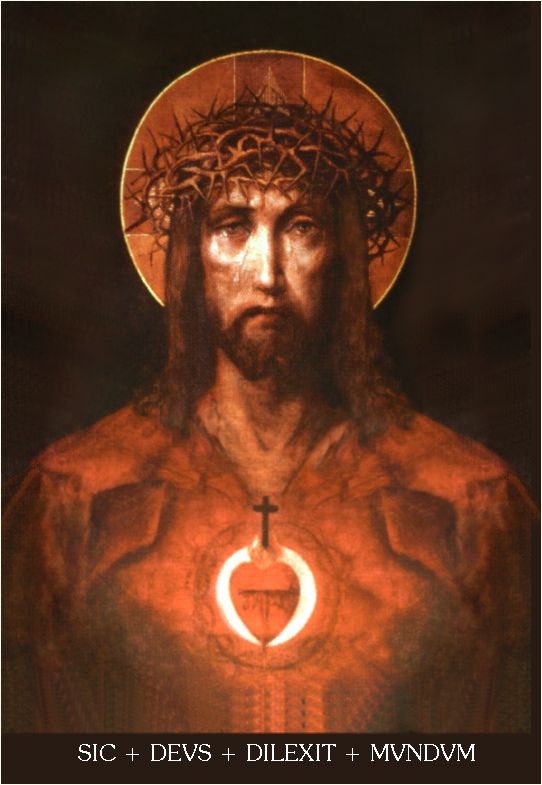
Our LORD appeared to Saint Margaret Mary Alacoque in 1673, promising great favours to all those who practised devotion to His Sacred Heart, and especially the Nine Holy Communions.
(1) “I will give them all the graces necessary in their state of life.
(2) I will establish peace in their homes.
(3) I will comfort them in all their afflictions.
(4) I will be their secure refuge during life, and above all, in death.
(5) I will bestow abundant blessings upon all their undertakings.
(6) Sinners will find in My Heart the source and infinite ocean of mercy.
(7) Lukewarm souls shall become fervent.
(8) Fervent souls shall quickly mount to high perfection.
(9) I will bless every place in which an image of My Heart is exposed and honoured.
10) I will give to priests the gift of touching the most hardened hearts.
(11) Those who shall promote this devotion shall have their names written in My Heart.
(12) I promise you in the excessive mercy of My Heart that My All-powerful love will grant to all those who receive Holy Communion on the First Fridays in nine consecutive months the grace of final perseverance; they shall not die in My disgrace, nor without receiving their Sacraments. My divine Heart shall be their safe refuge in this last moment.”
HOW TO COMPLETE THE NINE FIRST FRIDAYS:
On the first Friday of nine consecutive months, receive holy communion with the intention of honouring and making reparation for the offences against the Sacred Heart of Jesus.
Ephesians 4:17; 1 Thessalonians 5:15-18
This then I say and testify in the LORD: That henceforward you walk not as also the Gentiles walk in the vanity of their mind; See that none render evil for evil to any man: but ever follow that which is good towards each other and towards all men. – In all things give thanks for this is the Will of God in Christ Jesus concerning you all.
Always rejoice. Pray without ceasing. – In all things give thanks for this is the Will of God in Christ Jesus concerning you all.
Friday of the Twenty-Sixth Week in Ordinary Time
First Friday of the Month
Saint Bruno, Confessor
Blessed Marie Rose Durocher, Virgin
SAINT BRUNO, CONFESSOR
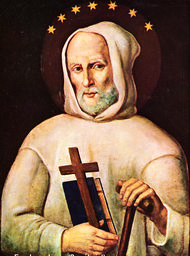
Saint Bruno, born of an illustrious family at Cologne in A.D 1030. After brilliant studies at Paris, was made a canon of Cologne and then of Rheims Cathedral. On the death of the bishop the see fell for a time into evil hands, feeling himself called to a life of retirement and penance, betook himself with six of his friends to one of the desert mountains of Dauphiny, called the Chartreuse, in the south east of France. There he established the first house with the Order of the Carthusians. They lived in poverty, self-denial, and silence, each apart in his own cell, meeting only for the worship of God, and employing themselves in copying books.

Six years later, Urban II called Bruno to Rome, that he might avail himself of his guidance. Bruno tried to live there as he had lived in the desert, but the echoes of the great city disturbed his solitude, and, after refusing high dignities, he wrung from the Pope permission to resume his monastic life in Calabria. There he passed the rest of his life in a most desolate cave, in humility and mortification and great peace, until his blessed death in 1101. Upon Bruno’s death in 1101, he was eulogised by his brethren: “His face was always joyful, and he was modest of tongue; he led with the authority of a father and the tenderness of a mother. No one found him too proud, but gentle like a lamb.”
BLESSED ROSE MARIE DUROCHER, VIRGIN
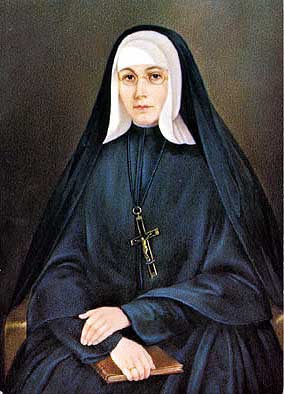
Blessed Marie-Rose was born Eulalie Mélanie in Saint-Antoine-sur-Richelieu, Quebec, on 6 October 1811. The tenth of eleven children born to a prosperous farming family. Home-schooled by her grandfather Olivier Durocher until the age of 10, she became pupil at a convent run by the Congregation of Notre Dame in Saint-Denis-sur-Richelieu.
In 1827, aged 16, Durocher entered the boarding school of the Congregation of Notre Dame in Montreal in 1827, where she intended to enter the novitiate as her sister Séraphine had earlier done, but her health proved to be too precarious. Upon the death of her mother, she assumed the role as homemaker. In 1831, her brother Theophile, curate of Saint-Mathieu Parish in Belœil, persuaded his father and her to move from the family farm to the rectory of his parish. Here, she worked as housekeeper and secretary to her brother. She became aware of the severe shortage of schools and teachers in the surrounding countryside and discussed with her family and acquaintances the need for a religious community specifically dedicated to the education of children both rich and poor.
In 1841, Louis-Moïse Brassard, parish priest of Longueuil, entered discussions with Charles-Joseph-Eugène de Mazenod, Bishop of Marseilles, France, for the establishment of a mission to Quebec by a French religious congregation known as the Sœurs des Saints-Noms de Jésus et de Marie (Sisters of the Holy Names of Jesus and Mary). Rose Marie learned of the proposed mission and along with her friend Mélodie Dufresne, she applied to join the novitiate of the new congregation upon its arrival in Canada. However, the mission ultimately did not go ahead, and Mazenod instead advised Ignace Bourget, Bishop of Montreal to establish a similar congregation in Canada, based upon the two women who had been eager to be part of the French group. In 1841, a mission of the Oblate Fathers arrived in Montreal, and in August 1842 opened a church at Longueuil. Among the Oblates was Father Pierre-Adrien Telmon, who traveled to Belœil to conduct popular missions, where he met Marie Rose and became her spiritual director. On 6 October 1843, she traveled to Longueuil to witness her brother Eusèbe profess his religious vows, and there she met Bishop Bourget. Together, Bourget and Telmon petitioned her to take a leading role in the foundation of a new religious congregation dedicated to the Christian education of youth. She agreed to this request, and in later that month she began her postulancy at Saint-Antoine Church in Longueuil under the direction of the Oblates. Two companions entered training alongside her: her friend Mélodie Dufresne, and Henriette Céré, a schoolteacher of Longueuil at whose school building Durocher and Dufresne roomed during their postulancy.
On 28 February 1844, in a ceremony conducted by Bishop Bourget, the three postulants began their novitiate, assumed the religious habit and received their religious names. Bishop Bourget gave the newly founded community diocesan approval and named it the Sisters of the Holy Names of Jesus and Mary, after the French community Durocher had hoped to join. The sisters adopted the rule and constitutions of their French namesakes, as well as a modified version of their habit. In December 1844, all professed religious. Bourget named Durocher as mother superior, mistress of novices, and depositary of the new congregation.
The new congregation began teaching out of Henriette Céré’s schoohouse, but demand for their services was extraordinary and in 1844 they were forced to move to larger premises. The number of prospective pupils continued to rise over the following years, with the result that between 1844 and 1849 the sisters established four convents employing 30 teachers and enrolling 448 pupils. The sisters developed a course of study that provided equally for English and French pupils. Originally the sisters had planned to teach only girls but their missionary requirements eventually forced them to teach boys in some provinces.
Durocher, troubled throughout her life by ill health, died on 6 October 1849, aged 38. On 23 May 1982 she was beatified by decree of Pope John Saint Paul II.
From the beginning of a letter to the Trallians by Saint Ignatius of Antioch, Bishop and Martyr
(Caput 1, 1-3, 2; 4, 1-2; 6, 1; 7, 1-8: Funk 1, 203-209)
I wish to forewarn you, for you are my dearest children
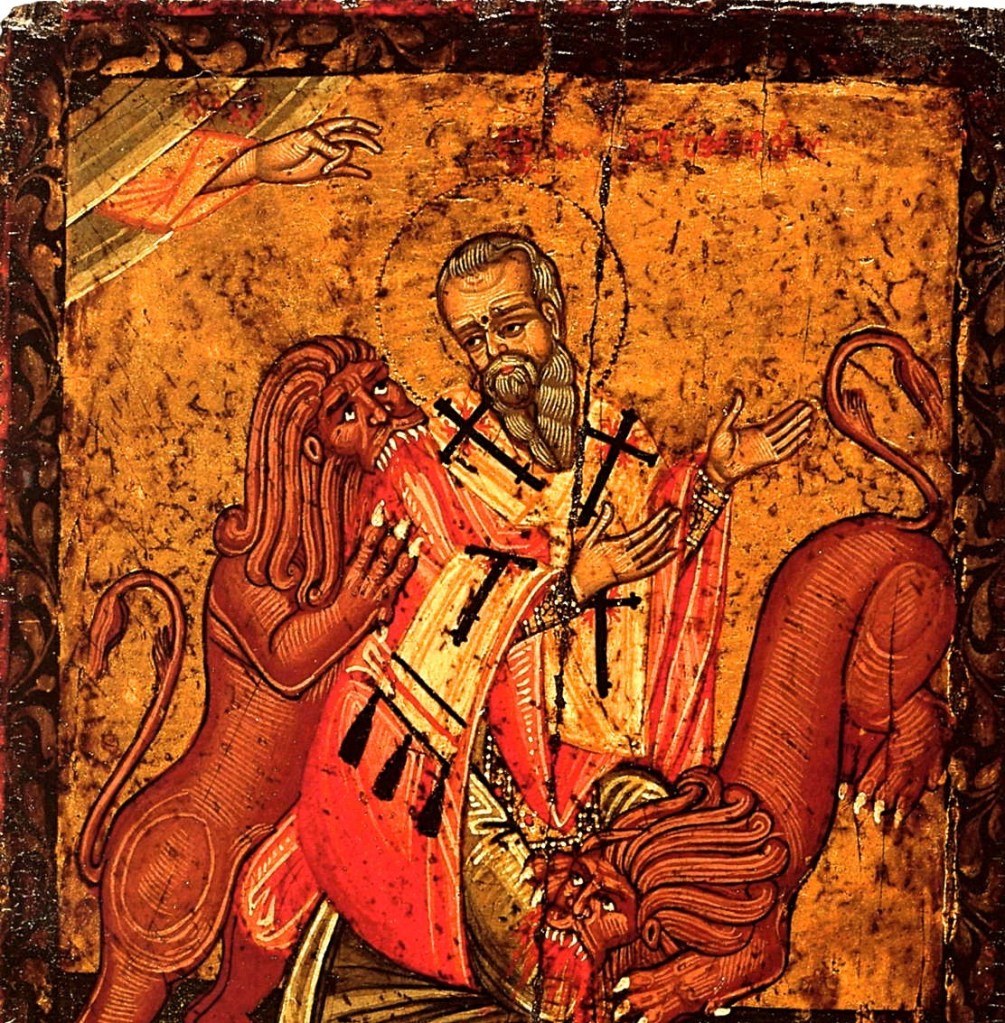
Ignatius, also called Theophorus, to the holy church at Tralles in the province of Asia, dear to God the Father of Jesus Christ, elect and worthy of God, enjoying peace in body and in the Spirit through the Passion of Jesus Christ, who is our Hope through our resurrection when we rise to Him. In the manner of the Apostles, I too send greetings to you with the fullness of grace and extend my every best wish.
Reports of your splendid character have reached me: how you are beyond reproach and ever unshaken in your patient endurance—qualities that you have not acquired but are yours by nature. My informant was your own bishop Polybius, who by the will of God and Jesus Christ visited me here in Smyrna. He so fully entered into my joy at being in chains for Christ that I came to see your whole community embodied in Him. Moreover, when I learned from him of your God-given kindliness toward me, I broke out in words of praise for God. It is on Him, I discovered, that you pattern your lives.
Your submission to your Bishop, who is in the place of Jesus Christ, shows me that you are not living as men usually do but in the manner of Jesus Himself, who died for us that you might escape death by belief in His death. Thus one thing is necessary, and you already observe it, that you do nothing without your bishop; indeed, be subject to the clergy as well, seeing in them the Apostles of Jesus Christ our hHope, for if we live in Him we shall be found in Him.
Deacons, too, who are ministers of the mysteries of Jesus should in all things be pleasing to all men. For they are not mere servants with food and drink, but emissaries of God’s Church; hence they should guard themselves against anything deserving reproach as they would against fire.
Similarly, all should respect the deacons as Jesus Christ, just as all should regard the Bishop as the image of the Father, and the clergy as God’s senate and the College of the Apostles. Without these three orders you cannot begin to speak of a church. I am confident that you share my feelings in this matter, for I have had an example of your love in the person of your bishop who is with me now. His whole bearing is a great lesson, and his very gentleness wields a mighty influence.
By God’s grace there are many things I understand, but I keep well within my limitations for fear that boasting should be my undoing. At the moment, then, I must be more apprehensive than ever and pay no attention at all to those who flatter me; their praise is as a scourge. For though I have a fierce desire to suffer martyrdom, I know not whether I am worthy of it. Most people are unaware of my passionate longing, but it assails me with increasing intensity. My present need, then, is for that Humility by which the prince of this world is overthrown.
And so I strongly urge you, not I so much as the love of Jesus Christ, to be nourished exclusively on Christian fare, abstaining from the alien food that is heresy. And this you will do if you are neither arrogant nor cut off from God, from Jesus Christ, and from the bishop and the teachings of the Apostles. Whoever is within the sanctuary is pure; but whoever is not is unclean. That is to say, whoever acts apart from the bishop and the clergy and the deacons is not pure in his conscience. In writing this, it is not that I am aware of anything of the sort among you; I only wish to forewarn you, for you are my dearest children
DAILY MEDITATION
Bruno had the happiness to possess pious parents, who left nothing undone to give him an excellent education, as well at home, as by sending him to college.
The first duty of parents is to give their children an education, the good fruits of which their afterlife will show. This education, to have a sound foundation, must begin at home…. As a rule, they cannot with safe conscience permit to have their children instructed in the public, or free schools, where they hear nothing of God, and, from which, all religious instruction is excluded. Never can parents excuse themselves by saying that their child is taught as well, or, perhaps, even better, in a free school…. How foolish such excuses are is made clear by the fact that such parents do not think why a child is sent to school. To learn? Yes, to learn, but still more to be taught to believe, and to live rightly. Hence the influence of religion is absolutely necessary…. Those who maintain that religion may be expelled from schools, and that it should be confined within the walls of the Church, are but poor dreamers, and do not know what education means.
Children are not sent to school merely to learn, but to be rightly educated, in order that they may live rightly, and not go to eternal perdition, but attain life everlasting. This education cannot be imparted where they do not speak of God.
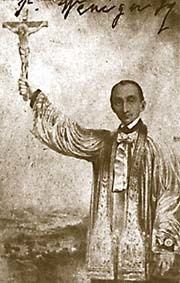
Fr. Francis Xavier Weninger [d. 1888] – Austrian priest, professor, and author; joined the Jesuits as missionary preacher to the United States.
“The refusal to take sides on great moral issues is itself a decision. It is a silent acquiescence to evil. The tragedy of our time is that those who still believe in honesty lack fire and conviction, while those who believe in dishonesty are full of passionate conviction.” – Ven. Archbishop Fulton Sheen
 Daily Reflections
Leave a comment