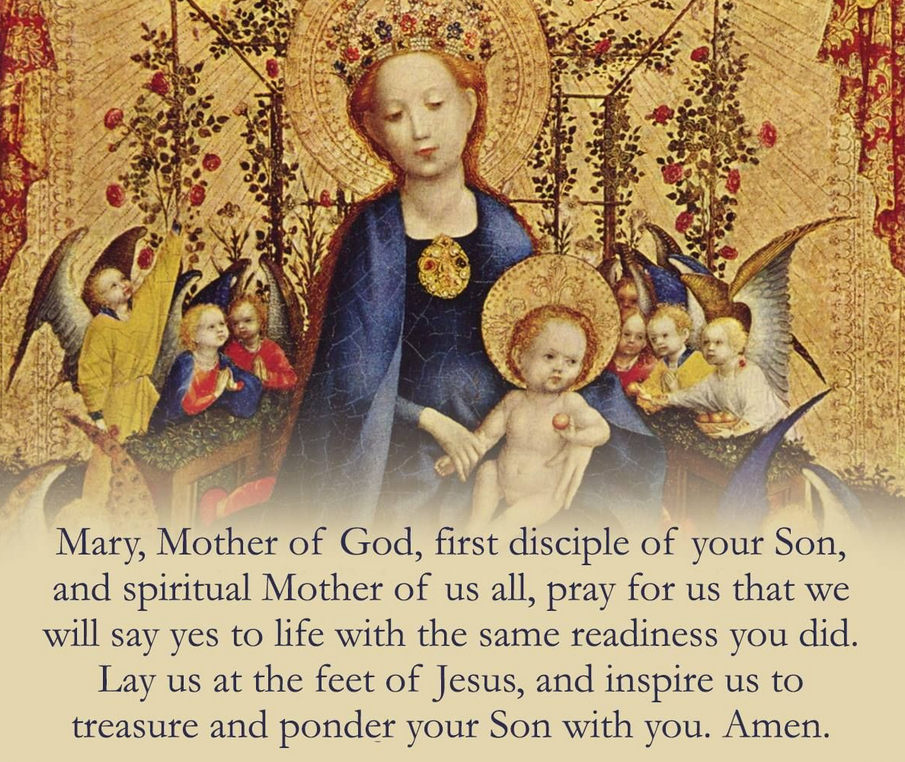
INTROIT Is. 7:14; Ps 97:1
Behold, a virgin shall conceive and bear a Son, and His name shall be called Emmanuel. Sing ye to the LORD a new canticle: because He has done wonderful things.
Maternity of the Blessed Virgin Mary (Traditional)
Saint Canice, (Ireland)
MATERNITY OF THE BLESSED VIRGIN MARY
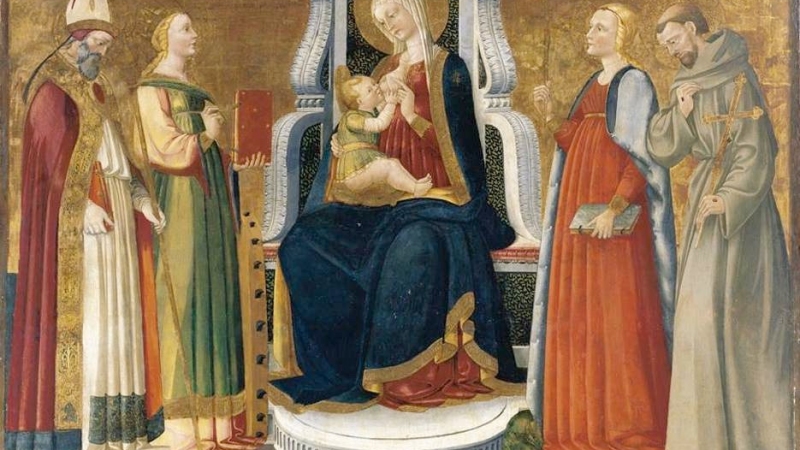
In the first ages of the Church the day sacred to our Blessed Lady, under her great title of Mother of God, was January 1. Evident traces of this devotion remain in the liturgy proper to the feast of the Circumcision, which is now kept on that day. Many churches having petitioned for a special festival in honour of Our Lady’s divine maternity, a day, usually in the month of October, was granted by the Holy See for its celebration. By a decree of the Sacred Congregation of Rites, April 24, 1914, the eleventh of October was assigned. Pius 1X raised it to a double of the second class and extended it to the Universal Church to commemorate in the Liturgy the fifteenth centenary of the Council of Ephesus (held in 431), which vindicated the title of “Theotokos” or “Mother of God” for Our Lady.

All Catholics believe that Mary is the Mother of God. This does not mean that she is not a creature of God, nor that God did not exist before she was created. It means that He who was her Son was a Divine Person. In Christ there are two natures: the nature of God and the nature of man; but in Him, there is only one Person, a Divine Person, the Second Person of the Blessed Trinity. Hence all that may be predicated of either nature may with propriety be said of the Saviour in the concrete form, without distinguishing the two natures. So we may say that God was born of the Blessed Virgin Mary. We then refer to the Person of the Son of God, Who is both God and man. Christ, Who is God, was born according to His human nature of the Blessed Virgin. She is, therefore, truly the Mother of God.
DAILY MEDITATION
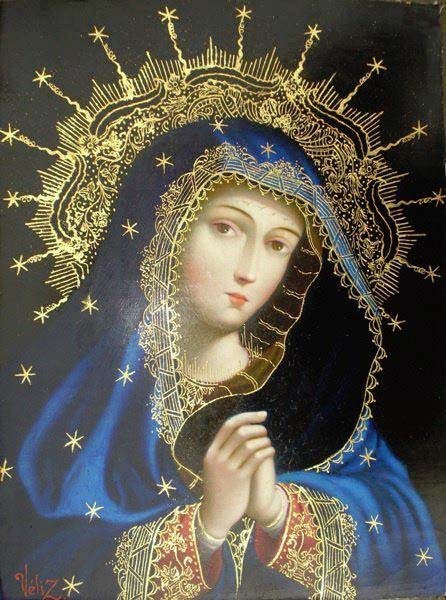
As I said before, the maternity of the Blessed Virgin, considered as a material of fact, is the least wonderful part of the subject. What will it be then, if we consider it as a moral fact, that is, as involving all those prerogatives that naturally belong to it? I confess that the very thought of these prerogatives astonishes me, and that I am bewildered in contemplating them. For the dignity of Mother of God, in this moral point of view, is absolutely the highest rank to which a pure creature can be raised, without exceeding its own proper limits. It is the very closest possible union of a creature with the Supreme uncreated Good. It is so near an approach to Deity, notwithstanding the infinite distance between God and any created thing, that Saint Thomas could not find more appropriate terms in which to express it than by saying that, in its operation, it comes closer than anything else to the limits of the Divinity. And in this sense he styles our Blessed Lady, Affinem Deo, that is, according to Cajetan, bordering upon God; though no doubt she might also as properly be said, in the ordinary sense of the word affinis, to be a kinswoman of God, since she truly is, and ought to be called, His Mother.
For this reason likewise, there is a peculiar species of worship [hyperdulia] due to her, which belongs to her alone, and is superior to all that may be granted to any other saint. For her dignity as Mother of God is of a rank far superior to that of all of the Saints or angels, and belongs in some manner to the dignity of the hypostatical union, on account of its necessary connection with it. Hence the Blessed Virgin, as I have already observed, forms of choir by herself in the kingdom of glory, and is exalted to a greater elevation above the other choirs in the emphyreal, than the emphyreal itself, though made to be the court and palace of God, is raised above the lower heavens, which were only designed for the use and benefit of men.
Fr. Paolo Segneri [d. 1694] – Italian Jesuit missionary preacher, ascetical writer, and one of Italy’s greatest orators.
ST. CANICE, ABBOT
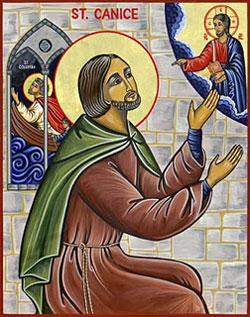
A native of Glengiven, Ireland, Canice, an Abbot of great virtue, preached across Ireland and Scotland. He was a close friend of the missionary priest, Saint Columba of Iona, and witnessed several prodigies in the life of the latter. In one instance, a pagan king who had refused to open his gates to Columba was startled to see the bolts unfastened and the gates opened by unseen hands after Columba had made the Sign of the Cross. On another occasion, Canice was among those who saw a fiery globe of light appear over the head of Columba as he was consecrating the Holy Eucharist, remaining thus until the end of the Mass. One day, as Canice was eating, he heard in his heart the voice of Columba, who at that moment was aboard a ship foundering in a storm at sea. Canice thereupon ran to the chapel so hastily that he lost one shoe. As Canice knelt to pray for his friend, miles away Columba watched the churning sea around him suddenly subside. Having seen in a vision Canice’s dash to the chapel, Columba thanked him in his heart, saying, “Your swift course to the church with one shoe exceedingly assists us.” He died in 600 A.D.
“The refusal to take sides on great moral issues is itself a decision. It is a silent acquiescence to evil. The tragedy of our time is that those who still believe in honesty lack fire and conviction, while those who believe in dishonesty are full of passionate conviction.” – Ven. Archbishop Fulton Sheen
 Daily Reflections
Leave a comment