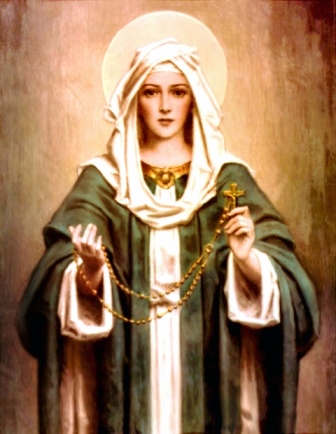
OCTOBER 13 – THE MIRACLE OF THE SUN
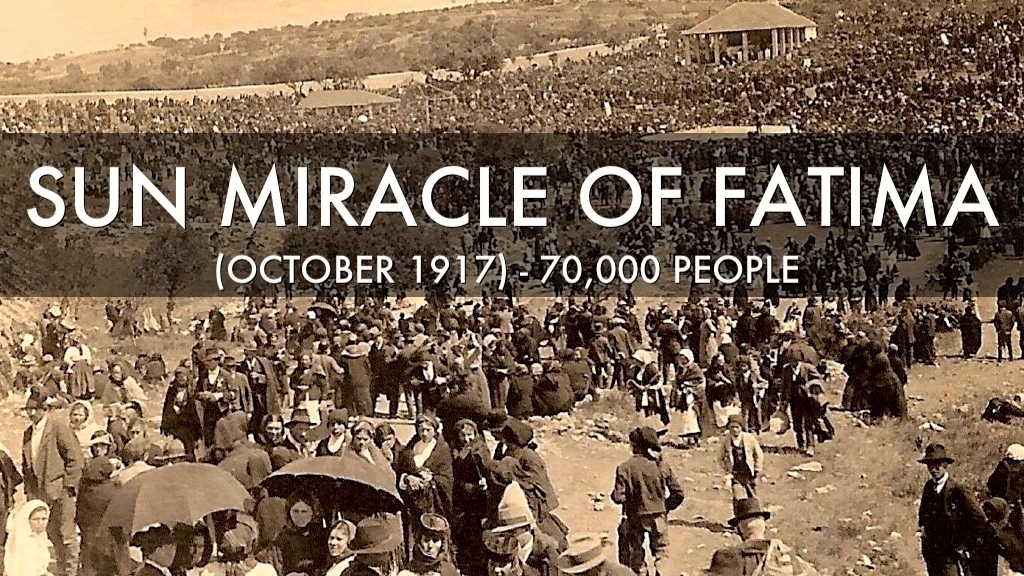
Every year on October 13 Catholics remember one of the apparitions of the Blessed Virgin to the three sheppard children in Fatima, Portugal. On this day in 1917, 70,000 people “At the hour of the last Apparitions they witnessed all the manifestations of the sun which paid homage to the Queen of Heaven and earth, more brilliant than the heavenly body itself at its zenith of light.“
Friday of the Twenty-Seventh Week in Ordinary Time
Saint Edward, Confessor, King (England)
The alarming message from the Prophet Joel (1:13-15;2:1-2) is not an irreversible reality before which we abandon all Hope, but a saving “attack” that can break through sin’s paralysing stronghold in our life and bestir us to be with Jesus. For Christ doesn’t merely cast out unclean spirits, leaving us empty inside; He fills us with His own Spirit. Knowing that the LORD “will judge the world with justice” invites our gratitude, gladness, and praise, for it means the devil’s kingdom cannot stand (Luke 11:15-26).
ST. EDWARD, CONFESSOR, KING
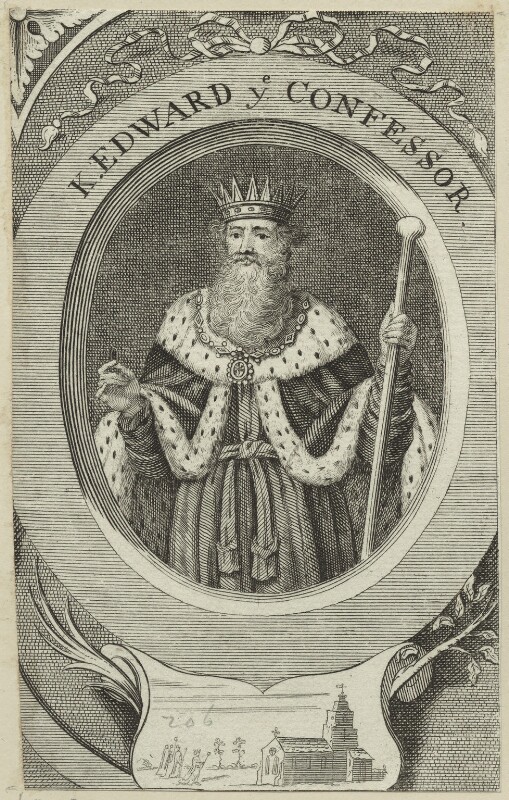
Saint Edward, the Confessor, the last but one of the Anglo-Saxon kings of England, reigned holily and happily for 24 years. On the throne, he rivaled the Saints by his untiring practice of austere virtue; his reign was one of almost unbroken peace; the country grew prosperous, ruined churches rose under his hand, the weak lived secure, and for long ages after, man spoke of the laws of “good King Edward.“ He died January 5, 1066. The saint’s body reposes in the shrine in Westminster Abbey, behind what used to be the High Altar.
From the first instruction by Saint Vincent of Lerins, Priest
(Cap. 23: PL 50, 667-668)
The development of Doctrine
Is there to be no development of religion in the Church of Christ? Certainly, there is to be development and on the largest scale.
Who can be so grudging to men, so full of hate for God, as to try to prevent it? But it must truly be development of the Faith, not alteration of the Faith. Development means that each thing expands to be itself, while alteration means that a thing is changed from one thing into another.
The understanding, knowledge and wisdom of one and all, of individuals as well as of the whole Church, ought then to make great and vigorous progress with the passing of the ages and the centuries, but only along its own line of development, that is, with the same doctrine, the same meaning and the same import.
The religion of souls should follow the law of development of bodies. Though bodies develop and unfold their component parts with the passing of the years, they always remain what they were. There is a great difference between the flower of childhood and the maturity of age, but those who become old are the very same people who were once young. Though the condition and appearance of one and the same individual may change, it is one and the same nature, one and the same person.
The tiny members of unweaned children and the grown members of young men are still the same members. Men have the same number of limbs as children. Whatever develops at a later age was already present in seminal form; there is nothing new in old age that was not already latent in childhood.
There is no doubt, then, that the legitimate and correct rule of development, the established and wonderful order of growth, is this: in older people the fullness of years always brings to completion those members and forms that the wisdom of the Creator fashioned beforehand in their earlier years.
If, however, the human form were to turn into some shape that did not belong to its own nature, or even if something were added to the sum of its members or subtracted from it, the whole body would necessarily perish or become grotesque or at least be enfeebled. In the same way, the Doctrine of the Christian religion should properly follow these laws of development, that is, by becoming firmer over the years, more ample in the course of time, more exalted as it advances in age.
In ancient times our ancestors sowed the good seed in the harvest field of the Church. It would be very wrong and unfitting if we, their descendants, were to reap, not the genuine wheat of truth but the intrusive growth of error.
On the contrary, what is right and fitting is this: there should be no inconsistency between first and last, but we should reap true doctrine from the growth of true teaching, so that when, in the course of time, those first sowings yield an increase it may flourish and be tended in our day also.
DAILY MEDITATION
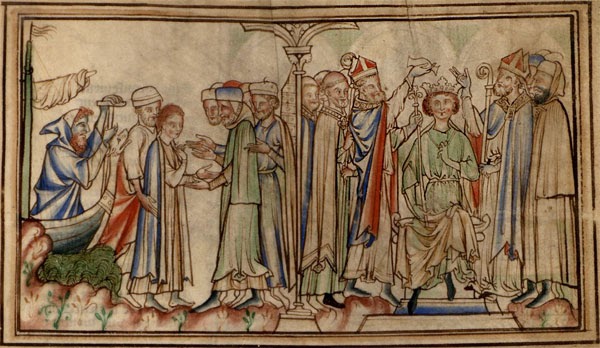
Saint Edward III, grand son of the holy king and martyr, Edward, was born in England, but educated in Normandy by his maternal uncle, as the Danes had conquered England. In the midst of the sensuality around and the temptations to all possible frivolities, Edward, while still very young, endeavoured to lead so retired and innocent a life, he was admired by all and was called the “Angel” of the court. He took no pleasure in those amusements in which young princes generally delight, but found his greatest joy in prayer and study. His devotion at church during Holy Mass was truly wonderful; and no time spent there seemed to him too long. He had the greatest horror for everything that was in the least contrary to angelical chastity. No immodest word ever passed his lips, and none was ever uttered in his presence without being severely censured by him.
The long absence from his home and kingdom he bore with the most admirable patience, and when, one day, some courtiers said to him that he must regain his kingdom by force of arms, he said that he did not desire a crown which must be won by shedding blood. But when the Danes had been driven from English soil, and peace restored throughout the land, the nobility recalled Edward from exile and placed him upon the throne. The new king bestowed his first care on the restoration of the prosperity of the kingdom, and to this end, he endeavoured to revive the worship of the true God and to reform the corrupted morals of his subjects. The revenues taken from the church were restored to it; churches were repaired or rebuilt, together with many monasteries for religious men and women, whose duty it would be to restore the old religion and the fear of God throughout the land; for he used to say: “The most efficacious means to secure happiness of a country is religion and the fear of God: for the well-being of a state depends mostly on the prosperity of the Church.“
Fr. Francis Xavier Weninger [D. 1888] – Austrian priest, professor, and author, joined the Jesuits as missionary preacher to the United States.
“The refusal to take sides on great moral issues is itself a decision. It is a silent acquiescence to evil. The tragedy of our time is that those who still believe in honesty lack fire and conviction, while those who believe in dishonesty are full of passionate conviction.” – Ven. Archbishop Fulton Sheen
 Daily Reflections
Leave a comment