Psalm 50/51:12, 11
Create a clean heart in me, O God,
– and renew a right spirit within my bowels.
Turn away Thy face from my sins, O God,
and blot out all my iniquities .
– and renew a right spirit within my bowels
Saturday of the Twenty-Second Week in Ordinary Time
Saturday of Our Lady
Saint Peter Claver, Priest
Saint Gorgonius, Martyr (Traditional)
Saint Ciaran, Abbot (Ireland)
SAINT PETER CLAVER, PRIEST

Born at 1581 at Verdu, Catalonia, Spain in 1581, Saint Peter Claver was the son of a farmer. He studied at the University of Barcelona and entered the Jesuits in 1601 at the age of 20. After his ordination as a priest he was influenced by Saint Alphonsus Rodriguez to become a missionary in America. Ten thousand African slaves arrived in the port every month. Peter was there to meet the ships arriving with food, medicine, brandy, and sweets, and filled with the smell of rotting flesh. “We must speak to them with our hands”, he said, “before we try to speak to them with our lips.” With the aid of interpreters and illustrations of Christ’s life, Peter taught the brutalised slaves about the mercy of God. He ministered physically and spiritually to slaves when they arrived in Cartegena, Colombia,the chief slave market of South America. He instructed and baptised a reported 300,000, working for the humane treatment on the plantations for 40 years. He organized charitable societies among the Spanish in the New World similar to those organized in Europe by Saint Vincent de Paul.
Saint Peter died on 8 September 1654 at Cartegena of natural causes.
SAINT GORGONIUS, MARTYR
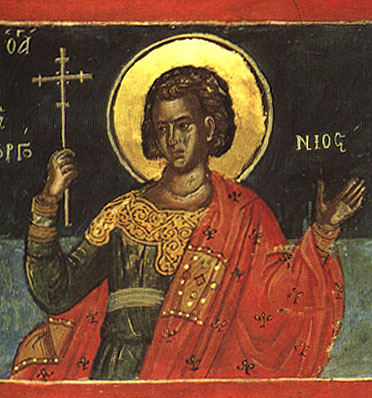
At Nicomedia, St. Gorgonius, an Officer of Diocletian’s household converted many servants of the imperial court. His cruel master condemned him and his companions to the most atrocious death in 302.
The body of this martyr was interred in the cemetery on the Via Labricana, and Pope Damasus adorned his tomb with the following inscription: “This sepulchre hollowed out of the hillside, contains the body of the martyr Gorgonius, who thus watches before the altar of Christ. Whosoever comes to seek the tombs of the Saints in this place will find that other blessed ones rest here, who were led to Heaven by the same Faith.“
SAINT CIARAN, ABBOT
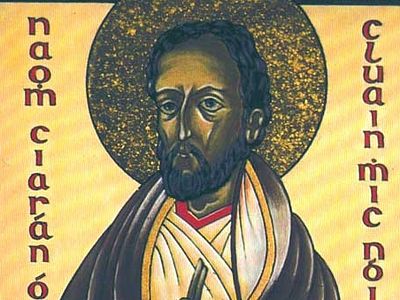
St. Ciaran (Kieran) of Clonmacnoise is known as “Ciaran the Younger”. He was born in about 512 (about 516 is also found) to the family of an itinerant carpenter and chariot-maker in the western Irish province (and former kingdom) of Connacht on the site of the present-day county of Roscommon. The saint’s birthplace was called Fuerty and his parents’ names Beoit and Darerca. Ciaran had brothers and sisters, some of whom also dedicated their lives to the service to God. The future abbot inherited from his ancestors a deep love for wisdom and learning. He was baptized by a righteous priest named Justus, who was his first instructor in the spiritual life. In his childhood the saint worked for some time as a cowherd, helping his family. His Life attributes his first miracles to that time when as a boy he already showed signs of holiness. Read more at: https://orthochristian.com/73745.html
From a letter by Saint Peter Claver, Priest
(Epist. Diei 31 maii 1627 ad Superiorem suum data: Edit [in lingua hispanica] A. Valtierra, S. I., San Pedro Claver, Cartagena, 1964, pp. 140-1)
To preach the Gospel to the poor, to heal the broken-hearted, to proclaim pardon to captives
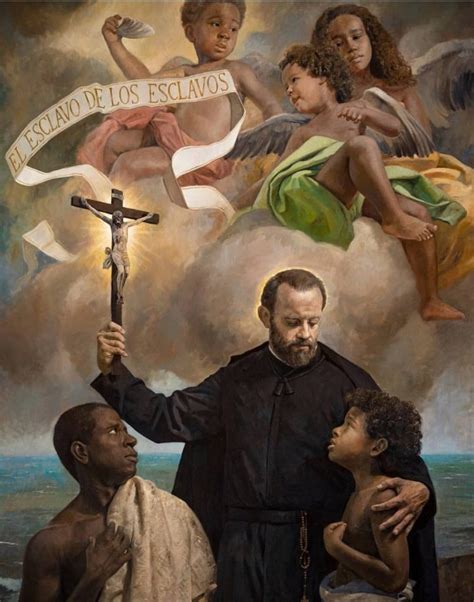
Yesterday, May 30, 1627, on the feast of the Most Holy Trinity, numerous blacks, brought from the rivers of Africa, disembarked from a large ship. Carrying two baskets of oranges, lemons, sweet biscuits, and I know not what else, we hurried toward them. When we approached their quarters, we thought we were entering another Guinea. We had to force our way through the crowd until we reached the sick. Large numbers of the sick were lying on the wet ground or rather in puddles of mud. To prevent excessive dampness, someone had thought of building up a mound with a mixture of tiles and broken pieces of bricks. This, then, was their couch, a very uncomfortable one not only for that reason, but especially because they were naked, without any clothing to protect them.
We laid aside our cloaks, therefore, and brought from a warehouse whatever was handy to build a platform. In that way we covered a space to which we at last transferred the sick, by forcing a passage through bands of slaves. Then we divided the sick into two groups: one group my companion approached with an interpreter, while I addressed the other group. There were two blacks, nearer death than life, already cold, whose pulse could scarcely be detected. With the help of a tile we pulled some live coals together and placed them in the middle near the dying men. Into this fire we tossed aromatics. Of these we had two wallets full, and we used them all up on this occasion. Then, using our own cloaks, for they had nothing of this sort, and to ask the owners for others would have been a waste of words, we provided for them a smoke treatment, by which they seemed to recover their warmth and the breath of life. The joy in their eyes as they looked at us was something to see.
This was how we spoke to them, not with words but with our hands and our actions. And in fact, convinced as they were that they had been brought here to be eaten, any other language would have proved utterly useless. Then we sat, or rather knelt, beside them and bathed their faces and bodies with wine. We made every effort to encourage them with friendly gestures and displayed in their presence the emotions which somehow naturally tend to hearten the sick.
After this we began an elementary instruction about baptism, that is, the wonderful effects of the Sacrament on body and soul. When by their answers to our questions they showed they had sufficiently understood this, we went on to a more extensive instruction, namely, about the One God, who rewards and punishes each one according to his merit, and the rest. We asked them to make an Act of Contrition and to manifest their detestation of their sins. Finally, when they appeared sufficiently prepared, we declared to them the mysteries of the Trinity, the Incarnation and the Passion. Showing them Christ fastened to the Cross, as He is depicted on the baptismal font on which streams of blood flow down from His wounds, we led them in reciting an Act of Contrition in their own language.
DAILY MEDITATION
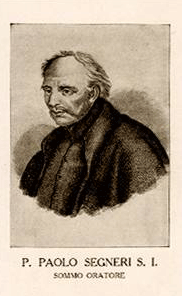
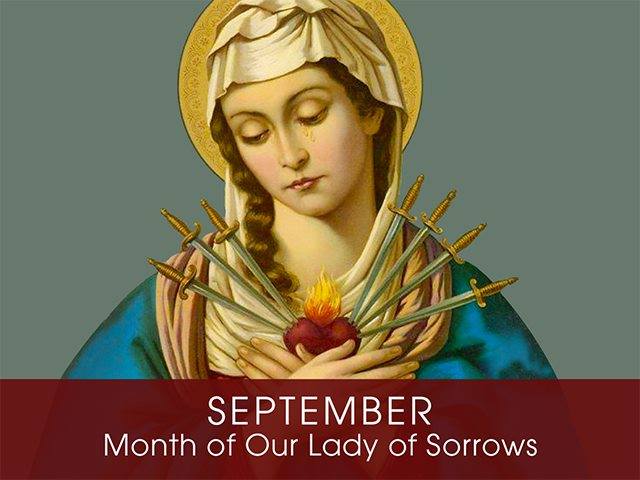
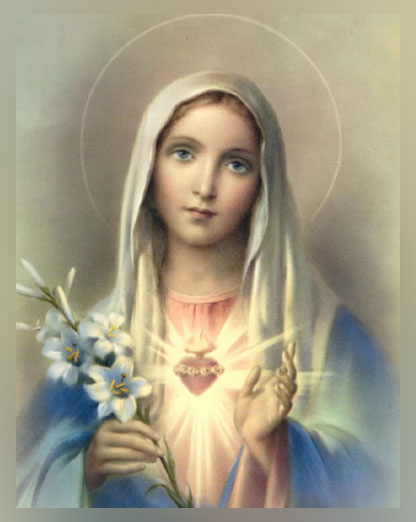
If the heart of Mary, now reigning in the empyreal, be a furnace of Divine love, “seven times more heated“ than the hearts of all the other saints together, it may be safely affirmed that the love which all the saints together have for mankind is but a small flame in comparison with that great fire, which is always burning for us in Mary’s breast. And this is the rule followed by Saint Augustine, to explain her care solicitude for us. “As much as the Blessed Virgin surpasses all of the saints in her love toward God so much,“ says the saint, “she surpasses them all in care and solicitude for us“; just as the highest sphere, which, in proportion as it exceeds the lesser spheres in height, exceeds them in the velocity, with which it is impelled for the benefit of our earth. For my part, I wonder sometimes how our souls are not ready to leap forth from our breasts, through pure excess of joy, to see ourselves, so immeasurably beloved by the great Mother of God…. Of what hard rock of flint must that ungrateful heart be made, which, while loaded with her benefits, would not thank her most affectionately, and, being the object of so much love, would not gratefully return her love?
Fr. Paolo Segneri (d.1694) – Italian Jesuit missionary preacher, ascetical writer, and one of Italy’s greatest orators.
Hungry for the Presence of the Son of Man
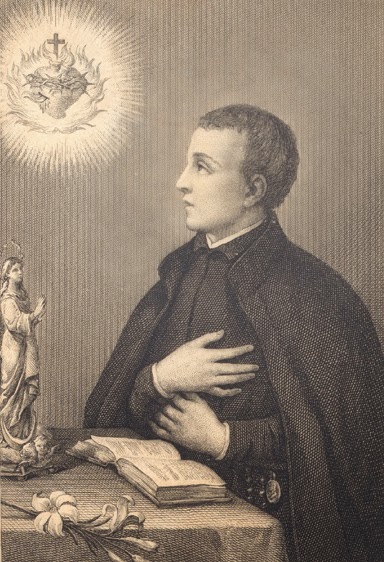
Despise temptations against Faith and remember that you believe what so many saints and doctors have believed. Your usual intention at Communion should be that of Jesus Christ in coming to you, for it is the purest and most excellent possible: to unite yourself to the Source and Object of love, to strengthen yourself in the service of God and in the practice of virtue, to purify yourself by union with Him who is Purity itself….
Why was the purity of Mary so great but because she was to bear the Son of God in her womb? If she had not been purer than the angels, it would not have been seemly for the Word to dwell in her; He would not have taken such delight in her, nor would He have brought her the precious gifts with which He filled her at the moment of the Incarnation. In Holy Communion we receive the same Jesus Christ that Mary bore for nine months in her womb. What is our purity? What care do we take to prepare our soul? We sometimes commit faults on the eve, on the day, and even in the very act of receiving Communion. Yet Jesus comes to us! How kind He is! Can God delight to come to me? Is He not repulsed at the sight of my misery? Yet I go to Him without shame, confusion, or contrition.
O my God, I will try so to prepare my heart that You may take pleasure and delight in it, and so that I may not place any obstacle to the immense graces I shall receive if I purify myself and realise what great good I shall lose if I do not do so.
Saint Claude La Colombière
Saint Claude La Colombière († 1682) was a French Jesuit priest and the spiritual director of Saint Margaret Mary Alacoque. [From The Spiritual Direction of Saint Claude de la Colombière, Mother M. Philip, i.b.v.m., Tr. ©
Matthew 25:35, 40
I was hungry, and you gave Me to eat;
I was thirsty, and you gave Me to drink;
I was a stranger, and you took Me in:
– Now I tell you this:
As long as you did it to one of these My least brethren,
you did it to Me.
This is what I command:
Love one another as I have loved you.
– Now I tell you this:
As long as you did it to one of these My least brethren,
you did them to Me.
“The refusal to take sides on great moral issues is itself a decision. It is a silent acquiescence to evil. The tragedy of our time is that those who still believe in honesty lack fire and conviction, while those who believe in dishonesty are full of passionate conviction.”– Ven. Archbishop Fulton Sheen


Leave a Reply