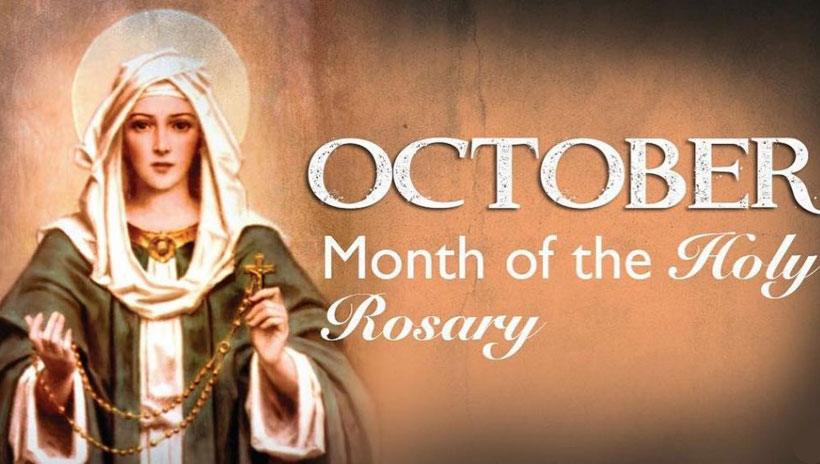
PRAYER FOR THE MONTH OF OCTOBER
Hasten, O most powerful destroyer of heresy, hasten the hour of mercy, seeing that the hour of judgement is dearly challenged by innumerable offenses…. Enable me to live, a just life on earth, and reign with the just in Heaven, whilst with the faithful throughout the world, O Queen of the Most Holy Rosary, I salute thee and cry out: Queen of the Most Holy Rosary, pray for us! Amen.
Acts 20:28; 1 Corinthians 4:2
Take heed to yourselves and to the whole flock,
wherein the Holy Ghost hath placed you bishops, – to rule the Church of God which He hath purchased with His own Blood.
Here now it is required among the dispensers that a man be found faithful. – to rule the Church of God which He hath purchased with His own Blood.
Tuesday of the Twenty-Seventh Week in Ordinary Time
Saint Francis Borgia, Confessor (Traditional)
Saint Paulinus of York, (England)
The witness and preaching of the prophet Jonah moves the wayward people of Nineveh to repentance and penitence—“their efforts to renounce their evil behaviour” (Book of Jonah 3:1-10). It is the presence of Jesus that transforms each of our own lives, too, and in different ways. Mary chose a life of perfect contemplation. Yet Martha, worried about “many things”, (Luke 10:38-42) needed to realise that all of her busyness and activity could also be unified by the one thing necessary—love for Jesus.
ST. FRANCIS BORGIA, CONFESSOR

Born October 28, 1510, St. Francis Borgia, Duke of Gandia and Viceroy of Catalonia, one of the most honoured nobles of Spain, after the death of his wife cut himself off from the chance of dignity or preferment, and entered the Society of Jesus, of which later he became the General. Conspicuous for the holiness of his life, he ended his days in Rome, October 10, 1572. He was canonized by Pope Clement X on June 10, 1670.
ST. PAULINUS OF YORK

In 601 St. Paulinus, a Roman monk, was named by Pope St. Gregory I the Great to accompany Sts. Justus and Mellitus on their mission to England to advance the cause of evangelization undertaken by St. Augustine of Canterbury. Paulinus laboured for some twenty four years in Kent and, in 625, was ordained Bishop of Kent. He was also responsible for bringing Christianity to Northumbria, baptizing the pagan king Edwin of Northumbria on Easter 627, and then converting thousands of other Northumbrians. Following the defeat and death of Edwin by pagan Mercians at the Battle of Hatfield in 633, Paulinus was driven from his See, and he returned to Kent with Edwin’s widow Ethelburga, her two children, and Edwin’s grandson Osfrid. Paulinus then took up the See of Rochester, which he headed until his death in 644.
Bede describes Paulinus as “a man tall of stature, a little stooping, with black hair and a thin face, a hooked and thin nose, his aspect both venerable and awe-inspiring”.
From the beginning of a letter to the Trallians by Saint Ignatius of Antioch, Bishop and Martyr
(Caput 1,1-3, 2; 4,1-2; 6,1; 7,1-8: Funk 1, 203-209)
I wish to forewarn you, for you are my dearest children
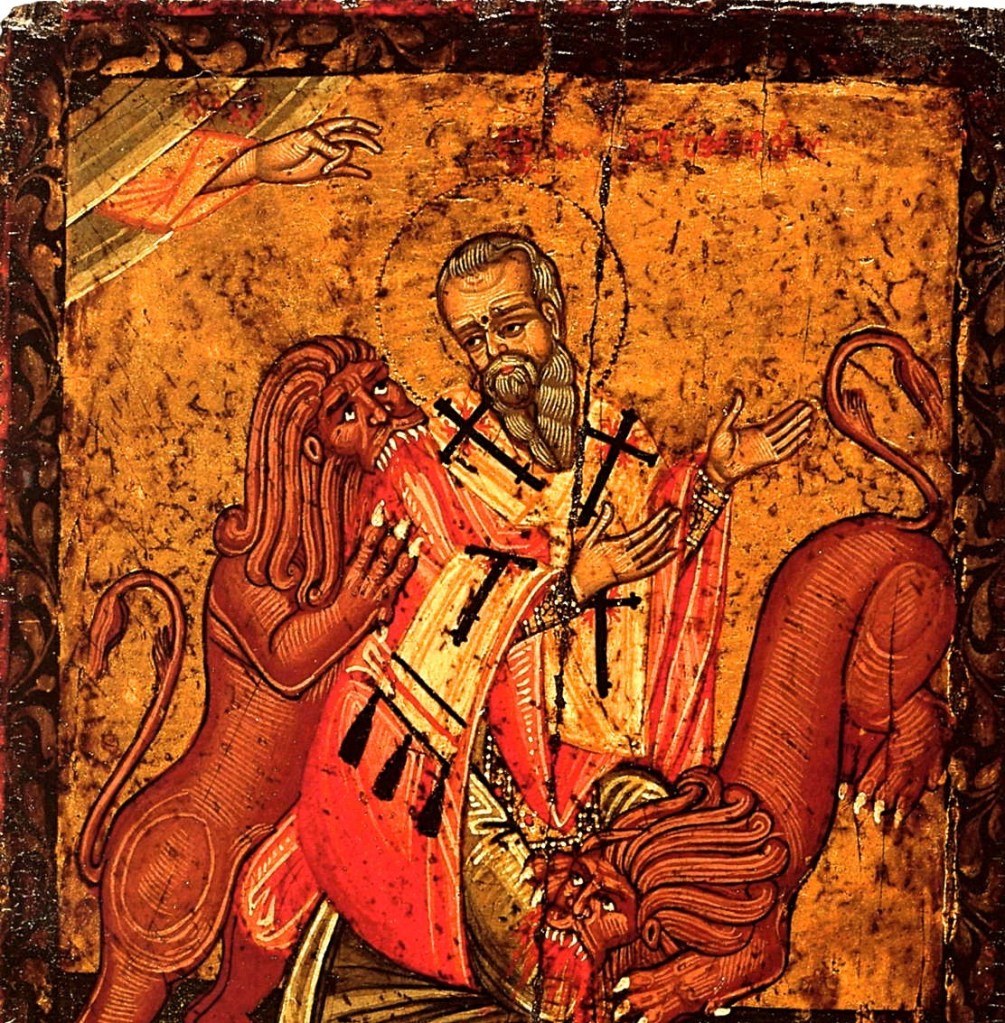
Ignatius, also called Theophorus, to the holy church at Tralles in the province of Asia, dear to God the Father of Jesus Christ, elect and worthy of God, enjoying peace in body and in the Spirit through the Passion of Jesus Christ, Who is our Hope through our resurrection when we rise to Him. In the manner of the Apostles, I too send greetings to you with the fullness of grace and extend my every best wish.
Reports of your splendid character have reached me: how you are beyond reproach and ever unshaken in your patient endurance—qualities that you have not acquired but are yours by nature. My informant was your own bishop Polybius, who by the will of God and Jesus Christ visited me here in Smyrna. He so fully entered into my joy at being in chains for Christ that I came to see your whole community embodied in him. Moreover, when I learned from him of your God-given kindliness toward me, I broke out in words of praise for God. It is on Him, I discovered, that you pattern your lives.
Your submission to your Bishop, who is in the place of Jesus Christ, shows me that you are not living as men usually do but in the manner of Jesus Himself, who died for us that you might escape death by belief in His death. Thus one thing is necessary, and you already observe it, that you do nothing without your bishop; indeed, be subject to the clergy as well, seeing in them the Apostles of Jesus Christ our Hope, for if we live in Him we shall be found in him.
Deacons, too, who are ministers of the mysteries of Jesus should in all things be pleasing to all men. For they are not mere servants with food and drink, but emissaries of God’s Church; hence they should guard themselves against anything deserving reproach as they would against fire.
Similarly, all should respect the deacons as Jesus Christ, just as all should regard the bishop as the image of the Father, and the clergy as God’s senate and the college of the Apostles. Without these three orders you cannot begin to speak of a Church. I am confident that you share my feelings in this matter, for I have had an example of your love in the person of your bishop who is with me now. His whole bearing is a great lesson, and his very gentleness wields a mighty influence.
By God’s grace there are many things I understand, but I keep well within my limitations for fear that boasting should be my undoing. At the moment, then, I must be more apprehensive than ever and pay no attention at all to those who flatter me; their praise is as a scourge. For though I have a fierce desire to suffer martyrdom, I know not whether I am worthy of it. Most people are unaware of my passionate longing, but it assails me with increasing intensity. My present need, then, is for that humility by which the prince of this world is overthrown.
And so I strongly urge you, not I so much as the love of Jesus Christ, to be nourished exclusively on Christian fare, abstaining from the alien food that is heresy. And this you will do if you are neither arrogant nor cut off from God, from Jesus Christ, and from the Bishop and the teachings of the Apostles. Whoever is within the sanctuary is pure; but whoever is not is unclean. That is to say, whoever acts apart from the bishop and the clergy and the deacons is not pure in his conscience. In writing this, it is not that I am aware of anything of the sort among you; I only wish to forewarn you, for you are my dearest children.
DAILY MEDITATION
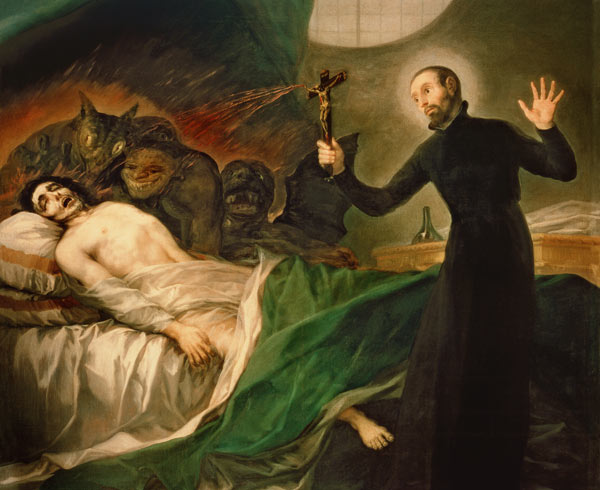
St. Francis instituted at his court, before he entered the religious life, the veneration of the saints of the month. Every Catholic, besides worshipping the Almighty, ought to honour the Saints. We should especially honour the divine Mother, as the Queen of All the Saints; then, the foster-father of Christ, St Joseph; and further, our guardian angel and patron saint. Besides this, we ought to select some special patrons for whom we feel particular esteem, and love. It is also very beneficial to adopt the practice of monthly patrons. This consists in selecting, on the last day of every month, a saint whose festival will be celebrated during the following month. Daily should he be invoked and honoured. If possible, his life should be read and something from it be selected for imitation. We may also approach the Sacraments on his festival, or on the Sunday after it; and employ a little more time than usual, in good works.
It is known that several great servants of God, at the end of their days, called upon the saints, whom they had honoured as their monthly patrons during life, and it cannot be doubted that they received benefit and comfort. “Everyone,“ says St. Bonaventure: “ought to venerate an especial saint with great devotion. To him, he ought daily to commend himself, and practice some good work in his honour.”
Fr. Francis Xavier Weninger [d. 1888] – Austrian priest, professor, and author; joined the Jesuits as missionary preacher to the United States.
The One Thing Necessary: Love
External occupations merely serve as a further means of raising the mind to God. They furnish constantly new motives for loving Him and ever more desiring Him and seeking Him in others. I am continually overwhelmed and filled with praise and wonder at the infinite Wisdom and goodness of our God. When I see how He permits Himself to dwell in souls which are so often distraught and engrossed in material occupations, I marvel. And yet I often become more aware of His presence in the midst of such duties than during the time of prayer itself. It seems to me that it is here the text “in so far as you did this to one of the least of these brothers of mine, you did it to me” applies. For I have always regarded the service of the sick in that way, and I am always conscious of His Presence when I am working among them.
For me, it suffices to work in silence, because then all things will help to unite us to God. It is enough to keep the outer doors closed, for then the heart and soul have no other place to go than into their centre, where God is to be found. As He is the beginning of all our work, so He is its end; and with His aid we accomplish it quickly and well, so that He is also the Way.
God is not tied by time or space. How great are the gifts which we continually receive from Him. We swim like little fish in the ocean of His mercy. We can make Him no suitable return, for we have nothing that we have not already received from Him. That being so, we are perpetually in debt, and that knowledge leads us to the pure, generous beneficence of our God.
I think of it as two people—let us say, two sisters—who love each other very dearly. Although they are constantly thrown into the closest companionship, they will never find such ubiquity distasteful, but rather in their mutual affection they will draw help and strength for their external occupations. It seems to me that living in the presence of God is as simple as that. Just as someone who loves a person often recalls that person to mind, so too we must constantly recall to mind that God is present and always working for our greater good. All that we have to do is return love for love. Our whole exercise and obligation is in loving alone.
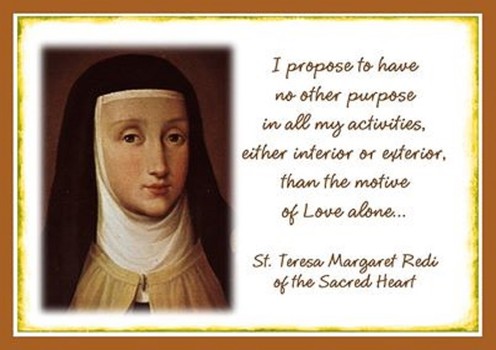
Saint Teresa Margaret of the Sacred Heart
Saint Teresa Margaret († 1770) was an Italian Carmelite nun who died at the age of twenty-two. [From God Is Love: Saint Teresa Margaret—Her Life, Margaret Rowe.] ©
“The refusal to take sides on great moral issues is itself a decision. It is a silent acquiescence to evil. The tragedy of our time is that those who still believe in honesty lack fire and conviction, while those who believe in dishonesty are full of passionate conviction.” – Ven. Archbishop Fulton Sheen


Leave a Reply